
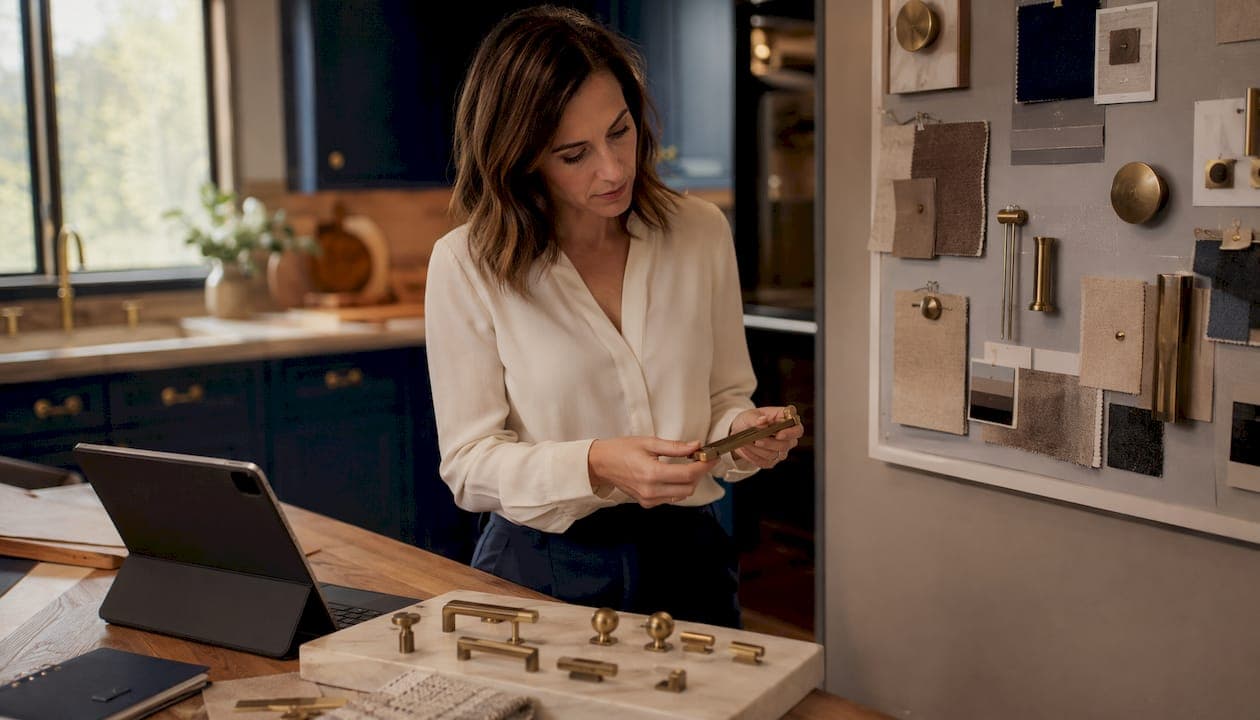
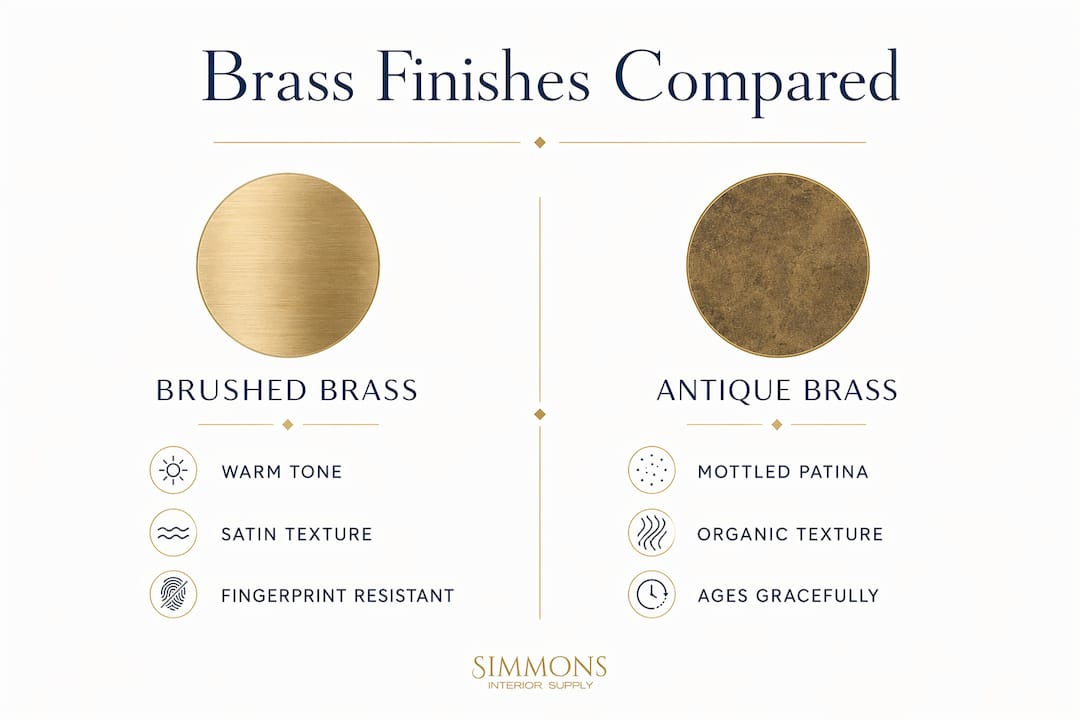
Antique brass presents a darker, mottled brown–gold patina that reads as deliberately timeworn and characterful; brushed (satin) brass offers a softer, directional matte sheen that feels luminous and contemporary. Antique brass is produced through chemical oxidation or mechanical tumbling, which creates its rich, layered depth. Brushed brass is made by drawing a fine abrasive across the surface in one direction, producing a uniform texture that hides fingerprints and water spots far more readily than polished finishes. Simmonsinteriorsupply offers both sealed and living versions of each, so the choice comes down to mood, maintenance tolerance, and the room itself.
- Best for heritage and rustic spaces: antique brass, where its mottled warmth settles naturally into period mouldings, aged timber, and farmhouse cabinetry.
- Best for contemporary and high-use family spaces: brushed brass, where its even texture and low-maintenance character suit open-plan kitchens and busy bathrooms.
- Bespoke unlacquered versus sealed: choose a living (unlacquered) finish when you want the metal to evolve with use; choose a sealed PVD or lacquered finish when you need long-term consistency and minimal upkeep.
Table of Contents
- What does brushed brass actually look like, and where does it work?
- What gives antique brass its distinctive character?
- How each finish ages in a UK home, and how to care for it
- How to choose between antique and brushed brass
- Can you mix antique and brushed brass in the same scheme?
- How to test finish samples at home before you order
- How Simmonsinteriorsupply handles brass finishes on bespoke commissions
- Key takeaways
- The case for offering both, not just one
- Bespoke brass finishing from Simmonsinteriorsupply
- Useful sources
What does brushed brass actually look like, and where does it work?
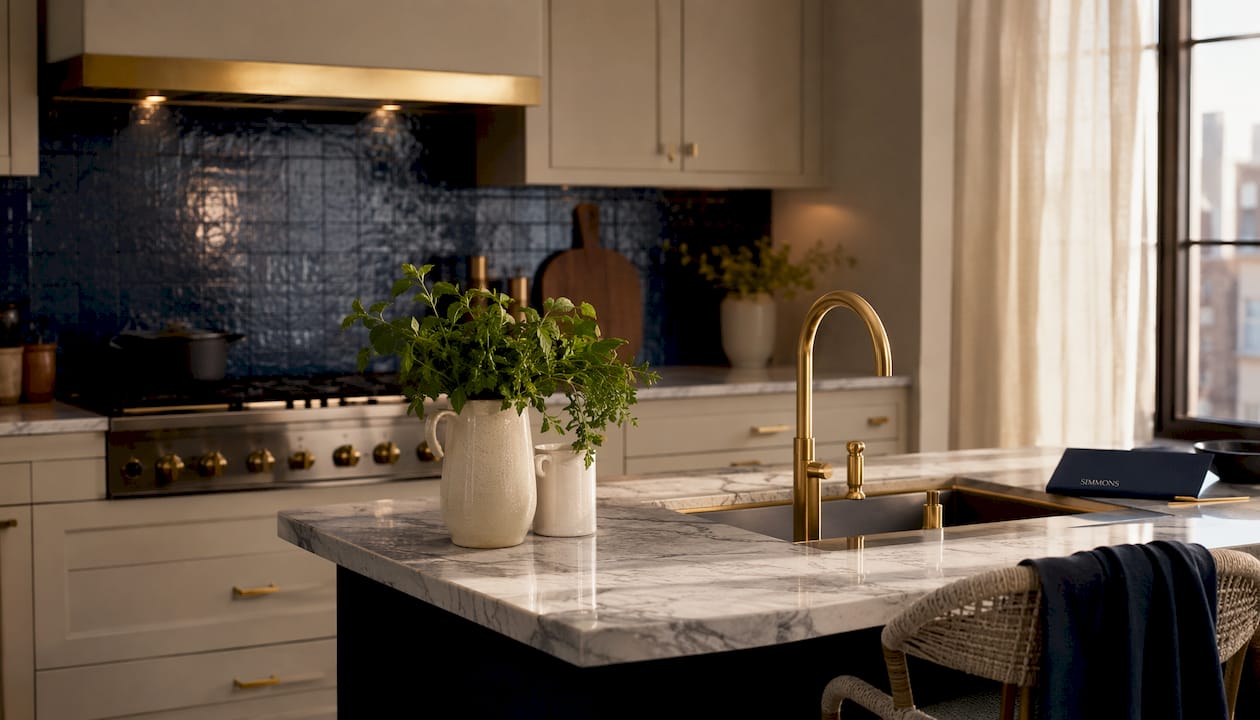
Brushed brass, often labelled satin brass, is produced by drawing sandpaper, wire brushes, or specialised brushing wheels across the metal surface in a single, consistent direction. The result is a fine, linear texture with a soft, matte sheen rather than a mirror-like reflection. In terms of colour, it sits in a warm champagne-to-gold register, though the diffused light gives it a calmer, more restrained quality than polished brass.
The practical appeal is real. Because the brushed texture scatters light rather than reflecting it directly, smudges and minor scratches simply disappear into the surface pattern. For an open-plan kitchen or a family bathroom where hands are not always pristine, that matters enormously. The mechanical brushing process is also highly repeatable, which means batch-to-batch colour consistency is easier to achieve than with hand-applied antique finishes.
Stylistically, brushed brass reads as architectural and contemporary. It suits minimalist kitchens, coastal or Hamptons-inspired schemes, transitional bathrooms, and any space where you want warmth without visual noise. Against white cabinetry or pale stone worktops, it adds just enough richness to feel considered rather than decorative.
| Brushed brass | |
|---|---|
| Colour tone | Warm champagne-gold, softened by diffused sheen |
| Texture | Directional linear marks, matte to the touch |
| Fingerprints | Hides well; low-maintenance for busy households |
| Batch consistency | High; mechanical process is repeatable |
| Ageing | Even, gradual darkening; retains matte quality |
| Typical cost | Generally more affordable than antique finishes |
Pros: forgiving on fingerprints and light scratches; consistent across large runs; suits a wide range of contemporary and transitional styles; typically faster to produce and more cost-effective.
Cons: less visual depth than antique brass; can feel slightly uniform or flat in schemes that call for organic variation; less suited to heavily ornate or period-style profiles.
What gives antique brass its distinctive character?
Antique brass is produced by chemical oxidation or mechanical tumbling to create a darker, mottled brown–gold patina that mimics naturally aged metal. Chemical routes typically use acidic or alkaline solutions to accelerate oxidation, producing deep brown and shadow tones that settle into recesses and around details. Tumbling achieves a similar effect through physical distressing. The result is intentionally timeworn: honey-brown at its lightest, almost bronze at its deepest, with tonal variation that gives each piece a sense of history.
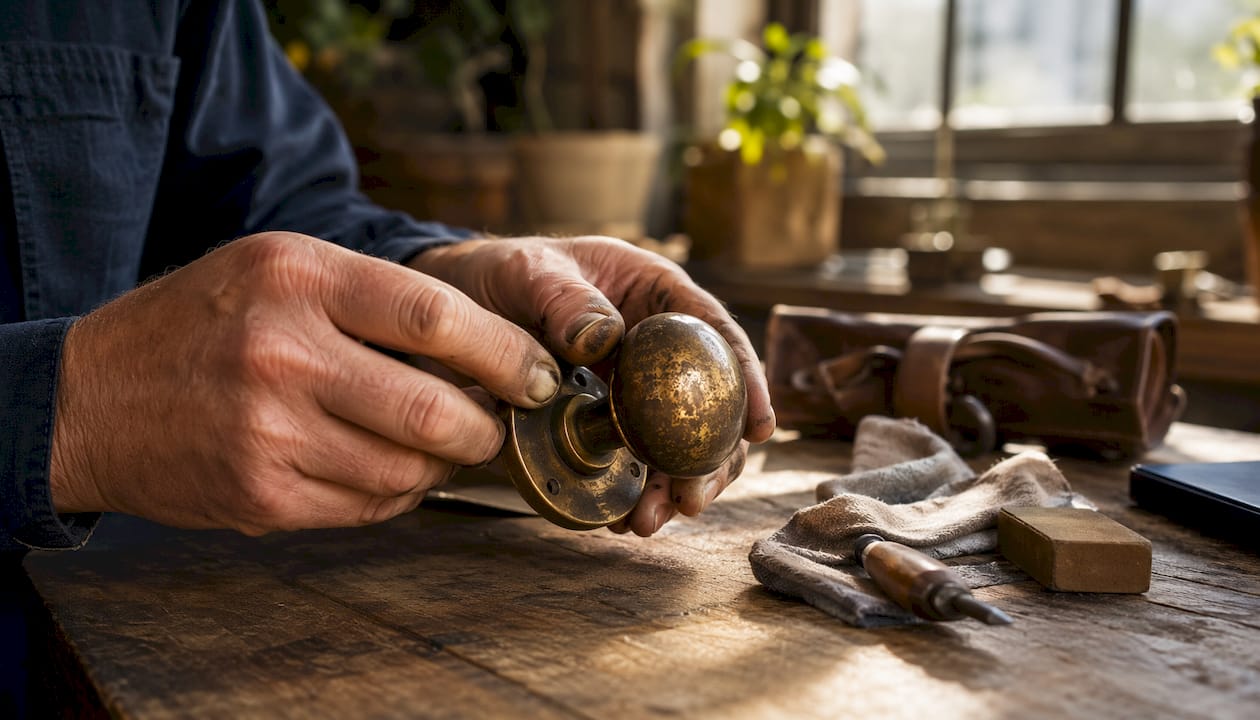
That variability is part of the appeal, but it carries a practical implication. Because chemical ageing is an artisanal process, tonal inconsistencies between batches are common unless a sealed PVD process is used or a golden-sample approval is in place. For large projects specifying multiple pieces, this is worth discussing with your supplier before ordering.
Where antique brass truly earns its place is in rooms that already carry texture and warmth: farmhouse kitchens with shaker cabinetry, period bathrooms with roll-top baths, rustic or Mediterranean dining spaces, and any scheme where aged timber, handmade tile, or limewash walls are doing the heavy lifting. The finish reads as deeper, muted warmth rather than luminous brightness, which makes it particularly flattering on ornate profiles where shadow and depth add visual interest.
| Antique brass | |
|---|---|
| Colour tone | Darker brown–gold with mottled variation |
| Texture | Organic, tactile; shadow in recesses |
| Fingerprints | Conceals well; pre-aged look absorbs marks |
| Batch consistency | Variable; golden-sample approval recommended |
| Ageing | Continues to develop character; wear blends in |
| Typical cost | Generally higher due to artisanal process |
Pros: rich warmth and visual depth; marks and light scratches blend into the finish; suits heritage and rustic schemes beautifully; available in sealed (PVD) or living versions.
Cons: pricier than brushed or polished finishes due to the hand-applied process; tonal variation between batches requires careful sample management; less suited to minimal or highly contemporary schemes.
How each finish ages in a UK home, and how to care for it
Antique brass is designed to absorb the passage of time gracefully. Everyday marks and light scratches blend into the pre-aged finish rather than standing out, which makes it particularly forgiving in high-traffic households. Brushed brass ages more evenly, gradually deepening in tone around touch points while retaining its matte quality across the broader surface.
The sealed versus living question shapes the entire lifecycle. A lacquered or PVD-sealed finish preserves the original appearance for years with minimal effort; an unlacquered living finish will evolve, sometimes dramatically, especially in humid rooms or coastal properties where salt air accelerates tarnishing. Some manufacturers offer both sealed antique options and raw tumbled finishes that continue to develop a patina, so the choice is genuinely yours.
Cleaning guidance by finish type:
- Lacquered or PVD-sealed brass (both finishes): wipe with a soft, damp cloth. Avoid abrasive cleaners, acidic products, and anything containing bleach, which will strip the coating.
- Living brushed brass: occasional wiping with a soft, damp cloth is usually sufficient; for deeper cleaning, use a metal-safe cleaner applied gently in the direction of the brush marks.
- Living antique brass: a damp cloth for day-to-day care; a specialist brass cleaner used sparingly if tarnishing becomes uneven. Avoid over-polishing, which removes the intentional patina.
For UK homes with hard water, water spots are a particular concern on any brass finish. Drying taps and handles after use makes a meaningful difference, especially on polished or lightly brushed surfaces.
One caution worth noting: if a lacquered finish is scratched during installation, the typical remedy is a specialist strip-and-recoat that can add 3–5 days to repair lead times. On a tight renovation schedule, that is worth factoring in before specifying a lacquered piece for a high-risk installation environment.
Pro Tip: For bathrooms, prefer a sealed PVD finish over standard lacquer. PVD coatings are harder, more resistant to humidity and cleaning chemicals, and far less likely to chip during installation.
How to choose between antique and brushed brass
Match the finish to your design mood first, then weigh maintenance tolerance and budget. A contemporary kitchen with handleless cabinetry and pale stone calls for brushed brass. A period hallway with panelled walls and parquet flooring calls for antique brass. The finish should feel inevitable in the room, not chosen.
Decision checklist:
- What is the dominant mood of the room? (Contemporary/coastal/minimal → brushed; heritage/rustic/period → antique)
- How much maintenance are you willing to do? (Low tolerance → sealed brushed or sealed antique; happy with evolving patina → living finish)
- Are you specifying multiple pieces across a large project? (Yes → brushed brass for easier batch consistency, or request a golden-sample approval for antique)
- What surfaces will the brass sit alongside? (Pale stone, white cabinetry → brushed; aged timber, handmade tile, limewash → antique)
- What is your budget and lead-time window? (Brushed finishes are generally more cost-effective and faster to produce; hand-applied antique finishes carry a price premium and longer lead times)
Questions to ask your supplier:
- Is the finish sealed? If so, is it lacquer or PVD?
- What are the batch tolerances, and can I see a golden sample before production begins?
- What are the delivery lead times for sealed versus living finishes?
- If the lacquer is damaged during installation, what is the repair process and typical turnaround?
For bespoke commissions in the UK, expect sealed PVD finishes to carry a modest price premium over standard lacquered options, and allow additional lead time for antique finishes where hand-application is involved. Living finishes are sometimes faster to produce but require careful handling and VCI packing during transport to prevent premature spotting.
Can you mix antique and brushed brass in the same scheme?
Yes, and when done with intention it can be one of the most characterful decisions in a room. The key is to treat the two finishes as deliberate layers rather than an attempt to match. Professionals advise using one finish as a neutral anchor and the other as a characterful accent, rather than scattering both evenly across a space.
Dos and don'ts for mixing:
- Do use brushed brass for larger, more functional fittings (taps, handles, cabinet hardware) and antique brass for focal-point pieces (pendant lights, decorative mirrors, statement door furniture).
- Do keep the two finishes in different zones or on different planes so the eye reads them as intentional contrast rather than inconsistency.
- Don't mix the two finishes on adjacent items of the same type (e.g. two door handles side by side in different finishes), as this reads as an oversight rather than a design choice.
- Don't finalise a mixed scheme without testing samples under both natural daylight and artificial evening light. Antique brass can shift noticeably warmer under incandescent or warm LED sources, while brushed brass stays relatively consistent.
Specifying finish samples from each supplier and placing them together in the room is the only reliable way to confirm tonal harmony. What looks cohesive on a screen can read as a clash under the specific light temperature of your space.
How to test finish samples at home before you order
Always order physical samples and test them in the room before committing to finished goods. Photographs and digital swatches cannot replicate how a brass finish behaves under your specific combination of natural light, artificial light, and surrounding materials.
- Order at least two samples per finish from any supplier you are seriously considering, so you can test one at height (a door handle position) and one at worktop level simultaneously.
- Place samples near the key surfaces they will sit alongside: stone worktops, painted cabinetry, timber flooring, or wall tiles. The brass should feel like it belongs, not compete.
- Test at different times of day: morning north light, midday south light, and evening under your actual artificial lighting. Antique brass in particular can shift dramatically between a cool morning and a warm-lit evening.
- Photograph samples with a colour reference card (a paint chip from your chosen wall colour works well) so trades and suppliers can see the tonal relationship clearly when approving orders.
- Request a golden sample from your supplier for any bespoke or large-volume order. This is the approved reference piece against which all production batches are matched.
For matched runs across multiple pieces, ask your supplier what their batch tolerance is and whether they can supply from a single production run. This matters most for antique finishes, where chemical ageing introduces natural variation between batches.
How Simmonsinteriorsupply handles brass finishes on bespoke commissions
Simmonsinteriorsupply offers both sealed and living brass finishing options across its bespoke furniture commissions, and the distinction matters practically. A sealed finish, whether PVD or lacquered, leaves the workshop looking exactly as approved and requires minimal maintenance from the client. A living finish is delivered in its current state and will continue to develop character with use and time, which suits clients who want their piece to feel genuinely alive in the room.
The finishing workflow begins with a golden-sample approval: before any production run proceeds, a reference sample is produced, approved by the client or designer, and retained as the benchmark for the full commission. For antique finishes, where batch variability is inherent to the process, this step is not optional. Living brass pieces are packed in corrosion-inhibitor (VCI) bags during transport to prevent premature spotting before installation.
What to expect from the Simmonsinteriorsupply finishing process:
- Sealed PVD and lacquered finishes available for both brushed and antique brass, with golden-sample approval as standard.
- Living (unlacquered) finishes available for clients who want an evolving patina, supplied with care instructions and VCI packing.
- If lacquer is damaged during installation, Simmonsinteriorsupply can advise on specialist recoating; allow 3–5 days for repair lead time when planning renovation schedules.
- Care instructions provided with every commission: sealed pieces require only a soft damp cloth; living pieces require metal-safe cleaning and periodic attention.
[Luke's professional qualifications or experience — insert here]
[First-hand customer testimonials or case studies — insert here]
[Internal data or proprietary quality assurance processes — insert here]
Pro Tip: When commissioning a bespoke piece with a living brass finish, photograph it on delivery and again at six and twelve months. The evolution is part of the story, and those images become invaluable when briefing trades on future commissions.
Key takeaways
Brushed brass suits contemporary, high-use spaces and offers superior batch consistency; antique brass brings deeper warmth and character to heritage schemes, at a modest price premium and with greater batch variability.
| Point | Details |
|---|---|
| Finish choice is mood-driven | Brushed brass suits contemporary and coastal schemes; antique brass suits heritage and rustic interiors. |
| Maintenance tolerance matters | Sealed finishes need only a damp cloth; living finishes require metal-safe cleaning and periodic attention. |
| Batch consistency differs | Brushed brass is mechanically consistent; antique brass requires a golden-sample approval to manage tonal variation. |
| Lacquer damage has schedule implications | A scratched lacquer typically requires a specialist strip-and-recoat, which can add additional days to repair lead times. |
| Simmonsinteriorsupply for bespoke commissions | Offers both sealed and living brass finishes with golden-sample approval, VCI packing, and trade support. |
The case for offering both, not just one
The conventional wisdom in interiors is to pick a finish and commit. Choose brushed brass for a modern kitchen, antique for a period hallway, and never the twain shall meet. That advice is sensible as far as it goes, but it misses something important: the most interesting spaces are rarely built around a single material decision.
What I find more useful is thinking about brass finishes the way you might think about paint sheens. You would not use the same sheen on every surface in a room, because different surfaces have different jobs. A brushed brass tap handle has a different job to an antique brass pendant light. One is touched dozens of times a day in a wet environment; the other hangs at ceiling height and catches the evening light. Treating them as the same decision is where schemes go flat.
The reason Simmonsinteriorsupply offers both sealed and living finishes is not to cover every trend. It is because clients genuinely need both, sometimes in the same project. A designer specifying a bespoke console for a period hallway and a sideboard for a contemporary dining room should not have to choose between suppliers. The finish should follow the room, not the other way around.
Bespoke brass finishing from Simmonsinteriorsupply
When you know which finish suits your room, the next question is finding a maker who can deliver it with the consistency and craftsmanship the specification deserves. Simmonsinteriorsupply produces handcrafted bespoke furniture with sealed and living brass finishing options, working directly with interior designers, architects, and homeowners across the UK.
Every commission begins with a golden-sample approval, so you see and sign off the exact finish before production proceeds. Samples are available on request; simply share your measurements, photographs of the space, and your preferred finish direction, and the trade team will guide you from there. Lead times and finish options are discussed at the enquiry stage, with no surprises mid-project.
Browse the finish gallery for tonal references, or get in touch to request a sample or open a trade account.
Useful sources
For deeper technical detail and design inspiration on brass finish types, the following resources are worth bookmarking:
- Polished vs Satin vs Antique Brass: How to Pick the Right Finish for Your Interior (Birds and Lilies) — excellent practical guidance on how different finishes behave under varying light conditions and alongside different paint palettes; best for design inspiration and room-by-room decision-making.
- 5 Types of Brass Finishes to Know (Better Homes & Gardens) — clear overview of finish types including cost differences and the manufacturing distinctions between antique and brushed brass; best for understanding why antique finishes carry a price premium.
- Brass Finishes for Custom Parts: A Practical Engineering Guide (TZR Metal) — technical detail on surface treatments, lacquer versus PVD, and repair lead times; best for specifiers who need manufacturing-level accuracy.
- A Guide to Our Brass Finishes (ABI Interiors) — useful for understanding the visual and tactile differences between brushed, antique Aurum, and tumbled aged brass, including sealed versus living options.
- Brass Finishes Explained (Inspire Hardware) — concise comparison of antique, satin, and polished brass with care guidance; good for sharing with clients who need a quick reference.