
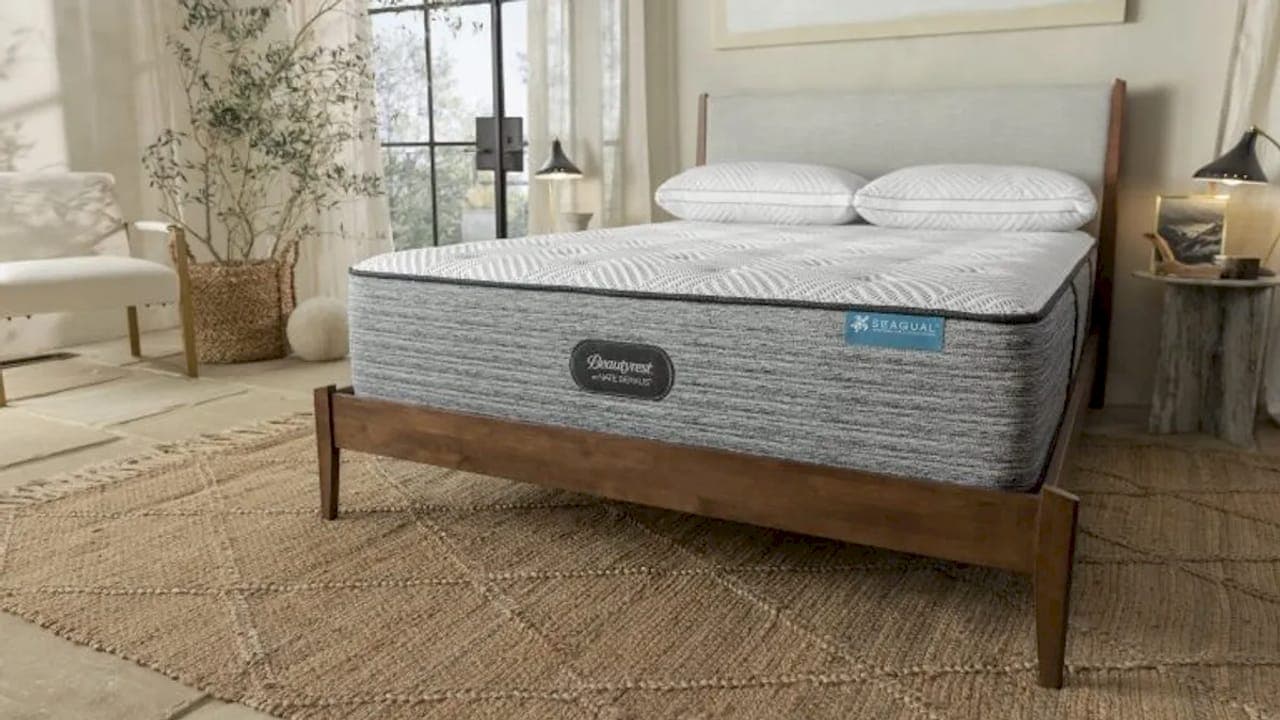

The ideal bedside table height matches the top of your mattress, or sits within approximately 5 cm of that level, for ergonomic comfort and visual balance. This single measurement principle, recognised by interior designers and furniture makers alike, governs how easily you can reach your phone, lamp, or glass of water without straining your shoulder or craning your neck. Get it right and your bedroom feels effortlessly composed. Get it wrong and even the most beautifully crafted piece will frustrate you every morning. This guide walks you through accurate measurement, standard height ranges by bed type, and the layout considerations that refine your final choice.
What is the correct bedside table height?
The industry-standard rule is to align your bedside table-top with your mattress surface, with a tolerance of ±5 cm. A deviation of more than 10 cm from mattress height negatively affects both accessibility and aesthetics. That 10 cm threshold is the point at which you begin to notice the mismatch physically, either reaching awkwardly upward or bending your wrist uncomfortably downward.
Standard bedside table heights usually range from 24 to 28 inches, which is approximately 61 to 71 cm, accommodating most bed profiles found in English homes. This range reflects the typical mattress height of a standard divan or sprung bed. Knowing this range gives you a useful starting point before you take a single measurement.
Designers prioritise natural arm reach in bed rather than matching headboard height or overall bed frame aesthetics. The headboard is a visual anchor; the bedside table is a functional one. Conflating the two leads to tables that look proportionate from across the room but feel wrong the moment you lie down.
How to measure your bed height correctly
Accurate measurement is the foundation of every good bedside table decision. The most common error is measuring the bed frame or box spring alone, which ignores the mattress and any topper sitting on top.
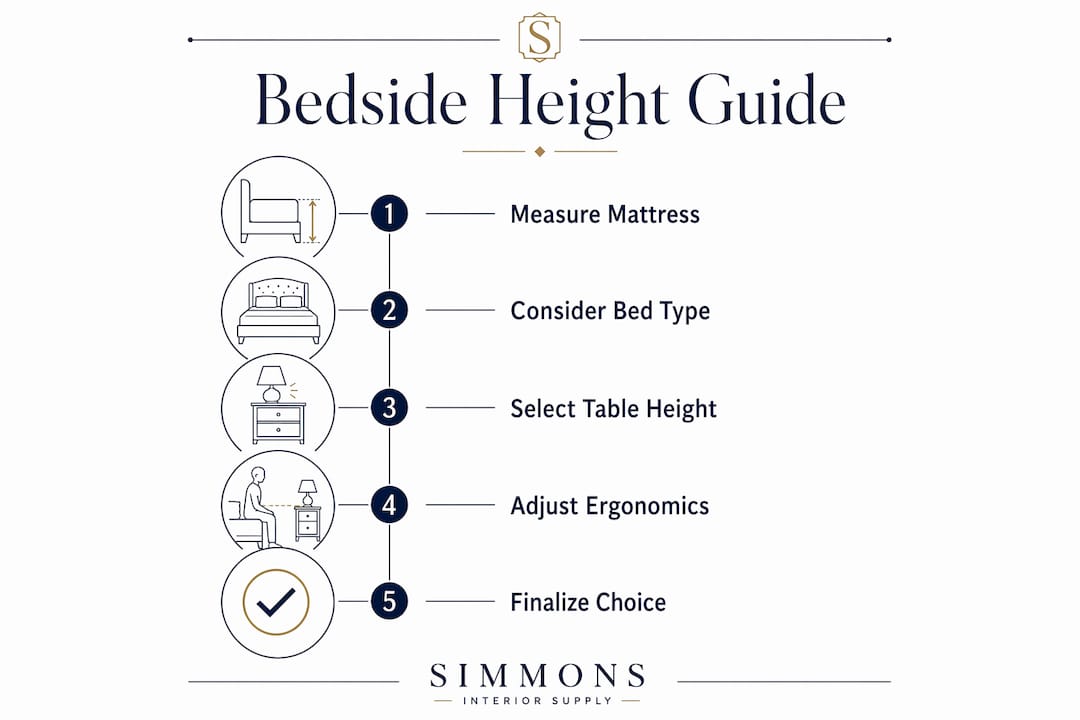
Follow these steps for a reliable reading:
- Strip back the bedding. Remove duvets, throws, and decorative cushions so you can see the mattress surface clearly.
- Add your topper. If you sleep with a memory foam or feather topper, place it on the mattress before measuring. It contributes meaningfully to the final height.
- Measure from floor to mattress top. Use a tape measure held vertically against the side of the bed. Record the figure in centimetres.
- Settle the bedding back. Replace your usual bedding and allow it to compress naturally for a few minutes.
- Re-measure with bedding in place. A thick duvet folded back over the mattress edge can add 3–5 cm to the effective surface height. Measuring with natural bedding settled reflects your true sleeping surface height.
- Check both sides. If your bedroom floor is slightly uneven, the two sides of the bed may differ by a centimetre or two. Measure each side independently if you are placing tables on both.
Pro Tip: Place a hardback book flat on the mattress surface and rest your tape measure against its spine. This gives you a stable, level reference point and reduces the chance of the tape bowing inward against soft bedding.
Accurate measurement also matters when you have an adjustable bed. The sleeping surface height changes with the bed's position, so measure at the angle you most commonly use for reading or resting.

Recommended height ranges by bed and mattress type
Different bed types demand very different bedside dimensions. The table below summarises the standard ranges you should work from.
| Bed type | Mattress top height | Recommended bedside table height |
|---|---|---|
| Platform bed | 30–46 cm (12–18 inches) | 30–46 cm |
| Standard divan or sprung bed | 55–65 cm (22–26 inches) | 55–65 cm |
| Standard nightstand range | 61–71 cm (24–28 inches) | 61–71 cm |
| Tall bed with thick mattress | 71–81 cm (28–32 inches) | 71–81 cm |
Platform beds sit close to the floor and need tables in the 30–46 cm range. Placing a standard 65 cm table beside a platform bed creates a jarring visual step and forces you to reach upward from a low sleeping position. The effect is the opposite of restful.
Standard UK mattress heights range from 55 cm to 65 cm, which means most English homeowners will find a table in the 55–65 cm band works well without any further adjustment. This is the sweet spot for a typical double or king divan.
Tall beds with thick mattresses, often seen in luxury hotel-style bedrooms, require tables in the 71–81 cm range. At this height, a standard off-the-shelf nightstand will look and feel too short. This is precisely where a bespoke piece, crafted to your exact specification, becomes the only satisfying solution.
Visual harmony is as important as ergonomics. A table much taller than the mattress disrupts sightlines and creates a top-heavy feeling in the room. A table that sits within ±5 cm of mattress height keeps the eye moving smoothly across the bed and its surroundings.
How do width, depth, and room layout affect height choice?
Bedside table height does not exist in isolation. Width and depth shape how a table reads in the room, and they influence whether your chosen height feels proportionate or out of place.
Bedside table width should scale with bed size. A king or super-king bed suits a table 22–24 inches wide, while a single or small double is better served by a table 16–18 inches wide. A narrow table beside a wide bed looks tentative; an oversized table beside a single bed crowds the room.
Key layout considerations to keep in mind:
- Depth. Typical bedside table depth runs 16–20 inches. Anything deeper than 22 inches risks encroaching on walkway space.
- Walkway clearance. Recommended clearance around the bed for comfortable movement is 24–30 inches. In smaller English bedrooms, this clearance often dictates depth more than any aesthetic preference.
- Visual weight. A taller table with a narrow footprint can feel spindly beside a low, wide bed. A shorter table with a generous surface can feel squat beside a tall divan. Proportional balance across all three dimensions produces the most composed result.
- Symmetry. In a shared bedroom, matching table heights on both sides creates a settled, considered look. If the two sleepers have very different preferences, a custom piece on each side resolves the conflict without compromise.
Pro Tip: Before committing to a purchase, cut a piece of cardboard to the exact dimensions of your intended table and place it beside the bed. Live with it for a day or two. You will notice immediately whether the height, width, and depth feel right in your specific room.
The bed should be the visual centrepiece of the bedroom, and bedside tables must be proportionally scaled to support that role rather than compete with it. Height is the most visible dimension, but width and depth determine whether the overall composition feels resolved.
Adjusting for special scenarios and personal ergonomics
Standard guidelines cover most situations, but personal habits and specific bedroom setups sometimes call for a different approach.
Reaching downward towards a slightly lower bedside table is ergonomically preferable to reaching upward. A table positioned 2–5 cm below mattress height is usually more comfortable for most people. This is a small but meaningful detail that mass-produced furniture rarely accounts for.
Situations where you might deviate from the standard range include:
- Reading in bed. If you sit upright against a headboard to read, a slightly taller table keeps your lamp and book at a more natural angle. A table at the lower end of the range will feel too far below your eyeline.
- Heavyweight or tall headboards. A headboard that rises significantly above the mattress can make a standard-height table look undersized. In this case, a table at the upper end of the recommended range restores visual balance.
- Extra-tall beds. For beds where the mattress top exceeds 75 cm, a custom piece or a floating shelf fixed at the correct height is often the most practical solution. Standard retail options rarely reach this height without looking ungainly.
- Mobility considerations. For anyone who finds it difficult to reach sideways from a lying position, a table positioned at mattress height or fractionally above reduces strain on the shoulder and wrist.
- Shared beds with different preferences. Two people of different heights or sleeping habits may benefit from tables set at slightly different heights on each side. This is one of the clearest cases for commissioning bespoke pieces rather than buying matching pairs off the shelf.
Sitting or lying posture directly affects the ideal height. A table that feels perfect when you are lying flat may feel awkward when you sit up to read. Consider your most common bedtime posture before finalising your choice.
Key takeaways
The most reliable rule for bedside table height is to match your mattress top and stay within ±5 cm of that measurement, adjusting slightly lower for the most comfortable ergonomic reach.
| Point | Details |
|---|---|
| Match mattress height | Align the table top with your mattress surface, within ±5 cm, for comfort and visual balance. |
| Measure with bedding on | Include mattress toppers and settled bedding in your measurement to get the true sleeping surface height. |
| Scale width to bed size | Use 16–18 inches wide for smaller beds and 22–24 inches for king or super-king beds. |
| Respect walkway clearance | Keep table depth to 16–20 inches and maintain at least 24–30 inches of clear walking space beside the bed. |
| Go bespoke for tall beds | Beds with mattress tops above 75 cm often require a custom or floating solution to reach the correct height. |
Why I think most people measure this wrong
People almost always measure the bed frame. They crouch down, hold the tape to the top of the wooden rail, and call it done. Then the table arrives and sits either too high or too low, and they assume the product is at fault.
The mattress top, including any topper, is the only measurement that matters. The frame is structural; the sleeping surface is functional. These are two entirely different heights, and conflating them is the single most common reason a beautifully chosen piece ends up feeling wrong in the room.
The detail I find most underappreciated is the 2–5 cm lower principle. Reaching slightly downward from a lying position is genuinely more comfortable than reaching level or upward. It is a small ergonomic truth that most buying guides gloss over, but once you experience a table set fractionally below mattress height, the difference is immediately apparent.
I also think people underestimate the role of width and depth in making height feel right. A table at the perfect height but with a surface that is too narrow looks precarious. A table at the correct height but too deep crowds the room and makes the height feel imposing. All three dimensions work together. Measure the space, cut the cardboard mock-up, and live with it before you commit. The Simmonsinteriorsupply gallery is a useful reference for seeing how proportions resolve in finished rooms.
The bedroom deserves the same rigour you would apply to any other room in the house. A bedside table is not an afterthought. It is the last thing you see at night and the first thing you reach for in the morning.
— Luke
Bespoke bedside tables crafted to your exact height
Once you have your measurements, the next step is finding a piece that actually meets them. Standard retail options cluster around a narrow height range and rarely accommodate the full spectrum of mattress profiles found in English bedrooms.

Simmonsinteriorsupply works with skilled artisans to handcraft bespoke bedside tables built to your precise specifications, whether you need a low platform companion at 35 cm or a sculptural piece at 78 cm for a hotel-style tall bed. Every piece is made from scratch, finished to your chosen specification, and proportioned to sit in harmony with your bed and room. Browse the full collection and find a piece that fits your bedroom as though it were always meant to be there.
FAQ
What is the standard bedside table height in the UK?
Standard bedside table heights in the UK range from approximately 55 to 65 cm, reflecting typical divan and sprung mattress heights. The general guideline is to match the table top to your mattress surface within ±5 cm.
How tall should a bedside table be for a platform bed?
Platform beds sit close to the floor, so the ideal bedside table height is 30–46 cm. A standard nightstand will sit too high beside a platform bed and disrupt both ergonomics and visual balance.
Should a bedside table be higher or lower than the mattress?
A table positioned 2–5 cm below mattress height is ergonomically preferable, as reaching slightly downward is more comfortable than reaching level or upward from a lying position.
How do I measure the correct height for my bedside table?
Measure from the floor to the top of your mattress with your usual topper and settled bedding in place. This gives you the true sleeping surface height, which is the figure your bedside table should match.
What width should a bedside table be for a king-size bed?
A king or super-king bed suits a bedside table 22–24 inches wide. Smaller beds, such as a single or small double, are better balanced by a table 16–18 inches wide.