

Which custom mirror sizing services lead in London?
Getting a mirror cut to your exact dimensions is far more straightforward than most people expect, provided you choose the right supplier. The four providers below represent the strongest options available to London clients in 2026, each with a distinct character worth understanding before you commit.
| Provider | Rating | Installation | Product options | Warranty/guarantee | Best for |
|---|---|---|---|---|---|
| London Glass & Mirror Co | 4.3★ (138 reviews) | Yes, full service | Custom thickness and finishes | Work guarantee | Experienced full-service projects |
| London Glass Solutions | 5★ (106 reviews) | Yes, residential and commercial | Certified premium products | Customer satisfaction guarantee | Certified, competitively priced work |
| Provincial Glass & Mirror Ltd | 4.3★ (78 reviews) | Yes, including emergency | Full glazing and mirror range | Quality installation guarantee | Comprehensive glazing with prompt support |
| Lambton Glass & Mirror | 4★ (23 reviews) | Yes, 24/7 emergency | Code-compliant custom fabrication | Workmanship guarantee | Cost-effective, fast turnaround |
Key trust signals to look for: insurance-approved work, written work guarantees, and independently verified customer reviews.
London Glass & Mirror Co has operated as a family-owned business since 1938, offering free in-home consultations for residential and commercial projects. That depth of experience translates into confident handling of unusual shapes, large-format pieces, and complex installations. London Glass Solutions holds authorised dealer status for Mirage Screen Systems and MaxxMar, which signals a level of product accountability that independent glaziers rarely carry.

Provincial Glass & Mirror Ltd brings decades of commercial and residential experience, including emergency glazing, making it a practical choice when timelines are tight. Lambton Glass & Mirror suits clients who prioritise code-compliant fabrication at a lower price point, with 24/7 emergency availability and over 30 years of experience behind them.
How do these providers compare on the details that matter?
The comparison above captures the headline picture. What separates these four in practice comes down to specialisation and service depth rather than any single metric.
London Glass & Mirror Co's free consultation model is genuinely useful for complex bespoke mirror projects, where getting the brief right before fabrication begins saves both time and money. London Glass Solutions' certified dealer status means the products themselves carry manufacturer accountability, a reassurance worth having for high-specification commercial installations. Provincial Glass & Mirror Ltd's emergency service capability sets it apart for clients managing commercial properties or hospitality venues where a broken mirror cannot wait. Lambton Glass & Mirror's Canadian-certified credentials and cost-focused positioning make it the natural fit when budget governs the brief.
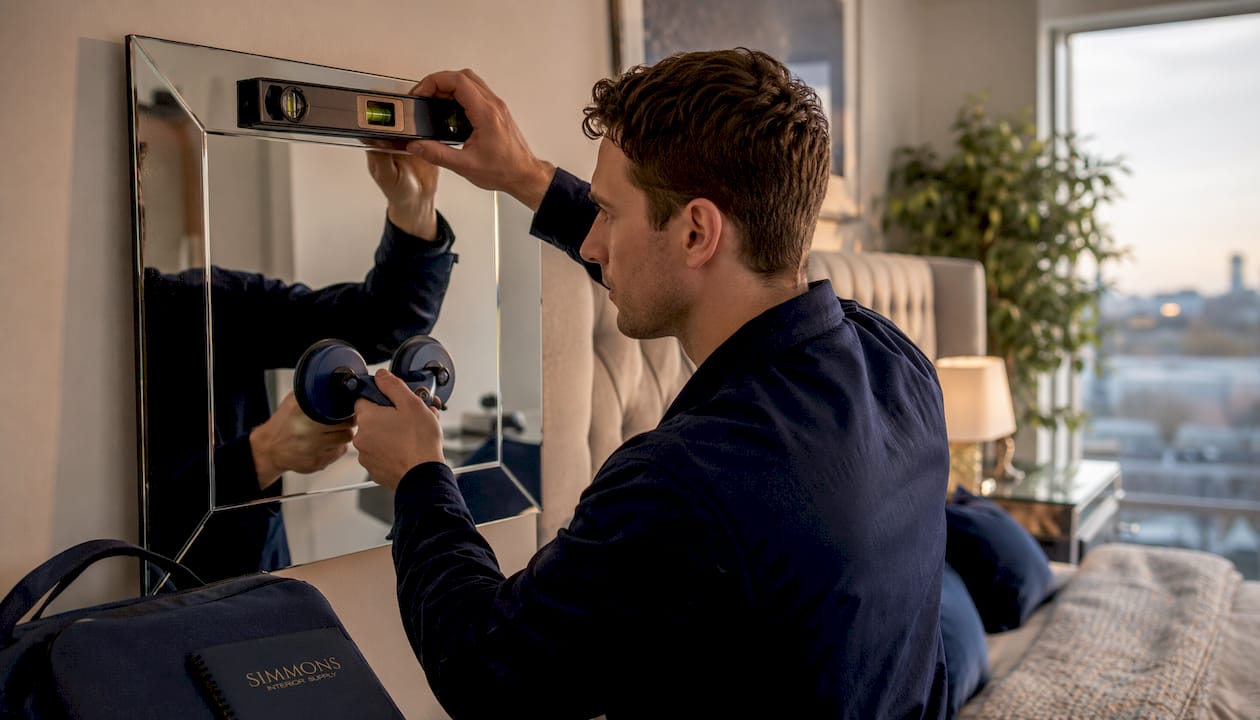
How do you order a custom size mirror, from measuring to installation?
Accurate measurement is where most orders go wrong, and the fix is simpler than people assume.
Step one: measure the space, not the mirror you imagine. Use a metal tape measure and record width and height to the nearest millimetre. Note the distance from surrounding fixtures, light fittings, and sockets. If a cut-out for an electrical socket or switch is required, technical diagrams must be prepared before fabrication begins, since alterations after glass toughening are impossible.
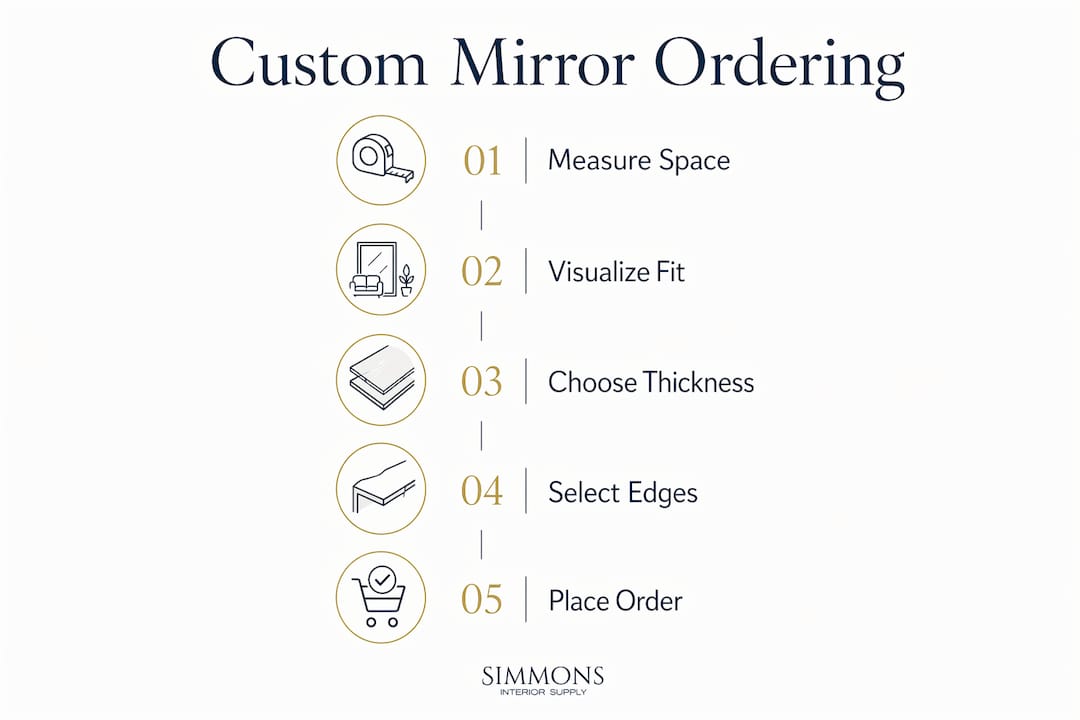
Step two: visualise before you order. Stick masking tape or cut paper to the wall at your intended dimensions. Physical templates on site are the single most effective way to avoid returns caused by misjudged scale.
Step three: choose your thickness. For most wall mirrors, 4mm glass is standard. For mirrors over 1m², or in high-traffic areas such as gyms and bathrooms, 6mm is the professional recommendation.
Step four: select an edge finish. Polished edges are durable and suit most interiors. Bevelled edges add decorative depth but require longer lead times due to additional cutting and polishing steps.
Step five: confirm the ordering process. Most reputable suppliers move from consultation to fabrication within a few days, with delivery and installation scheduled once the piece is ready. Always confirm lead times in writing before placing an order.
Pro Tip: Never rely on a single measurement. Measure twice in two different spots and use the larger figure to account for any wall irregularity.
What sizing standards and finishes should you know about?
Professional mirror sizing follows a well-established proportion rule. A mirror hung above furniture should be 66–75% of that furniture's width, creating visual harmony without the top-heavy effect of an oversized piece. Above a bathroom vanity, the mirror typically sits slightly narrower than the unit itself.
Thickness choices carry practical consequences beyond aesthetics:
- 4mm glass suits smaller decorative mirrors, picture frames, and standard wall applications.
- 6mm glass is recommended for any mirror exceeding 1m², gym installations, or bathroom environments where durability and weight distribution matter.
Edge finishing shapes both the look and the lead time:
- Polished edges are clean, durable, and the fastest to produce.
- Bevelled edges introduce a chamfered border that catches light elegantly, though the additional processing adds days to the order.
Mounting method is equally consequential. Mirrors larger than 1m² should not be fixed with screws alone. Adhesive backing or professional channel supports distribute weight far more safely, particularly with 6mm glass. For wet areas, moisture-resistant foil-backed glass is the only sensible choice: standard silvering oxidises when moisture penetrates the edges, causing the cloudy deterioration known as mirror rot.
Sizing standard to remember: a mirror width of 66–75% of the furniture beneath it is the professional benchmark for visual balance in most residential and commercial settings.
What does the timeline from order to installation look like?
A well-managed bespoke mirror order typically follows a clear sequence, though lead times vary by supplier and specification.
- Day 1–2: Initial consultation, site measurement, and brief confirmation. Suppliers offering free in-home consultations, as London Glass & Mirror Co does, complete this stage in a single visit.
- Day 3–5: Fabrication begins. Standard polished-edge mirrors in common thicknesses are usually ready within this window. Bevelled finishes or cut-outs for electrical fittings add two to four days.
- Day 6–10: Quality check, packaging, and delivery scheduling.
- Day 10–14: Installation, which for larger or more complex pieces may require a return visit for final adjustments.
Emergency glazing services, offered by both Provincial Glass & Mirror Ltd and Lambton Glass & Mirror, compress this timeline significantly for urgent replacements.
What criteria should guide your choice of supplier?
The most reliable suppliers share a few concrete characteristics. They carry public liability insurance and offer a written work guarantee. They are transparent about lead times before you pay, not after. They can provide references or independently verified reviews, and they will discuss your specific application rather than defaulting to a standard product.
For trade clients, interior designers, and architects, the ability to handle complex briefs, including unusual shapes, large formats, and integrated cut-outs, separates a genuinely capable fabricator from a basic glazier.
What should you ask a supplier before ordering?
Before placing any order, get clear answers to these questions:
- What glass thicknesses do you offer, and which do you recommend for my application?
- What edge finishes are available, and how do they affect lead time?
- Do you provide and install, or fabrication only?
- What is your policy if the mirror arrives damaged or incorrectly sized?
- Are you insured, and do you offer a written work guarantee?
- Can you accommodate cut-outs for sockets or switches, and what diagrams do you need from me?
What are the red flags to watch for?
A supplier who cannot confirm lead times in writing, offers no insurance documentation, or discourages you from visiting their premises warrants caution. Vague pricing with no itemised breakdown is another warning sign: legitimate fabricators can separate glass cost, edge finishing, delivery, and installation into distinct line items. Be equally wary of any supplier who dismisses the need for 6mm glass on a large-format mirror or suggests screw fixings alone for a piece over 1m².
What does a full cost breakdown look like?
Custom mirror pricing depends on glass area, thickness, edge finish, and whether installation is included. As a general guide:
- Glass fabrication: priced per square metre, with 6mm glass costing more than 4mm.
- Edge finishing: polished edges are typically included in the base price; bevelled edges carry a premium.
- Delivery: usually charged separately, based on distance and mirror size.
- Installation: quoted independently, and for complex or large-format pieces this can represent a meaningful portion of the total.
- Additional fees: cut-outs for electrical fittings, specialist fixings, and moisture-resistant backing all add to the final figure.
Always request a fully itemised quote before approving fabrication.
Key takeaways
Choosing the right supplier and getting your measurements right before ordering are the two decisions that determine whether a bespoke mirror project succeeds or requires costly correction.
| Point | Details |
|---|---|
| Use the two-thirds rule | A mirror should be 66–75% of the width of the furniture beneath it for balanced proportions. |
| Match thickness to application | Use 4mm glass for standard wall mirrors, and specify 6mm glass for mirrors over 1m² or in high-traffic areas. |
| Visualise before ordering | Fix masking tape or paper to the wall at your intended dimensions to catch scale errors before fabrication. |
| Bevelled edges add lead time | Bevelled finishes require additional processing and extend delivery by several days versus polished edges. |
| Simmonsinteriorsupply for trade | For interior designers and architects seeking made-to-order mirrors with bespoke dimensions and finishes, Simmonsinteriorsupply offers a trade-focused alternative to standard glaziers. |
Bespoke mirrors for designers and architects: Simmonsinteriorsupply
The providers compared above are excellent choices for direct glazing commissions. If your brief calls for something more considered, a mirror conceived as part of a wider interior scheme rather than a standalone trade order, Simmonsinteriorsupply offers a different kind of service.

Simmonsinteriorsupply works with interior designers, architects, and hospitality clients to produce made-to-order mirrors with tailored dimensions and finishes, handcrafted through skilled artisan partnerships. Every piece is conceived from scratch, which means the proportions, frame character, and finish can be calibrated to a specific room rather than selected from a catalogue. Trade account access, bespoke commission handling, and a portfolio of completed projects make it a natural fit for designers who need a fabrication partner rather than a glazier. If the mirror is the centrepiece, not just the fitting, this is where to begin.