

A designer trade account gives verified interior design professionals access to pricing, products, and services withheld from retail buyers, typically at 10 to 50% below list price depending on the supplier type. The immediate commercial benefit is margin: what you save on procurement either protects your fee or funds better specification. The next action is straightforward: gather your business documents today and apply to at least one trade programme this week.
TL;DR:
- Discount rates vary significantly, from 10-20% for retail-brand trade programs to up to 50% for trade-only manufacturers and direct factory sourcing.
- Application processes typically take 5 to 10 working days, with credit references, proof of active practice, and verification of payment history, especially for new studios.
- Consolidating spend with fewer suppliers and maintaining a strong payment record improves negotiation power and access to priority stock and delivery services.
- Using procurement aggregators, direct brand contacts, and showroom relationships can unlock additional value without extra paperwork.
- Clarify trade agreement terms, especially minimum order values, return policies, exclusivity clauses, and payment deadlines, before committing to any supplier.
Table of Contents
- How designer trade accounts work
- What discount can you actually expect?
- How do you apply for a trade account?
- Cost-plus, retail retention, or a hybrid model?
- Building leverage once your account is open
- Getting more from trade accounts without more paperwork
- How Simmons Interior Supply supports trade customers
- What to check before you sign a trade agreement
- An editorial view on trade accounts and studio margin
- Start a trade relationship with Simmons Interior Supply
- Sources
How designer trade accounts work
A trade account is simply a verified professional relationship with a supplier, and it takes a few recognisable shapes. Understanding which one you're dealing with matters more than most designers assume, because it changes how you get paid and how quickly you can move on a project.
Cash accounts settle at point of order or on delivery, with no credit extended. Credit accounts run on payment terms, most commonly 30 days from invoice, with a credit limit that reflects your trading history and the supplier's risk appetite. Newer studios often start on cash terms and graduate to credit once a payment pattern is established.
Access itself typically arrives through one of three routes:
- A dedicated trade portal with a hidden pricing tier, unlocked once you're approved
- A named account manager who quotes manually against your specification
- A B2B procurement platform that aggregates access across multiple manufacturers
Trade pricing stays confidential for a reason. Suppliers protect retail margin on the same catalogue, so most trade programmes require you to keep quoted prices out of client-facing documents. That confidentiality is precisely why the discount exists at all.
What discount can you actually expect?
Discounts vary sharply by where you sit in the supply chain, and treating every "trade account" as equivalent is the most common mistake studios make when weighing whether an application is worth the paperwork.
- Retail-brand trade programmes (the trade tier bolted onto a consumer-facing brand): commonly 10 to 20% off list price
- Trade-only manufacturers with no retail storefront: often 30 to 50% off list price
- Direct factory sourcing, particularly for bespoke or made-to-order pieces: frequently the deepest margin available, since there's no retail layer to protect
Run the numbers on a mid-sized project. A £60,000 furniture, fabric, and lighting budget sourced at retail leaves you negotiating fee against sticker price. Textiles, bespoke furniture, and decorative lighting tend to carry the widest trade margins of any category, largely because these are the areas where mass retail competition is weakest.
How do you apply for a trade account?
Verification exists to confirm you're a working professional, not a retail shopper wearing a designer's hat. The documents rarely change from supplier to supplier, but the sequence and speed do.
- Register your business — most suppliers ask for a company number or, if you trade as a sole trader, your Unique Taxpayer Reference (UTR)
- Provide your VAT number if you're registered, alongside standard bank details for invoicing
- Submit a portfolio or live website showing active client work, since proof of active practice is one of the most consistently checked items across trade programmes
- Offer trade references, typically one or two suppliers who can confirm your payment history
- Complete the application form, which most merchants process the same day
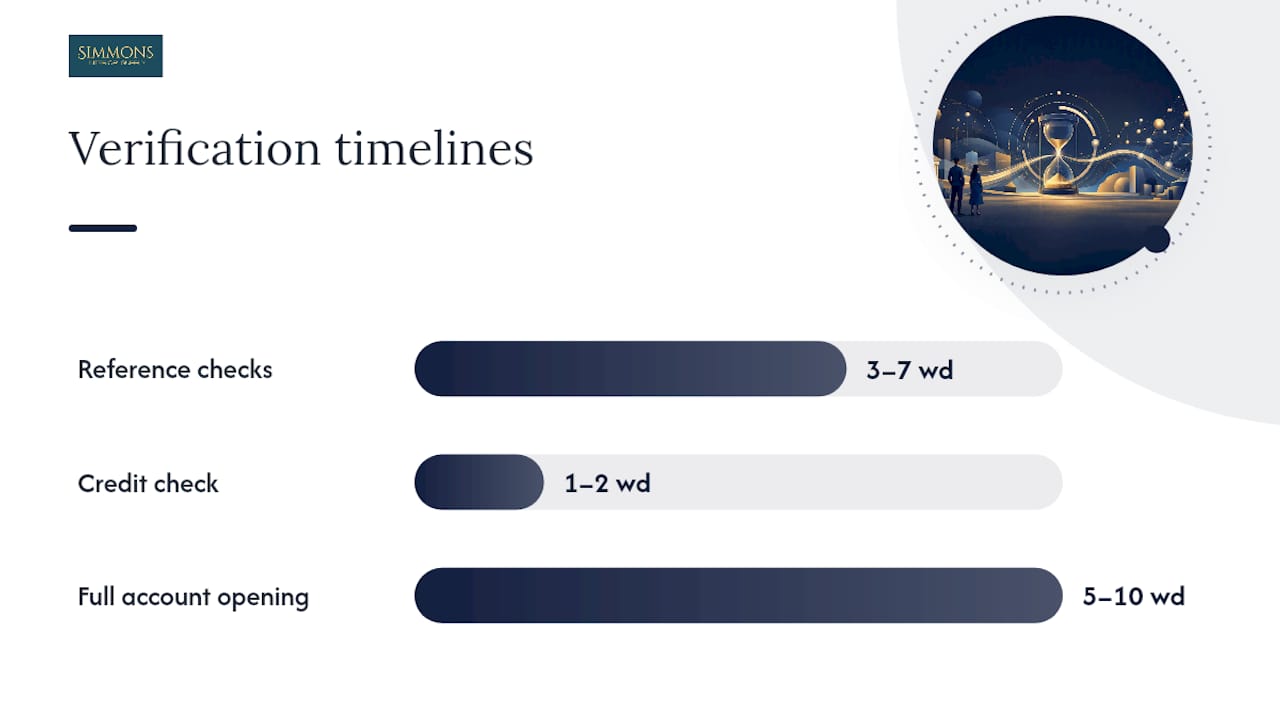
- Wait for verification — references are usually chased within 3 to 7 working days, with a credit check adding a further 1 to 2 working days, so a full account opening typically lands within 5 to 10 working days
If you're a sole trader or a new studio with no references yet, don't let that stop the application. Offer to start on a cash account, share a recent client testimonial or signed proposal in place of formal trade references, and ask directly whether a smaller initial credit limit is available while you build history.
Pro Tip: Apply to two or three suppliers in the same week rather than one at a time. Verification teams work in parallel, and a live reference check with one supplier often speeds up approval with another.
Cost-plus, retail retention, or a hybrid model?
How you charge for procurement shapes client trust as much as it shapes your margin, and the wrong model on the wrong project can quietly erode both.
Cost-plus means passing the trade price through to the client and adding a transparent procurement fee on top, often in a moderate percentage range. It's the most defensible model when a client asks to see invoices, because there's nothing to hide.
Retail retention means charging the client the retail price and keeping the discount as your margin. This suits studios with strong specification skills and clients who value a fixed, predictable number over line-item transparency, though the trend toward transparent pricing is genuinely nuanced. Some studios build trust by opening their books; others find retained margin funds the design service itself.
A hybrid approach applies cost-plus to big-ticket bespoke items and retains margin on smaller accessories, which often reads as fair to clients while still protecting studio income.
- State your model in the proposal, not the invoice
- Name the procurement fee as a line item if you're running cost-plus
- Decide the model per project, not per studio policy
Pro Tip: Never mix models on the same line item within one project. Clients notice inconsistency faster than they notice the percentage.
Building leverage once your account is open
An open account is the starting point, not the reward. The real commercial gain comes from what you do with it over the following twelve months.
Consolidating spend with one or two core suppliers, rather than spreading small orders across a dozen accounts, gives you the volume to negotiate discretionary reductions that a first-time applicant never sees. Before requesting a credit-limit review, prepare three things:
- Recent order statements showing consistent, on-time payment
- A rough forecast of upcoming project volume for the next two quarters
- Examples of prior orders that demonstrate reliability, not just spend
Suppliers reward consolidated, well-documented accounts with more than better pricing. Expect a dedicated account representative, priority stock allocation during shortages, and often click and collect or local delivery windows that a cash customer simply doesn't get offered.
Getting more from trade accounts without more paperwork
Some of the best value sits outside the formal application process entirely, and most designers never think to look for it.
- Use a procurement aggregator to compare pricing across several manufacturers at once, since some platforms bundle trade access across many suppliers and remove the need to file a separate application with each one
- Email the brand directly when there's no public trade portal listed. A short note to a brand's B2B or sales contact with a concise portfolio attached can unlock access that never appears on the website
- Request swatches deliberately, not speculatively. Ask for refundable sample fees where offered, and track return windows so you're not quietly charged for materials you sent back on time
Showrooms add a further layer worth exploring directly. A trade-only showroom relationship often gives you physical access to finishes and materials that a portal listing can't convey.
Pro Tip: Keep a single spreadsheet of every sample sent, its fee, and its return deadline. Sample fees are small individually but add up fast across a busy quarter, and suppliers rarely chase you to remind you of a return window.
How Simmons Interior Supply supports trade customers
Simmons Interior Supply builds bespoke, handcrafted furniture with artisan collaborators, working in custom sizes and finishes rather than fixed retail runs. For trade customers, that means every commission is genuinely made for the room it's going into, not adapted from a standard catalogue.
Practical support runs alongside the pieces themselves:
- A published white-glove delivery guide covering installation logistics for large or fragile items, including custom mirror handling
- A CAD commissioning guide for designers preparing precise specifications before manufacture begins
- Direct account access for trade professionals, rather than a generic retail checkout
Starting a relationship typically means sharing a project brief and portfolio link, after which an account contact confirms sizing, finish, and lead time before manufacture begins.
What to check before you sign a trade agreement
Trade terms read as boilerplate until the clause you skipped becomes the clause that costs you a project margin. A handful of specifics are worth checking before you commit spend to any one supplier.

Minimum order values catch smaller studios out most often. Some trade-only manufacturers set a minimum spend per order or per year to keep the account active, and falling below it can quietly downgrade your pricing tier without warning.
Returns policies on made-to-order or bespoke items are frequently far stricter than on stocked goods, sometimes non-existent once production has started. Get this in writing before you commission anything on a client's behalf.
Exclusivity clauses occasionally require you to source a category solely through one supplier to retain preferential pricing. That can be a fair trade if the pricing genuinely reflects it, but it's worth totalling what you'd lose in flexibility against what you'd gain in discount.
Payment terms that quietly shorten are a real risk on credit accounts. A supplier under cash-flow pressure can tighten 30-day terms to 14 days with little notice, which matters enormously if your own client payment schedule assumes the longer window.
Watch, too, for suppliers who won't put pricing or terms in writing at all, who demand upfront payment on every order despite an approved credit account, or who pressure you toward exclusivity before you've placed a single order. None of these are automatically dishonest, but each is a reason to ask more questions before you commit.
An editorial view on trade accounts and studio margin
Most guidance on trade accounts treats the application as the finish line. It isn't. The application is the easy part, arguably the least interesting decision a studio makes in this entire process.
What the research here actually supports is a shift in emphasis: the discount percentage matters less than the category it's attached to. A 15% retail-brand discount on furnishings a client barely notices is worth far less than a 35% factory rate on the bespoke pieces that anchor a room. Studios that chase account volume, collecting a dozen trade relationships for the sake of having them, often end up managing paperwork instead of margin.
The conventional advice to "apply everywhere" undersells consolidation. Fewer suppliers, deeper spend, and a genuine payment history unlock better terms than a scattergun approach ever will. If you do one thing differently after reading this, make it the pricing-model decision, cost-plus or retention, before your next proposal goes out. That single choice, made deliberately rather than by habit, shapes client trust for the life of the project.
— Luke
Start a trade relationship with Simmons Interior Supply
Simmons Interior Supply is the alternative to sourcing from catalogue-bound retail brands for designers who need a piece built to an exact brief rather than adapted from stock. Where retail trade programmes offer a fixed discount on fixed sizing, a bespoke commission gives you control over dimension, finish, and material from the outset, which matters most on the projects where an off-the-shelf compromise would show.

That fits naturally with the studio-first approach this article has argued for: fewer, deeper supplier relationships rather than a dozen shallow trade accounts. Browse the bespoke coffee table collection for a sense of the customisation available, or view the full gallery as evidence of the craft behind each commission. If you're ready to open a trade account, start at Simmonsinteriorsupply and share your project brief with the team.
Sources
- Trade Discount Programs for Interior Designers: How They Work, What to Expect, and How to Maximise Them
- Buildersmerchantsdirect
- How to Open a Builders' Merchant Trade Account | Renovation Notes