

FSC certified wood is timber verified to originate from forests managed to the rigorous environmental, social, and economic standards set by the Forest Stewardship Council. The FSC logo, that distinctive green check-tree mark, tells you the wood in your furniture or flooring has been traced from a responsibly managed forest through every link in the supply chain to the finished product. For designers, architects, and discerning homeowners sourcing bespoke pieces, it is the clearest signal available that a material choice carries genuine ethical weight.
FSC UK promotes environmentally appropriate, socially beneficial, and economically viable management of the world's forests through certification of wood, paper, and other forest products. The certification rests on four interconnected principles:
- Responsible forestry: forests are managed to sustain long-term yield without degrading the ecosystem
- Ecosystem protection: biodiversity, water quality, and old-growth habitats are actively preserved
- Community benefits: the rights and livelihoods of local communities and Indigenous peoples are respected
- Economic viability: forest operations remain financially sustainable so responsible management continues
What do the different FSC label types mean?
Not every product carrying the FSC mark is identical in its sourcing. Three distinct labels exist, each communicating something different about a product's material composition.
| Label | Content requirement | Typical use |
|---|---|---|
| FSC 100% | 100% virgin material from FSC-certified forests | Solid timber furniture, structural beams |
| FSC Mix | Minimum 70% FSC-certified or recycled content, plus controlled wood | Engineered panels, composite boards |
| FSC Recycled | 100% reclaimed or recycled material, independently verified | Paper products, reclaimed wood flooring |
FSC 100% is the most direct expression of the certification's mission. Every fibre in the product originates from a forest holding FSC Forest Management Certification, making it the label to specify when you want the strongest possible provenance claim.
FSC Mix acknowledges a practical reality: not every forest globally meets FSC standards yet. The controlled wood component is virgin material assessed to carry a low risk of originating from illegal logging or other unacceptable practices. The 70% threshold is a floor, not a ceiling, and many products exceed it considerably.
FSC Recycled carries independent verification that all wood or paper content has been genuinely reclaimed, unlike generic recycled claims which require no third-party check. Products carrying the FSC Mix label may also incorporate reclaimed materials, but only products at 100% recycled content qualify for the Recycled label itself.
Pro Tip: When specifying timber for a bespoke commission, always ask your supplier which FSC label applies. FSC 100% offers the strongest sustainability claim; FSC Mix is perfectly credible but warrants a conversation about the controlled wood proportion.
Why FSC certification matters in the UK market
The FSC label has become a market-leading symbol of sustainable sourcing in the UK furniture and construction sectors, and its influence on purchasing decisions is tangible. Over half of consumers worldwide recognise the FSC logo, and for professionals specifying materials for BREEAM-rated buildings or luxury interiors, it functions as a baseline expectation rather than a bonus.
The environmental criteria are exacting. FSC-certified forests operate under a zero deforestation commitment, with biodiversity preservation and sustainable yield management built into every forest management plan. Socially, the standards require respect for Indigenous peoples' rights, fair wages, and meaningful community engagement, criteria that go well beyond what most regional schemes demand.
For UK businesses, the economic case is equally clear:
- FSC certification signals supply chain transparency to clients and specifiers
- It supports compliance with procurement policies that reference recognised sustainability standards
- Certified products often command a premium, reflecting the genuine cost of responsible management
- The logo provides a defensible, third-party-verified sustainability claim in marketing and tender documents
How does FSC compare with PEFC in the UK?
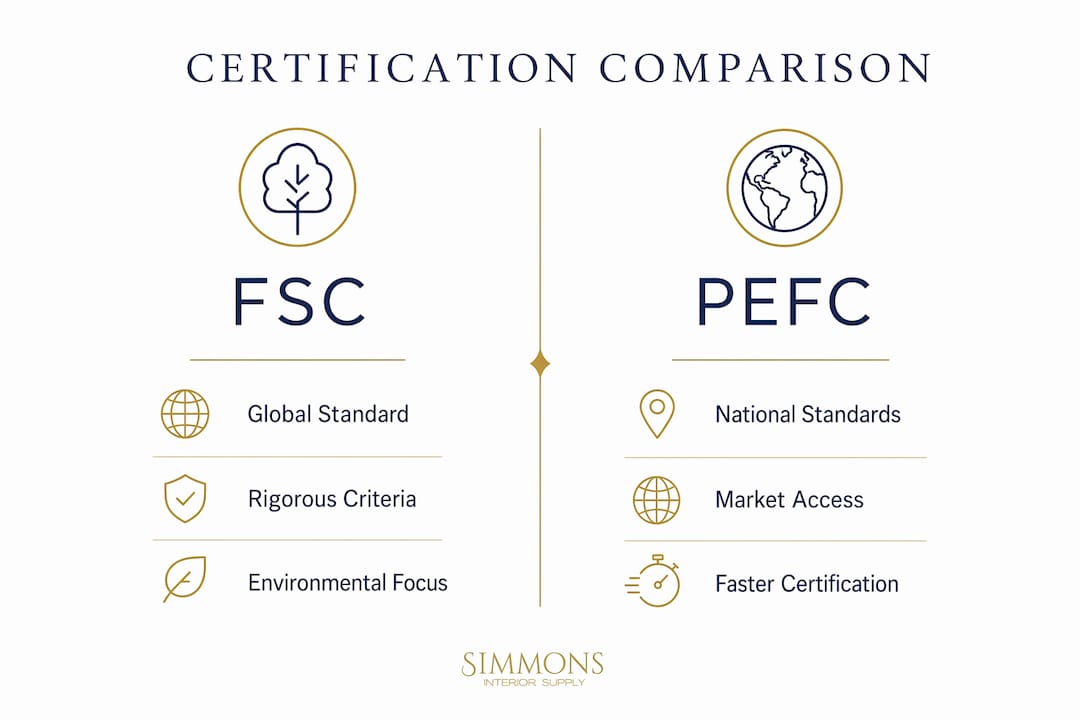
FSC and PEFC are the two dominant sustainable wood certification systems operating in the UK, and understanding their differences helps you make informed sourcing choices.
| Dimension | FSC | PEFC |
|---|---|---|
| Scope of certification | Single global standard, adapted nationally | Endorses national schemes against a benchmark |
| Environmental criteria rigour | Comprehensive, centrally governed | Varies by national scheme |
| Social criteria and Indigenous rights | Explicit, globally consistent | Less consistent across endorsed schemes |
| Global vs regional governance | Top-down, three-chamber system | Bottom-up, mutual recognition framework |
| Market acceptance in the UK | Strong NGO backing, higher consumer recognition | Widely accepted, less NGO endorsement |
FSC uses a top-down governance model developed by three chambers representing environmental, social, and economic interests with equal voting weight. PEFC, established in 1999, works differently: it endorses national certification schemes that meet its benchmark requirements rather than creating its own forest management standards. This makes PEFC the larger system by certified forest area globally, but it also means the rigour of individual national schemes can vary.
Environmental NGOs regard FSC as more rigorous, particularly on social criteria and Indigenous rights, where FSC's global consistency is difficult to match through a mutual recognition framework. In the UK market, both certifications are credible and widely accepted, but FSC carries stronger recognition among NGOs and consumers. Dual certification is common in the UK furnishing industry, allowing manufacturers to satisfy diverse client requirements including BREEAM and LEED compliance simultaneously.
How to verify authentic FSC certified wood products in the UK
Spotting the FSC logo on a product is the first step, but genuine verification goes further. Only companies holding valid FSC Chain of Custody certification are authorised to place the FSC label on products, and that certificate number is your key to independent confirmation.
- Identify the label type: FSC 100%, FSC Mix, or FSC Recycled, each communicates different sourcing content
- Request the supplier's FSC Chain of Custody certificate number before placing an order
- Search the FSC's public certificate database at info.fsc.org to confirm the certificate is current and valid
- Check that the FSC trademark appears correctly on the product, not as a self-printed sticker or unofficial reproduction
- For bespoke or bulk orders, ask for the FSC claim on the invoice or delivery documentation, not just the product label
Pro Tip: Certificate validity can lapse. Always check the FSC database at the point of ordering, not just when you first approved a supplier, particularly for long-running projects where months may pass between initial approval and final delivery.
One important nuance: FSC certification confirms raw timber provenance but does not cover chemical treatments applied after harvest. If you need assurances on VOC emissions, fire retardants, or finish safety, those require separate certifications entirely.
The benefits of choosing FSC certified wood
Choosing FSC certified timber carries tangible advantages for both individual buyers and trade professionals. For consumers, the label provides confidence that a purchase actively supports forest conservation rather than contributing to deforestation, a distinction that matters when a piece of furniture is intended to last decades. For businesses, it offers a credible, audited sustainability claim that holds up to scrutiny from clients, specifiers, and procurement teams.
Interior designers working on high-specification residential or hospitality projects find that FSC certification simplifies the sustainability conversation with clients. Rather than navigating complex supply chain questions, the label provides a clear, internationally recognised answer. It also supports compliance with green building standards, where specifying certified materials can contribute directly to BREEAM or LEED credits.
Honest challenges and criticisms of FSC certification
FSC certification is not without its critics, and a balanced view requires acknowledging where the system has limitations. The certification process can be costly and administratively demanding, which places it out of reach for smaller forest operators in developing regions, potentially excluding well-managed forests simply because the owners cannot afford the audit process.
There have also been documented cases where certified forests later faced allegations of poor practice, raising questions about the rigour of ongoing monitoring versus initial certification. The FSC has responded by strengthening its audit requirements over time, but the gap between certification and continuous on-the-ground performance remains a legitimate concern for those who look closely. Additionally, as noted earlier, the label says nothing about post-harvest chemical treatments, so professionals with specific material safety requirements need to layer additional verification on top.
FSC certification's role in UK sustainable forestry
The UK has a particular relationship with FSC certification, shaped by decades of public debate about deforestation, biodiversity loss, and the ethics of timber imports. FSC UK works with forest managers, businesses, and educational institutions to embed responsible forestry thinking across the supply chain, from the sawmill to the design studio. The organisation's Verified Impact programme helps forest managers demonstrate ecosystem services, connecting the abstract idea of sustainable management to measurable outcomes on the ground.
For the UK construction and interiors sectors, FSC certification has shifted from a niche preference to a procurement baseline. Government frameworks, major housebuilders, and luxury interior brands increasingly specify FSC-certified materials as standard, reflecting a broader cultural shift toward accountability in material sourcing.
Where to buy FSC certified wood and furniture in the UK
FSC certified timber and furniture are widely available across the UK, from large timber merchants to specialist joinery suppliers and bespoke furniture makers. When sourcing for a residential or hospitality project, the most reliable approach is to work directly with a manufacturer or supplier who holds their own FSC Chain of Custody certificate, rather than relying on a retailer's unverified claim.
Timber merchants such as those listed on the FSC UK website carry certified stock across a range of species and grades. For bespoke furniture, the key question to ask any maker is whether they hold FSC Chain of Custody certification themselves, which means their use of the label on your finished piece is fully audited and traceable.
At Simmonsinteriorsupply, our commitment to craftsmanship extends to the provenance of every material we work with. We collaborate with artisans who share our values, and we are always happy to discuss sustainable sourcing options for bespoke commissions. Whether you are specifying a sculptural dining table or a made-to-order cabinet, responsible material choices are part of the conversation from the very first brief.
Explore our handcrafted furniture collection or visit our gallery to see how considered material sourcing translates into pieces of genuine, lasting beauty.
Key takeaways
FSC certified wood is the most credible and widely recognised standard for responsible timber sourcing in the UK, verified through a rigorous chain of custody from forest to finished product.
| Point | Details |
|---|---|
| Three distinct labels | FSC 100%, FSC Mix, and FSC Recycled each communicate different sourcing content and composition. |
| 70% threshold for FSC Mix | FSC Mix products must contain at least 70% FSC-certified or recycled material, plus controlled wood, to carry the on-product label. |
| Chain of custody is mandatory | Only suppliers with valid FSC Chain of Custody certification may legally place the FSC logo on products. |
| FSC vs PEFC in the UK | Both are accepted, but FSC carries stronger NGO backing and consumer recognition in the UK market. |
| Scope limitation | FSC certification covers timber provenance only; chemical treatments require separate verification. |