
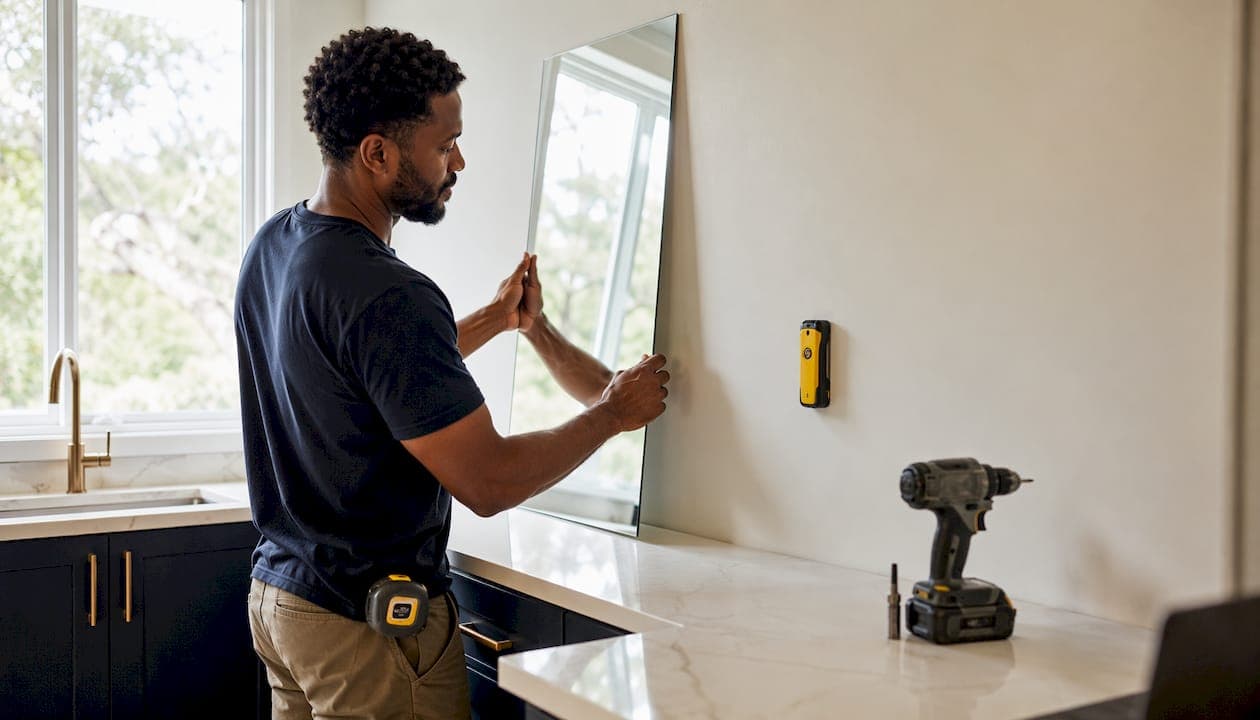
A large mirror is defined as any wall-mounted glass panel weighing over 20 lbs, and installing one safely means matching its weight to the correct hardware before a single hole is drilled. Get that pairing wrong and the consequences go beyond a cracked mirror. Falling glass shatters into shards that cause serious injury. This guide covers everything you need to know: how to weigh your mirror, read your wall type, select the right fixings, and mount the piece with confidence. Whether you are hanging a full-length statement mirror in a hallway or a bespoke framed piece above a console, the principles remain the same.
What do you need to install large mirror safely?
Preparation is the single most important phase of any heavy mirror installation. Arriving at the wall without the right tools or materials is the fastest route to a crooked hang, a damaged wall, or worse.
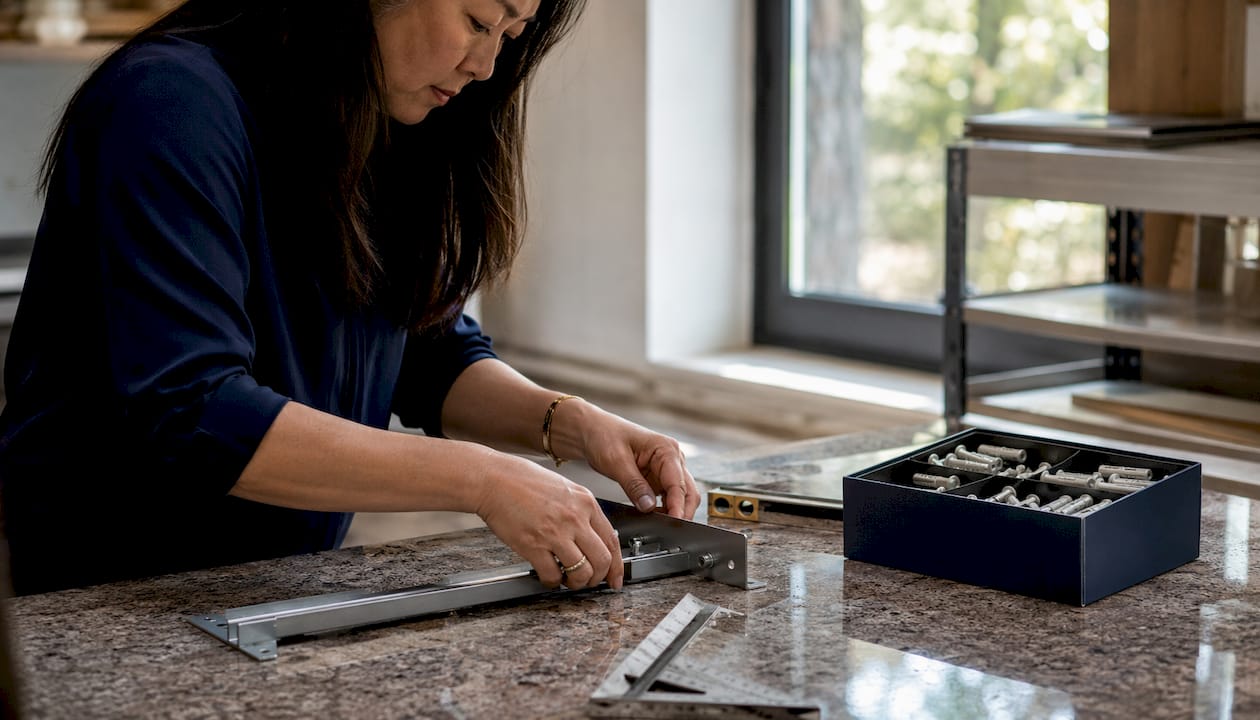
Tools checklist
Gather these before you start:
- Stud finder — locates timber or metal studs behind plasterboard
- Drill and drill bits — sized to match your chosen anchors
- Spirit level — a 600mm or longer level gives the most reliable reading
- Measuring tape — for marking anchor points accurately
- Pencil — for marking, not pen, which bleeds through paint
- Screwdriver — manual or powered, matching your screw heads
- Safety gloves and goggles — glass edges are unforgiving
Materials checklist
- Heavy-duty toggle bolts or snap toggles
- Masonry anchors (for brick or block walls)
- French cleat kit or D-ring hangers
- Mirror-safe adhesive (neutral-cure or solvent-free formula)
- Wall plugs rated for your mirror's weight
Weighing your mirror
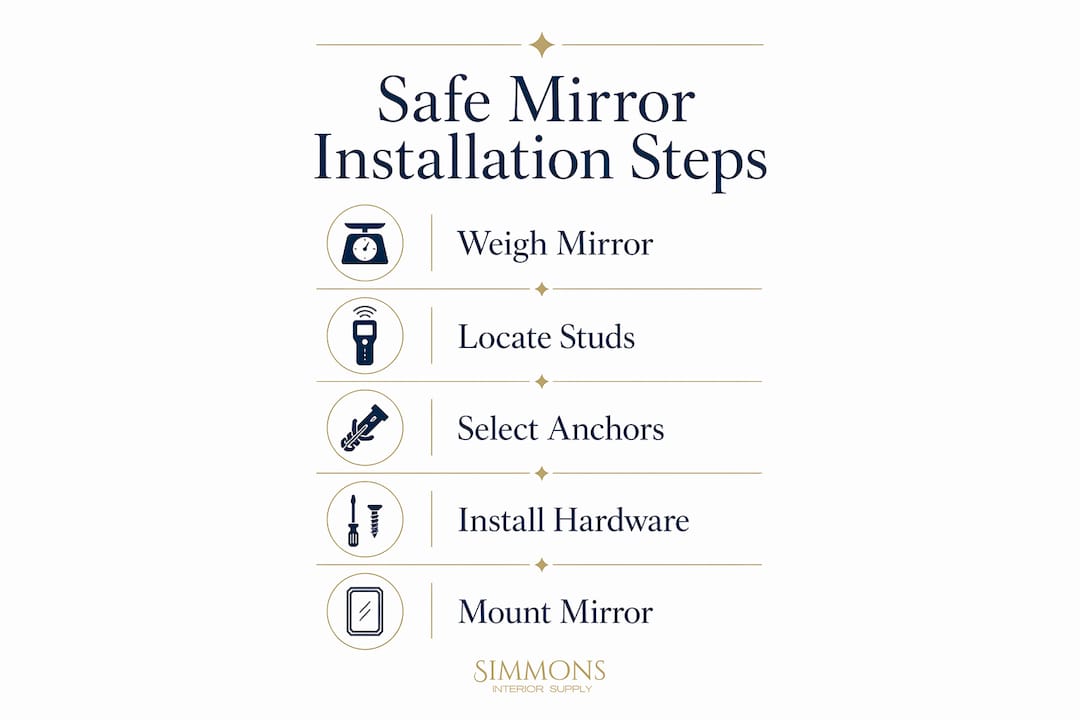
The most reliable method for assessing mirror weight at home uses a bathroom scale. Step on the scale alone and note your weight. Then hold the mirror and step back on. The difference is the mirror's weight. Standard full-length mirrors weigh between 33 and 55 lbs, so this method gives you a working figure before you select a single fixing.
Pro Tip: Always round your mirror's weight up to the nearest 5 lbs when selecting hardware. That small buffer accounts for dynamic load, which is the extra force created when the mirror shifts or vibrates.
| Wall type | Recommended fixing | Notes |
|---|---|---|
| Plasterboard over timber studs | Screw directly into stud | Strongest option; no anchor needed |
| Plasterboard (no stud) | Snap toggle or toggle bolt | Rated for hollow walls |
| Solid plaster | Masonry anchor or stud screw | Test for hollow sections first |
| Brick or block | Masonry anchor with rawl plug | Drill with hammer setting |
How do you choose the right anchors for your mirror's weight?
Wall material is the primary factor in hardware selection. Wrong anchors on drywall, plaster, or masonry cause most mirror falls. Choosing correctly from the outset removes the single biggest risk from the entire process.
Screwing into studs
Screwing directly into a timber stud is the gold standard for heavy mirror mounting. Studs are typically spaced at 400mm or 600mm centres in UK homes. A 75mm wood screw driven into a stud carries a load that no hollow-wall anchor can match. Locate your studs with a stud finder, confirm with a small pilot hole, and position your mirror to use them wherever possible.
Toggle bolts and snap toggles
Heavy mirrors over 20 lbs need toggle-style anchors or direct stud fastenings rather than standard plastic plugs. Plastic plugs are insufficient and pose a breaking hazard because falling glass shatters into dangerous shards. Toggle bolts work by expanding a metal wing behind the plasterboard, spreading the load across a wider area. Snap toggles are a refined version: they lock in place permanently, so you can remove and reattach the screw without losing the anchor inside the wall.
French cleats for heavier pieces
A French cleat is a length of timber or aluminium cut at a 45-degree angle, with one half fixed to the wall and the other to the mirror frame. A French cleat spanning two studs can support over 200 lbs, making it ideal for mirrors weighing 50 to 150 lbs. The load distributes evenly along the cleat's full length rather than concentrating at two small anchor points. French cleat hardware costs approximately £15–£25, which makes it one of the most cost-effective solutions for genuinely heavy pieces.
Understanding safe working load
Safe working load is a quarter of an anchor's rated shear load. This quadruple safety factor accounts for dynamic loads, vibration, and the natural degradation of fixings over time. If your mirror weighs 40 lbs, your combined anchor capacity should be rated at 160 lbs minimum. Always overbuild. The cost difference between a correctly rated anchor and an undersized one is negligible. The consequence of getting it wrong is not.
Pro Tip: When in doubt about your wall type, drill a small 3mm pilot hole and insert a thin wire. If the wire passes straight through with no resistance, you have a hollow cavity and need a toggle-style anchor.
Mirrors over 25 lbs must be secured with at least two anchor points spaced 12 to 24 inches apart. This distributes the load evenly and prevents the mirror from rotating or tilting over time.
Step-by-step: how to mount a big mirror securely
Follow these steps in order. Skipping any stage increases the risk of a failed mount.
-
Measure and mark your mirror position. Hold the mirror against the wall with a helper and use a pencil to mark the top centre point. Measure down to where the hanging hardware sits on the mirror's back. Mark those anchor points on the wall.
-
Check for level. Place your spirit level across the two anchor marks. A misalignment of just 6mm can cause structural strain and a visibly crooked hang. Adjust your marks until the bubble sits perfectly centred.
-
Locate studs or identify wall type. Run your stud finder across the marked area. If studs fall near your anchor points, adjust the mirror position slightly to use them. If no studs are available, confirm your wall type and select the appropriate anchor.
-
Drill pilot holes. Use a drill bit sized to match your anchor's instructions. Drill straight and at the correct depth. For masonry walls, switch to a hammer drill setting.
-
Install your anchors. For toggle bolts, fold the wings, push through the hole, and pull back until the wings expand behind the board. For masonry anchors, tap the plug flush with the wall surface before inserting the screw.
-
Test the anchors before hanging. Apply firm downward pressure to each anchor point by hand. Any movement or creaking signals a failed anchor. Replace it before proceeding.
-
Hang the mirror with assistance. Mirrors weighing above 50 lbs require a minimum of two people to ensure safety and prevent damage. One person holds the mirror steady while the other guides it onto the fixings. Never attempt a heavy mirror alone.
-
Check level and stability. Once hung, place your spirit level on the mirror's top edge. Adjust if needed. Push gently at each corner to confirm there is no movement.
Special considerations for frameless mirrors
Frameless mirrors rely on adhesive or specialist clips rather than traditional hangers. Standard construction adhesives can corrode mirror silver backing, causing permanent black stains. Use only neutral-cure or solvent-free adhesives labelled as mirror-safe. Apply adhesive in vertical strips rather than horizontal, which allows any moisture to escape downward. For frameless mirrors larger than 48 by 60 inches, at least two people are required for safe installation. You can find further guidance on hanging art without wall damage that applies equally well to frameless mirror installations.
Pro Tip: Once a mirror-safe adhesive contacts the wall, do not reposition it. Breaking the bond requires complete surface reapplication and risks damaging the mirror's silver backing permanently.
What mistakes should you avoid when hanging a heavy mirror?
Most mirror falls trace back to a small number of predictable errors. Knowing them in advance is the simplest form of prevention.
- Using plastic plugs for heavy mirrors. Plastic plugs are designed for lightweight items. They compress and fail under sustained load, particularly in older plaster walls.
- Skipping the stud finder. Guessing stud locations and missing them means your screws grip only plasterboard, which cannot hold significant weight.
- Drilling without a pilot hole. Forcing a screw without a pilot hole splits timber studs and cracks plaster, weakening the fixing point.
- Installing without help. A mirror that slips during hanging can fall onto the person holding it. Two people is the minimum for any mirror over 50 lbs.
- Ignoring signs of anchor failure. A mirror that tilts slightly over days or weeks is signalling anchor movement. Address it immediately rather than waiting for a full failure.
A mirror that falls from the wall does not simply break. It shatters into razor-edged fragments that travel several feet across a room. The risk is not just to the mirror or the wall. It is to anyone standing nearby. Treat every installation as a safety-critical task, not a decorating job.
Key takeaways
Safely mounting a large mirror requires matching its weight to correctly rated hardware, locating studs or using toggle anchors, and always working with at least one other person for mirrors over 50 lbs.
| Point | Details |
|---|---|
| Weigh your mirror first | Use bathroom scales to get an accurate weight before selecting any hardware. |
| Match anchors to wall type | Wrong fixings on drywall, plaster, or masonry cause most mirror falls. |
| Overbuild anchor capacity | Safe working load is one quarter of an anchor's rated shear load; always exceed it. |
| Use a French cleat for heavy pieces | A cleat spanning two studs supports over 200 lbs and distributes load evenly. |
| Never use mirror-safe adhesive twice | Repositioning after contact breaks the bond and risks permanent silver backing damage. |
Why I always overbuild when hanging heavy mirrors
After years of working with interior installations, the lesson that has stayed with me longest is this: the mirror you are most confident about is the one most likely to surprise you. A frameless piece that looks manageable at 35 lbs becomes a different proposition entirely when you are holding it at shoulder height against a wall you have not fully assessed.
My consistent advice is to overbuild every anchor point by a significant margin. If the mirror weighs 40 lbs, I want fixings rated for at least 160 lbs combined. That is not excessive caution. That is the correct application of the quadruple safety factor that professional installers use as standard.
The other thing I have learnt is that the wall art framing process and the mirror installation process share the same fundamental principle: the hanging system must be stronger than you think you need. A well-framed piece with properly rated hardware will outlast the wall it sits on. A mirror hung on undersized plugs will not make it through a warm summer, when walls expand and fixings loosen.
If you are ever uncertain about your wall type, your anchor choice, or the mirror's actual weight, bring in a professional. The cost of an hour's skilled labour is trivial compared to the cost of replacing a bespoke mirror and repairing a damaged wall.
— Luke
Simmonsinteriorsupply: your partner for safe mirror installations
A beautifully crafted mirror deserves a mounting solution that matches its quality. At Simmonsinteriorsupply, we understand that the hardware behind the glass is just as important as the glass itself.

Whether you are sourcing heavy-duty toggle anchors, French cleat kits, or mirror-safe adhesives, Simmonsinteriorsupply offers a curated selection of mounting supplies and installation hardware chosen for reliability and finish quality. Our team is always happy to advise on the right fixings for your specific mirror weight and wall type. For bespoke pieces and professional guidance, visit Simmonsinteriorsupply and speak with our specialists directly. We treat every installation as a craft, not a transaction.
FAQ
What is the safest way to hang a heavy mirror?
The safest method is to screw directly into wall studs using appropriately rated screws, or to use a French cleat spanning two studs for mirrors over 50 lbs. Always use at least two people for mirrors weighing above 50 lbs.
Can I use plastic wall plugs for a large mirror?
Plastic plugs are not suitable for mirrors over 20 lbs. They compress under sustained load and can fail without warning, creating a serious risk of falling glass.
How many anchor points does a large mirror need?
Mirrors over 25 lbs require at least two anchor points spaced 12 to 24 inches apart to distribute the load evenly and prevent tilting or rotation over time.
What adhesive should I use for a frameless mirror?
Use only neutral-cure or solvent-free adhesives labelled as mirror-safe. Standard construction adhesives corrode the silver backing and cause permanent black staining.
Do I need a professional to install a large mirror?
For mirrors over 50 lbs, or when wall type is uncertain, professional installation is the safest choice. A skilled installer will assess the wall, select correct fixings, and complete the job with the appropriate equipment.