

What does Martindale rub count actually measure?
The Martindale rub count is the industry-standard measure of abrasion resistance for upholstery fabrics across the UK and Europe, expressed as the number of rub cycles a fabric withstands before showing visible deterioration. Governed by ISO 12947 and its British equivalent BS EN ISO 12947, it is the test UK specifiers and contract furniture manufacturers certify against as a matter of course.
The test itself is elegantly methodical. A circular fabric sample is mounted face-down and rubbed against a worsted wool abradant in a figure-of-eight motion that moves the sample across the abradant in every direction simultaneously. This multidirectional motion is what distinguishes it from cruder linear tests. The machine pauses every 5,000 cycles for inspection under a standardised light source, and the test ends when two yarn breaks appear or the fabric surface shows a noticeable change in appearance.
Key aspects at a glance:
- Results are always reported in multiples of 5,000 cycles
- The abradant is replaced after every 50,000 cycles to prevent glazing
- Multiple samples from different areas of the same fabric are tested simultaneously
- The endpoint is two yarn breaks or appreciable surface change, including pilling or pile loss
- A result above 100,000 rubs is not considered an indicator of meaningfully increased lifespan
Why Martindale test results are not as precise as they look
Test results can vary by up to 25,000 cycles on the same fabric sample, a variability that has been recognised across the industry since 2016. That figure alone should temper any instinct to treat a rub count as an exact performance guarantee.
At very high counts, the reliability of results decreases due to testing variables; fabrics with reported differences at high rub counts may perform similarly in real use.
The honest reading of any Martindale score is that it indicates a fabric's general suitability for a given application, not a precise lifespan. Treat it as a guide, not a guarantee.
Choosing the right rub count for your UK interior project
Matching the count to the actual use is the single most useful thing you can take from any fabric data sheet. Over-specifying is a genuine problem: fabrics rated at 100,000 rubs are available in a far narrower aesthetic range than those at 25,000 rubs, and a private bedroom simply does not need contract-grade abrasion resistance.
UK and European thresholds by application:
- Under 10,000 rubs: decorative use only, cushions, throws, accent pieces with minimal friction
- 10,000–15,000 rubs: light domestic, occasional-use furniture such as a bedroom accent chair
- 15,000–25,000 rubs: general domestic, everyday living room sofas and dining chairs
- 25,000–40,000 rubs: heavy domestic and light contract, family homes with children, boutique hotel bedrooms
- 40,000 rubs or more: contract grade, hotels, restaurants, bars, offices, and public seating
For bespoke residential pieces, moderate rub counts offer a balance of durability and aesthetic qualities suitable for high-use but comfort-focused applications.
Why Martindale is the preferred test for luxury European interiors
The Wyzenbeek test, standard in North America, rubs fabric back and forth in straight lines against a cotton duck canvas abradant. Martindale's multidirectional figure-of-eight motion more faithfully replicates the complex, non-linear wear that upholstery actually experiences. Professional specifiers across the UK and Europe prefer it precisely because it reflects local furniture use patterns more closely.
There is no conversion between the two tests. Different abradants, different motions, and different pass criteria mean that 50,000 Martindale rubs and 50,000 Wyzenbeek double rubs represent entirely different levels of abrasion resistance. For any UK or European project, always specify Martindale to ISO 12947. If a supplier provides only a Wyzenbeek result, request Martindale testing before proceeding.
Fabric performance factors that rub count alone cannot tell you
Industry experts caution consistently that rub count is over-emphasised in marketing, and the warning is well-founded. Abrasion resistance is one dimension of durability, not the whole picture.
Factors that shape a fabric's real-world lifespan:
- Pilling resistance: surface fibres that ball up under friction affect appearance long before yarn breaks occur
- Seam slippage: the tendency of yarns to pull apart at seams under stress, particularly relevant in loose weaves
- Fibre composition: natural fibres often age more gracefully than synthetics but may require more careful cleaning
- UV exposure: direct sunlight degrades many fibres and dyes independently of any abrasion rating
- Cleaning requirements: a fabric rated at 40,000 rubs but requiring dry cleaning only may be impractical for a family dining chair
A fabric that scores beautifully on abrasion but pills within six months, or fades in a south-facing room, has not delivered on its promise.
How Simmonsinteriorsupply integrates durability data into bespoke commissions
At Simmonsinteriorsupply, fabric selection is never reduced to a single number. Every bespoke commission begins with a conversation about how a piece will actually live: who uses it, how often, and what the room demands aesthetically. Abrasion resistance data informs that conversation rather than concluding it.
The artisans Simmonsinteriorsupply collaborates with understand that a sculptural dining chair upholstered in a 20,000-rub linen velvet, chosen for its warmth and texture, is the right specification for a considered household. A contract-weight technical fabric on the same chair would be a different piece entirely. The bespoke process exists precisely to hold both considerations at once.
Pro Tip: When briefing a bespoke commission, share the room's orientation, the household composition, and your cleaning preferences alongside any rub count requirements. That context allows the maker to recommend fabrics that perform beautifully in practice, not just on a data sheet.
How to read Martindale rub count labels from manufacturers
When a fabric data sheet lists a rub count, check that it specifies the test method. In UK specification, an unlabelled rub count defaults to Martindale, but confirming this avoids ambiguity. The result should always be a multiple of 5,000; any other figure suggests the test was not conducted to standard intervals.
Look also for whether the result represents the average of multiple samples or the lowest individual result. Reputable suppliers test multiple samples simultaneously and report accordingly. A single-sample result from one area of the fabric is less reliable than a multi-sample average.
Certifications and standards associated with Martindale testing
The governing standard for Martindale abrasion testing is ISO 12947, adopted in the UK as BS EN ISO 12947. Pilling resistance, a related but distinct assessment, is covered by ISO 12945-2. In the United States, the corresponding abrasion standard is ASTM D4966.
For contract projects in hospitality or healthcare, fabric specifications often reference additional fire-resistance standards such as Crib 5 (BS 5852), which operates independently of the Martindale rating. A fabric can achieve 100,000 rubs and still require a separate interliner to meet fire regulations. Always verify both sets of requirements before specifying.
How to verify Martindale test authenticity and avoid misleading claims
Request the full test report, not just the headline figure. A credible test report names the accredited laboratory, the standard used, the number of samples tested, and the endpoint condition. UKAS-accredited laboratories in the UK provide independently verified results; a rub count from an unaccredited in-house test carries less weight.
Be cautious of marketing language that presents a rub count without context. A figure of 100,000 rubs on a decorative cushion fabric is not inherently more impressive than 25,000 rubs on a sofa fabric: the appropriate count depends entirely on the application. Suppliers who lead with very high numbers without discussing end use are often using the figure as a selling point rather than a specification tool.
Martindale versus other abrasion tests used in UK interiors
Martindale is by far the most common abrasion test in UK and European specification. The Wyzenbeek test appears on fabric data sheets from North American suppliers and is the standard for US contract projects, but its results cannot be compared directly to Martindale counts. For fabric durability testing in UK interiors, Wyzenbeek results should be noted for reference only.
The Taber Abrasion test, used more commonly in flooring and industrial textiles, occasionally appears in upholstery contexts but is not a recognised standard for UK contract furniture specification. When a supplier presents a Taber result alongside or instead of a Martindale result, request Martindale testing to ISO 12947 before proceeding with specification.
Putting Martindale rub count data to work in fabric selection
Use the rub count as a filter, not a ranking. Start by identifying the appropriate threshold for the application, then select from fabrics that meet it based on appearance, texture, fibre composition, and maintenance requirements. A fabric at 25,000 rubs that suits the room perfectly will serve your client better than one at 60,000 rubs that sits awkwardly within the scheme.
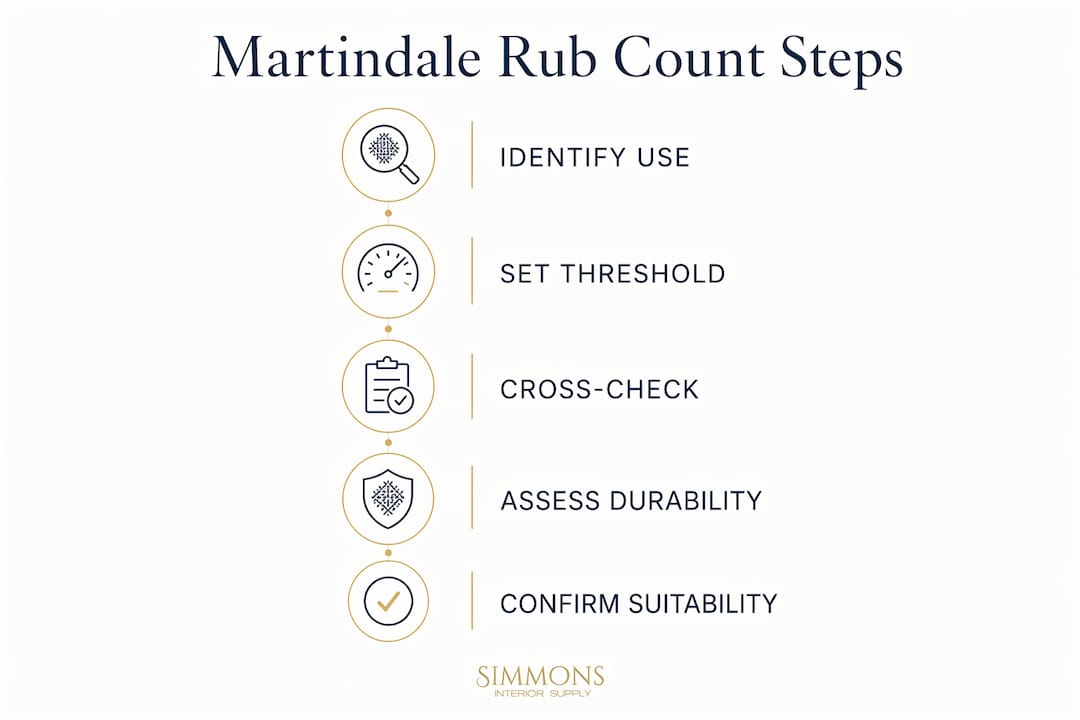
For residential furniture durability, cross-reference the rub count with pilling and seam slippage data where available. Ask the supplier whether the fabric has been tested for appearance retention after cleaning, particularly if the end use involves children or pets. The Martindale score opens the conversation; these additional details close it.
Key takeaways
The Martindale rub count is a reliable guide to fabric suitability by application, but its value lies in how you read it alongside fibre composition, pilling resistance, and cleaning requirements.
| Point | Details |
|---|---|
| Results vary by up to 25,000 cycles | Treat any rub count as a guide to application suitability, not a precise lifespan guarantee. |
| Match count to actual use | General domestic use suits 15,000–25,000 rubs; contract grade requires 40,000 rubs or more. |
| No conversion with Wyzenbeek | Martindale and Wyzenbeek results cannot be compared; always specify Martindale to ISO 12947 for UK projects. |
| Rub count is one factor only | Pilling, seam slippage, UV resistance, and cleaning requirements shape real-world durability equally. |
| Verify test authenticity | Request a full report from a UKAS-accredited laboratory, not just the headline figure from a data sheet. |