

For bespoke furniture in the UK, prioritise species that balance visual character, dimensional stability, and provenance before anything else. The shortlist that serves most commissions well: English oak (tabletops, structural frames), European walnut (sculptural statement pieces, veneers), cherry Prunus avium (cabinetry, drawer fronts), ash Fraxinus excelsior (bentwork, seating), sycamore/maple (clean-lined interiors, worktops), beech (carcasses, turned parts), birch plywood (concealed structure, painted carcasses), engineered oak veneer (wide panels, hospitality runs), and reclaimed timber (character pieces with provenance narrative).
- English oak: tabletops, structural frames, flooring-adjacent joinery
- European walnut: statement dining tables, veneered cabinet fronts
- Cherry (Prunus avium): cabinetry, bedroom furniture, drawer fronts
- Ash (Fraxinus excelsior): bentwork, chair frames, open-grain feature surfaces
- Sycamore/maple: clean-lined interiors, worktops, pale contemporary schemes
- Beech: carcass construction, turned legs, painted or clear-lacquered work
- Birch plywood: concealed structure, drawer boxes, painted carcasses
- Engineered oak veneer: wide tabletops, hospitality runs, large panel work
- Reclaimed timber: character pieces, sustainability briefs, feature walls
Pro Tip: Before any production timber is ordered, prepare a finish sample on the actual species and expose it to the room's light conditions for at least two weeks. Cherry in particular will shift colour dramatically; a client who signs off on a pale sample board and receives an amber piece six months later is a client who feels misled.
Table of Contents
- What hardwood, softwood, and engineered wood mean for your specification
- How to choose the right species for a bespoke commission
- Species guide: character, best uses, and finish notes
- How colour change and patina affect long-term design
- Exact specification items to give to your maker
- How to source responsibly in the UK
- How to test finishes and sign off before production
- Realistic lead times and cost drivers for bespoke timber furniture
- Recommended approach for specifying timber
- Key takeaways
- The case for treating timber specification as a design discipline
- Simmonsinteriorsupply: bespoke timber furniture for trade clients
- Useful sources for further reading
What hardwood, softwood, and engineered wood mean for your specification
For exposed furniture surfaces, hardwoods are the default choice; softwoods suit concealed framing or painted work; engineered panels solve the movement problem on large flat areas. The distinction matters practically, not just botanically.
Hardwoods come from deciduous trees and include oak, walnut, cherry, ash, sycamore, and beech. Softwoods come from conifers: pine, cedar, spruce. "Hardwood" does not automatically mean harder on the Janka scale; balsa is technically a hardwood. Engineered products, including MDF-core veneers and quality birch plywood, sacrifice the character of solid timber in exchange for dimensional predictability.
- Hardwoods: oak, walnut, cherry, ash, sycamore, beech — visible solid surfaces
- Softwoods: pine, cedar, spruce — concealed framing, painted secondary structure
- Engineered: birch plywood, MDF-core veneer, engineered oak — large panels, stability-critical work
How to choose the right species for a bespoke commission
Start with function, then visual character, then cost. The seven axes that materially affect every species decision are: colour and grain, Janka-related durability, dimensional stability, workability and joinery behaviour, finish compatibility, cost and UK availability, and sustainability credentials.
When axes conflict, resolve them in this order: structural and stability requirements first, then client lifestyle (pets, heavy use, humidity), then aesthetics. A beautiful walnut tabletop in a household with young children and no underfloor heating is a different specification problem than the same piece in a controlled hospitality environment.
- Colour and grain: match the visual register of the scheme; quarter-sawn cuts reduce figure for calmer interiors
- Janka durability: below ~800 lbf is soft; 800–1,200 lbf medium; above 1,200 lbf hard — choose accordingly for wear-critical surfaces
- Dimensional stability: species with high movement coefficients need wider joinery tolerances and acclimatisation time
- Workability: resinous or interlocked-grain species need different tooling and finishing sequences
- Finish compatibility: oils, lacquers, and waxes behave differently across species; test before committing
- Cost and availability: walnut rarely yields long clear lengths at FAS grade; plan yield losses into the budget
- Sustainability: FSC or PEFC certification, reclaimed options, and legal harvest evidence
Pro Tip: For any commission requiring more than one matching piece, source the entire run from a single lot or parcel. The same species varies by soil and climate; two boards from different mills can read as entirely different timbers side by side.
Species guide: character, best uses, and finish notes
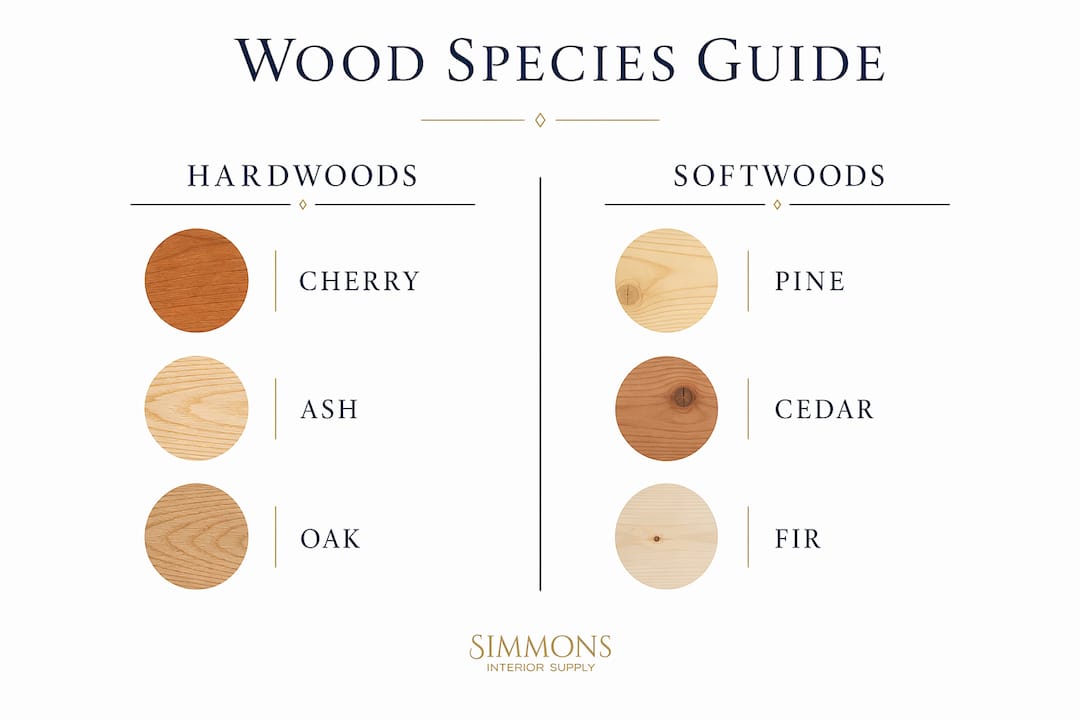
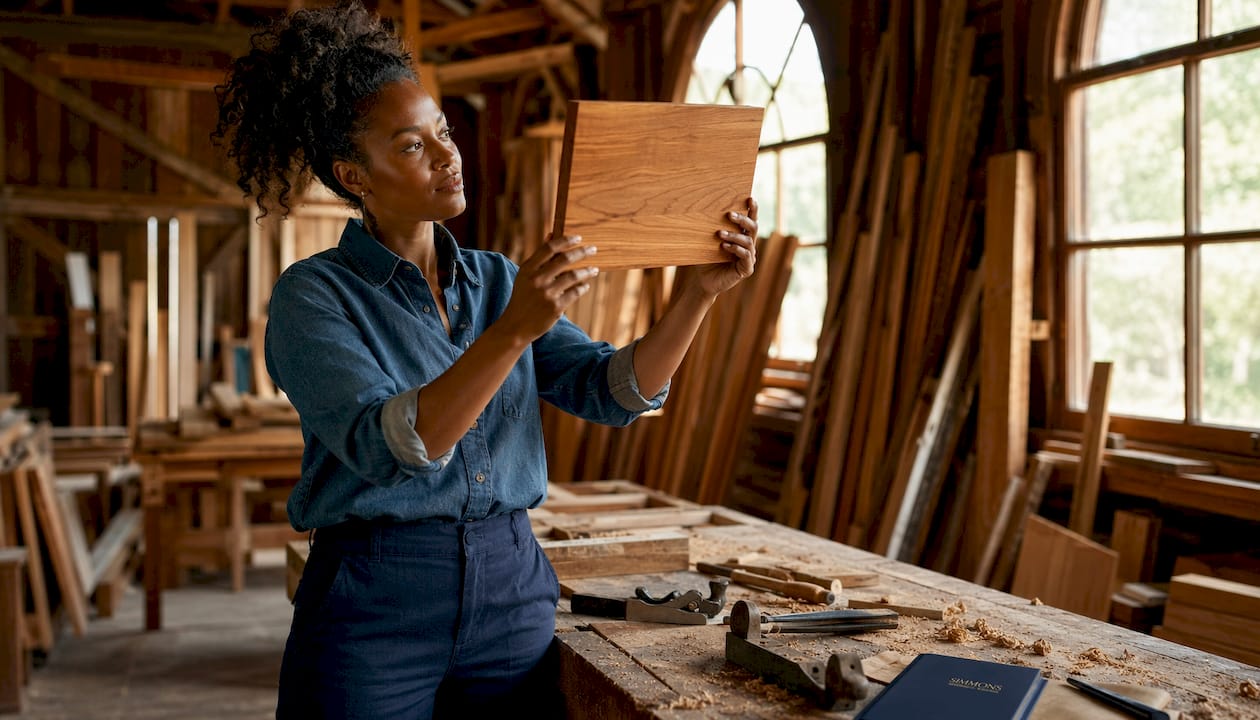
Each species below is assessed across the dimensions designers use when writing a maker's brief. Hardness figures are Janka-scale references drawn from published comparison data; photosensitivity and movement ratings from NWFA technical guidance.
| Species | Colour and grain | Hardness (Janka) | Stability | Workability | Finish compatibility | Typical uses | UK cost/availability | Sustainability |
|---|---|---|---|---|---|---|---|---|
| English oak | Warm honey-gold; pronounced ray figure on quarter-sawn | above 1,200 lbf (hard) | Moderate movement; quarter-sawn improves stability | Good; can blunt tools on silica | Oils, waxes, lacquers all excellent | Tabletops, frames, flooring-adjacent joinery | Widely available; moderate cost | FSC/PEFC certified stock available; domestic sourcing possible |
| European walnut | Rich chocolate-brown; straight to wavy grain | 800–1,200 lbf (medium) | Good stability; watch sapwood inclusion | Excellent; machines and carves cleanly | Oils and lacquers both superb | Statement tables, veneers, cabinet fronts | Premium cost; limited long clear lengths | FSC stock available; verify origin |
| Cherry (Prunus avium) | Pale pink-gold raw; deepens to amber-red with light | 800–1,200 lbf (medium) | Good; moderate movement | Very good; fine, even texture | Oils and lacquers; avoid heavy stain | Cabinetry, bedroom furniture, drawer fronts | Moderate cost; good availability | FSC certified; specify wild cherry for European provenance |
| Ash (Fraxinus excelsior) | Pale cream to light tan; bold open grain | above 1,200 lbf (hard) | Moderate; responds to humidity | Excellent for bentwork and steam bending | Oils, lacquers, stains all take well | Chair frames, bentwork, feature surfaces | Supply constraints due to ash dieback; verify stock | Specify certified stock; reclaimed ash available |
| Sycamore/maple | Creamy white; fine, even grain; subtle figure | above 1,200 lbf (hard) | Good when properly dried | Good; harder species may hold abrasive scratches | Lacquers and oils; staining can be patchy | Worktops, pale contemporary interiors, turned parts | Good availability; moderate cost | FSC certified stock available |
| Beech | Pale pinkish-tan; fine, tight grain | above 1,200 lbf (hard) | Higher movement; acclimatise carefully | Excellent; machines very cleanly | Lacquers and waxes; oils less common | Carcasses, turned legs, painted work | Widely available; economical | FSC/PEFC certified; European sourcing common |
| Birch plywood | Pale, fine face veneer; consistent panel | N/A (panel product) | Excellent; engineered stability | Easy to machine and finish | Paints and lacquers; edge-banding required | Drawer boxes, carcasses, painted structure | Widely available; cost-effective | Specify FSC-certified birch ply |
| Engineered oak veneer | Oak character face; stable substrate | N/A (engineered) | Excellent; minimal movement | Easy to work; substrate-dependent | Lacquers and oils on face veneer | Wide tabletops, hospitality runs, large panels | Competitive; wide format available | Specify FSC face veneer and substrate |
| Reclaimed timber | Variable; aged patina, character marks | Variable by species | Variable; re-dry before use | Variable; check for hidden fixings | Test finish on actual boards | Feature pieces, sustainability briefs | Premium for curated stock; variable | Requires documentation; no FSC but provenance records needed |
Cherry deserves a dedicated caution: photosensitivity means it will shift from pale pink to rich amber-red within roughly a year of light exposure. This is a natural patina, not a defect, but it must be written into the brief and signed off by the client before production.
Ash supply in the UK is under genuine pressure from ash dieback (Hymenoptera fraxinivora). Verify stock levels with your supplier before committing ash to a large run; have a secondary species agreed in advance.
Reclaimed timber introduces variability at every level: moisture content, hidden fixings, residual finishes, and dimensional inconsistency. Re-dry, re-mill, and test finish on actual boards before specifying.
How colour change and patina affect long-term design
Many premium hardwoods change colour with light exposure, and this must be specified up front in any client brief. Cherry is the most dramatic example, but walnut lightens, oak deepens, and sycamore can yellow slightly over time.
Cherry's shift from pale pink-gold to rich amber-red occurs within roughly a year of normal light exposure. The change is irreversible and accelerates under direct sunlight. Specify UV-stable lacquers to slow the process, or embrace it and document the expected end-state for the client.
- Species that darken: cherry (dramatically), oak (subtly), ash (slightly)
- Species that lighten: walnut (loses depth over decades), some mahoganies
- Mitigation options: UV-stable lacquers, controlled oiling schedules, avoiding direct sunlight placement
- Client management: expose a sample board in the actual room for 4–6 weeks before sign-off; photograph and date it
Pro Tip: Retain the signed-off sample board in the project file. If a client queries colour change two years later, a dated photograph of the approved sample is the clearest possible evidence that the shift was anticipated and agreed.
Exact specification items to give to your maker
Target moisture content is the single most critical item on any timber brief. Kiln-dried (KD) stock for interior furniture should arrive at 8–10% MC; air-dried (AD) stock needs acclimatisation time on site before machining.
- Species: common name and botanical name (e.g. Fraxinus excelsior)
- Grade: FAS, Selects, No.1 Common, or equivalent
- Stock form: solid, quarter-sawn, veneer, or plywood
- Thickness and tolerances: nominal and finished dimensions
- Target MC%: 8–10% for heated interiors; specify KD or AD
- Acclimatisation: minimum period on site before machining
- Finishing system: oil, lacquer, wax, or stain; specify sheen level
- Adhesive compatibility: confirm with maker for species with natural oils (walnut, teak)
- Edge and finish radii: specify any arrises, chamfers, or softened edges
- Joinery allowances: movement gaps for solid timber panels
- Acceptable defects: maximum knot size, sapwood percentage, permitted colour variation
- Provenance and certification: FSC/PEFC certificate number or reclaimed documentation
- Batch/lot sourcing: specify single-lot if colour consistency is critical; sawmills generally do not cut logs longer than approximately 4.8m, so discuss yield implications early
Pro Tip: Photograph every sample panel with a colour reference card, date it, and store it in the project folder alongside the supplier's kiln-dry certificate. This takes five minutes and prevents months of dispute.
How to source responsibly in the UK
Legality comes first, then chain of custody, then certification and provenance. The UK Timber Regulations (UKTR) require that timber placed on the market is legally harvested; FSC and PEFC certification provides the most straightforward evidence of this.
For most bespoke commissions, ask your supplier for: FSC or PEFC certificate number, country and region of origin, kiln-dry certificate, and sawmill or exporter name. For reclaimed timber, request documentation of the original source building and any treatment history.
- FSC/PEFC: the clearest chain-of-custody signal; request certificate numbers and verify them
- Reclaimed timber: no FSC applies, but provenance records (source building, treatment history) are required
- Single-provenance parcels: reduce colour variance and simplify traceability
- Kiln-dry certificates: confirm MC at point of despatch, not just on arrival
- Lead-time impact: certified or reclaimed stock often carries longer lead times and small-batch premiums; build this into the project programme
How to test finishes and sign off before production
The most effective single test is a full-size sample panel, finished with the chosen coating system, installed under the same lighting the final piece will experience. Nothing else replicates the in-situ result.
- Order sample boards from the same lot as the production timber
- Prepare finished samples with the exact coating system: species, grit sequence, and number of coats
- Expose samples in-situ for a realistic period (minimum two weeks; longer for photosensitive species)
- Photograph samples with a colour reference card; obtain dated client sign-off in writing
- Test critical joints for movement, adhesive compatibility, and finish behaviour on end-grain; harder species can hold abrasive scratches that only show under raking light
- Check edge profiles and arrises match the specification
Pro Tip: Retain a finished sample from the production run, not just the pre-production approval board. If the client reorders a matching piece in three years, that sample is the only reliable colour reference you have.
Realistic lead times and cost drivers for bespoke timber furniture
A straightforward bespoke cabinet carcass in birch plywood with a hardwood face typically runs 6–10 weeks from brief to delivery. A feature dining table in single-parcel English oak, quarter-sawn and hand-finished, is more realistically 14–20 weeks. Fully bespoke joinery with special finishes and certified reclaimed timber can extend to 24 weeks or beyond.
The primary cost drivers are species rarity and import costs, certification or reclaimed sourcing premiums, width and length availability (which affects yield directly), quarter-sawn or special cuts, finishing complexity, and labour-intensive joinery. Walnut rarely yields long clear lengths at FAS grade, which means more joints and higher waste allowances.
- Reduce cost: use engineered panels for large flat areas; specify solid timber only for visible faces
- Reduce lead time: accept staged deliveries; agree a secondary species if primary stock is delayed
- Compromise intelligently: surface species (visible) can differ from carcass species (concealed); beech or birch plywood carcasses with an oak or walnut face is a classic trade approach
Recommended approach for specifying timber
Prioritise function and provenance, then match the species visually; document everything in writing before a single board is ordered.
- Confirm target MC% and KD/AD status before any other specification decision
- Order and approve a finish sample from the production lot before committing to manufacture
- Specify botanical name, grade, and provenance on every brief
- Plan for colour ageing: state in the brief whether patina is expected and welcomed or to be minimised
- Check FSC/PEFC or reclaimed documentation before the order is placed
The most common mistakes are mismatching client expectations around colour change (particularly cherry), underspecifying moisture content, and assuming long clear lengths are available without checking yield with the supplier.
Key takeaways
Matching species to use-case, specifying moisture content, and sourcing from a single lot are the three decisions that most reliably prevent rework on bespoke timber commissions.
| Point | Details |
|---|---|
| Specify moisture content first | Target 8–10% MC for heated interiors; confirm KD status and acclimatisation requirement on every brief. |
| Run finish samples in-situ | Approve a full-size sample panel under the actual room lighting before production begins. |
| Source single-lot for consistency | Sourcing from one parcel or geographical lot reduces visible colour and grain variance across multiple pieces. |
| Plan for colour ageing | State in the brief whether patina is expected; cherry shifts from pale pink to amber-red within roughly a year. |
| Simmonsinteriorsupply for bespoke commissions | Simmonsinteriorsupply offers lot-matched sourcing, sample panels, and trade-account manufacture for designers specifying bespoke timber furniture. |
The case for treating timber specification as a design discipline
Most disputes on bespoke timber commissions trace back to a single omission: the designer assumed the maker understood the visual intent, and the maker assumed the designer understood the material's behaviour. Neither assumption is safe.
Timber is not a passive material. It moves with humidity, ages with light, and varies by the acre of forest it grew in. A species that reads as calm and consistent in a showroom sample can arrive on site as something altogether more characterful once it has been milled, dried, and finished at scale. The designers who navigate this most gracefully are the ones who treat specification as a design act in itself, not an administrative afterthought.
The practical implication is this: the brief you hand to a maker is as much a design document as the mood board you show the client. Botanical names, grade, MC%, provenance, finish system, and colour-ageing expectations belong in that document. When they are absent, the maker fills the gaps with their own judgement, and that judgement may be excellent or it may be entirely at odds with what the client envisioned.
Simmonsinteriorsupply: bespoke timber furniture for trade clients
Simmonsinteriorsupply works directly with interior designers and trade clients to produce handcrafted bespoke furniture from selected timber species, with lot-matched sourcing and sample-panel production built into the process from the outset.
Every commission begins with a specification conversation, not a catalogue. The studio collaborates with skilled artisans to manufacture each piece from scratch, with customisable dimensions, species, and finishing systems tailored to the project brief. Trade accounts are available for designers working on repeat or volume commissions.
- Lot-matched timber sourcing for colour and grain consistency across multiple pieces
- Sample panels prepared with the chosen species and finish system before production
- Specification support: moisture content, grade, provenance, and certification guidance
- Bespoke manufacture for residential and hospitality interiors, made to your exact dimensions
To discuss a commission or request sample panels, visit the Simmonsinteriorsupply trade page or explore the finished commission gallery to see how species and finishes read at full scale.
Useful sources for further reading
These references are the primary sources designers should consult for technical data, Janka values, and certification guidance.
- AHEC Species Guide: photosensitivity, provenance, single-lot sourcing, and sustainable American hardwood data
- NWH Hardwood Species Comparison Chart: Janka hardness, shrinkage coefficients, and specific gravity for side-by-side specification
- NWFA Wood Species Technical Publication: photosensitivity ratings, dimensional movement coefficients, and finishing guidance
- ForestSource Hardwood Species Guide: species properties, commercial uses, and engineered product guidance
- FSC UK and PEFC UK: retain copies of all supplier certificates and kiln-dry documentation in the project file; certificate numbers can be verified directly on the FSC and PEFC databases