
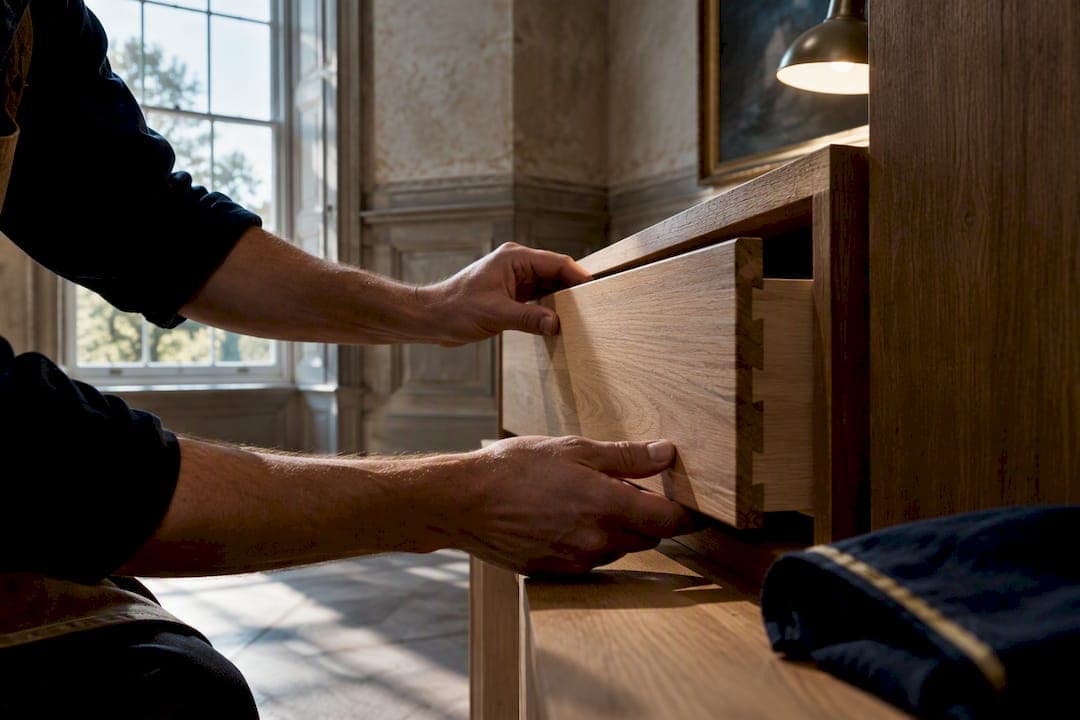
Match your listed building's furniture to its period language and proportion, favour bespoke pieces for irregular rooms, and layer antiques with contemporary furnishings so the house reads as lived in, not preserved. Start by identifying the building's era, taking a measured survey of the rooms you're furnishing, and checking its listing status with your local conservation officer if anything about the scope is unclear. For commissions that demand precise scaling or conservation-sensitive detailing, involving a specialist early can be beneficial.
TL;DR:
- Bespoke furniture is often necessary to properly fit irregular room proportions and architectural features in listed buildings.
- Using a combination of antiques, period-style new pieces, and custom commissions creates a balanced, lived-in feel rather than a museum-like atmosphere.
- Fully understanding the building’s era, scale, and historic furniture vocabulary ensures selections enhance rather than clash with period details.
- Custom pieces typically cost three to five times more than mass-market options but offer better repairability and longevity in conservation-sensitive settings.
- The commissioning process takes approximately 10 to 16 weeks, with costs largely dependent on design complexity and craftsmanship quality.
Table of Contents
- How to choose an approach: restore, match or reinterpret
- Recognise historic furniture languages and scale pieces to the room
- Materials, finishes and conservation-friendly choices
- Commissioning bespoke pieces for a listed building: process, timing and costs
- Practical planning, permissions and pre-order checklist
- Author's perspective: making listed houses liveable and loved
- Simmonsinteriorsupply: bespoke solutions for listed buildings
- Sources
- FAQ
How to choose an approach: restore, match or reinterpret
Three routes exist for furnishing a listed interior, and most successful schemes blend all three rather than committing to one.
Antiques suit owners who want documented provenance and are prepared to accommodate fragility. They work best in formal rooms with light daily use. Period-style new pieces bought through retail suit rooms needing durability on a moderate budget, though standard dimensions rarely solve the awkward proportions common in older houses. Bespoke commissions solve the problem retail can't: a sofa built to fit a bay window three centimetres out of true, or a dresser scaled to a low Georgian ceiling.
Work through this checklist before committing:
- Era suitability — does the piece's design language belong to the room's period, or clash with it?
- Fragility — can an antique tolerate daily use, or does it belong in a room seen rather than sat in?
- Functional needs — does the room need storage, seating capacity, or durability the antique market can't offer at your budget?
- Owner intent — are you building an heirloom collection, or furnishing a home for contemporary family life?
Pro Tip: Avoid what conservators privately call "museum syndrome": a house so faithfully dressed in period pieces it feels roped off. Break up formal furniture with a contemporary rug, current lighting, or a single modern artwork. The V&A's own design perspective on historic interiors makes the same point: successful schemes use traditional furniture as a foundation, then layer in the present day.
Recognise historic furniture languages and scale pieces to the room
Every English period has its own vocabulary of leg, line, and ornament, and reading it correctly is what separates a sympathetic scheme from a pastiche.
- Regency (early 19th century): classical motifs, saber legs, and cleaner, more architectural lines drawn from Greek and Roman sources.
- Chippendale and Georgian: a broader vocabulary spanning Gothic, Rococo, and Neoclassical variants, defined in Thomas Chippendale's own pattern books and still a standard reference for period detailing today.
Translating this into specification means more than picking a style name off a swatch card. A Regency drawing room typically wants lower-backed seating and slender table legs; a Georgian dining room can carry a deeper, weightier table without overwhelming the proportions. Ceiling height, window depth, and skirting profile all narrow the range further.
Museum collections offer the clearest visual grounding for this work. Knole's furniture collection houses some of the earliest surviving English state furniture, while Nostell Priory preserves a documented Chippendale "India" suite that shows how period motifs were applied to real, lived-in rooms rather than showroom pieces.
Materials, finishes and conservation-friendly choices
Solid hardwoods, traditional veneers, and brass fittings age the way historic interiors expect furniture to age: with visible grain, a patina that deepens rather than dulls, and joints that a skilled joiner can open and repair. Engineered board and permanent laminate finishes do the opposite. They can't be re-veneered, they chip rather than wear, and once damaged they're usually replaced rather than mended.
Finish matters as much as timber species:
- Wax builds a soft, repairable sheen and suits pieces that will see daily handling.
- Oil penetrates the grain and is easy to refresh locally without stripping the whole surface.
- French polish gives the high, glass-like finish associated with formal Georgian and Regency case pieces, though it marks more easily and needs a specialist to repair well.
Historic examples make useful reference points here too. Seating surviving at Kedleston Hall shows gilded walnut and mahogany frames paired with damask and chintz coverings, a combination still specified today precisely because it can be reupholstered indefinitely without touching the frame.
Bespoke furniture built from solid wood typically costs 2 to 5 times more than mass-market alternatives at the point of purchase. Because it can be repaired rather than replaced, it tends to carry a lower cost per year across a 15 to 25 year lifespan, which matters more in a listed building than almost anywhere else, since replacing a piece that no longer fits an irregular room is far harder than repairing one.
Commissioning bespoke pieces for a listed building: process, timing and costs
Bespoke earns its premium in listed buildings specifically because it solves problems retail furniture can't. Irregular proportions, sloping floors, and alcoves built for a fireplace that no longer exists all defeat standard sizing. Commissioned pieces can also specify reversible fixings, which matters if a conservation officer ever asks what happens to a fitted piece when the house changes hands.
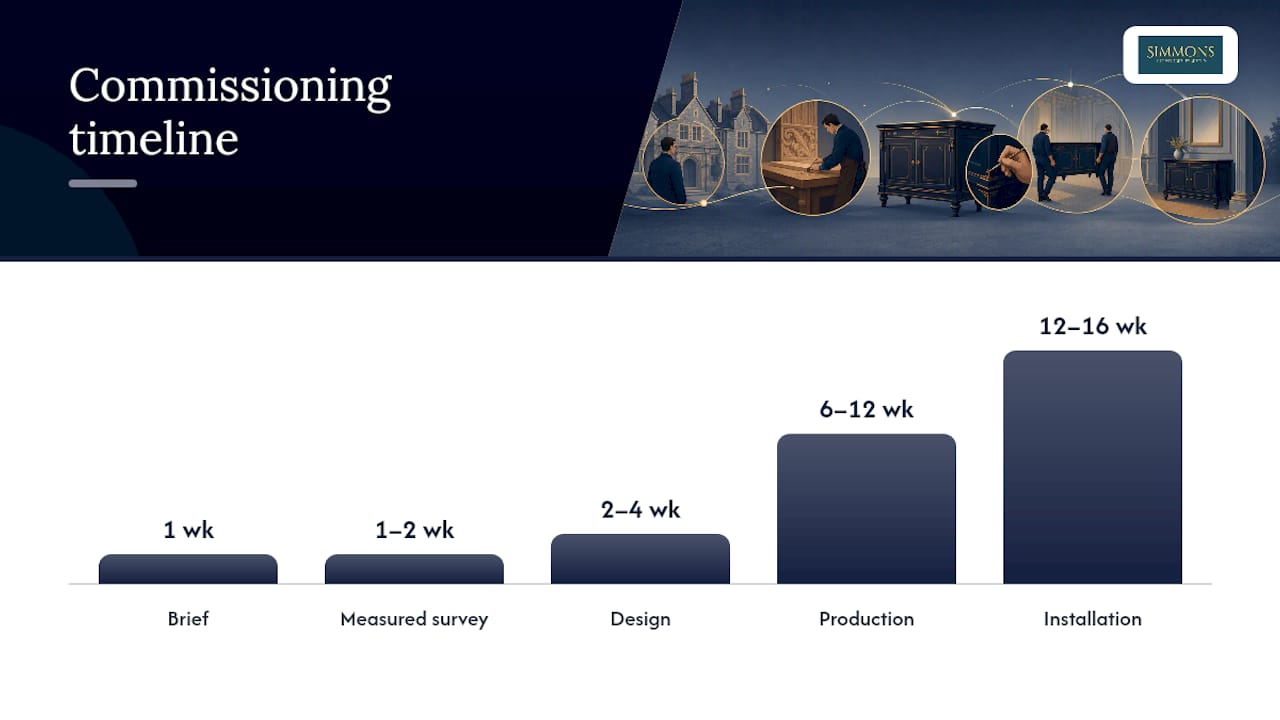
The process typically runs in six stages:
- Brief (week 1): room use, budget, and material preferences are agreed.
- Measured survey (weeks 1 to 2): exact room dimensions, including any out-of-true walls or floors, are recorded.
- Design (weeks 2 to 4): drawings and material samples are produced for approval.
- Prototype or sign-off sample (weeks 4 to 6): finish and joinery details are confirmed before full production.
- Production (weeks 6 to 12): artisans build the piece to order.
- Installation (weeks 12 to 16): delivery and fitting, timed around any access restrictions the building imposes.
That whole cycle commonly runs 10 to 16 weeks from commission to delivery, and costs generally sit at 3 to 5 times a high-end retail equivalent. For a full breakdown of how that budget translates into materials and labour, our guide to commissioning bespoke furniture walks through each stage in more detail.
Pro Tip: Book your measured survey before you fall in love with a design. Listed buildings rarely have a single true wall, and a survey done early can save weeks of rework once production has started.
Practical planning, permissions and pre-order checklist
Before ordering anything, confirm exactly what protection applies to your building. The National Heritage List for England lets any owner check listing status free of charge, and it's worth doing even if you're confident the building is listed, since the grade affects how much scrutiny alterations attract.
Consent generally applies to fixed, structural elements: built-in cupboards, panelling, fireplaces, and anything fastened permanently to walls or floors. Movable furniture, whatever its scale or grandeur, generally sits outside listed building consent because it can be removed without altering the fabric of the building. That said, this is guidance rather than a legal ruling, and a local conservation officer can confirm the position for anything borderline, particularly built-in joinery disguised as freestanding furniture.
Before placing an order, work through this:
- Complete a measured survey of every room being furnished, including floor level checks.
- Request fabric, veneer, and finish samples in the room's actual light before final sign-off.
- Agree a handling plan for any existing antiques being moved or restored alongside new pieces.
- Confirm delivery access, since narrow stairs and low doorways in older houses often dictate how a piece must be built in sections.
Author's perspective: making listed houses liveable and loved
Bespoke furniture suits listed buildings because it solves the specific problem retail can't: a room built before standard dimensions existed. Working closely with skilled artisans on scale and joinery, rather than accepting whatever a catalogue offers, tends to produce pieces that sit right in a way off the shelf furniture rarely manages.
The lifecycle argument matters more than the upfront price. A piece built to be repaired, in solid timber with joinery a craftsperson can open up decades later, tends to outlast several generations of mass-produced replacements. Furnishing a listed house well means choosing pieces that will still be worth mending in thirty years, not just ones that look right on delivery day.
— Luke
Simmonsinteriorsupply: bespoke solutions for listed buildings
Simmonsinteriorsupply is the alternative to fitting an off-the-shelf piece into a room it was never designed for. Every item in the bespoke furniture collection is handcrafted to order, with size and finish customised to fit the exact proportions of the room, whether that's a sloping Georgian floor or an alcove built for a fireplace long since bricked over.
The bespoke nest of coffee tables is a useful example of the approach: scaled and finished to the client's specification rather than pulled from a standard run, and built through close collaboration between designer and artisan from the first sketch to final installation. That collaborative process, working directly with skilled makers rather than a production line, is what Simmonsinteriorsupply offers trade clients and homeowners on complex, conservation-sensitive projects. Browse the gallery for finished commissions in period properties, or get in touch to arrange a specification meeting and request a quote for your own room.
Sources
- Historic England — National Heritage List and planning guidance
- National Trust — Knole furniture collection
- Petra Madalena — Is bespoke furniture worth it in 2026?
FAQ
Is Furniture Covered by Listed Building Consent?
Generally not. Listed building consent applies to fixed, structural elements such as panelling and built-in fireplaces, while movable furniture typically sits outside that scope. Borderline cases, particularly built-in joinery, are worth confirming with your local conservation officer.
How Do I Check if My House Is Listed?
Search the National Heritage List for England, which is free to use and shows the listing grade alongside the specific features protected. The grade affects how much scrutiny structural alterations attract, though it rarely restricts furniture choices.
Is Bespoke Furniture Worth the Extra Cost for a Listed Building?
Bespoke pieces typically cost 2 to 5 times more than mass-market alternatives upfront, but their repairability tends to lower the cost per year across a 15 to 25 year lifespan. For irregular room proportions common in older houses, it's often the only option that fits properly at all.
How Long Does a Bespoke Commission Take?
Most bespoke commissions run 10 to 16 weeks from initial brief to installation, covering measured survey, design approval, and production.
Should I Mix Antiques With Modern Furniture in a Listed House?
Yes. Relying entirely on period pieces risks what's often called museum syndrome, where a house feels preserved rather than lived in. Layering contemporary lighting, rugs, or art alongside period-appropriate furniture keeps the interior current without compromising its historic character.