
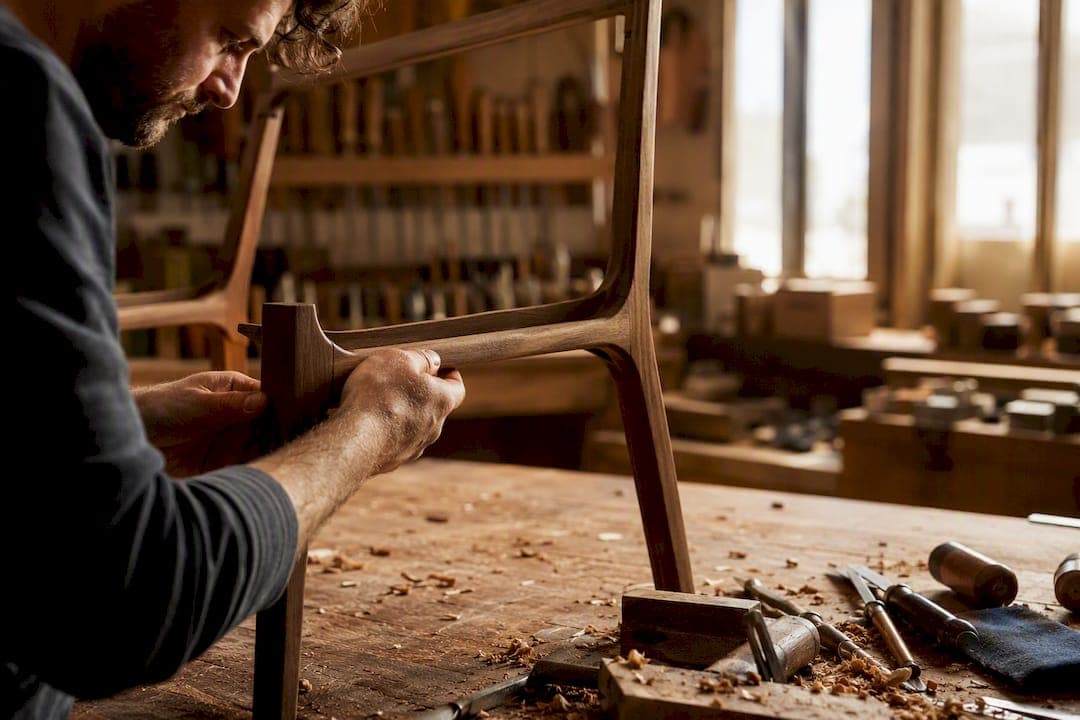
Here, value engineering furniture means something specific: bespoke, handcrafted, made-to-order furniture commissioned to fit a project's exact dimensions, brand language and operational demands, not a cost-cutting exercise that strips out craft to hit a budget line. For interior designers, architects and luxury hospitality buyers, this is the discipline of specifying pieces built to precise tolerances rather than settling for whatever the catalogue happens to offer.
Approached properly, it delivers:
- Furniture that fits the space exactly, down to the last centimetre of a reception desk or banquette run
- Materials and finishes that carry a property's brand identity through every guest touchpoint
- Ergonomics tailored to how a piece will actually be used, from covers-per-turn in a restaurant to wheelchair clearance in a lobby
- Durability specified against the real wear a commercial environment inflicts, not generic residential ratings
Key Takeaways
Bespoke furniture delivers real trade value when it is reserved for high-impact pieces, briefed precisely, and evaluated against total cost of ownership rather than unit price.
| Point | Details |
|---|---|
| Redefine the term | Treat "value engineering furniture" as bespoke, made-to-order commissioning, not cost-cutting redesign. |
| Reserve bespoke for impact | Commission bespoke for signature and public-area pieces; use catalogue stock for repeatable items. |
| Brief with precision | Specify dimensions, service integration, and performance standards like Crib 5 before approaching makers. |
| Plan for real lead times | Expect roughly eight to twenty weeks for bespoke production, and budget prototype rounds into the schedule. |
| Commission through Simmons Interior Supply | Simmons Interior Supply builds each piece from scratch with artisans, sized and finished to the brief. |
Table of Contents
- When does bespoke furniture make sense over off-the-shelf?
- How do you brief and commission a bespoke piece properly?
- What do bespoke lead times and costs actually look like?
- How do you choose a fabricator and avoid installation problems?
- What does good bespoke commissioning look like in practice?
- Why the phrase "value engineering" misleads trade buyers
- Get your bespoke project moving with Simmons Interior Supply
- Sources
When does bespoke furniture make sense over off-the-shelf?
Not every item on a specification schedule deserves bespoke treatment, and pretending otherwise wastes budget that should go on the pieces that matter. The discipline lies in knowing which items earn the investment and which can safely come from a curated catalogue.
Bespoke treatment tends to pay off on:
- Signature pieces that anchor a room's identity, such as a lobby console, a sculptural dining table, or a reception desk guests photograph.
- Public-area furniture that takes constant handling and needs to survive years of use without looking tired after eighteen months.
- Integrated elements where furniture meets architecture, joinery, banquette seating built into a fixed footprint, or storage that has to work around structural columns.
Weigh each item against four questions: how much visual impact does it carry, how often will guests physically interact with it, how hard is the operational life it will lead, and how easily can it be repaired or replaced if it fails. A hybrid procurement model works well here: commission bespoke for the handful of high-impact pieces and specify strong catalogue stock for repeatable, replaceable items like guestroom side chairs.
Pro Tip: Score every line item on your FF&E schedule against visual impact and guest interaction before you send a single enquiry. It stops budget drifting toward the wrong pieces before procurement even starts.
How do you brief and commission a bespoke piece properly?
A weak brief is where most bespoke projects lose time and money, usually because dimensions, service integration or finish tolerances get clarified after the maker has already started cutting. A strong brief front-loads every decision a fabricator needs.
Include, at minimum:
- Precise dimensions with tolerances, not approximate sizes
- Service integration requirements: power, USB, lighting runs, cable management
- Performance specifications, including fire-retardant standards such as Crib 5 for commercial upholstery
- Maintenance expectations and acceptable wear tolerances over the piece's expected lifespan
- Finish and material specifications, referenced to actual samples rather than descriptions
From there, the commissioning process should move through defined milestones rather than a single handoff:
- Concept approval, agreeing form, scale and finish direction
- Shop drawings or CAD, converting concept into buildable detail
- Prototype or mock-up, physically testing proportion, comfort and finish before committing to a production run
- Production sign-off, a formal go-ahead once every dimension and finish has been confirmed
Design-assist, bringing a fabricator into the conversation during concept development rather than after drawings are finished, is worth building into this workflow. Early fabricator engagement during design development routinely surfaces constructability issues before they become change orders, and an informal estimate at the concept stage often flags a simple dimensional tweak, adjusting a radius, standardising a panel size, that keeps the design intact while trimming cost and lead time. Catching that at week two is a different conversation to catching it at week twelve. For the CAD and shop-drawing stage specifically, a dedicated guide to custom furniture drawings sets out exactly what deliverables to request from a maker before production begins.
What do bespoke lead times and costs actually look like?
Bespoke furniture costs more upfront than catalogue stock and takes longer to arrive. Neither fact should surprise a trade buyer, but both need realistic planning rather than optimistic guesswork.
Lead times vary with complexity and factory backlog, but bespoke commissions commonly run from eight to twenty weeks once you account for prototyping and approval rounds. Material availability adds further variability, a bespoke walnut console waits on veneer supply in a way a stocked item never does.
The cost conversation matters more than the lead-time one. Comparing bespoke and off-the-shelf on unit price alone misses the point entirely. Total cost of ownership modelled over five to ten years, factoring in replacement cycles, maintenance and how the piece holds its finish under commercial use, often favours the bespoke option once a hotel or restaurant has replaced a flimsy catalogue chair for the third time in four years.
Where budget genuinely needs managing without compromising design intent, a few levers work reliably:
- Material substitution: thermally fused laminate in place of veneer on non-visible or lower-touch surfaces can meaningfully reduce material and labour cost while preserving the overall look
- Phased delivery: staggering production across a project timeline to smooth factory demand and cash flow
- Modularising details: standardising a bracket, leg profile or joint detail across several pieces so the fabricator gains efficiency without the design looking repetitive
- Ruthless scope prioritisation: spending the bespoke budget on the pieces guests touch and photograph, not the ones tucked into back-of-house
Set realistic budgets early using proper construction cost benchmarking methods rather than a rough percentage uplift on catalogue pricing. It gives procurement teams a defensible number to work from before quotes start arriving.
How do you choose a fabricator and avoid installation problems?
The maker matters as much as the material. A fabricator with genuine mock-up experience and a documented installation track record will save you from problems a beautiful portfolio photo never reveals.
Before committing, ask suppliers directly:
- What production capacity do they actually have, and where does your project sit in their current backlog?
- Have they built a full-scale prototype for a comparable piece, and can you see it?
- What does their installation history look like on comparable commercial projects?
- How do they handle spare parts and warranty claims once the piece is on site?
Quality assurance should follow fixed checkpoints: approved shop drawings before cutting starts, a physical prototype review, formal finish sign-off against agreed samples, and a confirmed delivery window that accounts for site readiness.
Pro Tip: Request a site survey before finalising dimensions, not after. A door frame or lift measurement missed at brief stage becomes an expensive redesign once a finished piece won't fit through the building.
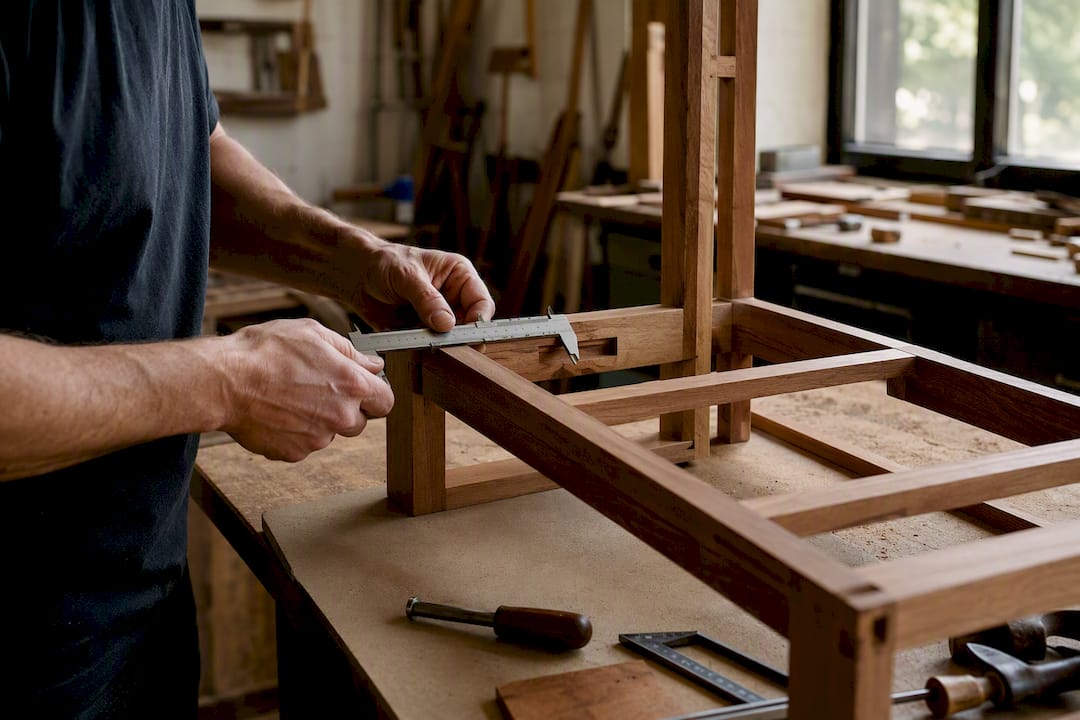
White-glove delivery, specialist handling, protective staging and trained installation, is standard practice on high-end hospitality projects for good reason: a beautifully made piece scuffed in transit undoes months of specification work. Sustainability credentials deserve the same early attention as delivery logistics. Specifying FSC-certified timber and low-VOC finishes at brief stage, rather than retrofitting them later, avoids late substitutions that can compromise compliance on projects with strict owner requirements.
What does good bespoke commissioning look like in practice?
A bespoke nest of coffee tables commissioned through Simmons Interior Supply illustrates the principle well. The brief called for a specific footprint to sit within an existing seating arrangement, sized and finished to match materials already specified elsewhere in the room, rather than a standard set adapted to fit.
That is the difference bespoke commissioning makes: dimensions built around the space rather than the space rearranged around stock furniture.
- Simmons Interior Supply works from scratch with skilled artisans on each commission, so size and finish are genuinely tailored rather than selected from limited variants
- The gallery of completed projects shows the range of finishes and forms delivered for trade clients
- White-glove delivery guidance is built into the trade workflow, protecting finish quality between workshop and final placement
Luke, who writes for the Simmons Interior Supply blog, covers this commissioning process regularly, and the pattern across projects is consistent: clarity at the brief stage saves far more time than any amount of negotiation at delivery stage.
Why the phrase "value engineering" misleads trade buyers
Most people who search "value engineering furniture" are picturing cost reduction. Strip out the veneer, simplify the joinery, shave the margin. That is a legitimate discipline in construction, but applied wholesale to trade FF&E it produces exactly the outcome designers spend careers trying to avoid: furniture that looks fine in a render and disappoints in the room.
The better version of this idea, and the one this guide has argued for, treats value as a ratio, not a reduction. You get genuine value by spending precisely on the pieces that carry visual weight and guest interaction, and spending less on the pieces that don't. That is a specification decision, not a discount.
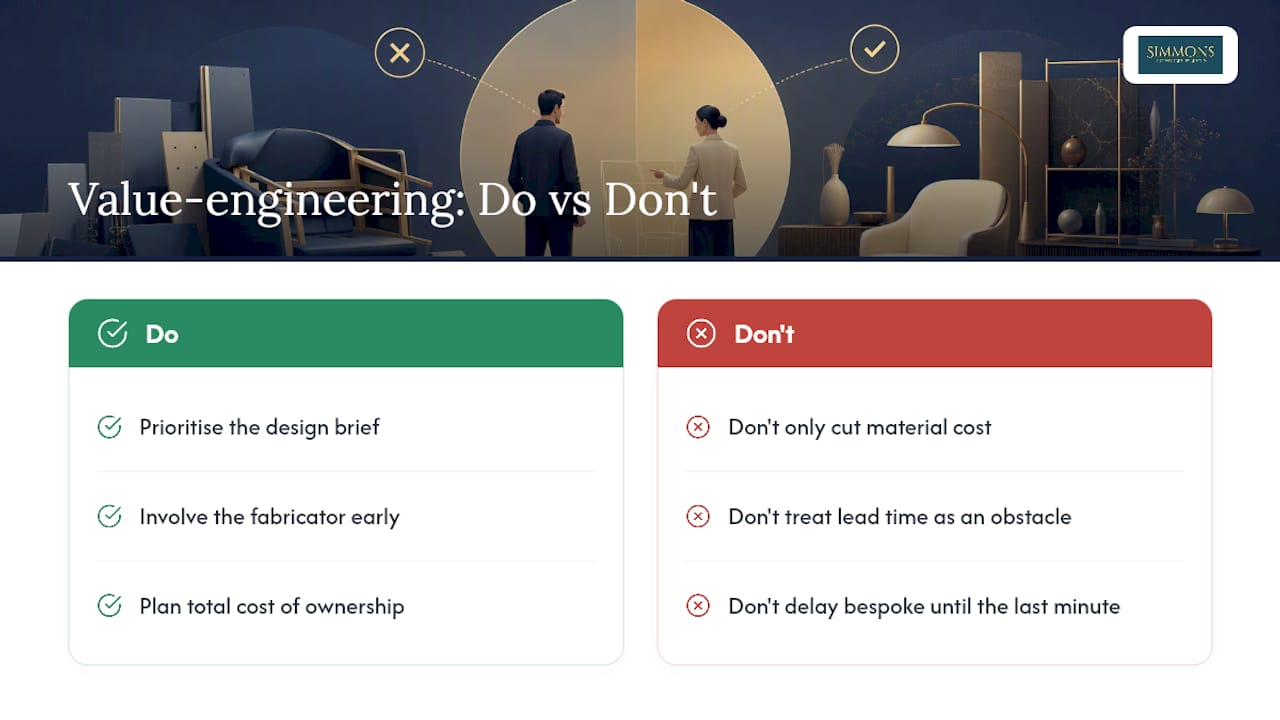
What the conventional advice gets wrong is treating lead time and cost as obstacles to negotiate down rather than variables to plan around. A hotel that books its bespoke joinery slot twelve weeks early rarely needs to compromise on finish later. One that leaves it until six weeks before opening will, and the panic decisions made under that pressure are what give bespoke furniture its unfair reputation for running over budget.
Prioritise the brief, involve your fabricator early, and treat total cost of ownership as the real scoreboard. Everything else in the process follows from getting those three things right.
— Luke
Get your bespoke project moving with Simmons Interior Supply
Simmons Interior Supply exists for exactly the commissioning process this guide describes: handcrafted furniture built from scratch, sized and finished to your specification, made by artisans rather than pulled from a warehouse run. Where a standard supplier offers you a fixed catalogue and a compromise, Simmons Interior Supply offers a piece built around your brief from the first drawing.
If you have a signature piece in mind, start with the bespoke nest of coffee tables as a working example of what custom sizing and finish selection can look like for your project. From there, request a trade quote, arrange a design-assist conversation about your dimensions and finish requirements, or ask for a prototype before committing to a full production run. Trade accounts and project enquiries begin at Simmons Interior Supply.
Sources
- Fabricator relationships for designers
- Why custom furniture elevates the guest experience in luxury hotels
- Construction cost benchmarking methods: a 2026 UK guide