

White oak for workhorse pieces; American black walnut for statement pieces. That is the verdict, and almost every room-by-room decision flows from it.
White oak has a higher Janka hardness rating on the scale compared to walnut, making it measurably more dent-resistant for high-traffic surfaces. Walnut commands a significant premium at the lumber level and typically retails notably above an equivalent oak piece. Both are premium hardwoods worth the investment; the question is simply which investment suits your room, your budget, and the life the furniture will lead.
- Dining tables for families or busy kitchens: white oak, for its hardness, water resistance, and ability to take a range of finishes without dominating the room.
- Statement consoles, bedheads, and focal coffee tables: American black walnut, for its chocolate-to-deep-brown figure and the quiet authority it brings to a considered interior.
- Flooring and large cabinetry runs: white oak again, where its tyloses and visual neutrality make it the more practical and cost-effective choice across a wide surface.
For bespoke commissions in either species, Simmonsinteriorsupply works with trade buyers and homeowners to specify grade, finish, and provenance from the outset.
Table of Contents
- How oak and walnut look, and how their tones change a room
- Durability, hardness, and the right uses for each species
- Price expectations and availability in the UK market
- How finishing techniques change oak and walnut
- Care, repairability, and how oak and walnut age
- Sourcing, legality, and sustainability for UK buyers
- Room-by-room and style guide: which wood to pick
- Trade-level tips, common mistakes, and specification advice
- Key takeaways
- Why bespoke specification changes the outcome
- Commission your oak or walnut piece with Simmonsinteriorsupply
- Useful sources and further reading
How oak and walnut look, and how their tones change a room
The colour difference between these two species is not subtle. White oak opens at a pale tan with grey undertones, a tone that reads as cool and expansive in a room with good natural light. American black walnut arrives at the opposite end of the spectrum: a rich chocolate brown, often with purple or violet undertones in freshly cut boards, that immediately anchors a space and draws the eye.
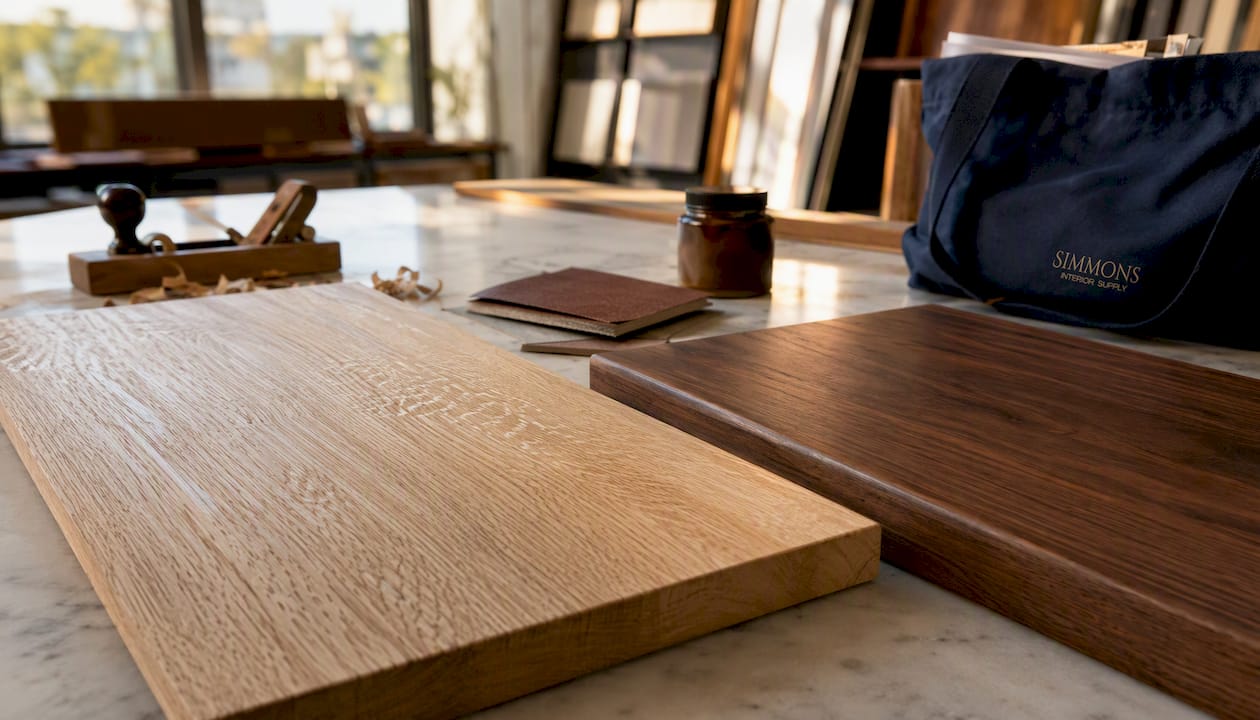
Grain character separates them further. White oak has an open, pronounced grain with the distinctive ray flake pattern visible on quartersawn boards, those silvery medullary rays that catch light and give the wood a quiet, almost textile quality. Walnut's grain tends to be straighter and finer, though figured boards can produce cathedral patterns and swirling figure that make each piece genuinely unique.
Ageing pulls them in opposite directions, which matters enormously for long-term schemes. Walnut lightens over its first 5–10 years toward a warm caramel patina, while white oak slowly darkens to an amber tone. A walnut dining table that reads as near-black on delivery will soften considerably over a decade; an oak piece will deepen and warm. Specify both with that trajectory in mind, not just the raw sample colour on the day of purchase.
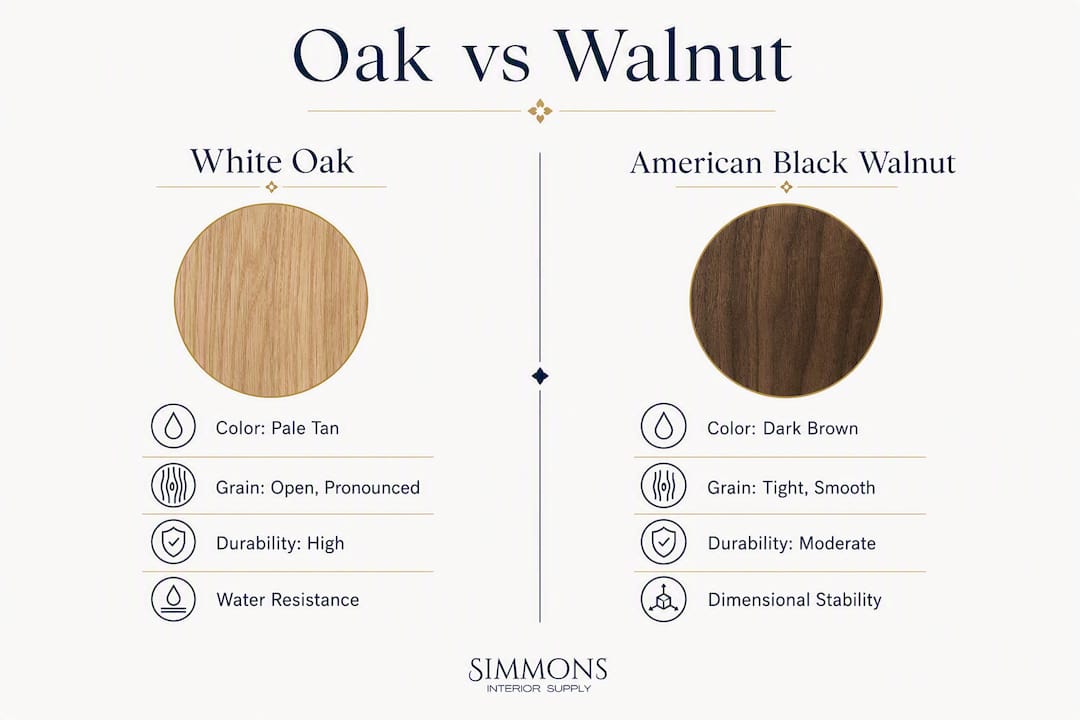
Designers working with both species in the same interior often use contrast deliberately: pale oak flooring beneath a walnut table creates a tonal dialogue that neither species could achieve alone. Placing them side by side in matching tones, however, rarely works. The grain characters are too different to read as a family, and the attempt tends to look like an accidental mismatch rather than a considered choice.
Pro Tip: When approving samples, ask your supplier to show you an aged or UV-exposed board alongside the fresh cut. Walnut's purple undertone fades quickly; what you see on delivery is not what you will live with in five years.
Durability, hardness, and the right uses for each species
What the Janka numbers mean in practice
White oak's Janka rating is higher than walnut's by a substantial margin, which translates to oak resisting chair-leg scuffs and dropped cutlery noticeably better than walnut. Walnut is still a hardwood and will outlast softwoods comfortably, but it will show wear on a heavily used tabletop faster than oak will.
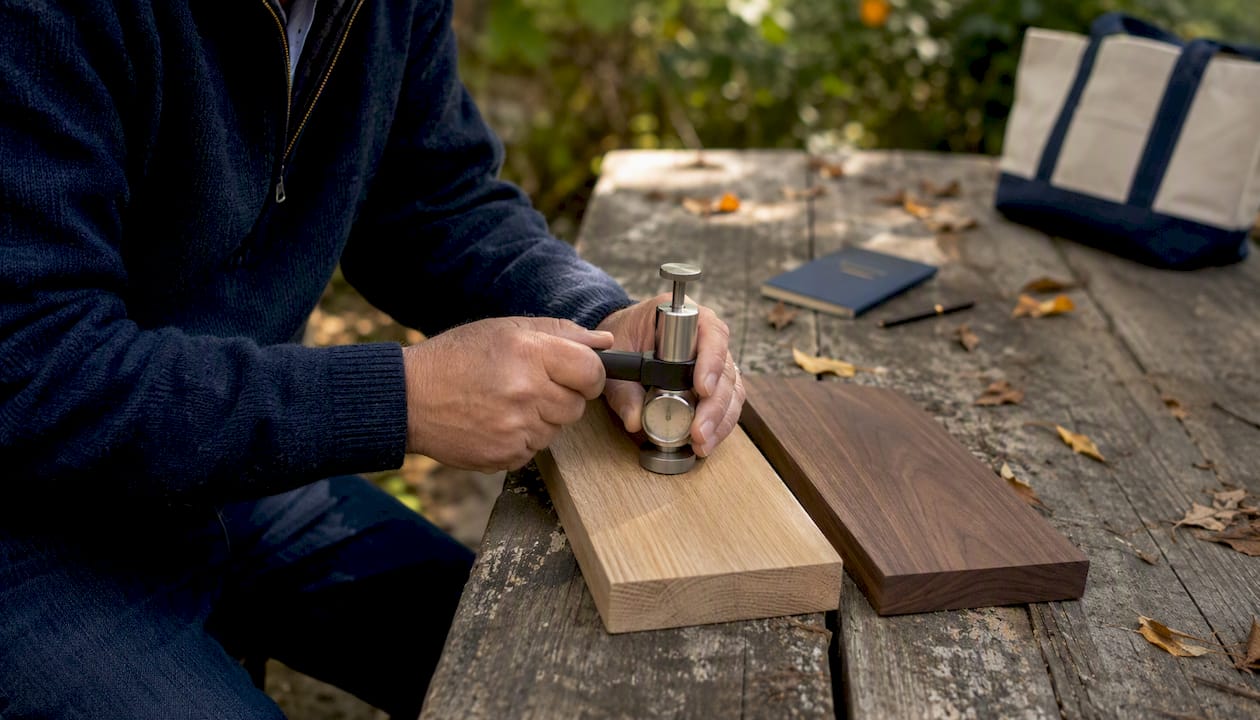
Dimensional stability is a different story. Walnut tends to shift less with seasonal humidity changes, which matters in centrally heated UK homes where winter air dries considerably. White oak's open grain also requires professional sealing to prevent liquid ingress, whereas walnut's tighter pore structure is somewhat more forgiving on that front.
White oak's natural tyloses make it more water-resistant than most hardwoods, which is why it dominates kitchen cabinetry and flooring specifications. For bespoke joinery and furniture, timber grade matters as much as species: FAS (First and Seconds) grade reduces unattractive knots and sapwood streaks and is the standard to specify for exposed tabletops and show faces.
Comparison: species attributes and best uses
| Attribute | White oak | American black walnut |
|---|---|---|
| Colour and grain | Pale tan/grey-tan, open grain, ray flake | Chocolate to deep brown, straight to figured grain |
| Janka hardness | 1,360 lbf | 1,010 lbf |
| Water resistance | High (natural tyloses) | Moderate |
| Dimensional stability | Good | Very good in heated interiors |
| Best furniture uses | Dining tables, kitchen cabinetry, large surfaces | Statement consoles, bedheads, focal coffee tables |
| Best for veneers | Yes, quartersawn for ray flake | Yes, bookmatched for figure |
| Finishability | Takes stains, fuming, oils well | Best with clear or lightly pigmented oils |
| Sustainability | Widely available, fast-growing | Slower-growing, higher cost |
Price expectations and availability in the UK market
Walnut's premium is real and consistent. At the lumber level, American black walnut typically commands 30–60% more than white oak, and that gap carries through to finished furniture, where equivalent walnut pieces retail roughly 25–50% above their oak counterparts. UK timber merchants, including Duffield Timber, reflect this in their per-square-metre pricing for both flooring and furniture-grade boards.
Several factors concentrate that cost:
- Grade: FAS-grade walnut costs more per board foot than lower grades, but the reduction in waste and the quality of visible faces justifies the premium for bespoke tabletops and joinery.
- Thickness: Thicker slabs for live-edge or solid-top tables amplify the price difference between species considerably.
- Solid versus veneer: Walnut veneer over a stable substrate (MDF or birch ply) can deliver the visual character of solid walnut at a fraction of the cost, a strategy worth discussing with your maker.
- Lead times: FAS-grade walnut in wider boards can carry longer lead times from UK merchants than white oak, which is more abundantly stocked. Build four to eight weeks into your procurement timeline for bespoke commissions.
Pro Tip: Budget walnut to retail at roughly 25–50% above an equivalent oak piece, all else equal. If the quote comes in lower, ask about the grade and provenance before signing off.
How finishing techniques change oak and walnut
The species you choose is the starting point; the finish is where the final tone is achieved. Fuming, oil selection, and the choice between water- and oil-based topcoats all significantly alter perceived colour and sheen, and a skilled finisher can move oak surprisingly close to walnut tones, though the grain character will always read differently.
For oak:
- Fuming (exposing the wood to ammonia vapour) reacts with oak's natural tannins to produce a deep, warm grey-brown that can approach walnut territory without pigment.
- Hard-wax oils (such as Rubio Monocoat or Osmo Polyx) preserve the natural tone while offering good protection and easy maintenance.
- Water-based topcoats keep the colour pale and cool; oil-based topcoats add warmth and amber saturation.
For walnut:
- Clear oils or a light hard-wax oil are almost always the right choice, allowing the natural figure and chocolate tones to speak without interference.
- Pigmented stains on walnut are rarely necessary and can flatten the figure that makes the species worth specifying in the first place.
Pro Tip: Never approve a finish from a small offcut. The grain orientation, porosity, and colour response on a 5cm sample will differ from a full board. Request a full-scale panel in the actual grade and board width you have specified, and view it in the room's own lighting before signing off.
A practical designer workflow for tonal consistency across a multi-piece commission:
- Agree the species and grade first, then select the finish system.
- Approve a full-scale panel in the intended finish before any cutting begins.
- Specify grain orientation (quartersawn, flatsawn, or rift-sawn) for each piece to control how the ray flake or figure reads.
- Stage the finish across all pieces in the same batch where possible, as oil lots and application conditions affect final tone.
Care, repairability, and how oak and walnut age
Both species reward straightforward maintenance. The differences lie in how each responds to damage and how the patina develops over years of use.
Routine care:
- Dust with a soft, dry cloth; avoid silicone-based sprays, which build up and dull the surface.
- Wipe spills immediately, particularly on oak, where the open grain can draw liquid into the wood if the surface seal is compromised.
- Re-oil oiled surfaces annually or when the wood begins to look dry; hard-wax oil finishes can be spot-repaired without stripping the whole piece.
- Keep furniture away from direct radiators and south-facing windows where possible, as rapid humidity swings cause more movement than seasonal change alone.
Repairability by finish type:
- Oiled surfaces (both species): light scratches can be sanded back with 240-grit paper and re-oiled in the affected area. The repair blends naturally as the oil cures.
- Lacquered or film-finish surfaces: scratches and chips require professional attention; the whole panel typically needs stripping and recoating for a seamless result.
- Dents in oak: the open grain responds well to steam-raising (a damp cloth and a warm iron lifts compression dents before sanding). Walnut's tighter grain responds similarly but requires more care not to raise the grain unevenly.
Over a 5–10 year span, walnut's lightening patina and oak's gradual amber deepening both produce beautiful results. The practical implication: if your upholstery or flooring is a fixed tone, consider where each species will travel over a decade, not just where it starts.
Sourcing, legality, and sustainability for UK buyers
White oak is a fast-growing, widely available species with strong FSC-certified supply chains in Europe and North America. American black walnut grows more slowly and yields less clear timber per tree, which contributes directly to its higher price and longer lead times. Neither species is subject to CITES restrictions in its standard furniture-grade form, but buyers sourcing exotic or figured walnut varieties (Claro walnut, for instance) should confirm provenance and legality with their supplier.
For UK buyers, the practical procurement checklist:
- Request FSC Chain of Custody certification or an equivalent independent mill certificate. Our guide to FSC-certified furniture explains what to look for and why it matters for trade specifications.
- Ask for the mill grade (FAS, Select, or No.1 Common) and confirm it in writing before ordering.
- Request kiln-drying data: furniture-grade timber should be dried to 6–8% moisture content for UK interior conditions.
- Confirm provenance: American black walnut from managed North American forests is the standard; ask for the country and region of origin.
- For veneer, ask whether the face veneer and the substrate carry separate certification.
The Forestry Commission publishes guidance on legal timber procurement under the UK Timber Regulation (UKTR), which requires importers to exercise due diligence on the legality of timber placed on the UK market. For most FAS-grade American black walnut from established merchants, this is straightforward, but it is worth confirming with your supplier that their due-diligence records are available on request.
Room-by-room and style guide: which wood to pick
Room matrix
- Kitchen cabinetry and worktops: white oak, for its water resistance, hardness, and ability to handle daily contact without showing wear quickly.
- Dining room table: white oak for family use; walnut for a more formal or lower-traffic dining room where the visual drama justifies the softer surface. See our dining table size guide for specification dimensions.
- Living room: walnut for a statement coffee table or console; oak for a media unit or shelving where a lighter, more neutral tone suits the room.
- Bedroom: walnut bedheads and side tables read as warm and enveloping; oak works well where the room is darker or where a Scandi-influenced palette calls for lighter tones.
- Home office: white oak for desktops, where hardness and a neutral tone reduce visual fatigue over long working days.
- Flooring: white oak is the more practical choice for whole-house flooring, particularly in homes with pets or children. Walnut flooring is beautiful but will show wear and scratching more readily.
Style matrix
- Scandi and Japandi: white oak, almost always. Its cool grey-tan and open grain are the visual foundation of both aesthetics.
- Mid-century modern: walnut is the quintessential choice, echoing the warm, figured tones of the period's most celebrated pieces.
- Traditional and country: European oak, with its pronounced grain and warm amber patina, suits panelled rooms and period properties.
- Contemporary and minimal: either species works; the finish system matters more than the species in a monochromatic or tonal scheme.
Buying red flags: walnut for whole-house flooring in a family home with dogs is a specification that tends to disappoint. The species is simply not hard enough to resist claw marks and heavy foot traffic without showing its age prematurely. Similarly, specifying oak for a single statement piece in a room full of warm, dark tones can read as an afterthought rather than a considered contrast.
Commissioning checklist for bespoke pieces:
- Confirm dimensions and tolerances in writing before manufacture begins.
- Specify grade (FAS for show faces) and board width where relevant.
- Approve a full-scale finish sample in the room's own lighting.
- Agree lead time and delivery conditions (humidity-controlled transport for solid tops).
Trade-level tips, common mistakes, and specification advice
The single most common mistake buyers make is conflating red oak with white oak. Specifying white oak explicitly avoids the pink undertone common in cheaper red oak and yields a more neutral, lasting base for finishes. Many furniture makers will supply whichever oak is available unless you specify otherwise; always name the species in full.
Veneer versus solid is a decision worth making deliberately rather than by default. Walnut's figure and tone are hard to mimic, and bookmatched walnut veneer on a stable substrate delivers the visual drama of solid walnut at a materially lower cost. For a guide to making that call, our piece on veneer versus solid wood covers the trade considerations in detail.
Demanding FAS grade for tabletops and bookmatched veneers for show faces is a trade-level control that materially improves finished appearance, despite increasing timber cost by 20–30%. On a bespoke dining table, that uplift is almost always worth it.
Pro Tip: When asking a maker to stain oak to 'match walnut', always test on the actual board grade and width you have specified. A fumed or stained oak will approach walnut's tone, but the open grain will read differently under raking light. Approve the result in situ before committing to a full commission.
A practical trade workflow:
- Request FAS grade for all visible faces; accept Select or No.1 Common only for concealed carcass work.
- Approve full-scale mockups before cutting begins.
- Specify the finish system (product name, number of coats, sheen level) in the contract.
- Include long-term maintenance responsibilities in the handover documentation so the client knows how to care for the piece.
Key takeaways
White oak suits high-use, lighter-toned, and large-surface applications; American black walnut is the species for sculptural, focal pieces where colour and figure take precedence over raw hardness.
| Point | Details |
|---|---|
| Hardness and use | White oak (1,360 lbf Janka) outperforms walnut (1,010 lbf) on high-traffic surfaces such as dining tables and kitchen cabinetry. |
| Price premium | Walnut lumber runs 30–60% above white oak; finished walnut furniture typically retails 25–50% higher than equivalent oak pieces. |
| Ageing direction | Walnut lightens over 5–10 years; oak darkens. Specify with the patina trajectory in mind, not just the raw sample colour. |
| Finish and grade | Always specify FAS grade for show faces and approve a full-scale finish sample in the room's own lighting before committing. |
| Simmonsinteriorsupply | Offers bespoke commissions in oak and walnut with grade, finish, and provenance specified from the outset, for trade buyers and homeowners alike. |
Why bespoke specification changes the outcome
The conventional wisdom in furniture buying is that species choice is the primary decision. Having worked through the evidence, the more defensible position is that grade and finish control matter at least as much. A beautifully finished FAS-grade white oak table will outlast and outperform a poorly specified walnut piece every time, and the reverse is equally true.
What buyers consistently underestimate is the patina question. Many people choose walnut for its dark, dramatic tone on the day of delivery, then find themselves living with a piece that has lightened considerably by year seven. That is not a flaw; it is the wood's natural character. But it is a surprise that a good specification conversation would have anticipated.
The case for commissioning bespoke rather than buying from stock is precisely this: you can specify the grade, the finish system, the board width, and the expected patina direction, and you can approve all of it at full scale before a single joint is cut. That level of control is not available from a warehouse floor, and it is the difference between a piece that ages with your interior and one that gradually works against it.
Commission your oak or walnut piece with Simmonsinteriorsupply
The sharpest advantage Simmonsinteriorsupply offers over stock furniture is specification control from the first conversation: grade, finish system, board width, and provenance agreed in writing before manufacture begins. Whether you are commissioning a walnut statement console or a white oak dining table built to survive a decade of family life, every piece is made to order by skilled artisans, sized to your exact dimensions, and finished to an approved sample.
Trade buyers and interior designers can request FAS-grade quotes, finish samples, and full-scale mockups as part of the standard commissioning process. Homeowners are equally welcome. Browse the bespoke nest of coffee tables as a starting point for what is possible in both species, or visit the gallery to see finished commissions across a range of finishes and timbers. To begin a conversation about your project, get in touch with Simmonsinteriorsupply directly.
Useful sources and further reading
The figures and recommendations throughout this article draw on the following authoritative sources. Trade buyers are encouraged to request mill certificates, FAS grade paperwork, and kiln-drying data directly from their timber merchant alongside any of the guidance below.
| Source | What it covers |
|---|---|
| Walnut vs Oak: A Furniture Buyer's Guide — Walnutry | Janka hardness ratings, price premiums, ageing direction, and species identification guidance |
| Oak vs Walnut: Appearance, Properties & Costs — Duffield Timber | UK price examples, finishing techniques, tyloses and water resistance, veneer applications |
| Best Wood for Furniture — Pro/Trade Guide — ToolsRadar | FAS grade guidance, trade specification workflow, and timber grade definitions |
| FSC-certified furniture: a guide for UK trade professionals — Simmonsinteriorsupply | Chain-of-custody certification, what to request from suppliers, and why provenance matters |
| FSC-certified wood meaning: your complete UK guide — Simmonsinteriorsupply | Deeper reading on FSC certification and UK Timber Regulation due diligence |
| Forestry Commission / Forest Research | UK Timber Regulation (UKTR) guidance and legal procurement requirements |
When procuring timber for bespoke commissions, always request the mill grade certificate, country of origin, and kiln-drying data in writing. For visual reference and commission enquiries, the Simmonsinteriorsupply gallery shows finished work across both species.