
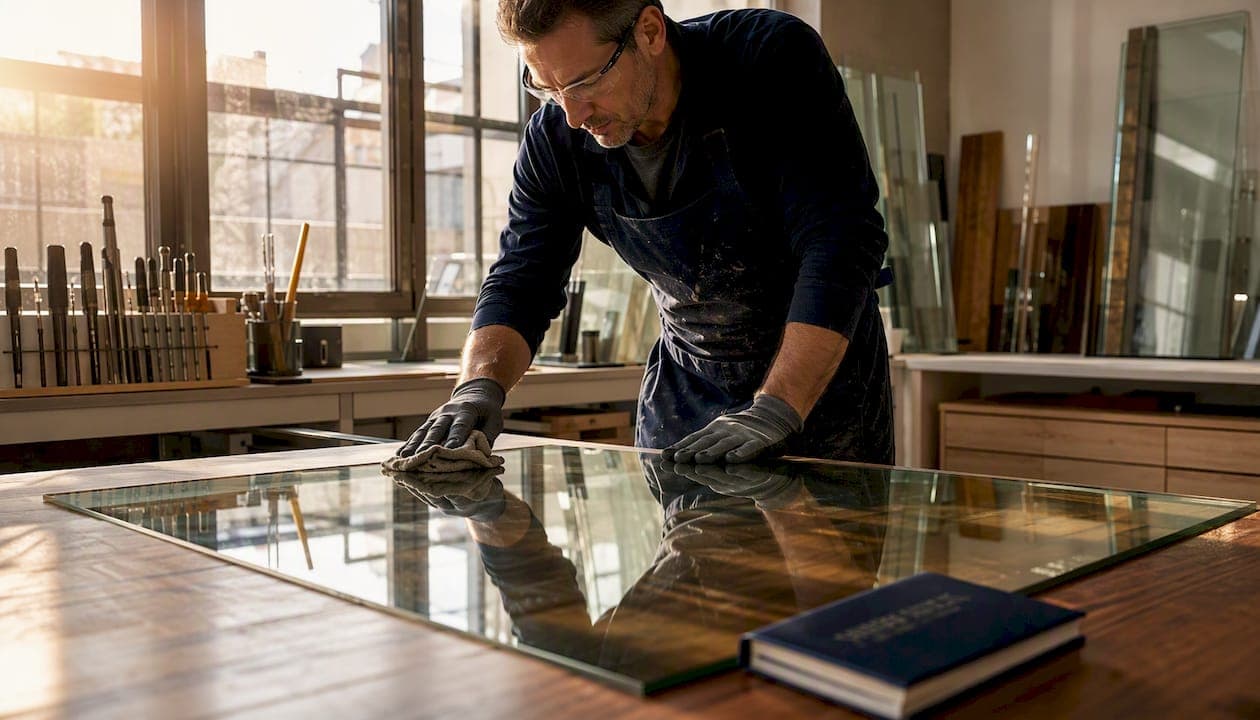
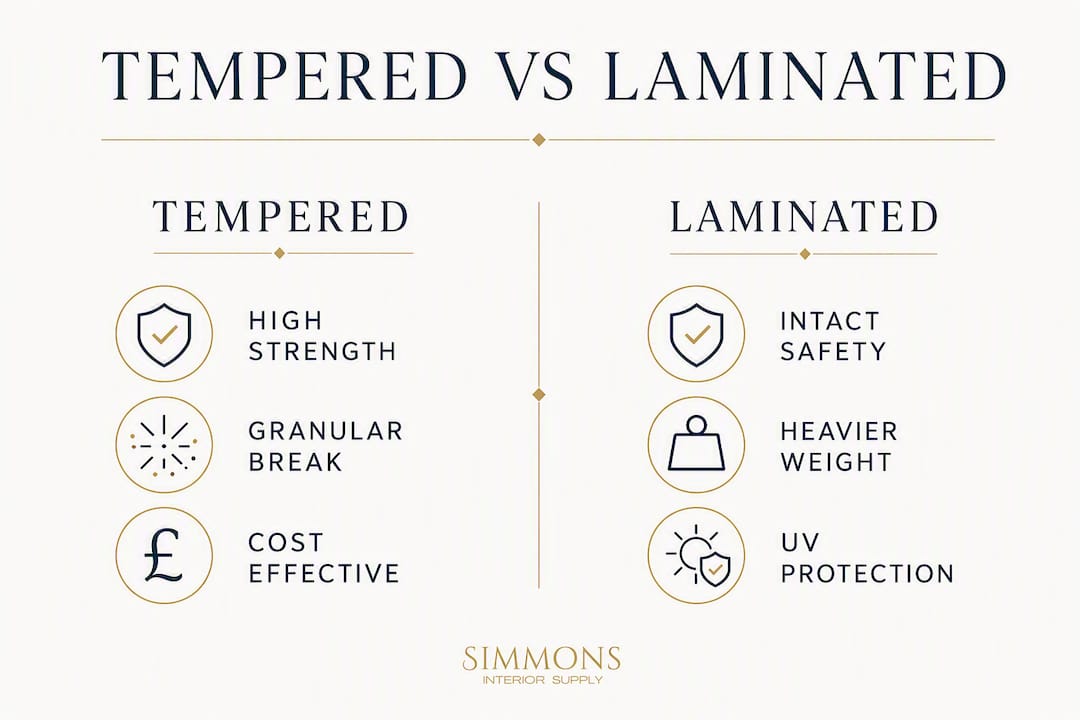
Tempered (toughened) glass gains its strength through a thermal process that produces surface compressive stress, causing it to shatter into small, blunt granules on impact. Laminated glass bonds two or more plies with an interlayer, so fragments adhere and the pane holds its position even when cracked. For most UK projects: favour tempered for shower screens, table tops, and everyday interior glazing where economy and impact resistance lead the brief; favour laminated wherever post-breakage containment, acoustic control, UV filtering, or a physical barrier function is required. UK building regulations under Approved Document K, alongside standards BS EN 12150, BS EN 14449, and BS EN 12600, govern which glass type is mandatory in critical locations, and in several of those locations laminated glass is the expected specification.
- Tempered glass: governed by BS EN 12150; breaks into granular fragments; no residual barrier after failure.
- Laminated glass: governed by BS EN 14449; retains fragments and maintains a physical barrier; often specified for balustrades, overhead glazing, and shopfronts.
- Both types are classified under the impact-performance standard BS EN 12600.
Table of Contents
- How is tempered glass made, and what does that mean in practice?
- What is laminated glass, and how do interlayer choices shape its performance?
- How do the two glass types behave when they break?
- Tempered vs laminated glass: at-a-glance comparison
- What do UK standards and building regulations require?
- Which glass type suits each application?
- Costs, lead times, and fabrication realities in the UK
- How can you tell whether a piece of glass is tempered or laminated?
- Toughened laminated glass: the hybrid that does both
- Glass in bespoke furniture: Simmonsinteriorsupply's approach
- Key takeaways
- The design trade-off that most specifications get wrong
- Bespoke glass-fitted furniture, crafted to your specification
- Key standards and further reading
How is tempered glass made, and what does that mean in practice?
Thermal toughening begins with ordinary float glass, which is heated to around 620°C and then rapidly cooled with jets of air. That sudden quench locks the outer surfaces into compression while the core remains in tension, producing a pane that resists bending and impact far better than untreated glass of the same thickness. When it does fail, it disintegrates into many small, blunt fragments rather than the long, knife-edged shards associated with annealed glass, which meaningfully reduces laceration risk.
The practical consequences for designers are significant. Tempered glass is the standard specification for:
- Shower screens and wet-room enclosures where impact resistance and hygiene are the priority
- Frameless table tops on coffee tables, consoles, and dining surfaces
- Internal doors and sidelights in domestic and hospitality settings
- Low-level glazing in some domestic contexts where a barrier function is not required
One fabrication constraint shapes every tempered specification: tempering is a terminal process. Once the glass has been toughened, it cannot be cut, drilled, or edge-worked without shattering. Every hole, notch, and polished edge must be completed before the pane enters the furnace.
Pro Tip: Specify all edgework, hole centres, and fixing details on production drawings before the glass goes to toughening. A single overlooked fixing hole means a new pane, not a remedial drill.
What is laminated glass, and how do interlayer choices shape its performance?
Laminated glass is built from two or more glass plies bonded under heat and pressure with a continuous interlayer. The three most common interlayer materials are PVB (polyvinyl butyral), EVA (ethylene-vinyl acetate), and ionoplast (often referred to by the trade name SGP). Each brings a different performance profile.
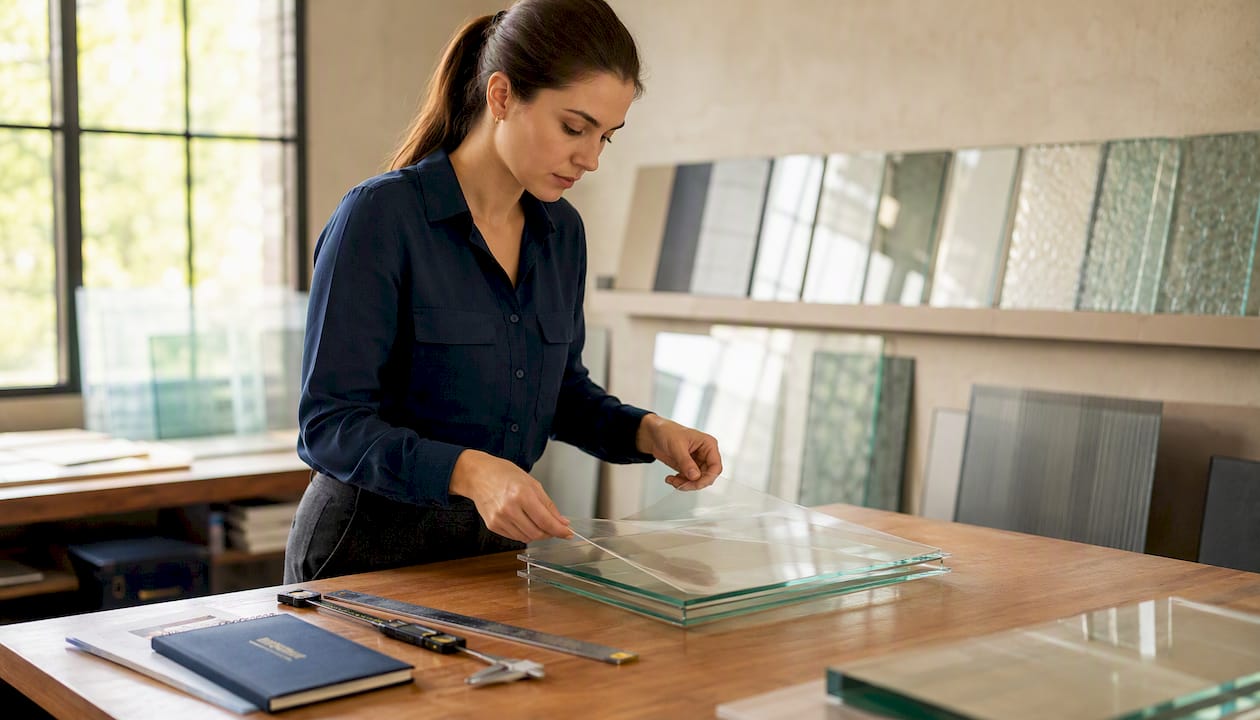
PVB is the workhorse: widely available, cost-effective, and well-proven for acoustic attenuation and UV filtering. EVA is favoured for decorative laminates and curved applications. Ionoplast interlayers are stiffer, stronger, and allow thinner overall make-ups for equivalent structural performance, which matters considerably in bespoke furniture where visual slimness is part of the brief.
The interlayer holds fragments in place after breakage, so the pane typically remains in its frame rather than falling away. Depending on interlayer specification, laminated glass can reduce noise by up to 50% and block up to 99% of UV rays. Those properties make it a compelling specification driver in luxury residential and hospitality interiors where acoustic comfort and artwork protection matter as much as structural safety.
Applications that commonly favour laminated glass include:
- Balustrades and guarding where a physical barrier must be maintained after impact
- Overhead glazing and rooflights where falling fragments would be dangerous
- Shopfronts and entrance screens requiring forced-entry resistance
- Acoustic partitions in open-plan offices, hotels, and residential schemes
- UV-sensitive environments such as galleries, wine rooms, and art-filled residences
The trade-offs are real: laminated units are heavier than single-ply tempered glass, typically cost more, and are usually made to order with longer fabrication lead times.
How do the two glass types behave when they break?
The difference in breakage behaviour is where the tempered vs laminated glass decision becomes most consequential. Tempered glass, when it fails, releases all its stored energy at once. The pane disintegrates rapidly into granular fragments, which reduces the risk of deep lacerations but immediately creates an open aperture. There is no residual barrier. Anyone relying on that pane for guarding, fall protection, or weather exclusion is left exposed.
Laminated glass behaves differently at every stage of failure. The interlayer absorbs energy, slows crack propagation, and holds the fractured plies together. The pane may be visibly damaged but it continues to function as a barrier, resisting penetration and preventing debris from falling.
- Injury profile: tempered granules cause minor cuts; laminated retains shards within the interlayer, reducing falling-debris risk.
- Security: laminated glass delays forced entry because repeated blows are needed to breach the interlayer, making it the preferred choice for shopfronts and ground-floor glazing.
- Fall protection: only laminated glass (or a laminated hybrid) can be relied upon to maintain a guarding function after impact, which is why Approved Document K and UK design guidance consistently point to laminated for balustrades.
Pro Tip: Where both impact resistance and post-breakage containment are needed, specify a toughened laminated unit: each ply is thermally toughened before lamination, combining the granular break pattern of tempered glass with the fragment-retention of the interlayer.
Tempered vs laminated glass: at-a-glance comparison

| Criterion | Tempered glass | Laminated glass |
|---|---|---|
| Pre-break strength / impact resistance | High; surface compressive stress resists bending and impact | Moderate to high; depends on ply thickness and interlayer stiffness |
| Breakage pattern and post-breakage retention | Disintegrates into small blunt granules; no residual barrier | Fragments retained by interlayer; pane holds position after failure |
| Acoustic performance and UV filtering | Minimal acoustic or UV benefit | Up to 50% noise reduction and up to 99% UV blocking with appropriate interlayer |
| Typical applications | Shower screens, table tops, internal doors, low-level glazing | Balustrades, overhead glazing, shopfronts, acoustic partitions, UV-sensitive interiors |
| Cost and fabrication lead time | Lower cost; stocked in common thicknesses (6 mm); short lead times | Higher cost; typically made to order; longer fabrication lead times |
| Relevant UK standards | BS EN 12150; impact classification BS EN 12600 | BS EN 14449; impact classification BS EN 12600 |
| Repair / replace considerations | Full pane replacement required; no post-tempering processing possible | Interlayer may allow temporary retention; full replacement usually required for structural roles |
What do UK standards and building regulations require?
BS EN 12150 governs thermally toughened glass; BS EN 14449 governs laminated glass. Both types are classified under BS EN 12600, the impact-performance standard that assigns Class 1, 2, or 3 ratings based on how a glazed panel behaves when struck by a pendulum impactor. Class 1(B)1 is the most demanding, and it is the classification most commonly required in critical locations under UK building practice.
Approved Document K (Protection from Falling, Collision and Impact) sets out where safety glazing is mandatory in England and Wales. Critical locations include:
- Doors and door side panels up to 1,500 mm from the floor
- Low-level glazing in walls and partitions below 800 mm from floor level
- Glazing in or near stairs, ramps, and landings
- Balustrades and guarding where glazing acts as the barrier
- Overhead glazing including rooflights and glass floors
For balustrades and overhead glazing, laminated glass is commonly specified because it maintains containment after damage. A tempered pane that shatters in a balustrade leaves an open fall hazard; a laminated pane, even when cracked, continues to provide guarding until it can be replaced.
Statistic callout: BS EN 12600 classifies safety glass by impact performance into three classes, with Class 1(B)1 representing the highest level of protection and the benchmark for critical UK glazing locations.
Which glass type suits each application?
Choosing between the two types becomes straightforward once you match the application's primary risk to the glass's primary strength.
Shower screens and wet rooms: tempered glass is the standard choice. The granular break pattern reduces injury risk in a wet environment, and the pane does not need to act as a barrier after failure.
Table tops and furniture glass: tempered suits most coffee tables, consoles, and dining surfaces where impact resistance and optical clarity are the priorities. For load-bearing or elevated glass shelves, laminated with an ionoplast interlayer offers better structural performance with a slimmer profile.
Balustrades: laminated glass is the expected specification under UK practice. The pane must maintain its guarding function after impact, which tempered glass cannot do once it has failed.
Internal doors and sidelights: tempered is generally acceptable for standard domestic doors. Where the door is in a high-traffic or high-risk location, or where acoustic separation matters, laminated is the stronger specification.
Overhead glazing and rooflights: laminated glass is required. Falling fragments from a failed tempered pane overhead are a serious hazard; the interlayer in a laminated unit holds everything in place.
Shopfronts and entrance screens: laminated, for forced-entry resistance and post-breakage containment.
Mirrors and bespoke furniture: for decorative mirrors, 4mm or 6mm float-backed mirror glass is typical, with 6mm preferred for larger panels where optical quality and reduced distortion matter. For safety-critical mirror applications (gym walls, for instance), tempered mirror glass is the appropriate specification.
Pro Tip: For bespoke furniture with overhead glass elements or glass acting as a structural shelf, specify toughened laminated glass with an ionoplast interlayer. You gain the impact resistance of tempered plies, the fragment retention of lamination, and a slimmer overall make-up than an equivalent PVB unit.
Costs, lead times, and fabrication realities in the UK
Tempered glass is generally the more economical option. Common thicknesses are stocked by most UK glass processors, meaning lead times for standard sizes can be measured in days rather than weeks. The cost advantage narrows for bespoke shapes, where every pane must be cut and edged before toughening regardless of type.
Laminated glass is almost always made to order. The interlayer must be selected, the plies cut and matched, and the assembly autoclave-bonded. That process adds both cost and time. Acoustic or UV-specific interlayers, ionoplast cores, and coloured or printed interlayers extend lead times further. Budget accordingly: a laminated balustrade panel generally costs more than a tempered equivalent, and the programme should allow for it.
Key fabrication points to carry into any UK project brief:
- Tempered glass — cannot be processed after toughening; all edgework, holes, and notches must be specified on production drawings before the pane is toughened.
How can you tell whether a piece of glass is tempered or laminated?
Visual and non-destructive checks can give a strong indication, though they should never substitute for supplier certification in regulated locations.
- Edge inspection: laminated glass typically shows a visible interlayer line at the edge, often with a slight colour tint (grey or green for PVB). Tempered glass has a clean, uniform edge with no visible ply separation.
- Standards marking: tempered glass manufactured to BS EN 12150 should carry an etched or printed mark on the pane, usually in a corner, stating the standard and the manufacturer's identity. Check for this before ordering a replacement.
- Polarised light test: hold a pair of polarised sunglasses (or use a smartphone camera with a polarising filter) at an angle to the glass and look for a pattern of coloured bands or a grid-like stress pattern. Tempered glass produces a distinctive iridescent pattern under polarised light; annealed and laminated glass do not.
- Tap test: tapping the glass and listening for a difference in resonance is sometimes suggested, but it is unreliable and should not be used as compliance evidence.
When the application is regulated (a balustrade, overhead panel, or critical location under Approved Document K), always request the supplier's test certificate and standards marking rather than relying on visual checks alone. A professional glazing survey or the original installation documentation is the appropriate route for formal compliance verification.
Toughened laminated glass: the hybrid that does both
Toughened laminated glass combines the two processes: each ply is thermally toughened before the assembly is laminated with an interlayer. The result is a unit with higher impact resistance than standard laminated glass and the fragment-retention properties that tempered glass alone cannot provide.
Typical applications where the hybrid is specified:
- Overhead glazing and structural rooflights where both impact resistance and containment are mandatory
- Structural glass facades and curtain walling in commercial and high-end residential projects
- High-security shopfronts requiring sustained resistance to repeated impact
- Bespoke furniture with load-bearing glass elements or glass acting in a fall-protection role
The cost and fabrication complexity are higher than either single-ply option. The toughening must be completed before lamination, which means all edgework and processing must be finalised even earlier in the programme. Tolerances are tighter, and interlayer selection (PVB, EVA, or ionoplast) must be confirmed at the outset. For projects where the performance case is clear, the additional investment is well justified.
Glass in bespoke furniture: Simmonsinteriorsupply's approach
Translating these general rules into bespoke furniture decisions requires a clear understanding of how each glass type performs at the scale and detail level of a handcrafted piece. At Simmonsinteriorsupply, the glass specification for a piece begins with the same questions that govern any architectural glazing project: what is the primary risk, what is the aesthetic requirement, and what does the fixing detail allow?
For coffee tables and console tops, tempered glass is the typical starting point. Its optical clarity, resistance to everyday impact, and clean polished edge suit the refined aesthetic of a handcrafted piece. Where a table top is large, elevated, or part of a design where a break would create a fall hazard, a toughened laminated unit with an ionoplast interlayer is the more considered specification, offering a slimmer visual profile than an equivalent PVB laminate.
For mirrors, the choice of thickness shapes both the optical quality and the structural integrity of the piece. A 4mm mirror suits smaller decorative applications; 6mm is the preferred specification for larger panels where optical quality and resistance to distortion matter. Our custom mirror installation guide covers the practical details of supporting and fixing larger mirror panels safely.
Production drawings for any glass-fitted piece should show pre-tempering edgework and hole centres with tolerances, handling instructions, and fixing details that distribute load away from edges. Simmonsinteriorsupply works with designers at the drawing stage to resolve these details before manufacture begins, avoiding the costly rework that follows a missed specification.
Pro Tip: When commissioning a bespoke glass-topped piece, provide your glass supplier with a dimensioned drawing that shows every hole, edge profile, and fixing point before toughening is ordered. A single overlooked detail at that stage means a new pane, additional lead time, and avoidable cost.
Key takeaways
Laminated glass is the correct specification wherever a physical barrier must be maintained after breakage; tempered glass suits applications where impact resistance and economy lead the brief and post-breakage containment is not required.
| Point | Details |
|---|---|
| Match glass to the primary risk | Tempered for impact resistance and economy; laminated where post-breakage containment, acoustics, or UV control are required. |
| Approved Document K locations | Balustrades, overhead glazing, and guarding roles typically require laminated glass under UK building regulations. |
| Fabrication order matters | All edgework and holes must be specified before toughening; post-tempering processing will shatter the pane. |
| Hybrid for high-risk applications | Toughened laminated glass combines impact resistance with fragment retention for overhead, structural, and security-critical uses. |
| Simmonsinteriorsupply | Bespoke furniture pieces are specified with tempered or toughened laminated glass matched to the application, with production drawings resolved before manufacture. |
The design trade-off that most specifications get wrong
There is a tendency in high-end interior projects to treat glass specification as a compliance exercise: confirm the standard, tick the box, move on. What gets lost in that approach is the non-safety performance of the interlayer. Acoustic attenuation and UV protection are not incidental benefits of laminated glass; in a luxury residential or hospitality context, they can be the primary reason to specify it. A laminated partition can reduce noise transmission by up to 50%, and a laminated rooflight can block up to 99% of UV, depending on interlayer choice, fulfilling critical design as well as structural requirements.
The environmental picture is worth acknowledging honestly. Tempered glass is difficult to recycle because its stress state prevents it from being remelted with standard cullet streams. Laminated glass presents its own challenge: the interlayer must be separated from the glass before either material can be recycled, and that separation is not universally available. Neither type is straightforwardly circular at end of life. The most sustainable specification is often the one that lasts longest without replacement, which argues for specifying correctly the first time rather than substituting a cheaper option that fails prematurely. For designers working to sustainability briefs, early engagement with the glass fabricator to discuss FSC-certified and responsibly sourced materials across the whole piece is a more productive conversation than glass type alone.
The real gain from understanding these differences comes at the brief stage, not the sign-off stage. A designer who specifies the right glass type, interlayer, and thickness before production drawings are issued avoids rework, reduces waste, and delivers a piece that performs exactly as intended for years.
Bespoke glass-fitted furniture, crafted to your specification
Simmonsinteriorsupply designs and manufactures bespoke furniture with glass elements specified to match the application, the aesthetic, and the regulatory context. Whether the brief calls for a tempered glass table top with a polished pencil edge, a toughened laminated console for a high-traffic hospitality interior, or a large-format mirror panel with the optical clarity that only 6mm glass delivers, each piece is resolved at the drawing stage before a single pane is ordered.

Trade clients and interior designers can request sample specifications, discuss interlayer options, and receive a bespoke quotation tailored to their project. Our bespoke coffee table collection illustrates the range of glass and material combinations we work with, and the project gallery shows finished pieces across residential and hospitality settings. To discuss a commission or request a trade quotation, contact Simmonsinteriorsupply directly through the website.
Key standards and further reading
The sources below underpin the guidance in this article. For formal compliance evidence, always request the manufacturer's test certificate and standards marking rather than relying on secondary descriptions.
- Approved Document K: Protection from Falling, Collision and Impact — the primary UK building regulation governing safety glazing locations in England and Wales.
- Glass Helper: Tempered vs Laminated Glass — practical guidance on BS EN 12150, BS EN 14449, and BS EN 12600, with application-specific recommendations.
- Colfax Glass: Tempered vs Laminated Glass Guide — detailed coverage of interlayer types, fabrication constraints, and acoustic/UV performance data.
- Solar Screen: Tempered vs Laminated Glass Differences — useful on film compatibility, thermal stress considerations, and hybrid specifications.
- BS EN 12150 — British Standard for thermally toughened soda lime silicate safety glass.
- BS EN 14449 — British Standard for laminated glass and laminated safety glass.
- BS EN 12600 — impact classification standard for flat glass used in buildings.