
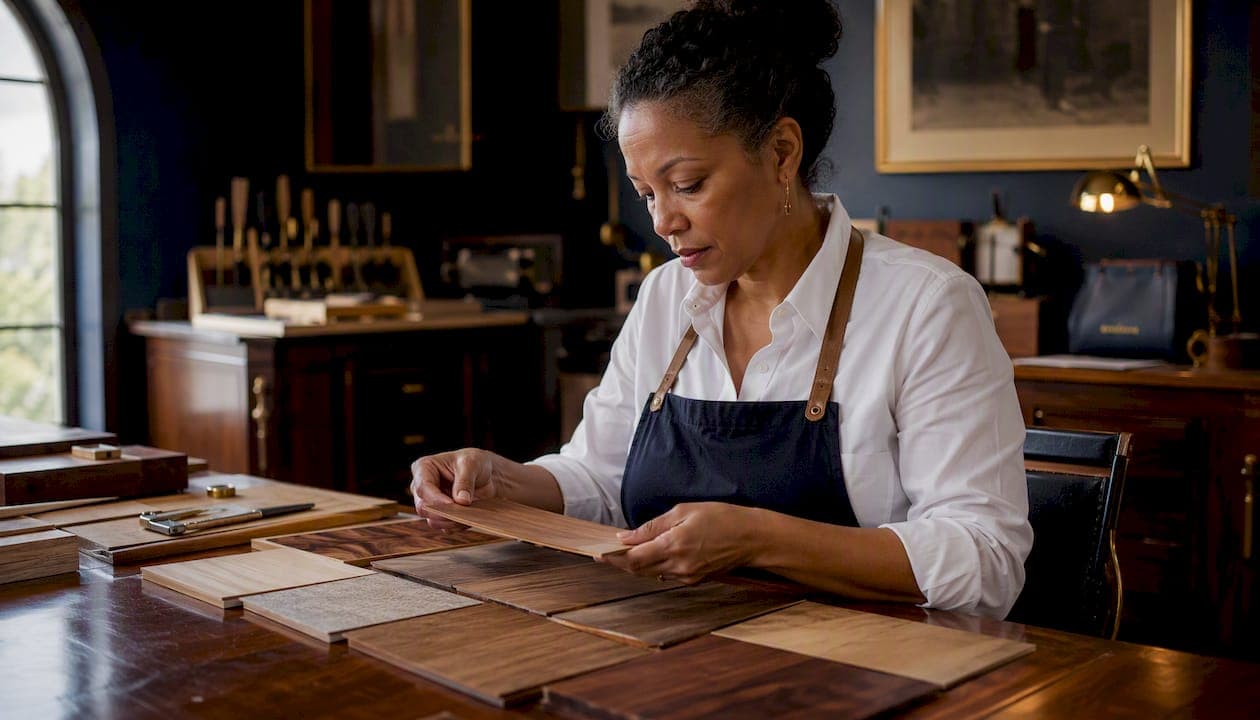
Wood veneer falls into four material categories — natural, engineered/reconstituted, dyed or smoked, and reclaimed — and its appearance is shaped primarily by one of four cutting methods: rotary, plain/flat slice, quarter slice, and rift cut. Three matching techniques (book, slip, and plank) then determine how individual leaves are arranged across a panel. For furniture, the decisions that matter most are species, cut, match, grade and thickness, and the backing or substrate to which the veneer is bonded.
Table of Contents
- What are the main types of wood veneer?
- Species guide: identifying the 10 most used veneers in the UK
- How does the cut change the way veneer looks?
- Book match, slip match, or plank match: which should you specify?
- Veneer grades and thickness: what do they mean in practice?
- Veneer vs solid wood: the practical trade-offs
- How to choose veneer for furniture: a UK procurement checklist
- Why bespoke veneering produces results that standard panels cannot
- How to care for veneered furniture
- Finishes and treatments: how they shape appearance and performance
- Environmental impact beyond FSC and CITES
- Key takeaways
- The detail that separates a good veneered piece from a great one
- Bespoke veneered furniture, made to your specification
- Useful sources and further reading
What are the main types of wood veneer?
Natural veneers are the industry standard for high-end bespoke furniture because every leaf carries a unique, non-repeating grain and character that no manufactured sheet can replicate. When a designer specifies walnut or figured maple for a statement cabinet, they are almost always working with natural veneer sliced directly from a log.
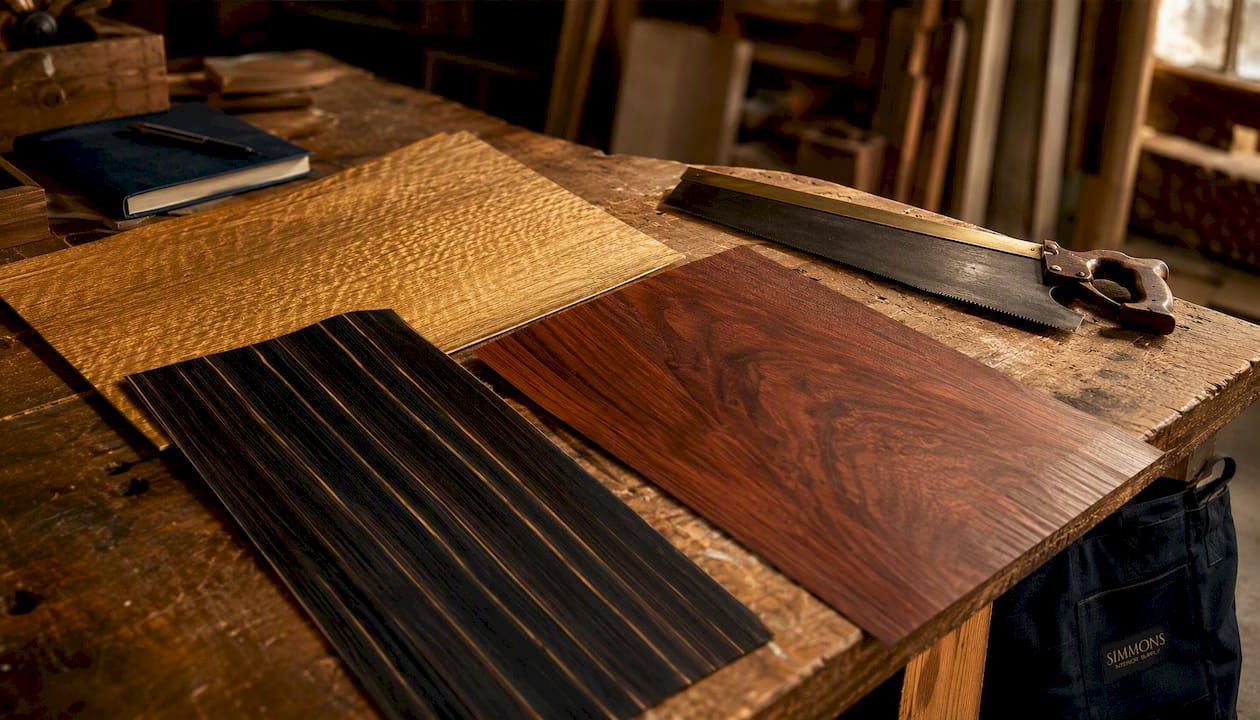
Engineered or reconstituted veneer is made by dyeing and recomposing wood fibres into a new billet, then slicing it to produce a consistent, repeatable pattern. It suits large commercial runs where uniformity matters more than character, and it costs considerably less than premium natural species.
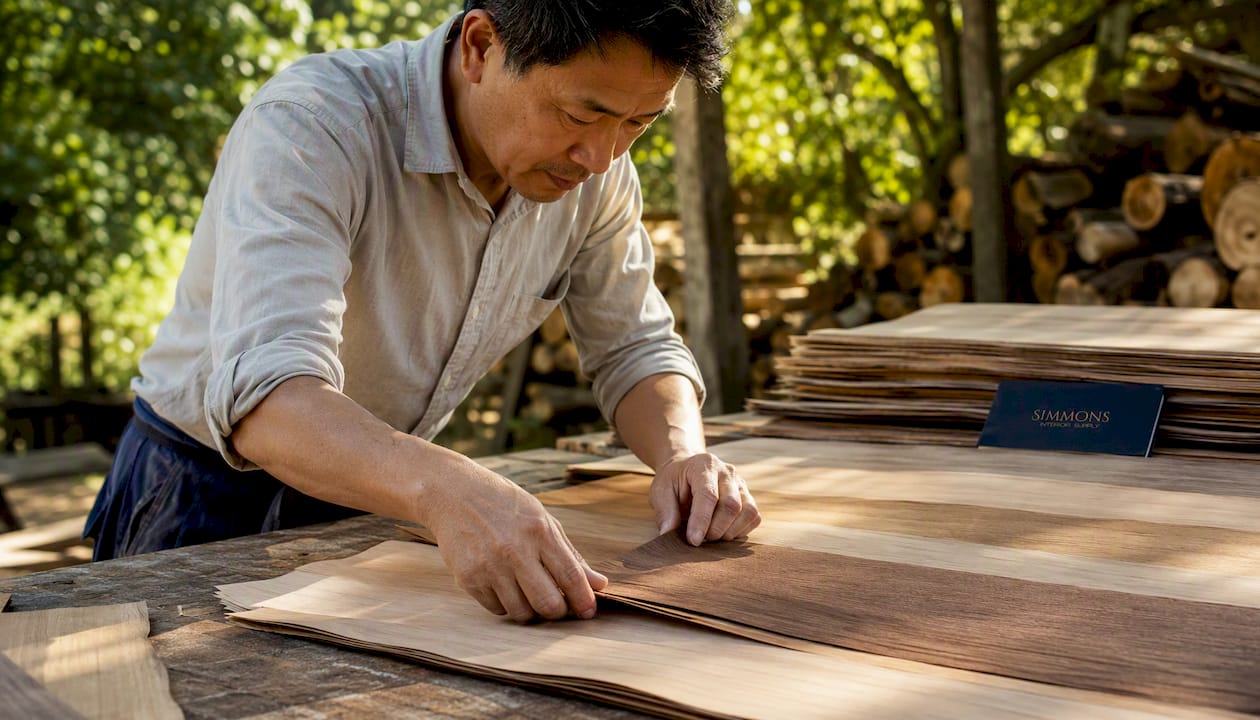
Dyed or smoked veneers start as natural wood but are treated with controlled colour or ammonia fuming to produce a deliberate aged or tinted appearance. Smoked oak, for instance, has become a signature material in contemporary British interiors, offering the warmth of real grain with a cooler, greyed tone.
Reclaimed veneers are sliced from salvaged timbers, old beams, or decommissioned structures. The character is extraordinary — patina, nail holes, and centuries of movement are all part of the surface — but consistency is limited and lead times can be unpredictable. For a bespoke commission where provenance and story matter as much as appearance, reclaimed veneer is hard to surpass.
- Natural: choose for luxury furniture, unique grain, and bespoke commissions.
- Engineered: choose for large uniform runs, cost control, and consistent colour.
- Dyed or smoked: choose when a specific tonal palette is non-negotiable.
-
- Reclaimed: choose character-led, sustainability-conscious projects where variation is a virtue.
Pro Tip: When specifying natural veneer for a bespoke piece, ask your supplier for high-resolution flitch photographs before committing. The difference between a mediocre and a spectacular result often comes down to which part of the log the leaves were taken from.
Species guide: identifying the 10 most used veneers in the UK
Veneer allows the large-scale use of rare species such as walnut, mahogany, and figured maple with better dimensional stability than solid timber on large panels, which is precisely why it dominates luxury furniture and architectural joinery. The species below are the ones you will encounter most often in UK trade and retail.
Oak
Pale honey to warm amber, with a pronounced ray figure when quarter-sliced that produces the characteristic silver fleck beloved in Arts and Crafts and contemporary Scandi-influenced interiors. Plain-sliced oak shows a bold cathedral grain. Widely available across the UK, it is one of the most affordable decorative species and carries strong FSC-certified supply chains. Best for dining tables, cabinetry, and wall panelling.
Walnut
Rich chocolate-brown with purple-grey undertones and a fine, straight-to-wavy grain. Plain-sliced and book-matched walnut is the quintessential choice for high-end cabinetry and statement dining furniture. It is moderately priced in the UK relative to its visual impact, and FSC-certified American black walnut is readily available. Quarter-sliced walnut produces a tighter, more contemporary stripe.
Mahogany
Warm reddish-brown with an interlocked grain that produces a distinctive ribbon figure when quarter-sliced. Genuine Swietenia mahogany is CITES Appendix II listed, so always verify legal provenance and chain-of-custody documentation before specifying. African mahogany (Khaya spp.) is a widely used and more freely available alternative. Best for traditional furniture, panelling, and period-style joinery.
Maple
Creamy white to pale gold, with a very fine, even grain. Hard maple can develop spectacular figure variants — bird's eye, curly, and quilted — that make it one of the most visually arresting species available. Plain-sliced maple suits contemporary furniture; figured cuts are reserved for feature panels and instrument-grade work. Widely available in the UK; FSC-certified North American supply is standard.
Cherry
Warm pinkish-brown that deepens to a rich amber over time with light exposure, making it one of the few species that genuinely improves in appearance with age. Fine, straight grain with occasional gum pockets that add character. Plain-sliced cherry is the preferred cut for elegant, traditional furniture. Moderately priced and available with FSC certification.
Ash
Pale cream to light tan with a bold, open grain and strong figure. Ash veneers are particularly striking when plain-sliced, producing dramatic cathedral patterns. It is one of the most tactile species, with a coarse texture that holds oil finishes beautifully. Widely available and affordable in the UK, though European ash supply has been affected by ash dieback disease, so confirm provenance carefully.
Beech
Pale pinkish-tan with a fine, even grain and distinctive small ray flecks. Beech is exceptionally stable and takes stain evenly, making it a practical choice for painted or tinted finishes where grain character is secondary. It is one of the most cost-effective decorative species in the UK and suits utility cabinetry, drawer linings, and interior panels.
Birch
White to pale yellow with a subtle, almost featureless grain that gives it a clean, Scandinavian quality. Birch veneer is commonly used as a face on birch plywood, which is a staple of contemporary furniture and fitted interiors. It accepts paint and stain readily. Very affordable and widely available; FSC-certified Baltic birch is the standard UK trade specification.
Teak
Golden-brown with a coarse, oily grain and a natural lustre that makes it one of the most weather-resistant decorative species. Plantation-grown teak is available with FSC certification, but wild-harvested teak from Myanmar is subject to import restrictions in the UK following post-2021 trade sanctions. Always verify origin documentation. Best for outdoor furniture, yacht interiors, and high-wear surfaces.
Wenge
Deep espresso-brown, almost black, with a coarse, straight grain and dramatic pale streaks. Wenge is a statement species that suits bold, contemporary furniture and feature walls. It is moderately expensive in the UK and can be difficult to finish cleanly because of its open grain. FSC-certified supply exists but is less common than for European species; confirm chain of custody.
Zebrawood (Zebrano)
Pale gold with bold, irregular dark brown stripes that make it one of the most immediately recognisable exotic species. Quarter-sliced zebrawood produces the most dramatic stripe; plain-sliced gives a more chaotic, figured appearance. It is relatively expensive and best used as an accent species on drawer fronts, inlays, or feature panels rather than large surfaces. Sustainability documentation varies by supplier.
A note on ebony: True ebony (Diospyros spp.) is among the most restricted species in trade, listed under CITES Appendix II. Its near-black colour and fine grain are extraordinary, but legal supply is extremely limited. Macassar ebony (D. celebica) is similarly restricted. If a project calls for ebony's aesthetic, consider smoked or dyed alternatives with verified provenance.
How does the cut change the way veneer looks?
The same species can look entirely different depending on how the log is sliced, and understanding the four principal cuts is one of the most useful skills a designer or maker can develop.
| Cut | Grain character | Typical use | Notes |
|---|---|---|---|
| Rotary | Wide, bold, repeating swirl | Utility panels, plywood face | Least decorative; most economical |
| Plain/flat slice | Cathedral arch pattern | Decorative furniture, cabinetry doors | Most common for decorative work |
| Quarter slice | Straight, parallel lines; ray fleck in oak | Contemporary panelling, reception desks | Uniform and elegant |
| Rift cut | Very straight, fine stripe; no ray fleck | Flooring, linear contemporary furniture | Quieter than quarter; no medullary ray |
Plain-sliced veneer is the most common choice for decorative furniture surfaces because the cathedral grain it produces is both visually rich and familiar. Quarter-sliced veneer, by contrast, gives a composed, architectural quality that suits contemporary interiors — engineered rift-cut oak, for instance, has become the go-to specification for uniform wall panelling in hotel lobbies and corporate reception areas.
Rotary-cut veneer is peeled from a spinning log in a continuous sheet, producing the widest possible leaves but a somewhat artificial-looking, repetitive pattern. It is the standard face for structural plywood and utility panels, rarely specified for visible decorative surfaces in quality furniture.
For high-impact doors and tabletops, plain-sliced book-matched panels are the classic choice. For curved surfaces, paper-backed rotary-cut veneer offers the flexibility needed to follow a radius without cracking.
Book match, slip match, or plank match: which should you specify?
Book matching is used in roughly nine out of ten spliced veneer applications because it creates a mirrored, symmetrical pattern that reads as a deliberate design statement. Alternate leaves are flipped like the pages of a book, producing a butterfly-wing symmetry across the panel face.
- Book match: — Produces a mirror image across the joint. Ideal for feature cabinet doors, headboards, and any surface where visual drama is the goal. A-grade spliced veneer is typically book-matched for architectural applications.
One practical rule: if you are specifying a dark stain or a highly figured species like crotch walnut, slip match is safer. Book match on those surfaces risks the barber-pole effect, where alternate leaves absorb stain at different rates because the tight and loose faces of the veneer are exposed alternately.
Pro Tip: Always test your chosen stain on scrap pieces from the same flitch before committing to a full run. The barber-pole effect is almost invisible on raw veneer and only reveals itself after finishing — by which point it is very expensive to correct.
Veneer grades and thickness: what do they mean in practice?
Grade conventions vary between suppliers, but the broad hierarchy runs from AA or premium grade (clear, consistent grain, minimal defects, tight joints) down through A, B, and commercial grades (increasing knots, colour variation, and joint gaps). For visible furniture surfaces, specify A or AA grade; commercial grades suit concealed panels, drawer bottoms, and utility work.
- AA / premium: Near-perfect leaves, consistent colour, tight joints. Required for high-end cabinetry and architectural feature panels.
- A grade: Minor natural character, small knots or colour variation acceptable. Standard for quality furniture.
- B grade: More pronounced character, small knots, colour variation. Suitable for painted finishes or rustic aesthetics.
- Commercial: Significant variation, repairs acceptable. For concealed or structural applications only.
Common thicknesses follow two broad conventions. Knife-cut veneers are typically around 0.6mm and are the standard for commercial sheet veneer and pre-veneered panels. Saw-cut veneers run from 2–3mm and are used where a more substantial face is needed — visible edges, restoration work, or surfaces that may require sanding back and refinishing over time.
| Thickness | Method | Best for | Matching difficulty |
|---|---|---|---|
| 0.6mm | Knife-cut | Sheet veneer, pre-veneered panels, splicing | Easier; grain continuity well-preserved |
| 2–3mm | Saw-cut | Visible edges, restoration, heavy-wear surfaces | Harder; saw kerf removes material between leaves |
Thicker saw-cut veneers require careful numbering and re-ordering to preserve visual continuity across a panel. The saw kerf removes a sliver of material between each leaf, which breaks grain continuity and makes matching more demanding. Workshops experienced with thicker veneers will plan the layout in advance and build waste allowances into the specification.
Always request grade definitions in writing from your supplier, and ask for flitch or sequence photographs for any critical project. What one supplier calls "A grade" another may call "B."
Veneer vs solid wood: the practical trade-offs
Veneer offers genuine advantages over solid timber on large surfaces — better dimensional stability, the ability to use rare or figured species economically, and consistent application across panels. But it is not without its limitations, and understanding them prevents costly mistakes.
- Edge wear: Thin knife-cut veneer is vulnerable at exposed edges. Solid timber lipping or thicker saw-cut veneer at edges is standard practice on quality furniture.
- Delamination: Poor adhesive application, incompatible substrates, or moisture ingress can cause the veneer face to lift. Specifying the correct adhesive for the substrate and end-use environment is non-negotiable.
- Moisture sensitivity: Veneer over MDF or particleboard is particularly vulnerable in high-humidity environments such as bathrooms or commercial kitchens. High-pressure laminate or solid timber may be more appropriate in those settings.
- Repair difficulty: A deep scratch or gouge in thin veneer is very difficult to repair invisibly. Thicker saw-cut veneer offers more scope for sanding and refinishing.
- Barber-pole staining: As noted above, book-matched panels can show tonal variation after staining. Test before committing.
- CITES and legal sourcing: Exotic species such as genuine mahogany, ebony, and some rosewoods carry CITES restrictions. Importing or selling veneer from restricted species without valid documentation is a criminal offence in the UK.
Pro Tip: For high-use surfaces such as dining tabletops, specify a saw-cut veneer of at least 2mm with solid timber lipping on all exposed edges. The additional cost is modest compared with the cost of replacing a delaminated or worn face after two years of use.
When solid timber genuinely outperforms veneer, it is usually on very small components (chair legs, turned elements), on surfaces subject to repeated heavy impact, or in environments where moisture control cannot be guaranteed.
How to choose veneer for furniture: a UK procurement checklist
A clear specification saves time, money, and disappointment. Work through these steps before placing any order.
- Clarify use and wear level. A dining tabletop, a wardrobe interior, and a hotel reception desk have very different performance requirements. Define the end use before choosing species or cut.
- Choose species and cut. Match the species' visual character and the cut's grain pattern to the design intent. Plain-sliced walnut for warmth and drama; quarter-sliced oak for contemporary linearity.
- Decide on matching method. Book match for symmetry and focal-point impact; slip match for large runs and dark stains; plank match for rustic or character-led work.
- Request flitch-matched panels or sequence photographs. For large bespoke runs, source from the same flitch and ask the supplier to plan flitch transitions at discreet locations if multiple flitches are required.
- Confirm grade and thickness. Specify in writing. For visible furniture surfaces, A or AA grade and a minimum of 0.6mm knife-cut (or 2mm saw-cut for edges and high-wear areas).
- Specify backing and core. Backing type determines flexibility, adhesive compatibility, and screw-holding capacity. Paper-backed veneer suits curved surfaces; wood-on-wood or phenolic-backed suits flat cabinetry panels. MDF core offers a stable, flat face; ply core gives better screw-holding for cabinet carcasses.
- Request FSC or CITES provenance documentation. For any species with sustainability or legal questions, chain-of-custody certification is not optional.
- Order samples and test finishes. Request a physical sample from the actual flitch, not a generic species sample. Test your intended finish on that sample before production begins.
For UK sourcing, ask about lead times early — premium flitch-matched walnut or figured maple may take several weeks to arrive from specialist suppliers. Budget for bespoke flitch matching to add a noticeable premium to material costs compared with off-the-shelf sheet veneer, but the visual result on a statement piece justifies it entirely.
For large-scale commercial installations, professional cabinet installation teams can advise on substrate preparation and adhesive compatibility before veneer is applied, which prevents costly delamination on site.
Why bespoke veneering produces results that standard panels cannot
The difference between a bespoke veneered piece and a factory-veneered panel is most visible at the joints, the edges, and under a raking light. In a bespoke commission, the maker selects leaves from the same flitch in sequence, plans the layout across the entire piece before a single leaf is glued, and hand-finishes the joints so they are virtually invisible. Plan-matched panels achieve maximum grain continuity but require accurate site measurement and careful flitch selection — the kind of meticulous preparation that a production line simply cannot accommodate.
Consider a walnut dining table with a book-matched top: in a bespoke commission, the maker will lay out the full sequence of leaves on the bench, adjust the match point to centre the most dramatic figure, and test the stain on offcuts from the same flitch before touching the final surface. The result is a top where the grain flows continuously from one end to the other, the match is perfectly centred, and the colour is consistent across every leaf.
Simmonsinteriorsupply works in exactly this way. Every veneered piece begins with flitch selection, proceeds through hand-laid sequence matching, and is finished with the same care given to solid timber. You can browse the finished gallery to see how species, cut, and match decisions translate into completed furniture.
Pro Tip: Ask your maker to photograph the laid-out veneer sequence before gluing. That single step confirms the match, the grain flow, and the stain test result — and gives you a reference point if any question arises after delivery.
How to care for veneered furniture
Veneer is more forgiving than many people assume, provided it is treated with the same respect you would give a fine solid timber surface. The key threats are moisture, heat, and abrasion.
Keep veneered furniture away from direct sunlight and heat sources such as radiators. Prolonged UV exposure fades most species, and thermal cycling causes the substrate to expand and contract at a different rate from the veneer face, which stresses the adhesive bond over time. A tablecloth or felt pad under hot dishes is not merely decorative etiquette; it protects the finish from heat rings that penetrate through lacquer to the veneer itself.
For cleaning, a slightly damp cloth followed immediately by a dry one is sufficient for most surfaces. Avoid silicone-based polishes, which build up a residue that obscures the grain and complicates future refinishing. For oil-finished veneers, a periodic application of the same oil used in the original finish will maintain the surface and prevent the wood from drying out.
Wenge and teak, both open-grained species, benefit from occasional waxing to prevent the grain from lifting or splintering at the surface. Cherry and walnut, which are finer-grained, need less maintenance but will develop a patina with age that is best left to develop naturally rather than stripped back with abrasive cleaners.
Finishes and treatments: how they shape appearance and performance
The finish applied to a veneer surface does more than protect it. It determines the final colour, the sheen level, the tactile quality, and how the piece will age.
Lacquer (nitrocellulose or two-pack polyurethane) is the most common commercial finish for veneered furniture. It seals the surface completely, giving a consistent sheen from matt to high gloss, and is highly resistant to water and alcohol. The trade-off is that it sits on top of the wood rather than penetrating it, which can give a slightly plastic quality to the surface on very high-gloss specifications.
Hardwax oil penetrates the grain and cures within the wood fibres, leaving a natural, tactile surface that feels like wood rather than a coated panel. It is the preferred finish for oak, ash, and walnut in contemporary interiors. It is easier to spot-repair than lacquer but requires periodic re-oiling.
Stains and reactive finishes change the colour of the veneer before a topcoat is applied. Reactive stains (such as iron acetate on oak) produce a chemical colour change rather than a surface deposit, giving a more natural result than pigmented stains. This is how the smoked-oak effect is achieved on a production scale. As noted earlier, always test stains on flitch-matched offcuts before applying to the finished piece.
Veneers over MDF generally accept lacquer and stain finishes well because MDF provides a stable, flat substrate with no grain movement. Veneers over solid timber substrates require more careful finishing because the substrate moves seasonally, which can stress a rigid topcoat over time.
Environmental impact beyond FSC and CITES
FSC certification and CITES compliance are the legal and ethical floor, not the ceiling. For designers and specifiers who want to go further, several additional considerations are worth building into a specification.
Carbon footprint and transport. European species (oak, ash, beech, birch) have a significantly lower transport carbon footprint than species shipped from North America or South-East Asia. Where the design allows, specifying European-origin veneer reduces embodied carbon without compromising quality.
Recycled content and reclaimed timber. Reclaimed veneer from salvaged structures carries no new-harvest carbon cost and often comes with a provenance story that adds value to a bespoke commission. Some UK suppliers now offer veneer sliced from urban trees felled for development or disease management, which is genuinely zero-deforestation material.
Formaldehyde emissions from substrates. The veneer face is only part of the environmental picture. MDF and particleboard cores bonded with urea-formaldehyde adhesives off-gas formaldehyde, which is a regulated indoor air pollutant. Specifying CARB Phase 2 compliant or E0/E1 rated boards reduces emissions significantly. For residential interiors, this is worth specifying explicitly.
Engineered veneer as a conservation tool. Engineered or reconstituted veneer, often dismissed as a lesser product, uses fast-growing plantation species as its raw material and produces a consistent face with minimal waste. For large commercial runs where rare species would otherwise be consumed in quantity, it is a genuinely responsible choice.
Key takeaways
The most important decision in specifying veneer for furniture is choosing the right combination of species, cut, and matching method for the design intent — everything else follows from that.
| Point | Details |
|---|---|
| Species and cut determine appearance | Plain-sliced gives cathedral grain; quarter-sliced gives straight stripe; the same species looks entirely different by cut. |
| Matching method changes the panel's character | Book match for symmetry and drama; slip match for large runs and dark stains; plank match for rustic variation. |
| Grade and thickness affect durability | Specify A or AA grade for visible surfaces; saw-cut 2–3mm veneer for edges and high-wear areas. |
| Provenance and legality are non-negotiable | Always request FSC chain-of-custody documentation; verify CITES compliance for mahogany, ebony, and exotic species. |
| Simmonsinteriorsupply for bespoke commissions | Simmonsinteriorsupply offers flitch selection, sequence matching, and hand-finished veneered furniture for trade and residential clients. |
The detail that separates a good veneered piece from a great one
Most specification guides focus on species and grade, and both matter. But in practice, the single biggest variable in the quality of a veneered piece is the conversation that happens before any material is ordered.
The designers and makers who produce the most consistently beautiful veneered furniture share one habit: they insist on seeing the actual flitch, or at minimum a full-resolution photograph of the laid-out sequence, before approving the material. A species description tells you the colour range and typical figure. A flitch photograph tells you whether this particular log has the movement, the figure, and the tonal consistency the project needs. Those are not the same thing.
There is also a tendency to underestimate the importance of the stain test. Book-matched walnut with a dark ebonising stain is a combination that looks spectacular in a mood board and can look patchy and uneven on the finished piece if the barber-pole effect has not been tested and addressed. The fix is simple and costs almost nothing at the sample stage. At the production stage, it costs everything.
The practical mantra worth keeping: specify the flitch, test the stain, approve the sequence. In that order, every time.
Bespoke veneered furniture, made to your specification
Simmonsinteriorsupply offers something that off-the-shelf veneered panels cannot: a complete bespoke commission service where species, cut, matching method, and finish are chosen specifically for your project, not selected from a catalogue. Every piece begins with flitch selection, proceeds through hand-laid sequence matching, and is finished by skilled artisans who treat the veneer face with the same care given to solid timber.
Whether you are an interior designer specifying a statement dining table, an architect sourcing panelling for a hotel lobby, or a homeowner commissioning a piece that will hold its own for decades, Simmonsinteriorsupply works with you from material selection through to delivery. You can view finished examples in the bespoke furniture gallery, or explore a piece such as the bespoke nest of coffee tables to see how veneer choices translate into completed work. To discuss a commission, request samples, or ask about flitch availability for a specific species, get in touch through simmonsinteriorsupply.com.
Useful sources and further reading
The sources below informed this guide and are worth consulting for deeper technical detail or supplier guidance.
- When Selecting Material, Do You Slip or Book Match? — Axminster Tools: Practical workshop-level guidance on thickness trade-offs, saw-cut vs knife-cut veneers, and matching difficulty.
- Selecting a Veneer Match: What to Know — Woodworking Network: Industry-level overview of grade conventions, A-grade book matching, and exceptions for knotty species.