
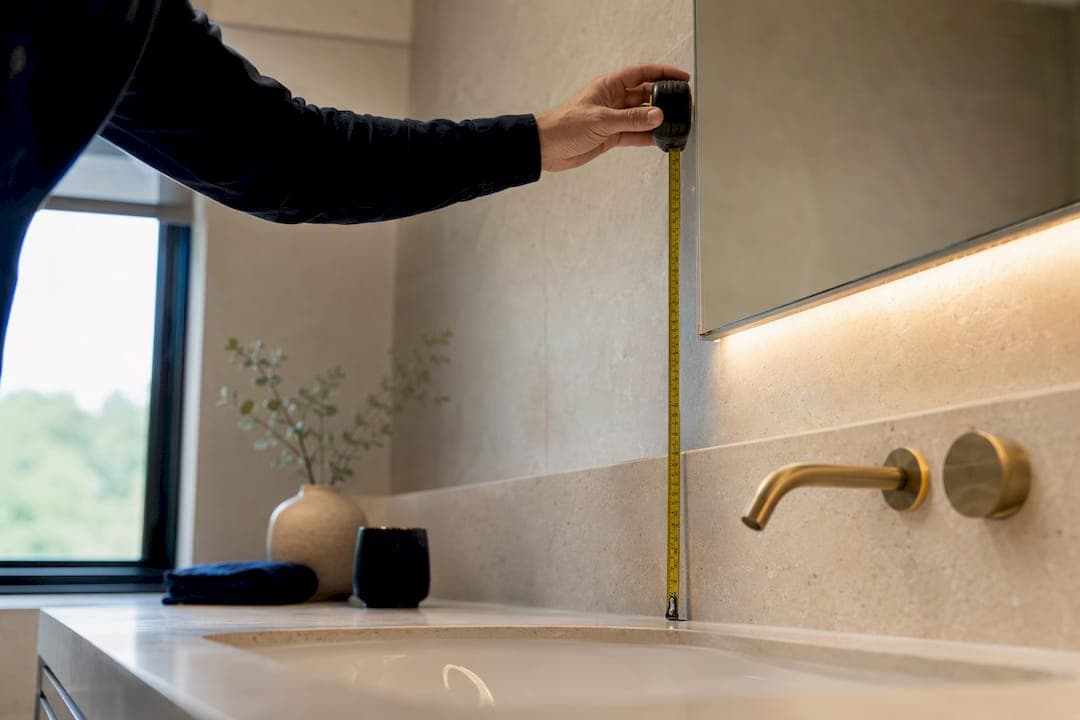
Set the centre of your bathroom mirror between 1500 mm and 1650 mm from the finished floor, with 1550 mm to 1600 mm working for most households. This range puts the average adult's eyes near the mirror's midpoint without stooping or craning. If you would rather work upward from the vanity, leave 150 to 200 mm between the basin or tap and the mirror's bottom edge. The details that follow help you adjust for family bathrooms, lighting, and fixing methods.
TL;DR:
- The ideal centre height for most bathroom mirrors is between 1550 mm and 1600 mm from the finished floor, matching the average adult eye level.
- For households with children or tall members, adjustments such as lower or higher placements or dual mirrors improve usability.
- Measure from the finished floor to the basin top, then add 150 to 200 mm to set the mirror's bottom edge for consistent positioning.
- The mirror width should generally be 70 to 80% of the vanity's width, with size considerations influencing the centre height especially for very tall or compact mirrors.
- Proper mounting depends on wall type, with heavier mirrors requiring battens or French cleats, and safety wiring and IP ratings must align with bathroom zone regulations.
Table of Contents
- What height should a bathroom mirror be?
- How do I measure from the vanity to position the mirror?
- What size mirror works with your vanity?
- How do you set mirror height for shared bathrooms?
- Does lighting change where you hang the mirror?
- How do you mount a bathroom mirror safely?
- When does a bespoke mirror solve the height problem?
- A trade contributor's view on getting it right
- Get a made-to-measure mirror sized to your bathroom
- Sources
- FAQ
What height should a bathroom mirror be?
The centre of a bathroom mirror commonly sits at roughly 1500 to 1650 mm from finished floor level, with many UK trade fitters favouring 1550 to 1650 mm as the working band. That range exists for a reason: it puts the eye line of an adult somewhere between 1600 mm and 1700 mm tall roughly at the mirror's centre, sparing the neck and back from the daily indignity of hunching over a basin.

For a quick, no-fuss mark, aim the centreline at 1550 mm. It suits a broad spread of household heights and looks balanced against most vanity units without any further calculation.
Household composition still matters:
- Single-user en suite: nudge the centre towards the primary user's actual eye height, measured standing naturally at the basin.
- Family bathroom: settle on 1550 to 1600 mm as a workable compromise for adults and teenagers.
- Households with a tall member (over 1850 mm): shift the centre towards 1650 mm, or consider the shared-bathroom strategies covered further on.
Trade examples for a standard family bathroom often pair a 600 mm vanity with a bottom edge sitting 150 to 200 mm above the basin, which typically lands the centreline close to that 1550 to 1600 mm sweet spot.
How do I measure from the vanity to position the mirror?

Working up from the basin is often more reliable than working down from the ceiling, since basin heights vary far less than ceiling heights do. A practical rule of thumb is to leave 100 to 200 mm between the basin top or splashback and the mirror's bottom edge, with 200 mm being the trade preference where taps are tall or a mixer sits proud of the counter.
Here's a simple sequence to follow:
- Measure from the finished floor to the top of the basin or vanity.
- Add 150 to 200 mm to that figure to find the mirror's bottom edge.
- Mark the bottom edge on the wall using a spirit level, not by eye.
- Add the mirror's height to find the top edge, and check the resulting centre falls within 1500 to 1650 mm.
- Adjust the bottom-edge gap slightly if the centre lands outside that band.
Pro Tip: Measure with the tap, splashback, and any soap dispenser already fitted. A mirror that clears a low tap can still clash with a tall mixer or an upstand added later, so always work from the finished setup, not the bare counter.
What size mirror works with your vanity?
Mirror width should typically run 70 to 80% of the vanity's width, narrowing to 60 to 70% for round or oval designs. A mirror stretched edge-to-edge across the vanity tends to look oversized and can crowd wall lights or shaving points either side.
Size affects more than aesthetics, though. A tall mirror shifts more of the reflected area above the ideal eye-line, which matters if the centreline is fixed by a gap-from-basin rule rather than chosen freely. Consider these adjustments:
- Larger mirrors (over 900 mm tall): keep the centre at 1550 to 1600 mm rather than letting the bottom-edge gap push it higher.
- Compact mirrors (under 600 mm tall): bias the centre towards 1600 to 1650 mm so the visible area still captures the face comfortably.
- Round mirrors: check the proportion against vanity width first, since a narrower diameter changes how the piece reads on the wall.
How do you set mirror height for shared bathrooms?
Family bathrooms rarely have one "correct" answer, since a 1550 mm centre that suits an adult sits awkwardly for a child. Four workable strategies cover most households:
- Set to the primary user: sensible for a couple with a shared height range, or a family bathroom used mainly by adults.
- Average household eye-line: split the difference between the tallest and shortest regular user, usually landing near 1575 to 1600 mm.
- Two mirrors at different heights: a full-size mirror at 1550 to 1600 mm plus a smaller one lower down for children, magnification, or a wheelchair user.
- Tilt or adjustable mirrors: a hinged or extendable mirror lets each user angle the reflection without moving the fixing point.
For younger children, a supplementary mirror at 1100 to 1200 mm, or a pull-down magnifying mirror, works better than lowering the main mirror and compromising it for everyone else.
Does lighting change where you hang the mirror?
Lighting position and the mirror's electrical requirements can override a purely ergonomic height choice, particularly where a fitting sits inside a regulated zone. UK bathroom wiring rules define Zone 1 and Zone 2 as extending up to 2.25 m from the floor and 0.6 m horizontally from the basin, and fittings within those zones generally need a minimum IPX4 rating.
Front-lit LED mirrors bring an added constraint: the light needs to fall across the face at the user's actual eye-line, not above or below it, which occasionally means nudging the centre height by 20 to 30 mm from the standard band.
Before fixing anything to the wall, check three things:
- The mirror or light fitting carries at least an IPX4 rating for its zone.
- Colour temperature sits around 2700K to 3000K, since cooler 4000K light tends to flatten skin tones at close range.
- Any demister pad or sensor switch is positioned so it doesn't interfere with the wiring route.
Many off-the-shelf mirrors fall down on exactly this point: they're hung at a reasonable height but lit with the wrong colour temperature, which undoes the benefit of getting the placement right.
How do you mount a bathroom mirror safely?
Fixing method depends entirely on wall type. Solid masonry takes standard wall plugs and screws rated for the mirror's weight; stud partitions need fixings that land on the timber studs or a noggin fitted specifically to take the load; tiled walls call for a masonry drill bit and a slow start to avoid cracking the glaze.
For anything heavier than a basic unlit mirror, follow this checklist:
- Confirm the wall type and locate studs or solid fixing points with a detector.
- Fit a backing batten or French cleat for mirrors over roughly 15 kg.
- Mark the centreline and bottom edge before drilling, using a level rather than a tape measure alone.
- For mirror cabinets, plan the cable route and switch position before the wall finish goes on.
- Route any wiring through a qualified electrician, particularly within Zone 1 or Zone 2.
Pro Tip: Dry-fit heavy mirrors with a cardboard template taped to the wall first. It costs nothing and catches problems, a clashing light switch, an off-centre tap, a shadow line, before you've drilled a single hole.
The most common mistakes are hanging the mirror too low so tall users stoop, mounting it too high so the bottom edge cuts off the chin, and fixing it before checking that a wall light or shaver socket will end up dead centre behind the glass.
When does a bespoke mirror solve the height problem?
Standard sizes assume a standard vanity, and plenty of bathrooms don't have one. Some bespoke furniture and mirror makers work with interior designers, architects, and homeowners on made-to-measure mirrors precisely because awkward wall widths, an off-centre light fitting, or a vanity that doesn't match any stock size are common problems, not rare ones.
Bespoke sizing earns its cost when a standard mirror would leave uneven margins either side of the vanity, when an obstructing pipe or extractor limits the usable wall space, or when you want lighting built into the frame itself rather than added afterwards.
If you're briefing a maker, come prepared with the vanity width, the tap or mixer height, your preferred centre height, and any electrical or IP requirements for the room's zone. That handful of measurements is usually enough for a fitter to translate your bathroom into a mirror that actually matches it, rather than one you've had to compromise around.
A trade contributor's view on getting it right
Most height mistakes trace back to skipping the dry-fit and drilling straight from a tape-measure guess. Mark the centreline for whoever actually uses the mirror most, tape up a template, and stand at the basin before committing to a hole. Check tap height and wall fixings twice. If the wall is awkward or the mirror heavy, a proper installer or a bespoke sizing conversation costs far less than a cracked tile.
— Luke
Get a made-to-measure mirror sized to your bathroom
Every bathroom we've discussed here assumes a standard vanity and a standard wall, and plenty of real bathrooms have neither. Some bespoke furniture makers work with trade partners on made-to-order mirrors sized to fit your actual wall, tap height, and lighting plan, rather than asking you to compromise around a stock size.

If your vanity sits at an unusual width, your lighting needs to be integrated into the frame, or you're fitting around a fixture that a standard mirror simply won't clear, it's worth requesting a quote before you settle for something that's nearly right. For broader inspiration on how mirror placement fits into a wider bathroom composition, the design examples on Batistatos Interior Design are worth a look too. Get in touch through the Simmonsinteriorsupply site with your vanity width, tap height, and desired centre height, and we'll talk you through what a bespoke mirror could look like in your space.
Sources
For wiring and IP-rated fittings within bathroom zones, consult a qualified electrician alongside the UK electrical standards guide for hardwired LED mirrors. For heavier mirrors or cabinets, a professional installer will confirm the right fixings for your wall type, as outlined in our large mirror installation guide.
- Bathroom mirror cabinet installation | DIY step-by-step - Elegant Showers UK
- Bathroom mirror sizes & shapes guide: get the proportions right
- UK electrical standards: hardwired LED mirrors explained
- Bathroom mirror lighting: 2700K and £400–£1,500 | Bowmans
FAQ
Should a bathroom mirror touch the backsplash?
No, a small gap is preferable. Leaving 100 to 200 mm between the basin or splashback and the mirror's bottom edge keeps the centreline within the comfortable eye-level band and avoids the mirror trapping moisture against the tiles.
How high should a bathroom mirror be mounted above the sink?
Most trade guidance places the bottom edge 150 to 200 mm above the basin, which typically puts the centre around 1550 to 1600 mm from the floor. Adjust upward slightly if your household includes taller users or a tall tap fitting.
What is the recommended blocking height for a bathroom mirror?
Blocking or backing battens should be positioned to support the mirror's actual weight distribution, usually a horizontal batten fixed to studs at the height where the top fixing brackets will sit. For mirrors over roughly 15 kg, a batten or French cleat is safer than relying on wall plugs alone.
How high is too high for a mirror?
Once the centre climbs much past 1650 mm, shorter users and children will struggle to see themselves without stepping back or using a step. If your household includes a wide height range, a second lower mirror or an adjustable, tilting mirror solves this better than pushing one mirror uncomfortably high.