
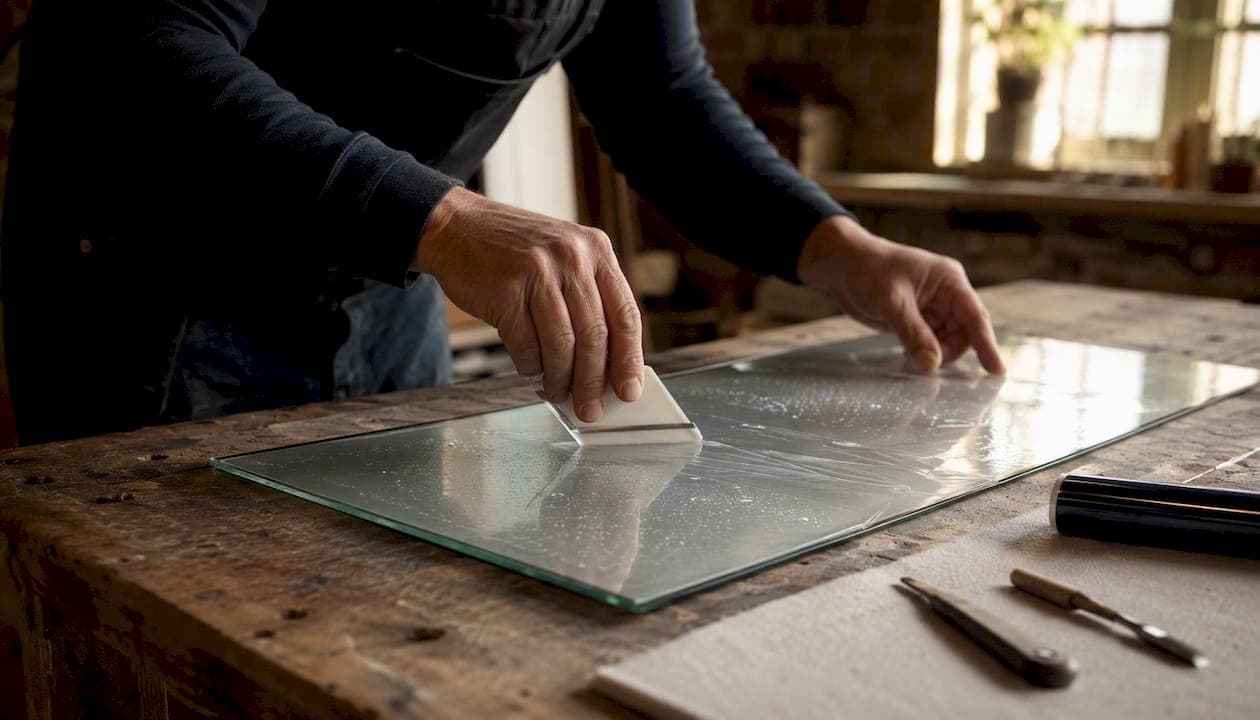
Mirror safety backing is a clear, high-tack film or tape applied to the rear of a mirror to hold glass fragments together if the mirror breaks. It does not make the mirror unbreakable, but it dramatically reduces the risk of injury from flying shards. Whether you are retrofitting a bathroom mirror or specifying a large feature wall for a hospitality project, the right backing product makes a meaningful difference to both safety and longevity.
Three quick recommendations before you read further:
- Small domestic mirrors (bathrooms, hallways, children's rooms): a self-adhesive safety film or backing tape is a practical DIY solution you can apply in under an hour.
- Large or frameless mirrors: combine mechanical fixing with factory-applied safety backing; DIY film application on panels over roughly 1 metre carries a real bubble and adhesion risk.
- Commercial or high-risk installations: specify a product tested to BS EN 12600 and request a full technical data sheet, installation method statement, and manufacturer warranty before ordering.
Key takeaways
Safety backing is a containment measure, not a structural upgrade — choose the product type, standard, and installation route to match the mirror's size, location, and risk level.
| Point | Details |
|---|---|
| Backing contains, not strengthens | Film holds fragments together after breakage; it does not replace toughened glass where impact resistance is required. |
| Match product type to application | Use self-adhesive film for DIY small mirrors, backing tape for narrow panels, and factory lamination for large or bespoke work. |
| Check BS EN 12600 classification | Always request the technical data sheet and confirm the product's impact classification before ordering or specifying. |
| Respect the 18-month shelf life | CRL notes an 18-month shelf life for safety tape; expired product risks reduced bond strength and containment performance. |
| Simmonsinteriorsupply for bespoke work | Factory-backed bespoke mirrors with certified performance and trade datasheets are available through Simmonsinteriorsupply. |
Table of Contents
- What mirror safety backing actually does — and what it doesn't
- The three types of safety backing and where each belongs
- Where safety backing is recommended in the UK
- What to check on product specs and UK standards
- How to apply safety backing film yourself
- When to hire a professional for bespoke and large-scale work
- Cleaning, maintenance and how long safety backing lasts
- Typical cost and time to fit safety backing
- A quick checklist for choosing the right backing product
- A note from the trade on specifying safety backing for bespoke mirrors
- Simmonsinteriorsupply's bespoke mirror service for trade clients
- Sources
What mirror safety backing actually does — and what it doesn't
Mirror safety backing is a rear-applied protective film that keeps shards adhered to the film surface after impact, preventing fragments from scattering across a floor or into a person's path. Most products are made from clear polyester or bi-axially orientated polypropylene, as GlassParts describes, with a high-tack pressure-sensitive adhesive on one face. Higher-performance tapes incorporate a woven scrim layer to increase tensile strength, giving the film resistance to tearing even when the glass behind it has fractured.
A secondary benefit, particularly valued in wet environments, is silvering protection. The film seals the rear of the mirror against moisture ingress, slowing the edge blackening that eventually ruins unprotected mirrors in bathrooms and shower rooms.
What it cannot do is replace toughened or laminated glass where structural impact resistance is the requirement. Safety backing is a containment measure, not a structural upgrade. If a location demands glass that withstands repeated or forceful impact, the specification should start with the glass type, not the backing.
The three types of safety backing and where each belongs
There are three practical categories, and choosing the wrong one for your application is the most common specifier mistake.
Self-adhesive safety film comes in wide rolls or pre-cut sheets and covers the entire rear face of a mirror in a single pass. It suits DIY retrofitting of small to medium mirrors and is the format most commonly found in retail. Products such as those described by Stick2 are tested to BS 6206 class B & C and conform to BSEN 12600 2B2, giving you a clear compliance reference for domestic and light-commercial use.
Mirror backing tape is a narrower roll format, typically 50–100 mm wide, designed to be applied in overlapping strips or around the perimeter of a panel. PCD Sales describes anti-shatter backing tape as a clear polyester product suited to wardrobe doors and narrow panels where a wide film roll would be unwieldy. The strip format makes retrofitting easier in confined spaces, though full-panel coverage requires careful overlap alignment to avoid gaps.
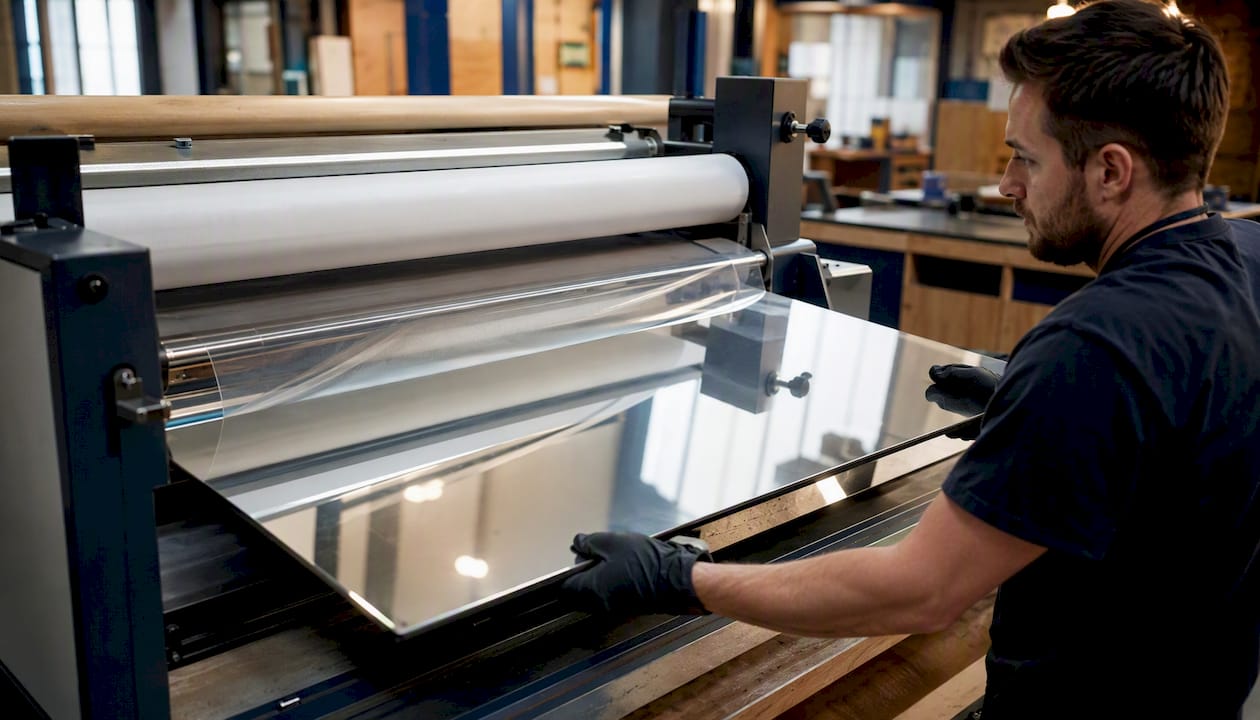
Factory-applied safety-backed mirrors are laminated at manufacture using dedicated equipment. Novacel's 9212 safety film, for example, is designed to remain permanently bonded to the mirror rear, and the manufacturer recommends lamination machines for consistent, permanent adhesion on large panels. Factory lamination eliminates the bubble and edge-lift risks inherent in hand application and is the appropriate route for bespoke mirrors, feature walls, and any installation requiring certified performance.
| Type | Best for | Adhesive and clarity | Installation method | Relative cost and time | Durability |
|---|---|---|---|---|---|
| Self-adhesive safety film | DIY small to medium mirrors | High-tack PSA; optically clear | Wet or dry hand application | Low cost; under 1 hour | Good with correct prep |
| Mirror backing tape (narrow roll) | Wardrobe doors, narrow panels | High-tack PSA; clear polyester | Strip application, overlapping | Low cost; under an hour | Good; edge gaps are a risk |
| Factory-applied laminated backing | Large bespoke mirrors, commercial | Machine-applied; consistent clarity | Lamination press at manufacture | Higher cost; days lead time | Excellent; certified performance |
Where safety backing is recommended in the UK
Certain locations make a backed mirror not merely sensible but expected by building occupiers, insurers, and in some cases building control.
- Bathrooms and wet rooms: moisture accelerates edge failure; backing protects silvering and contains fragments near water.
- Gyms and fitness studios: large wall mirrors are vulnerable to equipment impact and vibration; safety backing is standard practice in commercial fitness environments.
- Children's rooms and nurseries: low mounting heights and unpredictable impact make containment film a straightforward precaution.
- Hallways and entrance areas: high-traffic zones where a dropped bag or door impact can reach a mirror.
- Commercial and hospitality spaces: hotels, retail, and leisure venues where public liability considerations apply.
- Large or frameless mirrors: size alone increases risk; a frameless panel over roughly 1 metre in any dimension warrants backing regardless of location.
Pro Tip: For large frameless mirrors, never rely on backing film alone. Mechanical fixings — mirror screws, standoffs, or a bonded aluminium channel — should always accompany the film. Read our guide on installing large mirrors safely for a full fixing methodology.
What to check on product specs and UK standards
Specifying the right product means reading the technical data sheet before you order, not after. These are the items that matter most.
Standards to request on the datasheet:
- BS EN 12600: the European pendulum impact test for flat glass; look for the classification code (e.g. 2B2) which tells you drop height, breakage mode, and fragment behaviour.
- BS 6206: the UK safety glazing standard; class B and C ratings are commonly cited on retail safety film products.
- ANSI Z97.1 / 16 CFR 1201: US standards occasionally referenced on imported products; useful as supplementary evidence of impact performance but not a substitute for BS/EN classification in UK specifications.
Technical details to confirm:
- Film thickness (typically expressed in microns; thicker films generally offer greater tensile strength)
- Adhesive type: permanent versus removable (most safety applications require permanent)
- Optical clarity / haze rating: critical for decorative mirrors where distortion is unacceptable
- Scrim presence: CRL's Category II safety tape incorporates an embedded woven scrim for enhanced tensile and impact strength
- Shelf life: CRL notes an 18-month shelf life recommendation for their tape products
- Temperature and humidity limits: relevant for steam rooms and exterior-facing installations
Procurement action: always request the full technical data sheet, the performance certificate, and the manufacturer's installation instructions. Retain these with the project record.
How to apply safety backing film yourself
Done carefully, DIY application on a small to medium fixed mirror is well within the competent homeowner's reach. Rushing the surface preparation is where most applications fail.
What you will need:
- Spray bottle with a solution of water and a few drops of washing-up liquid (or 70% isopropyl alcohol for a dry application)
- Plastic squeegee or credit card wrapped in a lint-free cloth
- Sharp craft knife or scalpel with a fresh blade
- Tape measure and marker
- Clean, lint-free cloths and PPE (safety glasses and cut-resistant gloves)
- Check the film's manufacture date against the 18-month shelf life guidance before opening
Step-by-step application:
- Clean the mirror rear thoroughly. Remove all dust, grease, and residue. Allow to dry completely — any moisture trapped beneath the film will cause adhesion failure.
- Measure and cut the film to the mirror dimensions, leaving a 5–10 mm overlap on each edge for trimming.
- Peel back a small section of the release liner and align the film to one edge of the mirror.
- Apply the film gradually, peeling the liner back as you press the film down from the centre outward using the squeegee. For wet application, mist the mirror surface lightly first to allow repositioning.
- Squeegee out all air bubbles using firm, overlapping strokes from the centre to the edges.
- Trim the excess with the craft knife held flat against the mirror edge.
- Allow the adhesive to cure per the manufacturer's instructions before handling or mounting the mirror.
Pro Tip: Edge delamination is the most common long-term failure point. If the mirror is also fixed with mastic adhesive, check both the mastic and the film's technical data sheets for compatibility. CRL notes that certain mastics are incompatible with safety tapes unless the tape is cut away at the contact points.
Stop and call a professional if the mirror is already delaminating, if the silvering is damaged, or if the panel exceeds a size you can handle safely with two people.
When to hire a professional for bespoke and large-scale work
Some installations genuinely warrant professional lamination or a trade supplier's factory-backed product. These are the scenarios where DIY application introduces unacceptable risk.
- Large wall mirrors and mirrored feature walls: hand application on panels over roughly 1 metre risks bubbles, uneven adhesion, and uncertified performance; factory lamination is the reliable route.
- Mirrors with cut-outs, bonded fixings, or complex shapes: backing must be applied before cut-outs are made; a fabricator handles this as part of the manufacturing process. See our guide on custom mirror shapes for how backing interacts with bespoke profiles.
- Commercial and hospitality installations: public liability and building regulations make certified, documented performance a practical necessity.
What to request from a trade supplier or installer:
- Full technical data sheet and compliance certificate (BS EN 12600 classification)
- Written installation method statement
- Manufacturer warranty covering both the backing and the finished mirror
- Confirmation of mechanical fixing recommendations for the panel size and weight
- For bespoke commissions, ask specifically for factory lamination and certified testing
Cleaning, maintenance and how long safety backing lasts
A well-applied backing film on a correctly prepared surface should last the working life of the mirror in most domestic settings. The limiting factors are edge exposure, cleaning chemistry, and, for tape products, whether the original shelf life was respected before application.
- Shelf life: CRL's guidance cites an 18-month shelf life recommendation for safety tape from manufacture; using expired product risks reduced bond strength.
- Cleaning: use a soft cloth with a mild, non-abrasive glass cleaner on the mirror face. Avoid spraying cleaner directly onto the edges, where it can seep behind the film and weaken the adhesive bond over time.
- Edge blackening: if blackening appears at the mirror edges despite backing, it usually indicates moisture has penetrated at an unsealed edge or through a gap in the film. Re-sealing the edge with a compatible sealant can slow progression.
- Removal: where removal is necessary, gentle heat from a heat gun on a low setting softens the adhesive on most film products. Follow the manufacturer's solvent recommendations. If the silvering has already bonded to the film, removal may damage the mirror surface beyond repair, making replacement the more practical choice.
Typical cost and time to fit safety backing
Budget and scheduling vary considerably between a DIY retrofit and a factory-backed bespoke commission.
- DIY safety film or tape: retail rolls typically range from a few pounds for a small sheet to £20–£40 for a larger roll suitable for multiple mirrors; total fitting time for a standard bathroom mirror is relatively short, including preparation.
- Professional supply and fit for large mirrors: trade labour rates and supply-plus-fit quotes for large bespoke panels vary by region, panel size, and specification; always obtain a written quote with the product datasheet attached before committing.
- Factory lamination lead time: bespoke factory-backed mirrors are made to order; allow several working days for production in addition to delivery and installation scheduling.
Always request a written quote and the product's technical data sheet together — a quote without a datasheet tells you nothing about what you are actually buying.
A quick checklist for choosing the right backing product
Before ordering, work through these points:
- Application type: DIY retrofit, trade installation, or factory lamination?
- Mirror size: panels over roughly 1 metre warrant factory lamination or professional application.
- Standards and certification: does the product carry a BS EN 12600 classification? Request the certificate.
- Adhesive type: permanent for safety applications; confirm compatibility with any mastic being used.
- Optical clarity: check the haze rating if the mirror is decorative or high-specification.
- Shelf life: confirm the manufacture date and check against the product's stated shelf life before application.
- Warranty: does the manufacturer offer a written warranty covering the backing's performance?
- Installer competence: for large or commercial work, ask for evidence of relevant experience and a written method statement.
DIY threshold: if the mirror is small, fixed, and accessible, DIY film application is reasonable. If it is frameless, large, or in a commercial setting, the specification and installation should go to a trade professional.
A note from the trade on specifying safety backing for bespoke mirrors
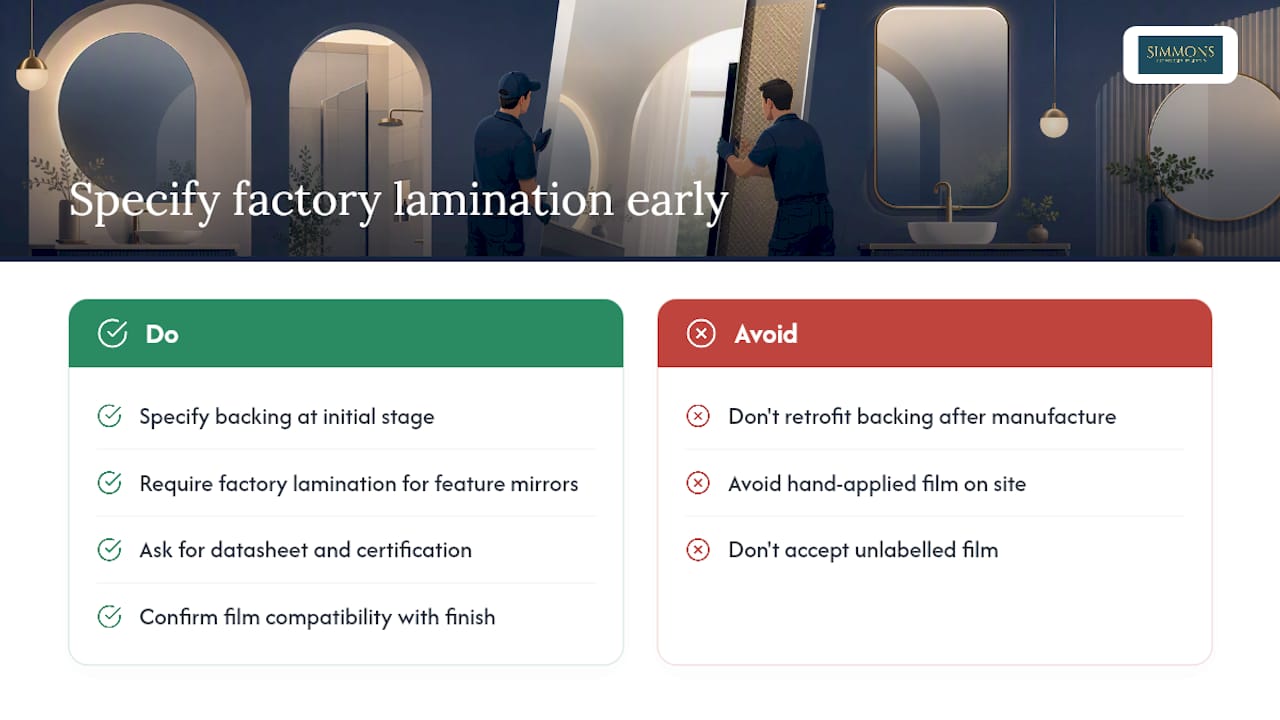
At Simmonsinteriorsupply, we work with interior designers and hospitality procurement teams who commission mirrors as centrepieces rather than afterthoughts. A sculptural, hand-finished mirror deserves a backing specification that matches its quality — not a roll of generic film applied on-site without a datasheet in sight. For every bespoke mirror commission we handle, we discuss backing requirements as part of the initial specification conversation, not as a retrofit consideration after the piece has been made.
For large feature walls and luxury finishes in particular, factory lamination is the only approach we recommend. The clarity of a machine-applied film is simply superior to hand application on a panel of any significant size, and the certified performance gives designers and their clients the documented assurance that building control and insurers increasingly expect.
Pro Tip: When specifying a mirror with an antique or bronzed finish for a feature wall, confirm with your supplier that the backing film is compatible with the specific silvering process used. Some specialist finishes require a different adhesive chemistry to avoid reaction with the coating.
Simmonsinteriorsupply's bespoke mirror service for trade clients
For designers and contractors who need more than a roll of film from a builders' merchant, Simmonsinteriorsupply offers bespoke mirror commissions with factory-applied safety backing specified from the outset. Every piece is made to your exact dimensions and finish, with backing selected to match the installation environment — whether that is a frameless feature wall in a boutique hotel or a custom-shaped mirror for a residential dressing room.
We work directly with trade accounts to provide technical datasheets, compliance references, and written installation guidance as standard. If you are specifying a large or high-value mirror and want the assurance of certified backing performance alongside the craftsmanship, request a trade quote or browse our finished installations to see the quality of work we deliver.
Sources
- CRL White 24" Category II Shatterproof Safety Tape for Mirrors | CRL
- Safety films for Mirror backing and lacquered glass | Novacel
- Mirror Safety Backing: What It Is & Why It Matters - Glass Mirror Pro LLC
- Mirror Safety Backing
Retain all datasheets with the project record and request a written installation method statement from any trade installer before work begins.