
A contract furniture warranty is a voluntary promise from a seller or manufacturer to repair, replace, or refund specific parts if they fail within a defined period. Coverage and duration vary significantly by component, from mechanisms to frames to fabric. Before placing an order, insist on written scope, a clear start date, and a documented claims process. Verbal assurances are worth nothing once a chair leg fails eighteen months into a hotel refurbishment.
TL;DR:
- Manufacturers often exclude damage caused by misuse, improper installation, or unauthorised modifications, which can void or limit warranty coverage.
- The typical warranty for structural components ranges from three years to a limited lifetime, with finishes and upholstery usually warrantied from one to five years.
- A written scope, start date, remedies, and maintenance obligations must be specified in purchase orders to ensure enforceable warranty protection.
- Claims require evidence such as photographs, proof of purchase, and installation records, with most suppliers prioritising remote inspection before site visits.
- Statutory consumer law protects buyers beyond the manufacturer's warranty, so legal rights remain even after the warranty period ends.
Table of Contents
- What does a contract furniture warranty cover?
- How long does furniture warranty last by component?
- How should you specify warranty terms in a purchase order?
- How does the furniture warranty claims process actually work?
- Do statutory rights still apply after the warranty ends?
- What should you expect from a bespoke trade supplier's aftercare?
- Three priorities every specifier should get right
- Request warranty details with your next trade quotation
- Where to check the details yourself
- Sources
- FAQ
What does a contract furniture warranty cover?
A well-drafted commercial warranty protects against genuine manufacturing failure, not the ordinary consequences of daily use. Structural defects, frame cracking under normal load, and mechanisms that fail without misuse all sit squarely within typical cover. What gets excluded is where most disputes begin, and where specifiers most often get caught out.
Manufacturers routinely exclude fair wear and tear, damage from improper installation, and any unauthorised modification made after delivery. If a client supplies their own fabric under a customer's own material (COM) arrangement, that fabric usually falls outside the manufacturer's warranty entirely, since the maker never controlled its quality or suitability.
Use also matters more than most buyers assume. Fermob's contract warranty ties cover directly to the product's designed environment, meaning outdoor furniture used indoors, or vice versa, can void protection outright. Allsteel goes further still, defining "normal use" as a single eight-hour shift per day and reserving the right to prorate or void cover where a piece is worked harder than that.
Common exclusion categories to check for in any warranty document:
- Normal wear and tear (fading, minor scuffing, seat compression over time)
- Damage from installation by unauthorised third parties
- Unapproved modifications, including re-upholstery or hardware swaps
- COM fabrics and finishes supplied outside the manufacturer's approved range
- Use beyond stated duty cycles, shift patterns, or intended indoor/outdoor environment
Read these exclusions before you compare price, not after. A cheaper quote with a thin exclusion list can cost far more across a furniture's working life.
How long does furniture warranty last by component?
Warranty duration is rarely a single number. It's a schedule, and the schedule tells you far more about build quality than any marketing copy ever will.
Frame and structural warranties tend to run longest, often between three years and a limited lifetime, reflecting the manufacturer's confidence in the underlying engineering. Roche Bobois' commercial warranty separates cover this way explicitly: structure is commonly warranted around five years, while upholstery and finishes carry noticeably shorter periods, because fabric and foam simply age faster than a welded steel frame.
Typical ranges seen across contract manufacturer schedules:
- Frame or structure: 3 years to limited lifetime
- Mechanisms and electrical components: 1 to 5 years
- Upholstery, fabric, and finishes: 1 to 5 years, often prorated after the first year or two
Pro Tip: A "limited lifetime" warranty almost never means forever. It usually means for the life of the original product model, or while the original purchaser owns the piece, whichever ends first. Always ask the supplier to define the term in writing rather than accepting the phrase at face value.
Prorating matters too. Many finish warranties reduce the settlement value the further you get from purchase, so a five-year-old upholstery claim might return a fraction of replacement cost rather than a full remedy. KI's warranty terms illustrate this component-by-component approach clearly, including limited lifetime cover for select structural items alongside time-limited cover elsewhere.
How should you specify warranty terms in a purchase order?
Warranty protection is only as strong as the paperwork behind it. A verbal promise from a sales rep does not survive a dispute; a written specification does.
Build the following into every purchase order or contract for commercial furniture:
- Explicit scope naming every covered component (frame, mechanism, upholstery, finish) separately.
- A defined start date, tied to invoice date or delivery date, never left ambiguous.
- Evidence of workmanship standards the supplier commits to, referencing recognised construction or flammability standards where relevant.
- A transferability clause, stating clearly whether cover moves with the furniture if the business changes hands or relocates.
- A remedies ladder, setting out the order of repair, then replacement, then refund, so there's no argument later about which remedy applies first.
- Maintenance obligations, spelling out what the buyer must do (cleaning regimes, load limits, environment) to keep cover valid.
Value engineering a bespoke order shouldn't mean quietly stripping out warranty terms to hit a budget line. If you're weighing cost against durability, our guide to value engineering bespoke FF&E covers where those trade-offs genuinely make sense and where they don't.
Pro Tip: Keep every installation photograph, delivery note, and maintenance log in one project file from day one. Insurers and manufacturers alike will ask for this evidence at claim stage, and reconstructing it after the fact rarely goes well.
How does the furniture warranty claims process actually work?
A claim moves faster when you arrive prepared. Manufacturers processing claims typically ask for the same core evidence, so gather it before you pick up the phone.
You'll generally need to supply:
- Photographs of the defect from multiple angles, including any visible serial or batch number
- Proof of purchase, invoice, or order confirmation showing the original purchase date
- Delivery and installation records confirming the piece was fitted correctly
- A written description of how and when the fault appeared
Once submitted, most suppliers inspect the evidence remotely first, then may request a site visit for structural or large-item claims. HPFi's warranty terms set out the typical order of remedies: repair first where practical, replacement where repair isn't viable, and a prorated refund as the last resort for older items nearing the end of their warranty window. Timelines vary by manufacturer, but expect an initial response within days and a resolution measured in weeks rather than months for straightforward claims.
Do statutory rights still apply after the warranty ends?
Statutory consumer protection exists entirely separately from any commercial warranty a manufacturer chooses to offer. A voluntary warranty can expire; your legal rights against defective goods do not disappear with it.
Legal guarantees of conformity and hidden-defect protections sit outside and beyond a manufacturer's own warranty terms. UK consumer protection guidance confirms these statutory remedies can still apply even once a commercial warranty period has run out, giving buyers a second route to redress rather than a single point of failure.
This matters practically. If a supplier refuses a reasonable remedy under their own warranty, or if a defect only becomes apparent after cover ends, statutory routes may still offer recourse. Keep both options open: document the fault, retain your purchase records, and don't assume that "warranty expired" means the conversation is over. Roche Bobois' own terms make the same point explicitly, noting that legal guarantees remain independent of whatever the commercial warranty states.
What should you expect from a bespoke trade supplier's aftercare?
Bespoke manufacturing raises the stakes on warranty clarity, since every piece is made to order rather than pulled from stock. At a bespoke trade supplier, each item is handcrafted in collaboration with skilled artisans, which means workmanship documentation matters as much as the finished piece itself.
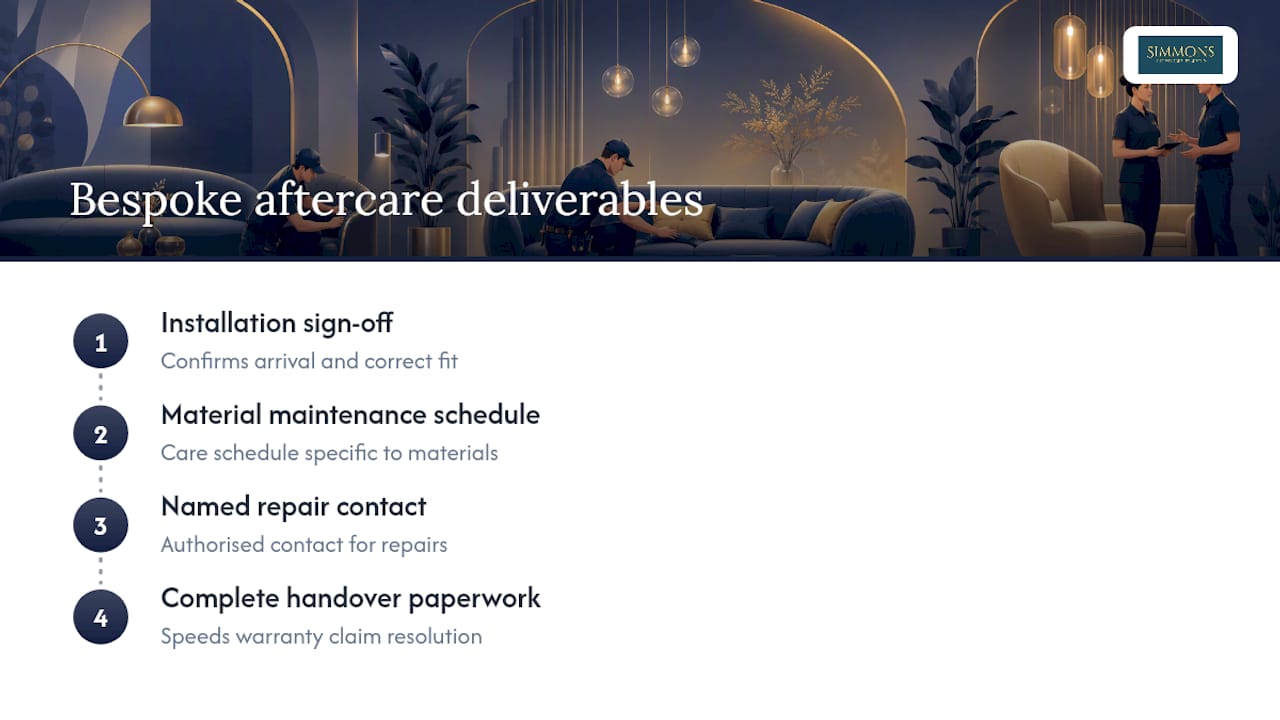
When specifying from any bespoke trade supplier, ask for three things beyond the warranty certificate: a formal installation sign-off confirming the piece arrived and was fitted correctly, a maintenance schedule specific to the materials used, and a named contact for authorised repairs. Our own guidance on contract-grade furniture specification sets out why these deliverables separate a serious trade supplier from one offering cover on paper alone. A clear certificate paired with proper handover paperwork consistently shortens claim resolution times when something does need attention.
Three priorities every specifier should get right
If there's one habit that separates smooth projects from painful ones, it's treating warranty terms as a contract document, not marketing collateral. Insist on written scope and a defined remedies ladder before you sign, not after a problem surfaces.
Retain every piece of installation and maintenance evidence from day one. Claims stall or fail far more often from missing paperwork than from genuine manufacturer reluctance. Bring procurement and facilities teams into the conversation early too, since warranty terms agreed at order stage are worthless if nobody downstream knows they exist or how to enforce them.
— Luke
Request warranty details with your next trade quotation
Every piece made by a bespoke trade supplier is handcrafted to order, sized and finished fitting your space exactly, with workmanship documentation that gives specifiers confidence long after installation day. That's a different proposition to buying from stock: you get a maker who knows the piece from first sketch to final fitting, not a warranty department reading from a script.

When you request a trade quotation, ask for your warranty terms and certificate to be issued alongside it, so scope, duration, and claims contacts are settled before manufacturing begins. Explore the bespoke furniture collection and start a trade quotation today, or browse a finished example like the bespoke nest of coffee tables to see the level of craftsmanship behind every warranty we stand behind.
Where to check the details yourself
For statutory rights that sit alongside any commercial warranty, consult gov.uk's consumer protection guidance directly. The Roche Bobois and Fermob warranty pages referenced throughout this guide are illustrative examples only; always request and read the full terms from your own supplier before relying on any cover.
Sources
FAQ
What does a warranty cover on furniture?
A furniture warranty typically covers manufacturing defects in the frame, structure, and mechanisms, plus faults in upholstery or finishes within a stated period. It generally excludes normal wear and tear, misuse, and damage from unauthorised modifications, as Roche Bobois' warranty terms illustrate with their component-by-component exclusion list.
In contract law, what is a warranty?
A warranty in contract law is a promise or assurance about the quality, condition, or performance of goods, distinct from the main obligation to deliver them. In furniture procurement, this promise is set out in the supplier's written warranty terms and sits alongside, rather than replaces, statutory consumer protections.
What are my rights with a faulty sofa?
You have the right to pursue remedies under both the manufacturer's commercial warranty, if one applies, and separate statutory protections. UK consumer protection guidance confirms these statutory rights exist independently and can still provide redress even where a commercial warranty has expired or been refused.
Do I have consumer rights if my product has a 2-year warranty?
Yes. A manufacturer's stated warranty period, whether two years or otherwise, does not limit or replace your separate statutory rights. Those legal protections against hidden defects and conformity issues continue to apply on their own terms, regardless of what the commercial warranty document specifies.
How long should a contract furniture warranty last?
Duration depends on the component: frames and structures commonly carry cover from three years up to a limited lifetime, while mechanisms and upholstery typically range from one to five years. Always request the full component-by-component schedule in writing rather than relying on a single headline figure.