
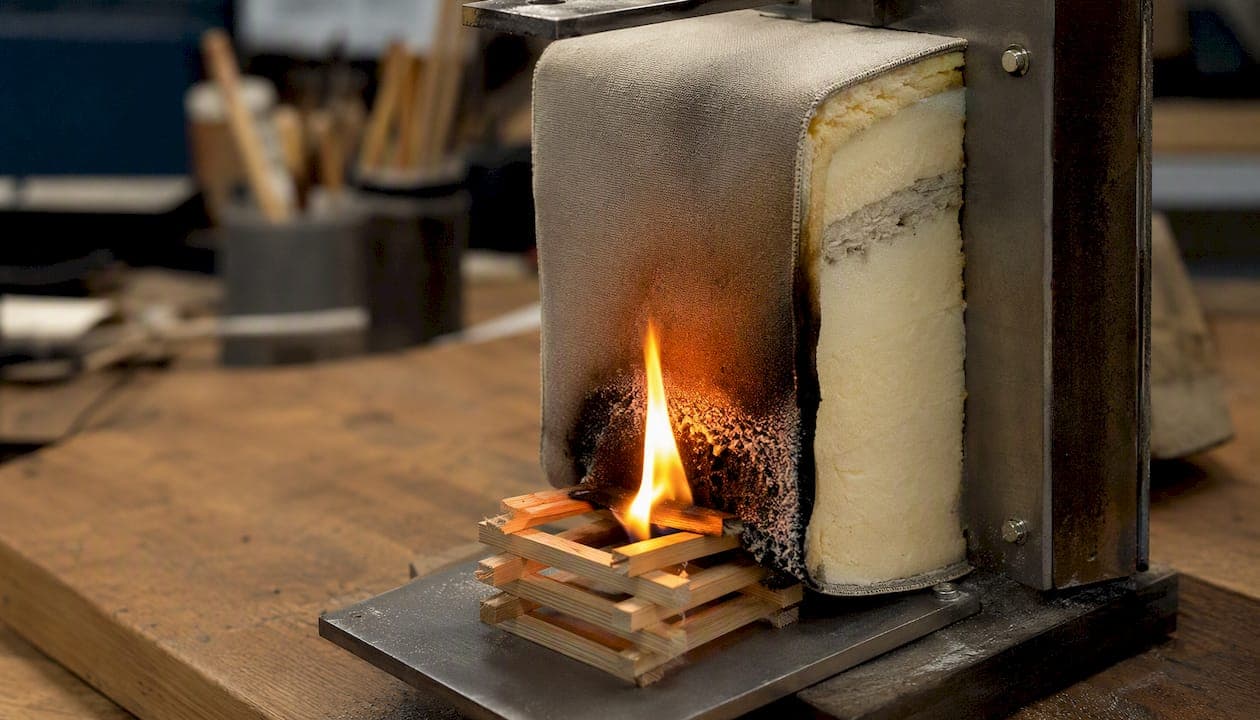
Crib 5 (formally BS 5852 Ignition Source 5) is the fire-resistance rating you must specify for most commercial soft seating in the UK. If you are procuring upholstery for a hotel, care home, student accommodation, or any build-to-rent scheme, this standard is your baseline. Before you sign off any fabric or foam, three things need to happen:
- Request the full UKAS-accredited laboratory test report citing BS 5852 Ignition Source 5 by name, not a summary sheet or a supplier's assurance letter.
- Confirm the exact composite tested: face fabric, interliner (if used), and foam specification must all match what you plan to use in the finished piece.
- Obtain traceable roll or batch numbers and the date of the test, so your documentation chain is unbroken from mill to installation.
Miss any one of those three steps and your compliance position is weaker than it looks on paper.
Table of Contents
- What is Crib 5 and what does BS 5852 actually cover?
- How does the Crib 5 test work, and what does a pass look like?
- Practical ways to achieve Crib 5 in upholstered seating
- How to specify and verify compliance: a procurement checklist
- Key takeaways
- The specification mistake that costs projects most
- Simmonsinteriorsupply: bespoke seating with full compliance support
What is Crib 5 and what does BS 5852 actually cover?
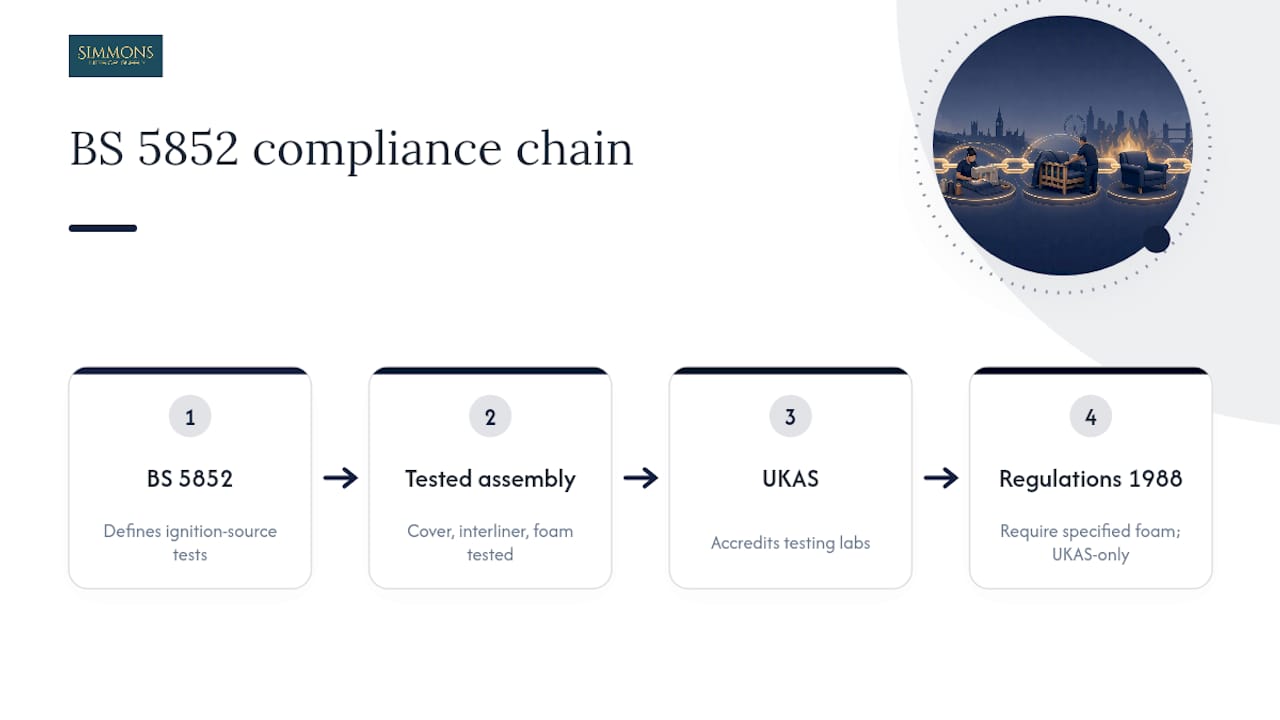
BS 5852 is the British Standard that defines how upholstered composites are tested for ignitability. It uses a numbered ignition-source system: lower numbers represent smaller, less severe sources of ignition, and higher numbers represent progressively more demanding ones. Ignition Source 5, universally known as Crib 5, uses a five-tier timber lattice (the "crib") as the ignition device. BS 5852 defines multiple ignition sources, ranging from gas flames through to wooden cribs of increasing size, with Crib 7 representing a significantly larger and more demanding test used in higher-risk environments such as prisons and offshore installations.
The critical point that catches specifiers out: BS 5852 tests the assembly, not the face fabric in isolation. A cover cloth, an interliner, and a foam filling are tested together as a composite. A fabric that passes Crib 5 when paired with one foam may fail entirely when paired with another. Schedule 4 of the Furniture and Furnishings (Fire) (Safety) Regulations 1988 makes this explicit: the foam used in the test must be specified, and different fillings must be tested separately.
Three named entities underpin every compliant specification: BS 5852 (the test standard), the Furniture and Furnishings (Fire) (Safety) Regulations 1988 (the legal instrument), and UKAS (the United Kingdom Accreditation Service, which accredits the laboratories that issue valid test reports). A certificate from a non-UKAS laboratory carries no legal weight in a UK contract context.
How does the Crib 5 test work, and what does a pass look like?
The three-stage testing sequence that suppliers commonly reference follows a logical escalation: the composite must first pass the cigarette test (Ignition Source 0), then the match test (Ignition Source 1), before proceeding to the crib test (Ignition Source 5). Failing at an earlier stage means the material does not progress. The London Fire Brigade's smoking safety guidance provides useful background on why smouldering ignition sources remain a primary risk driver in furnished interiors, which is precisely why the cigarette test sits at the start of the sequence.
For the Crib 5 test itself, the composite assembly is draped over a test rig in a standardised configuration. The five-tier timber crib is placed at the junction of the seat and back, ignited, and the assembly is observed for flaming, smouldering, and char behaviour. The key pass/fail criteria include no sustained flaming beyond the duration of the test. | Progressive smouldering | No smouldering that continues to spread after crib extinguishes | | Char extent | Within defined limits per the standard | | Ignition source | Five-tier timber crib (Ignition Source 5) |
The 10-minute flaming limit is the headline criterion for Ignition Source 5. Any assembly that sustains flaming beyond that point fails, regardless of char extent.
When you receive a test report, check these specifics before accepting it:
- The ignition source number is stated as IS5 or Ignition Source 5, not a lower number.
- The laboratory holds current UKAS accreditation and the report carries the UKAS schedule number.
- The foam specification used in the test is named explicitly, matching what you plan to use.
- The test date is recent enough to be valid for your project, and the certificate has not lapsed.
- If a topical FR treatment was used, confirm whether the report includes a water-soak retest stage.
Practical ways to achieve Crib 5 in upholstered seating
There is no single route to a compliant assembly, and the choice of approach shapes everything from the hand of the finished fabric to its longevity in a high-cleaning environment. The four main strategies each carry genuine tradeoffs.
-
Inherently FR fibres: Certain fibres, including some wool blends, modacrylic, and glass-fibre-core yarns, carry fire resistance as an intrinsic property of the fibre itself. The compliance survives cleaning, re-upholstery, and years of use without degradation. For high-turnover hospitality or healthcare environments, this is the most durable route, though inherent FR fabrics often carry a price premium and can limit aesthetic choice.
-
Topical or back-coating FR treatments: Many contract fabrics achieve Crib 5 through a factory-applied chemical treatment or a back-coating. The compliance is real, but it is conditional: cleaning, particularly wet cleaning or laundering, can reduce or remove the treatment's effectiveness. Full certification for treated fabrics should include a water-soak retest stage. If the certificate you receive does not mention water-soak, ask explicitly whether it was tested. Where topical treatment is unavoidable, insist on treatment by a UKAS-accredited house and request documentary proof of the water-soak retest.
-
Fire-barrier interliners: A compliant interliner placed between the face fabric and the foam can bring an otherwise non-compliant cover cloth into a passing composite. This approach is popular because it preserves fabric choice, but the interliner must be part of the tested assembly. Swapping the interliner brand or weight after certification invalidates the certificate.
-
CMHR (combustion-modified high-resilience) foam: Combustion-modified foams are formulated to resist ignition and limit flame spread. Using a CMHR foam specified in a tested composite is often the most straightforward route to compliance for standard contract seating. The foam grade and density must match the test report exactly; substituting a cheaper or different-grade foam is a common and costly mistake.
The assembly principle bears repeating: an elegant face fabric with a valid Crib 5 certificate for one composite is not automatically compliant when paired with a different foam or no interliner. The certificate belongs to the combination, not the cloth.
Pro Tip: The most common hidden failure mode is a replacement or repair foam that was never tested in the certified composite. When specifying bespoke or re-upholstered pieces, include the foam specification in the purchase order and insist the maker confirms it matches the test report. A loose-fill cushion insert sourced separately is a particular risk.
How to specify and verify compliance: a procurement checklist
Clarity at the procurement stage prevents expensive remediation later. Work through these steps in order before committing to any material.
- Request the full UKAS test report, not a summary, a certificate of conformity alone, or a supplier's own declaration. The report must name the laboratory, its UKAS accreditation number, the ignition source (IS5), and the exact composite tested.
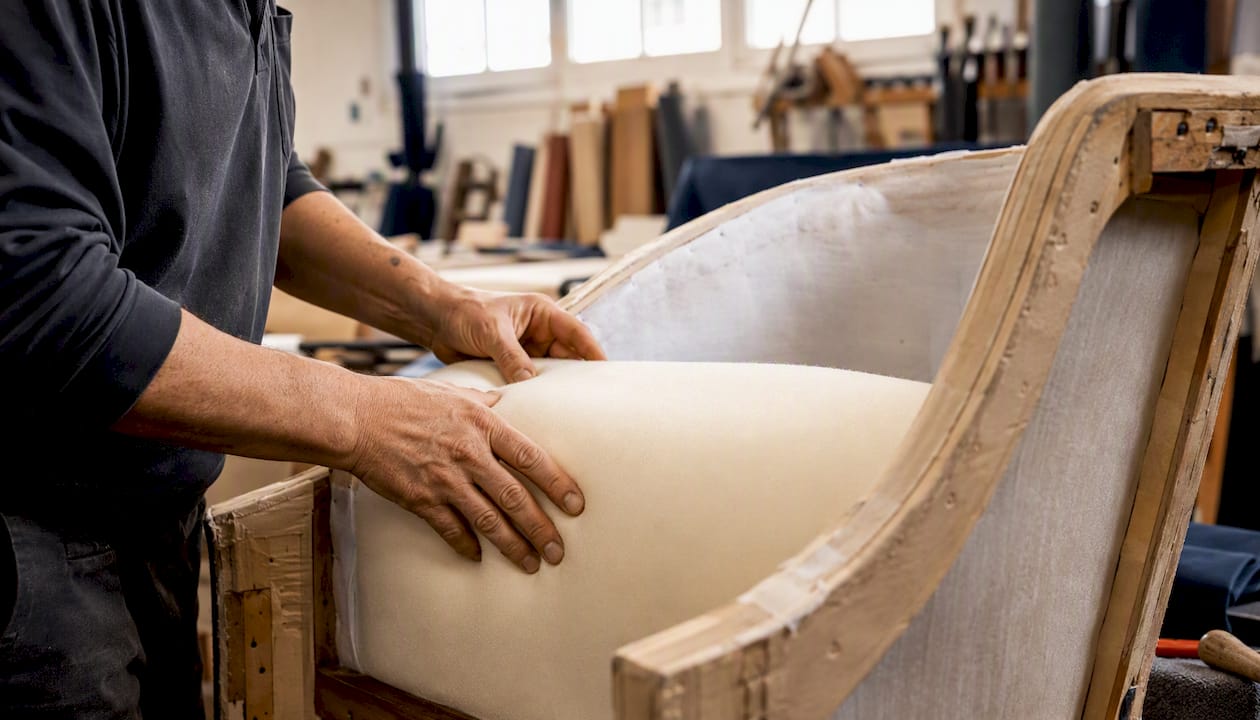
- Supply the exact composite you will use. Provide the supplier with your intended face fabric, interliner (if applicable), and foam specification, and confirm that the certificate covers that precise combination.
- Obtain roll or lot numbers for the fabric and interliner, and the foam batch reference. These go into your project file and onto the purchase order.
- Confirm water-soak status. Ask whether the certificate includes the post-soak retest stage, particularly for topically treated fabrics.
- Request the technical datasheet alongside the test report. The datasheet should state BS 5852 / Crib 5 compliance, Martindale abrasion rating, cleaning code, and stain-resistance details. Martindale rub count guidance explains how to interpret abrasion ratings alongside fire certification for contract performance assurance.
- For critical projects, consider specifying to BS 7176 (Medium Hazard) rather than Crib 5 alone. BS 7176 documents end-use and foam specification explicitly, giving clearer assurance for hospitality and healthcare procurement.
A short sample enquiry you can send to any fabric supplier:
Watch for these red flags in supplier responses:
- The supplier offers only an "indicative" test result or a summary certificate without the full laboratory report.
- The report does not name a UKAS-accredited laboratory.
- Roll or lot traceability is unavailable or vague.
- The wording reads "meets Crib 5 when treated" without evidence of a water-soak retest.
- The foam used in the test is unnamed or described generically as "standard foam."
Key takeaways
Crib 5 compliance in upholstery requires a UKAS-accredited test report for the exact composite you specify: face fabric, interliner, and foam must all match the tested assembly.
| Point | Details |
|---|---|
| Test the whole assembly | The BS 5852 Crib 5 certificate belongs to the composite, not the face fabric alone. |
| Water-soak retest matters | Topically treated fabrics can fail after cleaning; always confirm whether the certificate includes the water-soak stage. |
| Sectors requiring Crib 5 | Hotels, care homes, student accommodation, BTR, and leisure venues commonly require Crib 5 as a minimum. |
| Documentation non-negotiables | Demand the full UKAS lab report, technical datasheet, roll/lot numbers, and foam specification before sign-off. |
| Simmonsinteriorsupply's approach | Simmonsinteriorsupply provides full UKAS test reports, batch traceability, and cleaning guidance with every bespoke seating commission. |
The specification mistake that costs projects most
The most persistent error in contract upholstery specification is treating a fabric's Crib 5 claim as self-contained proof of compliance. It is not. A face fabric with a valid certificate, paired with an untested foam or a missing interliner, is an uncertified assembly. The certificate describes a specific combination of materials tested on a specific date in a specific laboratory. Change one element and you are, technically, starting again.
What makes this particularly frustrating is that it is entirely avoidable. The fix is procedural, not expensive: write the foam specification and interliner reference into the purchase order, file the UKAS report against the project, and do not accept a substitution without a fresh compliance review. Projects that run into trouble almost always skipped one of those steps under time pressure.
The second common mistake is leaving FR treatment to the last moment. Topical treatment takes time, and if the treatment house is busy, lead times stretch. A fabric that "can be treated to Crib 5" is not the same as a fabric that is treated and certified. Specifying an inherently FR fabric from the outset, where the aesthetic allows, removes that variable entirely. For environments where cleaning frequency is high, such as care homes or children's spaces, inherent FR is not a luxury preference but a practical necessity.
Simmonsinteriorsupply: bespoke seating with full compliance support
For trade clients who need Crib 5 seating without the administrative burden of chasing certificates across multiple suppliers, Simmonsinteriorsupply offers a different kind of service. Every bespoke piece is made to order, with material sign-off, UKAS documentation handling, and full batch traceability built into the workflow from the first briefing call.
When you commission seating through Simmonsinteriorsupply, you receive the full UKAS test report for your exact composite, the technical datasheet, cleaning guidance, and traceable batch references as standard. There is no chasing, no ambiguity about which foam was tested, and no last-minute scramble for paperwork before a site handover. The craftsmanship is bespoke; the compliance documentation is thorough.
Trade enquiries are welcome. Start your project with a brief and we will confirm material options, compliance documentation, and lead times from the outset.