
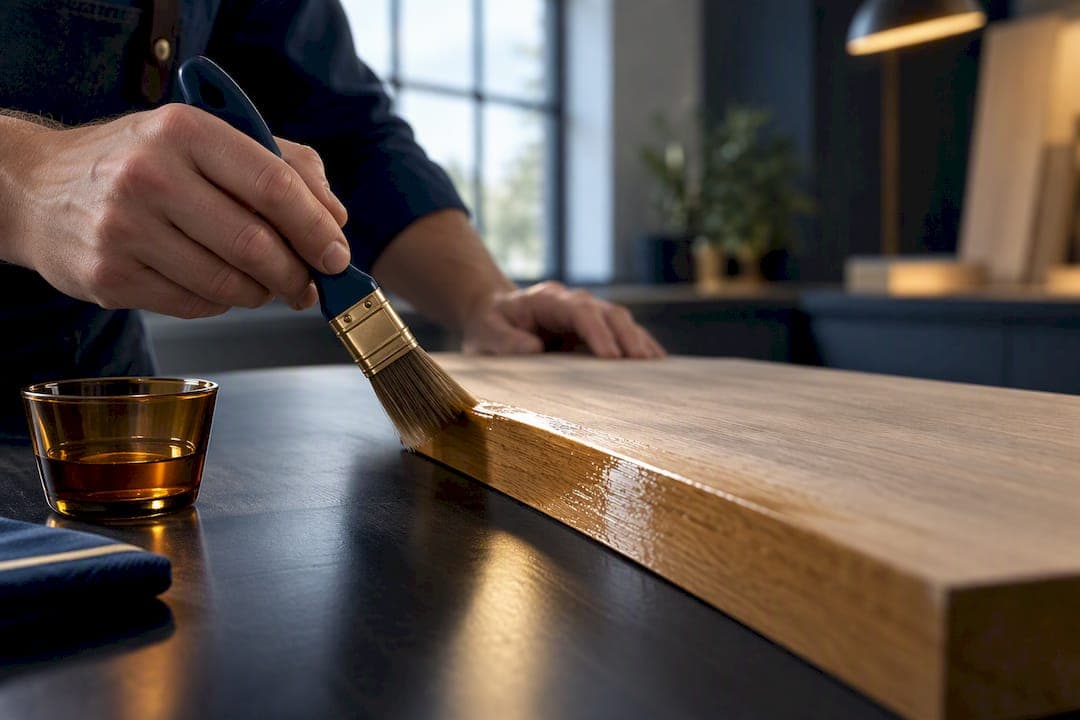
For healthier indoor furniture, favour water-borne acrylic or acrylic-polyurethane systems for hardworking pieces and natural oils or hard wax oils where a softer, more tactile finish suits the wood. Both families sit comfortably within accepted low VOC content thresholds, but the figure on the tin is only half the story. A finish can be low in VOC content and still release odorous compounds as it cures, so where indoor air quality matters most, pair your choice with independent emissions testing rather than the label alone.
TL;DR:
- Water-borne acrylic-polyurethane lacquers suit furniture needing frequent use due to their durability, but may require multiple coats to minimize emissions.
- Traditional natural oils like tung or linseed sit in the low-emission category but demand regular reapplication and less resistive to water and wear.
- Independent emission testing and considering cure time provide more insight into actual indoor air quality than VOC content alone.
- Applying thin, even coats and ventilating during and after finishing significantly reduces odour and post-application VOC release.
- Choosing finishes tailored to furniture use and room sensitivities requires assessing wear, moisture exposure, and performance rather than relying solely on label VOC figures.
Table of Contents
- Types of low VOC finishes: water-borne systems, shellac and natural oils
- How to pick the right low VOC finish for your furniture project
- Application, curing and shop controls to reduce odour and emissions
- Trade perspective: how Simmons Interior Supply specifies finishes
- An editorial take on chasing the lowest number
- Bring your finish decisions to a bespoke maker
- Sources
- FAQ
Types of low VOC finishes: water-borne systems, shellac and natural oils
Water-borne varnishes and acrylic-polyurethane lacquers have become the default recommendation for furniture makers who want durability without heavy solvent loads. Under UK regulations, interior and exterior trim varnishes and woodstains face a ready-to-use limit of 130 grams per litre for water-borne coatings, against 400 grams per litre for solvent-borne equivalents, a gap wide enough to explain why so many manufacturers have shifted formulations towards water as the primary carrier.
Pre-catalysed and post-catalysed lacquers complicate the picture. Many high-performance two-pack systems remain solvent-based because the chemistry that delivers exceptional abrasion and chemical resistance, particularly for commercial and hospitality furniture, has proven harder to replicate in water-borne form. A post-cat conversion varnish will often outperform a water-borne acrylic on a heavily used tabletop, and that trade-off between environmental profile and sheer toughness is one every specifier eventually has to weigh.
Shellac, tung oil, linseed oil and hard wax oils sit at the other end of the spectrum. These are traditional, naturally derived options with genuinely low solvent content, prized for the way they sit in the grain rather than forming a hard film. Their weakness is maintenance: a waxed or oiled surface asks for periodic reapplication and offers less resistance to standing water or heavy abrasion than a cured lacquer film.
A few points worth keeping in mind when comparing families:
- Water-borne acrylic-PU systems suit tables, chairs and other pieces that need daily wear resistance.
- Hard wax oils and natural oils suit lower-traffic pieces where touch and appearance matter more than industrial toughness.
- Shellac remains useful for restoration work and for sealing knots or resinous timbers before a final coat.
- Solvent-borne two-pack lacquers still have a place where maximum durability outweighs the emissions cost.
"Low odour" is not a guarantee of low emissions. Some water-borne formulations still contain co-solvents, coalescing agents or residual monomers that produce a noticeable smell even when the headline VOC figure is modest, a reminder that formulation detail matters as much as the category name on the tin.
How to pick the right low VOC finish for your furniture project
Start by being honest about how the piece will be used. A dining table that hosts daily meals needs different protection from a display cabinet that rarely sees a hand on it, and sheen preference, moisture exposure and how much maintenance the owner is willing to do should all shape the decision before you open a single tin.
- Assess the piece's wear pattern, moisture exposure and the sheen level the client wants.
- Check the product label for its subcategory and confirm the ready-to-use VOC content against the Schedule 2 limit values for that category.
- Where available, favour products carrying EU Ecolabel accreditation or independent low-emission test certification over VOC content alone.
- Ask the supplier directly for emission test data if the intended use is a bedroom, nursery or other space with limited ventilation.
- Weigh the product's "efficiency in use", meaning its spreading rate and the number of coats it needs, against a simple VOC number.
That last point deserves emphasis. A finish with an impressively low VOC content that requires four thin coats instead of two can end up releasing more total solvent over the life of the job than a slightly higher-VOC product applied economically. Efficiency in use, covering spreading rate, coverage per coat and drying behaviour between coats, is built into the EU Ecolabel's own criteria for a reason: a coating's environmental footprint depends on how much of it you actually use, not just what is in each litre; this is well explained in the Additives for Polyurethane Coatings: Selection Guide.
Pro Tip: Before committing to a finish for a full run of furniture, apply it to an offcut of the same timber and let it cure for the full recommended period; smell and touch it again after a week rather than judging it fresh off the brush.
When speaking with suppliers, it helps to ask about cure time under normal shop conditions, the ventilation rate they recommend during application, how many coats their own testing was based on, and which abrasion resistance class the finish has been rated to.
Application, curing and shop controls to reduce odour and emissions
Preparation matters as much as the finish itself. Manufactured boards and the adhesives that hold them together are a genuine source of indoor VOCs, so where a project allows it, choosing solid timber or a low-emission board substrate reduces the overall chemical load before a single coat goes on. Sanding to an even, consistent grain and sealing correctly gives any finish, water-borne or oil-based, a fair chance to perform as intended.

Thin, even coats cure more completely than thick ones. A heavy application traps solvent beneath a skinned-over surface, which extends the period over which volatile compounds continue to escape into the room long after the piece feels dry to the touch. Respecting the manufacturer's recoat window rather than rushing the next layer avoids this trap entirely.
A few shop practices make a measurable difference:
- Ventilate the finishing area during application and for several hours afterwards, ideally with a through draught rather than a single open window.
- Maintain a stable, moderate temperature, since both very cold and very warm conditions alter how a coating cures and off-gases.
- Store freshly finished pieces away from occupied rooms until the surface has fully cured, not merely until it feels dry.
- Keep the piece out of bedrooms and nurseries for longer if you are working with a solvent-borne two-pack system.
Pro Tip: As a rule of thumb, "dry to the touch" and "fully cured" are different milestones. Most water-borne lacquers feel dry within hours but can continue releasing trace VOCs for one to two weeks, so give a piece that time in a ventilated space before it goes into daily use.
Trade perspective: how Simmons Interior Supply specifies finishes
Every bespoke commission at Simmons Interior Supply starts with the same question: how will this piece actually live in its room. A dining table destined for countless languid lunches and longwinded dinners needs a harder-wearing water-borne acrylic-PU or, for demanding hospitality projects, a solvent-borne conversion varnish where durability has to come first. A bedside table, seeing lighter use and closer proximity to a sleeping occupant, is a natural fit for a hard wax oil or a low-emission water-borne lacquer.
Our own specification checklist runs through wear category, room type, sheen preference and any client sensitivities before a finish is ever proposed, because the right answer changes with every commission rather than defaulting to whichever product sits lowest on a VOC chart.
An editorial take on chasing the lowest number

The furniture trade has fallen into a habit of treating VOC content as a single competitive score, the lower the better, full stop. That instinct is understandable but incomplete. A water-based coating that needs three extra coats to match the coverage of a solvent-borne alternative, or one that off-gases for a fortnight despite a flattering label, has not necessarily delivered a healthier result, only a more reassuring number.
What the evidence actually supports is a shift in priority from content to consequence. Efficiency in use, cure time and independent emission testing tell you more about what a room will actually smell and breathe like than the grams-per-litre figure on the tin. If there is one habit worth adopting from this guide, it is asking suppliers for post-cure emission data before assuming a "low VOC" claim has done the work for you. The label is a starting point, not a verdict.
— Luke
Bring your finish decisions to a bespoke maker
Choosing between finish families is easier when the piece is being built specifically for the room it will live in, rather than adapted from a stock design after the fact. At Simmons Interior Supply, every piece in the bespoke furniture collection is handcrafted to order, which means the finish gets chosen alongside the timber, the joinery and the intended use rather than bolted on at the end.

If you are an interior designer, architect or trade buyer working on a commission where indoor air quality and durability both matter, our gallery of finished work shows the range of finishes we specify across residential and hospitality projects, and our current collection is a useful starting point for seeing custom sizing and finish options in practice. Get in touch to discuss a commission suited to your space.
Sources
For anyone specifying finishes professionally, three sources are worth bookmarking directly:
- The Volatile Organic Compounds in Paints, Varnishes and Vehicle Refinishing Products Regulations 2012 (Schedule 2)
- Indoor airborne VOCs from water‑based coatings: transfer dynamics and health implications (MDPI, 2025)
FAQ
What are some low VOC finishes for wood?
Water-borne acrylic and acrylic-polyurethane lacquers, shellac, natural oils such as tung or linseed, and hard wax oils are all commonly marketed as low VOC options. Each sits within different VOC content limits and offers a different balance of durability and maintenance, so the right choice depends on how the piece will be used.
What are low VOC finishes?
A low VOC finish is a paint, varnish or lacquer whose ready-to-use volatile organic compound content falls at or below the limits set for its product category, such as the 130 grams per litre threshold for water-borne interior trim varnishes. The figure describes the product as sold, not necessarily what it emits once applied and curing.
What is a non-toxic clear finish for wood?
There is no finish that is entirely free of volatile compounds, but hard wax oils, shellac and water-borne acrylic clear coats are widely regarded as the lower-risk options for indoor furniture. Choosing a product with independent low-emission certification, rather than relying on VOC content alone, gives a more reliable picture of what it releases after it cures.
What is the least smelly wood finish?
Hard wax oils and water-borne acrylic lacquers formulated without strong co-solvents tend to produce the least noticeable odour during and after application. Even so, a 2025 study found that some water-based coatings marketed as low-emission still released detectable VOCs, so airing a finished piece for one to two weeks before daily use remains the safer habit.