
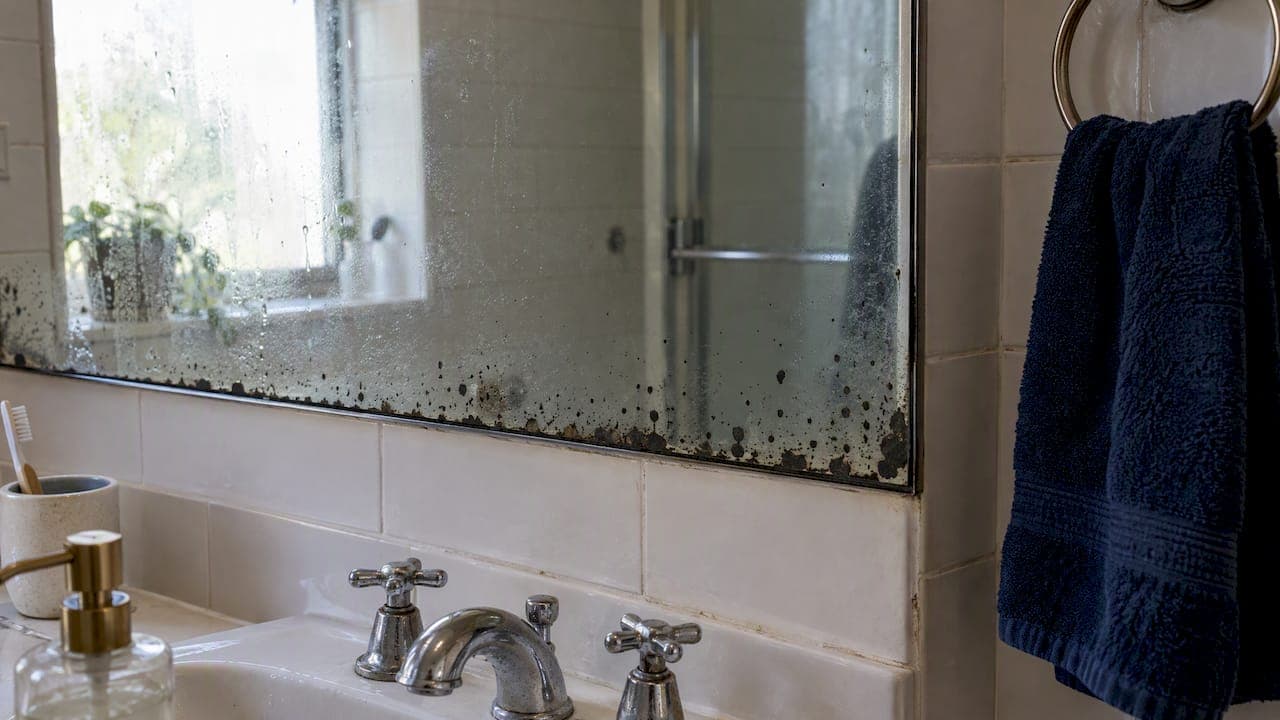
Preventing mirror desilvering comes down to three things: control moisture, protect the mirror's edges, and stop using harsh chemicals near the glass. This afternoon, check that your bathroom or hallway has working ventilation, swap any ammonia-based spray for a gentler alternative, and run a finger along the mirror's back edge to feel for gaps or peeling tape. If the backing already shows black patches spreading from the edge, that is corrosion in progress, and it is worth calling a glazing specialist before the damage reaches the viewing area.
TL;DR:
- Household moisture reaches roughly 12 liters daily, and indoor laundry can push it above 20; dry clothes outdoors or in a vented utility room.
- Inspect bathroom edge seals every three to four months and other mirrors twice yearly, checking for lifted tape, cracked sealant, or a faint gray haze.
- Clean with demineralized water and mild detergent or dilute isopropyl alcohol; avoid ammonia, bleach, and strong acids or alkalis, and spray the cloth rather than the glass.
- A repair kit can mask isolated black spots, but cleaning cannot reverse corrosion, and replacement is the only lasting fix once damage spreads across glass.
- Standard silvered mirrors are unsuitable for saunas, poolside areas, and commercial wet rooms; uneven heating from poorly fitted demister pads can also speed corrosion.
Table of Contents
- Quick prevention checklist for homeowners and trades
- Why mirrors desilver: condensation, chemicals, edge ingress and heat
- Practical prevention methods: ventilation, humidity and maintenance routines
- Cleaning: safe products and correct technique
- Installation and edge protection that extends mirror life
- Special cases: heated mirrors, defogger films and alternatives
- A tradesperson's view on specification and bespoke finishing
- What I've learned from watching mirrors fail
- How we help when prevention isn't enough
- FAQ
- Sources
Quick prevention checklist for homeowners and trades
Most desilvering starts quietly, long before the first black fleck appears, so the checklist below is ordered by what stops damage fastest.
- Ventilate first: open a window or run an extractor fan during and after showers or baths, since this is the single cheapest fix.
- Fit a humidistat extractor: these switch on automatically once humidity crosses a set threshold, which South Kesteven District Council's condensation guidance recommends for efficient, low-effort moisture control.
- Add a dehumidifier in rooms with no outside wall or window, particularly basement bathrooms or internal cloakrooms.
- Inspect edge seals every few months, looking for lifted tape, cracked sealant, or any gap where water could creep behind the glass.
- Keep background heating low but constant rather than letting rooms swing cold, since steady air temperature reduces the condensation that settles on glass.
The humidistat fan and dehumidifier are DIY installs for most homeowners; resealing a damaged edge or replacing a backing plate is trade work. Expect visibly less condensation within a week or two of improving ventilation, though edge corrosion that has already started will not reverse itself.
Pro Tip: Wipe the mirror dry after every shower for the first fortnight after fitting a new extractor. It tells you quickly whether the fan is actually keeping pace with the steam.
Why mirrors desilver: condensation, chemicals, edge ingress and heat
A mirror's reflective layer is a thin coat of silver (or sometimes aluminium) sitting behind the glass, protected by a copper layer and a paint backing. When moisture reaches that silver, it oxidises and turns black, usually starting at the edges and creeping inward in a pattern that looks like spreading ink.
Condensation is the most common trigger. Warm, humid air meets the cool glass surface, water collects, and if it is never fully dried, it eventually finds its way past the backing paint through pinholes or the cut edge. Ammonia and bleach make this worse directly: both chemicals attack the copper and paint layers that are meant to shield the silver, which is why they are flagged repeatedly in mirror care guidance as substances to avoid altogether.
Edge ingress is the quieter culprit. A poorly finished or unsealed edge lets moisture travel sideways into the mirror by capillary action, which is why black spots so often begin at the perimeter rather than the centre. Heat adds another layer of risk: uneven warming, such as from a poorly fitted heated demister pad, can accelerate corrosion at the point where hot and cold sections meet. BS EN 1036-1 sets the durability and condensation-resistance tests that commercial mirrors are measured against, including the protective coatings meant to guard against exactly this failure mode.

Practical prevention methods: ventilation, humidity and maintenance routines
Controlling the air around a mirror matters more than almost anything done to the glass itself. Approved Document F sets out the ventilation standards that bathrooms and kitchens in England are expected to meet, and the same principles apply whether you are renovating or simply trying to keep an existing mirror in good condition.
- Fit extract ventilation in wet rooms: a humidistat-controlled fan sized to the room clears water vapour at source, which is the core requirement in current building ventilation guidance.
- Use trickle vents and purge ventilation: background trickle vents keep a slow exchange of air going, while opening a window fully after bathing clears a sudden spike in humidity.
- Keep a low, steady background heat: a warm, stable room generates less condensation than one that is cold most of the day and briefly steamy during a shower.
- Dry laundry outside where possible: ordinary household activity generates roughly 12 litres of moisture a day, and indoor drying can push that well beyond 20 litres, so moving laundry outdoors or into a vented utility space noticeably reduces the load on your extractor.
- Run a dehumidifier in persistently damp rooms: this costs more to run than a humidistat fan but suits rooms with no external wall, where ventilation alone cannot clear moisture fast enough.
A sensible inspection routine is to check edge seals and backing condition every three to four months in bathrooms, and twice a year elsewhere in the home. Look for lifted tape, hairline cracks in the sealant, or the faint grey haze that often precedes visible black spotting.
Pro Tip: If you can see your breath fog the mirror within seconds of entering a cold bathroom, your background heating is too low, whatever your extractor fan is doing.
Cleaning: safe products and correct technique
What you clean a mirror with matters as much as how often. The wrong product does not just fail to clean properly, it actively shortens the mirror's life.
- Avoid ammonia-based glass cleaners, which are among the most commonly cited causes of accelerated backing corrosion.
- Avoid bleach and strong acids or alkalis, since both can strip the protective paint layer on contact.
- Use demineralised water with a mild detergent, or a dilute isopropyl alcohol solution, for routine cleaning.
- Spray the cloth, not the glass, so liquid never has the chance to run down behind the frame or pool at the base.
- Dry the edges thoroughly after cleaning, since this is where trapped moisture does the most damage.
- Never soak or flood the backing, particularly around any existing chips or scratches in the paint.
Small, isolated black spots can sometimes be masked with a mirror repair kit or covered decoratively, but once corrosion has spread across a visible section, no cleaning product reverses it. At that point, replacement is the only real fix, and our guide to custom mirror costs and an RFQ checklist is a useful starting point for budgeting that decision.
Installation and edge protection that extends mirror life
Most desilvering that happens within the first few years traces back to how the mirror was finished and fitted rather than how it was cleaned afterwards. Industry guidance from Pilkington on processing and edge treatment recommends cleaning cut edges with demineralised water immediately after processing and stacking mirrors with spacers so air can circulate before and after installation.
- Specify polished, chip-free edges, since rough or chipped glass gives moisture a route in by capillary action.
- Use neutral-cure silicone sealants that are compatible with mirror backing paint; acidic sealants can attack the coating on contact.
- Leave a ventilation path behind the mirror, using spacers or vertical ventilation strips rather than mounting flush against a solid wall.
- Consider safety backing such as laminated or tempered glass for large or heavy pieces, particularly in bathrooms where a failure risk exists alongside the corrosion risk; our guide to safety backing covers the options in more depth.
- For bespoke mirrors, request finish choices and backing coatings at the specification stage rather than treating them as an afterthought, since this is where most future desilvering risk gets decided.
Special cases: heated mirrors, defogger films and alternatives
A heated demister pad or film clears condensation reliably when fitted well, but uneven heating across the pad or poor adhesion between the film and backing can accelerate corrosion exactly where the temperature gradient is sharpest. A good installer tests for even heat distribution before handover, rather than relying on a single power-on check.
- Specify quality heated film installation, checking the surface by hand for cold spots once the demister has been running for a few minutes.
- Choose acrylic or polished metal in extreme environments, since standard silvered glass is not built for constant high humidity.
- Avoid standard mirrors in saunas, poolside areas, or commercial wet rooms, where BS EN 1036-1's own scope excludes constantly humid atmospheres and calls for different materials entirely.
- Treat heated mirrors as a trade specification item, not a retrofit accessory, if the mirror is design-critical or difficult to replace.
A tradesperson's view on specification and bespoke finishing
Years of fitting and replacing mirrors across homes and commercial interiors teaches a simple lesson: the mirrors that fail early are almost always the ones where edge finishing was an afterthought. We specify protective backing coatings and compatible edge sealants as standard practice, because a mirror ordered to the right size with the right finish rarely needs the repair conversations this guide is written to help readers avoid. When we build a bespoke piece, finish choice is part of the brief from the first conversation, not a late addition.

What I've learned from watching mirrors fail
The mirrors I've seen fail hardest were never the ones with sudden, dramatic damage. They were the quiet ones, a faint grey edge nobody noticed for months until it had spread halfway across the glass. Catch moisture early, protect the edge properly, and a mirror will outlast most of the room around it.
— Luke
How we help when prevention isn't enough
Sometimes the honest answer is that a mirror has failed beyond rescue, or the space it sits in (a steamy ensuite, a design-critical hallway) deserves a piece specified properly from the outset rather than patched repeatedly. That is where a bespoke order earns its cost.

We handcraft every mirror to the size and finish a space actually needs, working through protective backing coatings, edge sealant compatibility, and ventilated fitting details at the specification stage rather than leaving them to chance.
- Request bespoke sizing and finish when a standard mirror has failed more than once in the same spot.
- Ask for protective edge detailing on any mirror destined for a bathroom, hallway with poor ventilation, or commercial wet area.
- Bring us design-critical projects, where a mirror's size, shape or finish matters as much as its longevity.
Browse examples of our finished work in the gallery or start a project enquiry through our trade and bespoke ordering page.
FAQ
How do I stop my mirror from smearing after cleaning?
Smearing usually means a cleaning product has left a residue or the cloth itself was dirty. Switch to demineralised water with a mild detergent, spray the cloth rather than the glass, and finish with a dry microfibre pass.
Why should mirrors be covered or screened at night?
Covering a mirror overnight is mostly a tradition rather than a moisture-prevention measure, and it has no bearing on desilvering risk. Ventilation and edge sealing do the actual protective work regardless of what happens after dark.
Does shaving foam stop condensation on mirrors?
A thin film of shaving foam wiped and buffed off can temporarily reduce fogging by altering how water beads on the glass surface, but it is a short-lived trick rather than a fix for the underlying humidity. Proper ventilation, as set out in Approved Document F, addresses the actual cause.
Why do mirrors look smeared right after cleaning?
This is often caused by ammonia-based cleaners, which can leave a streaky film and, over repeated use, contribute to backing damage at the edges. Switching to a dilute isopropyl solution or demineralised water with a soft cloth usually resolves it immediately.
What causes those black spots at the edge of a mirror?
Black spotting at the edges is almost always moisture reaching the silver backing through a poorly finished or unsealed cut edge. Once it appears, cleaning will not remove it, and the only lasting fix is resealing the edge early or replacing the mirror once corrosion has spread.
Sources
- Approved Document F: ventilation (2026)
- Pilkington/industry notes on Optimirror range (via Acorn Glazing)
- BS EN 1036-1:2007 — Intertek / BSI listing
- Condensation information — South Kesteven District Council