
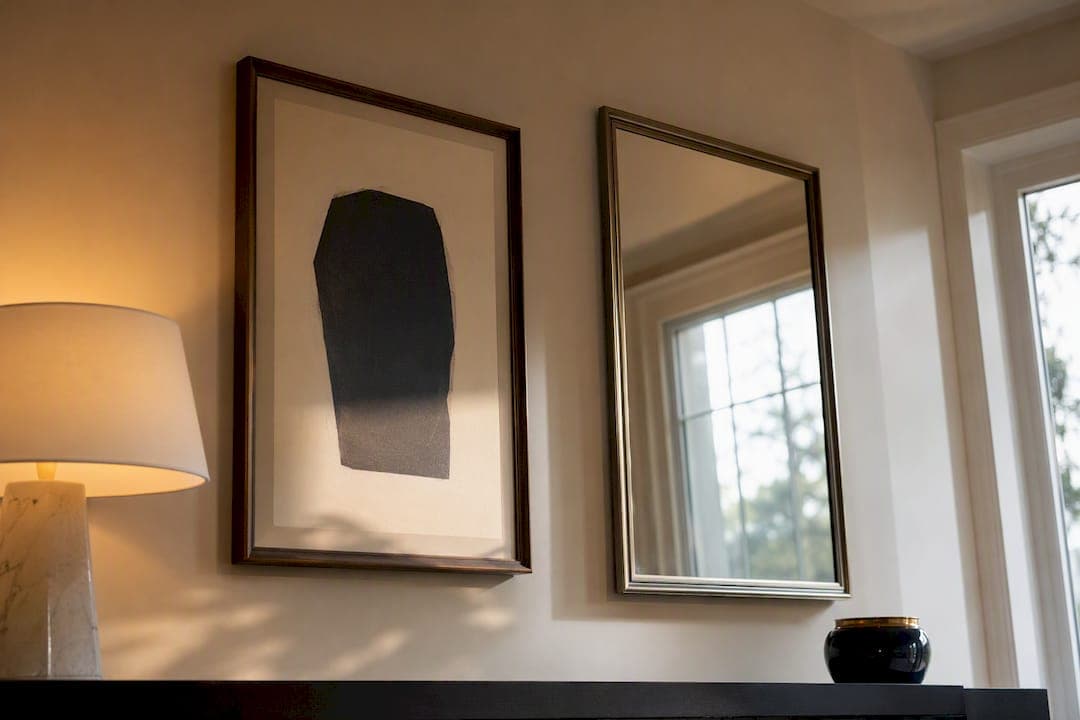
Choose a mirror when the console sits somewhere that needs light, depth, or a practical checking point, such as a narrow hallway or an entryway. Choose artwork when you want personality, texture, and permanence, particularly in a large foyer or a room with generous ceiling height. As a starting rule, size artwork to generally be between about 60 and 75 percent of the console's width and a mirror to about 50 to 75 percent, with the bottom edge sitting a moderate distance above the tabletop to connect the two visually.
TL;DR:
- Standard-sized mirrors are best for narrow, well-lit spaces where reflection quality and ease of maintenance are priorities, especially in humid or high-traffic areas.
- Art pieces should be between 60 and 75 percent of the console's width, with the bottom edge about 15 to 25 centimeters above the tabletop for balanced proportions.
- When consoles are non-standard width or in awkward alcoves, custom-sized furniture and made-to-measure mirror or art framing are recommended to ensure proper scale and placement.
- Reflection in mirrors can be problematic if it faces clutter or dim lighting, so testing the reflection at night helps determine if art might be a better choice.
- Trending options include textured metal frames, organic-shaped mirrors, and textile wall hangings, which soften light and add tactile richness to console wall arrangements.
Table of Contents
- Mirror vs art over console: weighing the trade-offs
- How big should the mirror or art be above a console?
- Where exactly should you hang it?
- How do you style the console top so it all reads as one piece?
- Which decor works best for your room and light?
- Trade insight: solving awkward consoles with bespoke sizing
- Do mirrors need more upkeep than artwork?
- How much should you budget for a mirror versus art?
- What's trending above console tables right now?
- Two ways to start, and a three-step check
- Bespoke sizing when standard consoles won't fit
- Sources
- FAQ
Mirror vs art over console: weighing the trade-offs
Both choices solve different problems, and the honest answer is that neither is universally "better" above a console. It depends on what the wall needs to do.
A mirror earns its place by bouncing available light around a room and making a tight hallway feel less like a corridor and more like a considered space. That's genuinely useful in a north-facing entryway or a flat with limited natural light. But a mirror's success depends entirely on what it reflects. Point it at a cluttered coat rack or a gloomy stairwell, and you've doubled the mess rather than solved it, a problem Fab's guide to console styling flags as the most common regret among people who hang a mirror without checking the reflection first. Mirrors also demand more upkeep. Glass shows every fingerprint and water spot, and the frame, especially anything gilded or aged, needs periodic attention to stay presentable.
Artwork, by contrast, introduces colour, texture, and a sense of permanence that a mirror can't. It commits to a mood rather than reflecting whatever happens to be opposite it. Textured or hand-painted pieces scatter light diffusely across their surface, which some designers describe as a kind of permanent glow that lifts a room's brightness without the glare a mirror can throw back at you, a distinction explored in MontCarta's analysis of scale and light in entryway design. The trade-off is commitment: art requires you to like it for years, and getting the scale wrong is more visible than a mismatched mirror shape.
- Mirrors: better light, better perceived space, more glass maintenance, reflection-dependent success
- Art: better mood and texture, no reflection risk, higher commitment to scale and subject
- Hybrid option: lean a mirror against the wall rather than hang it, or pair a smaller mirror with one larger art piece for both effects at once
Pro Tip: Before you commit to a mirror, stand where you'll actually walk past it and switch the hallway light on and off. If the reflection looks worse in the dark than the wall would on its own, choose art instead.
How big should the mirror or art be above a console?
Getting the proportions right is less about taste and more about arithmetic. Once you have the console's width, the rest follows.
- Measure the console's visible width. Ignore any overhang from lamps or decorative objects; use the tabletop edge to edge.
- Calculate the target width. For art, aim for 60–75% of that measurement, a ratio Home Decor Bliss's sizing guide treats as the standard for a single statement piece. For a mirror, you can go slightly wider, up to around 75%, but it should still read as narrower than the console beneath it, keeping the piece visually contained rather than overhanging, a principle Tom Faulkner's guide to pairing consoles and mirrors illustrates well.
- Set the bottom edge. Leave a gap of roughly 15–25cm between the tabletop and the frame's lower edge. This connects the two elements as one composition rather than two separate zones, a spacing DeckArts' guide to console wall art recommends specifically to avoid a floating, disconnected look.
- Check the visual centre. Gallery convention places the centre of the piece around 145–152cm from the floor, a sightline height most adults find comfortable without craning, according to Resin Society's guidance on art sizing above consoles.
Here's how that plays out on common widths. A 90cm console suits art roughly 54 to 68cm wide. A 120cm console takes something between 72 and 90cm. A 150cm console, the kind you'd find in a generous hallway or behind a sofa, calls for a piece in the 90 to 113cm range. Odd widths, say 105cm or 135cm, are exactly where off-the-shelf framing starts to struggle, which is often the moment homeowners look at bespoke sizing for console tables instead of compromising on proportion.
Where exactly should you hang it?
Measurements only work if the placement respects the room around them, not just the console itself.
- Hang art with its bottom edge a moderate distance above the tabletop; for mirrors, a slightly smaller gap still applies, adjusted as needed if the console itself sits unusually low.
- If the console is off-centre on its wall, whether because of a doorway, radiator, or window, centre the piece on the console rather than the wall. The tabletop is the visual anchor, and Artfully Walls' guide to hanging height notes this keeps the installation looking deliberate rather than accidental.
- Stand at normal eye level, roughly a metre and a half from the floor, and check the piece doesn't feel like it's straining upward or sinking into the console.
- Walk to the room's threshold and look back. This is the angle guests will actually see first, and it often reveals a mirror reflecting something you'd rather it didn't.
- For mirrors specifically, switch the hallway or room lights on and off. A reflection that looks fine in daylight can throw an odd glare under a pendant or downlight at night.
How do you style the console top so it all reads as one piece?
The console surface and the wall piece are never seen separately. Treat them as a single, three-dimensional composition, not two decorating decisions made independently.
Restraint is the operating principle here. Limit tabletop objects to one primary sculptural piece, one smaller accent, and perhaps a single light source such as a lamp or a pair of candlesticks, a discipline Edward Martin's guide to sideboard and console styling treats as the difference between a considered vignette and visual noise. Three items, maximum, is the number to hold yourself to.
- Match finishes: a brass-framed mirror pairs naturally with a brass or aged-metal object below it; a raw timber console suits ceramics or stone over polished glass.
- Break perfect symmetry deliberately. Set the lamp slightly left of centre and the sculptural object slightly right, rather than lining everything up like a shop display.
- Vary height across the tabletop objects so the eye moves rather than skims straight across a flat row.
Pro Tip: If your wall piece has a warm frame or gilded edge, echo that warmth in just one tabletop object rather than matching every piece to it. One deliberate echo reads as intentional; three feels forced.
Which decor works best for your room and light?
The same rules apply everywhere, but the right choice shifts depending on the room doing the asking.
- Narrow, dim corridors. A mirror is usually the better call here, since it multiplies whatever light exists. Just be certain it faces a wall, window, or tidy vignette rather than a coat hook or open door.
- Large foyers or high ceilings. Artwork tends to win in these spaces. A mirror can feel lost against a tall wall, whereas a substantial painting or textile gives the eye something to land on and bridges the scale between console and ceiling.
- Above a fireplace or seating area. Consider who's sitting and where they'll be looking. A mirror opposite a window can throw glare into someone's eyeline; art avoids that entirely and tends to suit a room built for conversation rather than transit.
Trade insight: solving awkward consoles with bespoke sizing
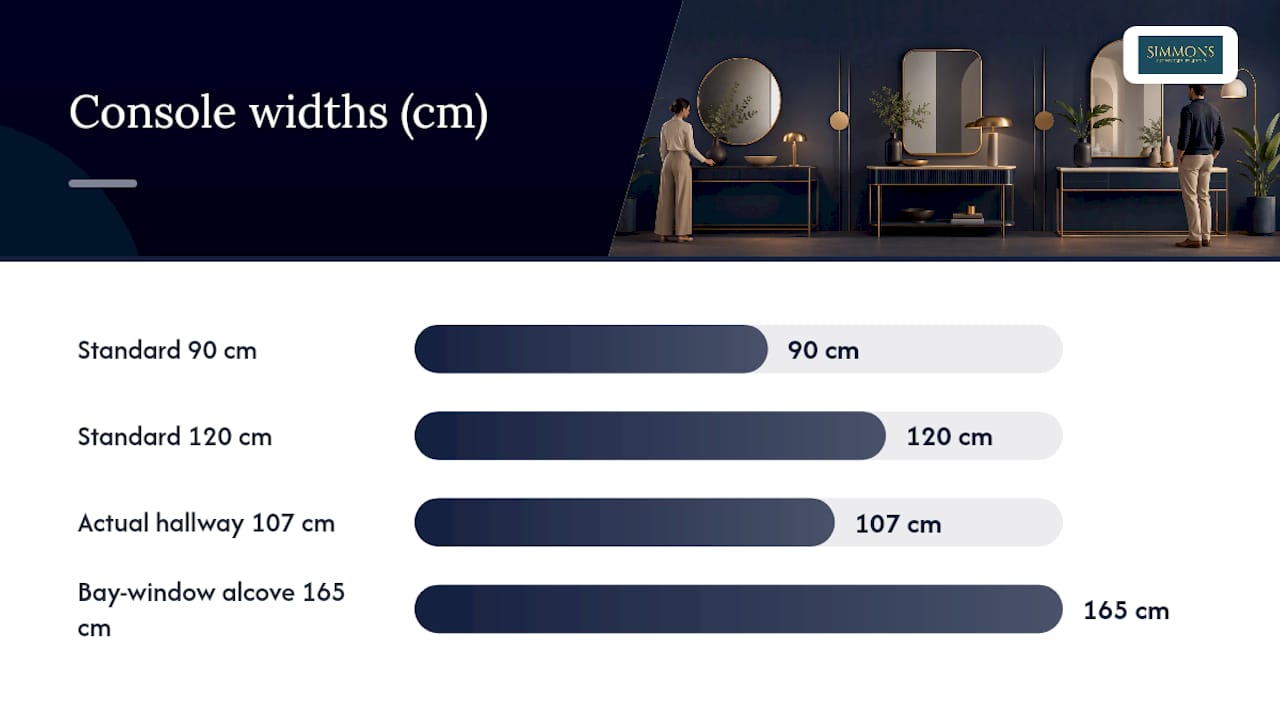
Off-the-shelf framing assumes a tidy world of 90cm and 120cm consoles. Real homes rarely cooperate. An 1830s hallway console might measure 107cm; a bay-window alcove might demand something closer to 165cm. That's where standard art and mirror sizing breaks down, and where made-to-measure furniture earns its keep.
Some furniture makers build consoles to the width a room actually has, rather than asking the room to accommodate a standard size. The Park Console Table offers a slim, tapered silhouette that suits a smaller art piece sitting close to its edges. The Hammered Console Table carries a textured metal finish that pairs naturally with a mirror in a complementary metal frame, following the same finish-matching logic covered above. The Vienna Console Table has a more substantial presence, well suited to a larger statement piece or a wider mirror that needs a console with enough visual weight beneath it. Custom dimensions and finishes can often be commissioned, which helps address asymmetric-wall and odd-width challenges.
Do mirrors need more upkeep than artwork?
Mirrors demand noticeably more routine attention than framed art. Glass shows fingerprints, water spots, and dust in direct light in a way that a painted or printed surface simply doesn't, so a hallway mirror near a coat rack or front door often needs wiping down weekly rather than monthly.

Frames matter too. Aged brass or gilded mirror frames can tarnish or need occasional resealing, while a simple painted or timber art frame holds its finish for years with little more than an occasional dust. Humidity is the other factor worth knowing about: mirrors in bathrooms or steamy entryways can develop edge fogging or silvering damage over time if the backing isn't sealed well, whereas artwork under glass or a UV-protective varnish tends to be more forgiving in damp corners of a home.
Neither is high maintenance in absolute terms, but if you're choosing for a console in a busy, humid, or high-traffic spot, the artwork side of the ledger asks less of you week to week. That's worth weighing alongside the light and space benefits a mirror brings.
How much should you budget for a mirror versus art?
Cost comparisons here rarely favour one category outright, because both mirrors and art span an enormous price range depending on size, materials, and whether the piece is off-the-shelf or commissioned.
A mass-produced mirror in a standard frame can cost relatively little, but anything with a hand-finished frame, an aged patina, or an unusual shape climbs quickly, particularly once you move into bespoke sizing for an awkward console width. Original or limited-edition artwork carries similar variability: a print reproduction sits at one end, while a commissioned painting or textile piece sits considerably higher, and pricing there tends to reflect the artist's reputation as much as the physical size.
The more useful budget question isn't "which is cheaper" but "which needs to be bespoke." A standard-width console taking off-the-shelf art or a mirror keeps costs predictable. An unusual width, an asymmetric alcove, or a console paired with a very specific finish is where custom framing or a made-to-measure mirror becomes the only route to a proportion that actually works, and that's the point at which budgeting shifts from "buying a piece" to "commissioning one."
What's trending above console tables right now?
Textured and tactile finishes have moved firmly into the mainstream for both categories. Hand-hammered metal mirror frames, the kind that catch light unevenly rather than throwing a flat reflection, have become a popular alternative to the smooth gilded frames that dominated the last decade. On the art side, textile wall hangings and richly textured canvases are gaining ground over flat prints, partly because they behave more like the "diffuse light" pieces mentioned earlier, softening a room's brightness rather than bouncing it directly back.
Asymmetric and organically shaped mirrors, arched, freeform, or irregular silhouettes, are also replacing the strict rectangle-over-rectangle pairing that once felt obligatory above a console. That shift rewards exactly the restraint-and-contrast styling covered earlier: an irregular mirror shape needs a calmer, simpler tabletop vignette beneath it to avoid visual competition.
Warm, aged metal finishes, whether on a mirror frame or a console itself, continue to outpace cool chrome and stainless steel as the console-and-wall-piece pairing of choice. If you're furnishing an entryway or hallway from scratch, that finish direction is worth bearing in mind before locking in a console material, since matching a warm-toned mirror to a cool-toned console tends to fight rather than flow. For smaller or shallower entryways where space itself is the constraint, Livingdeco's ideas for styling narrow console spaces offer useful angles on working with limited depth without sacrificing the composition.
Two ways to start, and a three-step check
For a mirror-first entryway, pick something narrower than the console and check the reflection at night. For an art-first foyer, size to two-thirds width and centre on the console. Either way: measure, check the sightline from the threshold, then choose no more than three tabletop objects.
— Luke
Bespoke sizing when standard consoles won't fit
Standard mirror and art sizing works fine until your console doesn't match a standard width, and that's a more common problem than most people expect. An 1830s hallway, a bay-window alcove, or a bespoke joinery project rarely lands on 90cm or 120cm exactly, which leaves you compromising on proportion or hunting for a framer willing to custom-cut.

Simmons Interior Supply builds consoles to the exact width, height, and finish a space calls for, so the sizing rules in this guide apply cleanly rather than needing awkward rounding. The Park Console Table, Hammered Console Table, and Vienna Console Table all ship in custom dimensions and finishes, and each pairs differently with mirror or art depending on the silhouette you need. Browse the full console and furniture collection to see current models, or look through the installation gallery for real console-and-wall-piece pairings before you commission your own. If you have a tricky width or an unusual alcove, get in touch through the site to discuss a made-to-measure piece.
Sources
- An illustrated guide to pairing console tables & mirrors — Tom Faulkner
- Art above console table — DeckArts (2026)
- How big should a mirror or art be over a console table? — Home Decor Bliss
FAQ
Should you hang a mirror or a picture above a fireplace?
Either works, but consider what the mirror would reflect from the seating area; art avoids glare from windows or lamps entirely, while a well-placed mirror can widen a small living room visually.
How far above a console should a mirror hang?
Leave a moderate gap between the tabletop and the mirror's bottom edge, adjusting slightly lower if the console itself sits unusually low.
What is the two-thirds rule for wall art?
A single piece of art above furniture like a console should measure roughly 60–75% of the piece's width, keeping the art visually contained rather than overhanging the edges.
How far above a console should art be hung?
The bottom edge should sit a moderate distance above the tabletop, with the visual centre of the piece near common sightline heights from the floor for comfortable viewing.