
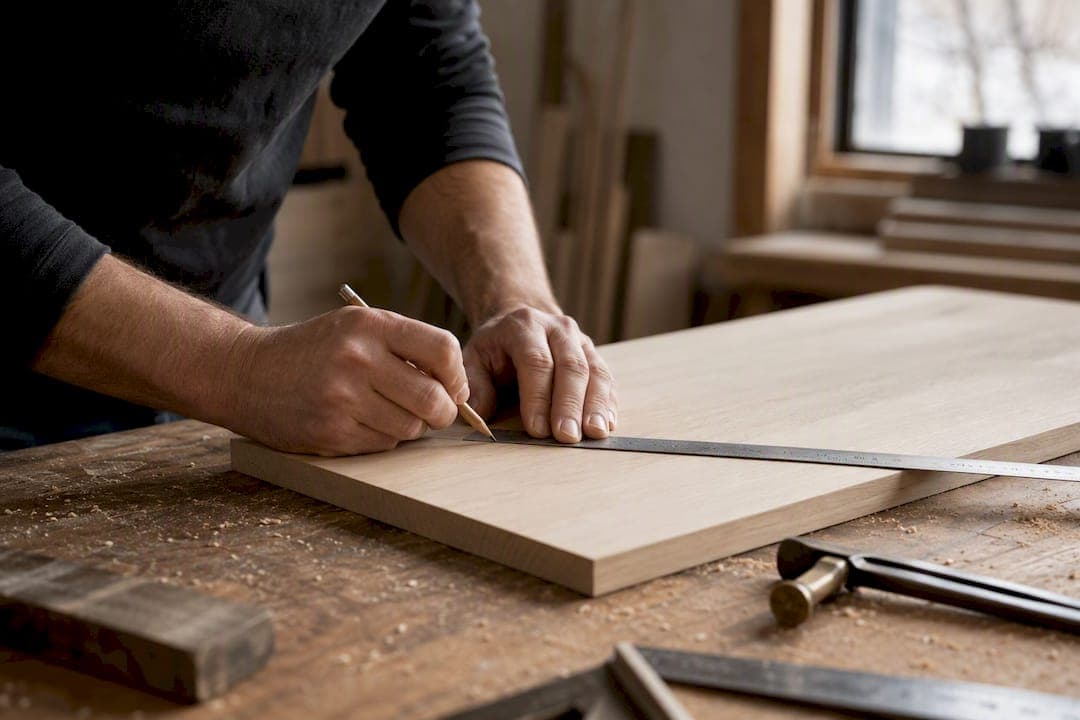
A prototype proves the design works. A production sample, whether called a pre-production sample (PPS), first article, or golden sample, proves the factory can make it, consistently, thousands of times over. Use a prototype for design and marketing sign-off. Use a production sample, built on final tooling with final materials, for the manufacturing go or no-go decision.
- Prototype = design validation, rapid materials, typical loose tolerances around a tenth of a millimeter to half a millimeter
- Production sample (PPS/first article) = process validation, final tooling, tighter tolerances around a few hundredths to a tenth of a millimeter
- Recommendation: sign off aesthetics and function on a prototype; sign off the production process on a pre-production sample, never on a prototype or a marketing sample
This distinction sits behind quality frameworks like ISO 13485 for regulated goods, and behind the engineering-change cost curves that NIST has long documented. At Simmons Interior Supply, we apply the same discipline to bespoke furniture, because a beautiful showroom piece and a repeatable production run are two different problems entirely.
Key Takeaways
A prototype validates design intent using substitute materials, while only a production sample built on final tooling and materials can validate the manufacturing process itself.
| Point | Details |
|---|---|
| Use the right sample for the gate | Sign off design and marketing on a prototype; sign off manufacturing on a PPS or golden sample. |
| Never contract off a marketing sample | Salesman samples are built to impress, not to prove repeatable production quality. |
| Tighten the tech pack first | Ambiguous callouts and missing machine tolerances are the leading cause of sample-to-production drift. |
| Retain the golden sample | Keep a signed physical reference at the machine station to anchor operators during long runs. |
| Build production-intent samples with Simmons Interior Supply | Simmons Interior Supply confirms finish, material, and joinery on a production sample before any batch order proceeds. |
Table of Contents
- Prototype vs production sample: a side-by-side comparison
- What are the main sample types, and who should use them?
- Why do prototypes and bulk production diverge?
- How do you turn a prototype into a production-ready sample?
- What should a production sample review actually check?
- How Simmons Interior Supply treats prototype and production sample sign-off
- Get production-intent samples right before you commit to a batch
- Sources
Prototype vs production sample: a side-by-side comparison
The two sample types answer different questions, and mixing them up is where product programmes come unstuck.
A prototype answers "does this design work?" It is usually built by a single maker, a workshop, or a rapid-prototyping shop, using 3D printing, CNC machining, or hand tools rather than the tooling that will eventually mass-produce the part. Fidelity to the final product is deliberately loose: tolerances often sit around ±0.1 to 0.5mm, and materials are frequently substitutes chosen for speed rather than final specification. A production sample answers "can the factory make this reliably?" It comes from the actual production line, using final tooling, final materials, and the machine settings that bulk output will use, which is why tolerances tighten to roughly ±0.05 to 0.1mm.
| Dimension | Prototype | Production sample (PPS / first article) |
|---|---|---|
| Purpose | Validate design, form, and function | Validate the manufacturing process itself |
| Who builds it | Designer, workshop, rapid-prototyping shop | Production line, using final tooling |
| Fidelity to final product | Substitute materials, loose tolerances | Final materials, final tolerances, final process |
| Repeatability | One-off, not scalable | Proven scalable if it passes inspection |
| Typical cost and lead time | Low cost, days | Higher cost, weeks, tooling-dependent |
| Role in sign-off | Design and marketing approval | Contractual, manufacturing go/no-go |
A related control worth knowing: the golden sample, a physical PPS retained permanently as the benchmark against which every later production pull is measured. A TOP pull (top-of-production pull) is a spot check taken mid-run to confirm the line has not drifted from that benchmark.
One caution: never treat a salesman or marketing sample as a contractual reference. It is built to impress a buyer, not to prove the factory can repeat it at volume, and using it during final inspection is a common source of disputes.
What are the main sample types, and who should use them?
Naming confusion causes more approval mistakes than almost anything else in product development. Each sample type below has a distinct owner and a distinct job.
- Proto/design sample: built by the designer or a prototyping shop, in days, to prove the concept works. Owned by design.
- Salesman/marketing sample: hand-finished to look flawless for a buyer or trade show. Owned by sales and marketing, never quality.
- Pre-production sample (PPS): built on the actual line with final materials and tooling, usually one to five units. Owned by production engineering and QA, and it is the correct basis for manufacturing sign-off.
- First article / golden sample: the PPS that passes inspection and becomes the permanent reference standard, retained for the life of the product run.
- TOP pull: a sample pulled during the live production run to check the line hasn't drifted since the PPS was approved.
- Mass-production sample: a routine output check once volume manufacturing is underway.
Label every sample clearly with its type and whether it is a sample-room build or production-intent. A box arriving marked simply "sample" tells nobody, least of all the factory, what standard it's meant to meet.
Why do prototypes and bulk production diverge?
Most sample-to-production mismatches trace back to a handful of repeat offenders, and each has a specific fix.
Material and dye-lot variation. Plastic mixes, fabric dye lots, and wood grain vary batch to batch. Fix it by requiring material certificates and defined shade bands for every production run, not just the first one.
Sample-room craftsmanship versus line production. A skilled sample maker can hand-finish a joint that a production line, running at speed, cannot replicate. Sample-room builds routinely mask problems that only appear once stitch tension, hardware torque, or shrinkage are tested at production pace.
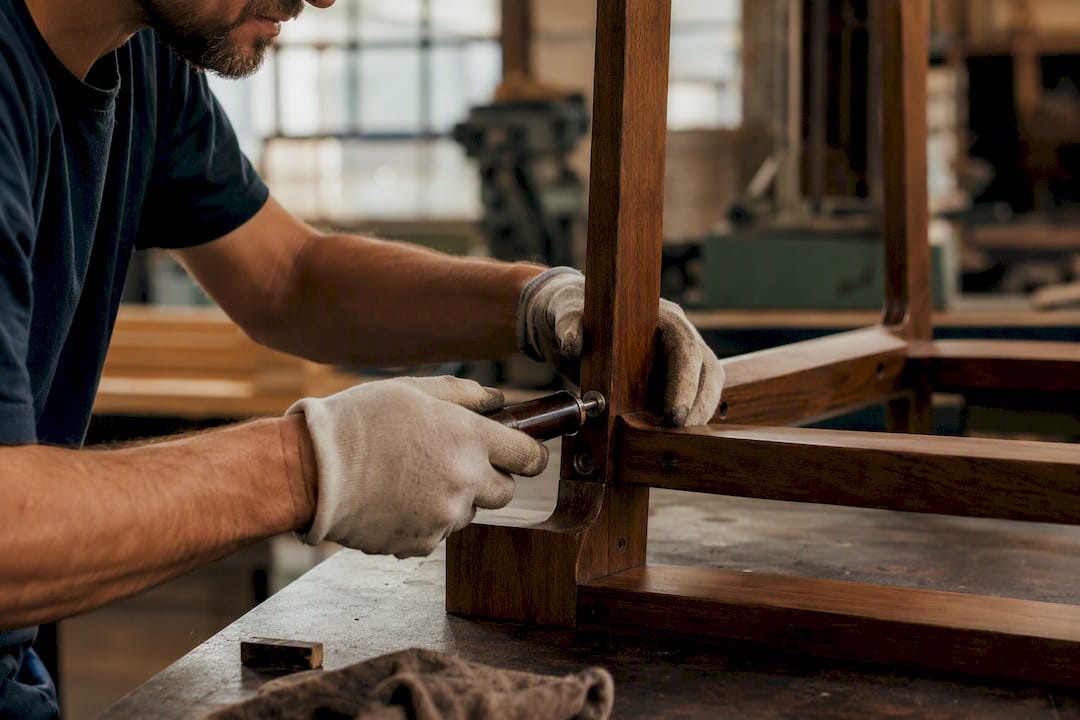
Machine speed and pressure differences. Tooling optimised for a slow first run behaves differently once production speed ramps up. Specify machine-level tolerances and recovery targets in the tech pack before the first sample is even cut.
Ambiguous tech pack callouts. Vague specification leaves the factory to interpret quality, and interpretation always drifts toward whatever is cheapest to produce. Tighten tolerances and callouts until there is no room for guesswork.
Skipping the PPS altogether. Using a prototype, or worse, a salesman sample, as the production benchmark strips quality control of any real process basis. NIST's engineering-change research shows the cost of correcting a fault rises sharply once tooling is already committed. A rushed order that skips PPS and discovers a fit problem at 5,000 units is a far more expensive fix than a two-week delay for proper sign-off.
Pro Tip: Keep a signed physical "Red Seal" counter-sample at the machine station itself. Operators anchor to what they can touch, and a golden sample sitting on a shelf in the QA office does nothing for the person running the line at 2am.
How do you turn a prototype into a production-ready sample?
The path from concept to approved production sample follows a fixed sequence, and skipping a step almost always costs more than the time it would have taken.
- Finish prototype validation. Confirm form, fit, and function on rapid-build materials. Typical duration: a few days per iteration.
- Freeze the design. No further changes once tooling begins; this is the point of no return for cheap corrections.
- Produce tooling and make DFM adjustments. Design-for-manufacture tweaks happen here, owned by the production engineer. Expect several weeks to a couple of months before the first sample run is possible.
- Run pre-production samples (PPS). Built on final tooling, final materials, and production machine settings. QA and production engineering co-own this gate.
- Measure and document a First Article Inspection (FAI). Dimensional checks, material certification, and process records go into a formal report.
- Approve the golden sample. This becomes the permanent reference, signed off jointly by design, production, and QA.
- Schedule the TOP pull and pilot run. A mid-run check confirms the line hasn't drifted from the approved golden sample before full volume commits.
Cost trades off against speed at every gate: prototype iteration is cheap and fast, while tooling amortisation only makes sense once the design is genuinely frozen. Rushing tooling to save a week at step three is the single most common way teams lose months later.
What should a production sample review actually check?
Approving a production sample means checking specific, measurable things, not simply eyeballing whether it "looks right."
- Dimensional accuracy: CMM measurement against GD&T callouts in the tech pack.
- Surface finish: texture, sheen, and consistency against the approved standard.
- Material certification: lot numbers and certificates matched to the tech pack specification.
- Assembly and fit: joints, seams, and hardware torque checked under realistic handling.
- Functional testing: the sample performs under the conditions it will actually meet in use.
- Visual shade and colour match: checked against the agreed shade band, not just a single reference chip.
Acceptance criteria should be written down before the sample arrives: named tolerances, a structured FAI report, and a named sign-off owner. Any non-conformance triggers rework and a fresh sample round rather than a quiet exception. Retain the approved golden sample indefinitely; it is your only reliable reference if a dispute arises months into a production run.
How Simmons Interior Supply treats prototype and production sample sign-off
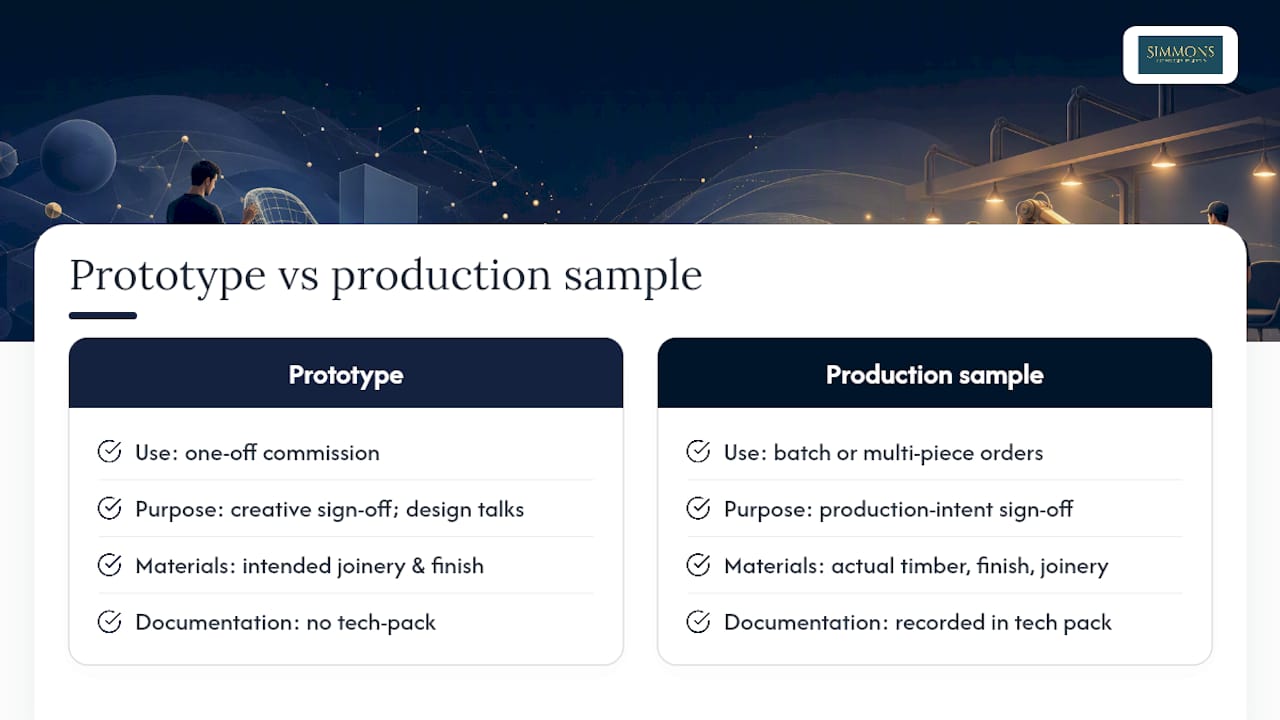
Bespoke furniture lives and dies by this exact distinction. For a one-off commission, we treat a finished prototype, complete with the intended joinery, finish, and proportions, as the creative sign-off point with the client. That is where design conversations happen.
For batch orders across a hospitality project or a multi-piece trade commission, we insist on a production-intent sample: the actual timber, the actual finish process, and the actual joinery method the workshop will use for every subsequent piece. Finish matching and material sourcing are documented against a tech pack before a single additional unit is cut, and we retain a reference piece the way a golden sample is retained in any other manufacturing discipline. It's the only way to guarantee that piece six of a twelve-piece dining set matches piece one.
Get production-intent samples right before you commit to a batch
Simmons Interior Supply builds handcrafted, made-to-order furniture with the same production-sample discipline this guide sets out: a confirmed finish, material, and joinery reference before batch manufacture begins, so the tenth chair matches the first. That matters most for trade professionals and hospitality buyers ordering multiples, where a mismatched finish across a run is far costlier to fix than a single custom piece.
If you're specifying a multi-piece order, such as a bespoke nest of coffee tables for a hospitality project or a trade commission, we can work from your tech pack and finish requirements to produce a production sample before committing to the full run. Browse the gallery for finish and material examples, then get in touch through Simmons Interior Supply to request a quote and sample approval for your project.
Sources
- Prototype vs pre-production sample
- What Are Prototypes and First Samples, How Do They Drive Product Development? Yigu Rapid Prototyping
- Prototype vs. Production Sample: Essential Differences - China Inspection Service- China Inspection Company-FBA