
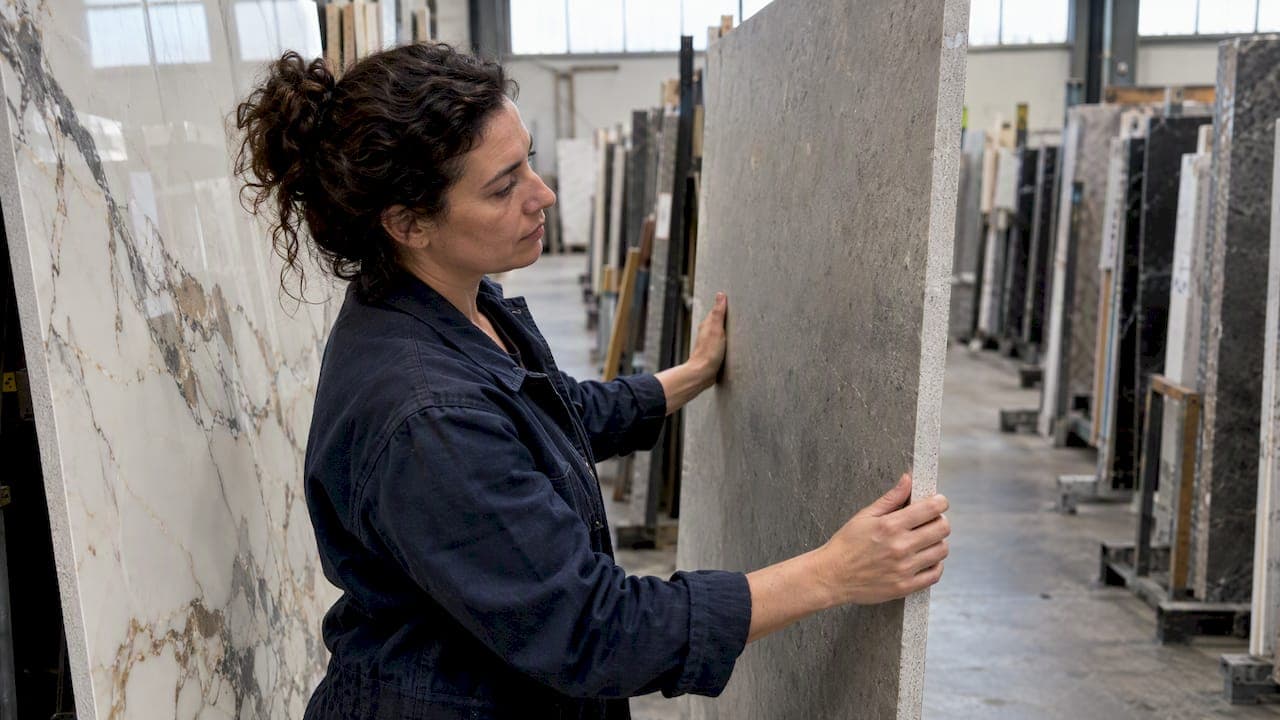
For heavy-duty, heat-exposed worktops and large, seam-minimised panels, sintered stone is generally the stronger choice, while porcelain tends to win where tile-format flexibility, a wider range of finishes and a lower starting cost matter most. That said, the final answer for any single project rests on the specific product technical manual and the installer's own workmanship, not on the material label alone.
TL;DR:
- Review slabs or tiles from the production batch before ordering, because variation runs from V0 to V4 and sample chips can misrepresent the finished surface.
- A shower or splashback needs a dedicated waterproofing membrane behind the surface; neither porcelain nor sintered stone provides the water barrier.
- Installers should provide about 95% mortar coverage, with no voids larger than 2 square inches and full support beneath corners and edges.
- Porcelain tiles can keep upfront costs lower and allow piece by piece repairs, while gauged panels and sintered slabs add specialist handling and fabrication costs.
- Confirm the fabricator’s experience with the chosen material, and review technical instructions, adhesive recommendations, warranty terms, and fabrication tolerances before ordering.
Table of Contents
- How each material is made and what that means for format options
- Appearance, patterning and size: how they affect design choices
- Durability: porosity, water resistance, scratch, chip and heat behaviour
- Maintenance and cleaning: what owners need to do
- Cost and value: budgeting for materials and installation
- Fabrication and installation: specialist techniques and installer requirements
- How to choose for a specific surface: a short decision checklist
- Practical note from a bespoke interiors specialist
- FAQ
- Sources
- Build your bespoke interior around the right surface
How each material is made and what that means for format options
Sintered stone begins life as mineral powders, compacted and fused under extreme heat and pressure into dense, through-body slabs that contain no resins, which is part of why it handles heat so confidently. Porcelain follows a different path: fine clay is fired at high temperatures, then either glazed for a decorative surface or left through-bodied, and it reaches the market as both traditional tiles and larger gauged panels.
Format is where the practical differences show up. A sintered stone worktop can often be cut from a single oversized slab, leaving a surface with few or no visible joints. Porcelain tiles, by contrast, are modular: easier to transport and replace piece by piece, but with grout lines across a large run. Gauged porcelain panels narrow that gap, approaching slab-like coverage, though handling these thin sheets calls for specialist lifting and cutting equipment, which has its own bearing on transport costs and installation timelines.

Appearance, patterning and size: how they affect design choices
Porcelain's manufacturing process gives it an unusually wide palette of finishes, and it is often chosen precisely because it can convincingly echo marble, timber or concrete at a fraction of the cost of the real thing. Sintered stone tends to offer a more consistent, through-body look from edge to edge, which is why fabricators favour it for near-seamless kitchen benchtops and for bespoke cladding where a single uninterrupted plane is the whole point of the design.
Whichever material you choose, shade and pattern variation deserve attention before an order is placed. The industry categorises variation from V0 to V4, from barely perceptible to pronounced, and it is worth reviewing full slabs or tiles from the actual production batch rather than a sample chip, since a swatch rarely tells the whole story of a finished room.
Durability: porosity, water resistance, scratch, chip and heat behaviour
Both materials offer low porosity, and neither is naturally thirsty for water, but that is not the same as a wet area being waterproof. Tile and slab surfaces are not themselves a complete waterproofing system, according to the Ceramic Tile Education Foundation, which means a shower or splashback needs a dedicated, water-impermeable membrane behind the surface, with joint detailing that matches the manufacturer's own guidance.
Sintered stone is highly resistant to heat, which is why it copes well with a pan lifted straight off the hob, though like any dense ceramic material it can behave brittlely if struck sharply at an edge or corner. Porcelain is extremely hard and dense, standing up well to everyday abrasion, but thinner formats can chip under a sharp, concentrated impact. In both cases, the edge profile and the fabricator's cutting technique have a real bearing on chip resistance, so the finished detailing matters as much as the raw material.

Maintenance and cleaning: what owners need to do
Neither material typically needs sealing, which is a relief for anyone who has tended a natural stone surface before. Polished finishes and some porcelains, however, carry micro-pores that can hold a stain if a spill sits too long, so prompt attention still pays off, particularly with red wine, turmeric or strong coffee.
- Wipe spills as soon as they happen, rather than leaving them to dry on a polished finish.
- Use a mild, pH-neutral cleaner and a soft cloth; skip harsh abrasives and strong acids on glazed or polished surfaces.
- Avoid dragging heavy or sharp objects across an edge, where chipping is most likely.
- Check joints and grout lines periodically for wear, especially in wet areas.
Pro Tip: Treat a sintered stone or porcelain worktop much like the care routine for a travertine table: a few consistent habits each week do more for longevity than an occasional deep clean.
Cost and value: budgeting for materials and installation
The sticker price of the raw material is only part of the budget. Fabrication, transport and the specialist labour needed to lift and set a large slab can account for a substantial share of the final bill, particularly when a kitchen run demands a single oversized piece with no visible joint.
Porcelain tile ranges can start at a genuinely modest price point, which is part of its appeal for floors and splashbacks on a tighter budget. Premium gauged porcelain panels and sintered stone slabs sit further up the scale, reflecting both the material cost and the skilled fabrication they demand. The trade-off is straightforward: fewer joints and a more seamless look generally cost more upfront, while a tiled surface is cheaper to repair piece by piece if a single tile is ever damaged.
Fabrication and installation: specialist techniques and installer requirements
Both materials call for diamond-tipped, specialist cutting blades, and sintered stone in particular can wear blades faster given its density, so a fabricator's experience with the specific material is worth confirming before work begins.
- Ask whether the fabricator has handled your chosen material before, since technique and blade selection vary between sintered stone and porcelain.
- Confirm the adhesive or mortar system being used and request evidence of coverage.
- Specify the correct waterproofing membrane for any wet area before tiling begins, rather than assuming the surface itself will do that job.
Industry guidance for stone and tile installation calls for mortar coverage of around 95%, with no voids larger than 2 square inches and full support under corners and edges, which matters because inadequate coverage is a common cause of cracking under a heavy or point load. For any shower, wet room or splashback, remember that the tile or slab surface is not the waterproof barrier itself: that job belongs to a membrane system specified and compliant with recognised standards, so ask your installer to name the product they intend to use.
How to choose for a specific surface: a short decision checklist
For kitchen worktops, sintered stone tends to be the preferred route when heat resistance and a large, seam-minimised appearance are the priority, though porcelain remains entirely viable where a tile format or a tighter budget suits the project better. For floors and wet-wall splashbacks, a textured, appropriately rated porcelain tile is often the practical choice, while sintered slabs come into their own on high-end seamless floors or exterior cladding where a single continuous plane is the ambition.
Before placing an order, request the following from your supplier or fabricator:
- The full technical data sheet for the specific slab or tile batch.
- Written installation instructions, including recommended adhesives and membranes.
- Confirmation of warranty terms and fabrication tolerances.
- Evidence of mortar coverage and waterproofing compliance for wet areas.
Practical note from a bespoke interiors specialist
Where a slab meets a piece of bespoke furniture, the order of operations matters more than people expect. We find that coordinating the fabricator and the furniture maker early, before either has cut a single piece, prevents the edge-mismatch and scheduling clashes that otherwise surface on site. Ask for a slab template as soon as it exists, and build your installation sequence around it rather than around the cabinetry alone. A short fabrication plan, shared between both trades, along with the relevant technical manuals, saves far more time than it costs.
— Luke
FAQ
Which is better, sintered stone or porcelain?
Neither material is universally better: sintered stone tends to suit heavy-duty, heat-exposed worktops and large seamless panels, while porcelain often fits floors, splashbacks and tighter budgets better. The right answer depends on the surface, the technical data sheet for the specific product, and how well the installer follows it.
What are the disadvantages of sintered stone?
Sintered stone can behave brittlely under a sharp, concentrated impact, particularly at edges and corners, and its density means cutting tools wear faster, which calls for an experienced fabricator. Large-format slabs also need specialist handling and transport, which adds to installation cost.
What are the disadvantages of a porcelain countertop?
Porcelain is hard and dense but can be brittle in thinner formats, making it vulnerable to chipping from a sharp impact on an unsupported edge. Polished finishes can also show micro-pores that stain if spills are not cleaned promptly.
Is sintered stone like porcelain?
The two share some common ground: both are manufactured, low-porosity surfaces made from mineral materials under heat. Sintered stone is typically through-body with no resins and fused at especially high pressure, while porcelain is fired clay that can be glazed, through-bodied, or produced as large gauged panels.
Sources
- What's the Difference Between Porcelain Tile and. Ceramic Tile | HGTV
- What Is Sintered Stone? A Complete Guide
Build your bespoke interior around the right surface
Choosing between sintered stone and porcelain is only one part of shaping a room that feels considered rather than assembled. Once the worktop or floor is settled, the furniture and joinery around it need the same attention to proportion, finish and sequencing, which is exactly where our work at Simmons Interior Supply comes in. Every piece we make is handcrafted to order, in the size and finish your space actually calls for, so a bespoke table, cabinet or coffee table edge can be matched to a specific slab rather than forced to fit an off-the-shelf alternative. For finish choices that need to sit comfortably alongside a polished or textured surface, our guidance on custom finish options is a useful starting point, and our stone side table offers another example of our work. If you are weighing up matte against gloss for a finish alongside your chosen slab, CrispSign's guidance on matte versus gloss is a practical reference from outside our own trade. When you are ready to coordinate bespoke furniture with your chosen surfaces, browse our bespoke nest of coffee tables or get in touch through Simmons Interior Supply to start the conversation.