
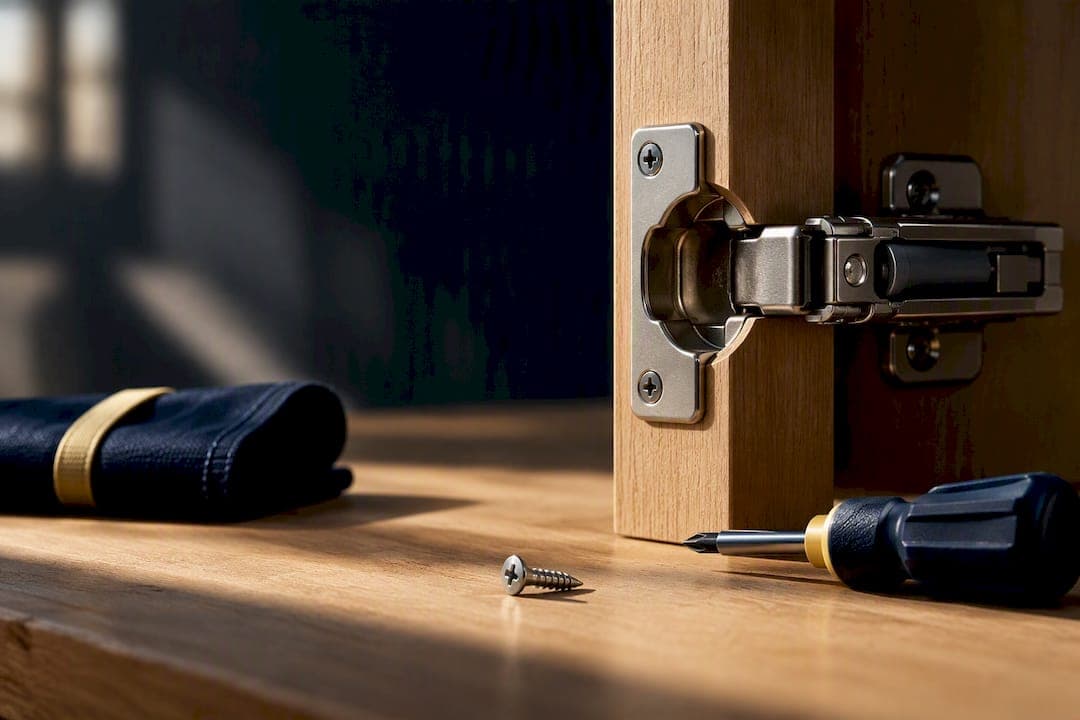
Soft close hinges use a built-in damper to slow a cabinet door in its final few centimetres of travel, so it settles shut instead of slamming. Yes, fitting them is almost always worthwhile, and retrofitting existing cabinetry is frequently possible. Before buying anything, measure your current hinge cup's diameter and depth and note whether your doors sit as overlay, half-overlay, or inset.
TL;DR:
- Soft close hinges typically use hydraulic or spring dampers that activate in the last few centimeters of door closure, preventing slamming and reducing wear.
- Correct hinge type depends on cabinet overlay, inset, or half-overlay configuration, with matching cup diameter and depth being essential for a proper retrofit.
- Retrofitting is usually straightforward if the existing cup depth is at least 13mm, with spacer options available for shallower holes, using basic tools and proper measurements.
- Problems like slamming or uneven gaps often result from worn dampers, loose screws, or misaligned cams, which can generally be fixed through simple adjustments.
- Match hinge finish and material to door use, with steel, stainless steel, brass, and nickel options varying in durability and appearance, and heavier doors needing rated hinges for support.
Table of Contents
- What are soft close hinges and how do they work?
- Which type of soft close hinge suits your cabinet?
- How do you choose the right soft-close hinge?
- Can you retrofit soft close hinges to existing cabinets?
- Why is my soft close hinge not working properly?
- What materials and finishes do soft close hinges come in?
- Are soft close hinges more durable than traditional hinges?
- Do temperature and humidity affect soft close hinge performance?
- Practical note from a bespoke furniture supplier
- Authoritative technical and buying resources
- Sources
- FAQ
What are soft close hinges and how do they work?
A soft close hinge does its work through a small damping unit tucked inside the hinge body, invisible once the door is shut. That damper is either hydraulic, using fluid resistance to control speed, or spring-based, using tension to achieve a similar effect. Both approaches slow the door during the last phase of closing to prevent slamming and reduce wear, rather than throughout the entire swing.
The mechanism only engages in roughly the last few centimetres before the door meets the frame. Before that point, the door swings freely, exactly as a standard hinge would. Once the damper takes over, momentum bleeds away smoothly, and the door eases shut under its own weight.
The payoff is noticeable in a few ways:
- Far quieter kitchens and bedrooms, especially with children or late-night fridge raids in the mix.
- Less impact stress on the door panel, hinge screws, and cabinet carcass over years of daily use.
- Reduced risk of chipped paint, dented veneer, or loosened joinery around the hinge plate.
- A calmer, more considered feel to everyday cabinetry, which matters more than people expect once they've lived with it.
Which type of soft close hinge suits your cabinet?
Not every soft close hinge suits every door, and getting the configuration wrong is one of the most common retrofit mistakes. Professionals routinely advise matching hinge type to your existing cabinet construction before buying anything, because the wrong choice leaves a door that never quite closes flush.
The three core configurations cover almost every cabinet you'll encounter:
- Overlay hinges sit the door fully over the cabinet edge, the standard choice for most contemporary kitchen and wardrobe fronts.
- Half-overlay hinges suit doors that share a shared central post with a neighbouring door, common on older or face-frame cabinetry.
- Inset hinges set the door flush within the cabinet opening, giving a cleaner, more architectural line but demanding tighter tolerances.
Frameless (European-style) cabinets and face-frame cabinets also call for different hinge geometry, since the frame adds depth that the hinge arm must accommodate. Beyond that, look at how the plate attaches. Clip-on mounting plates are repeatedly recommended in buying guides because they simplify installation, removal, and post-fit alignment, which trade fitters particularly value when doors need to come off repeatedly for finishing or site access. Opening angle varies too, typically between 100 and 170 degrees, so check that a wide corner cabinet or a tight run near a wall will actually clear.
How do you choose the right soft-close hinge?
Getting this right comes down to four measurements and a short list of priorities, in this order.
- Measure your existing cup diameter and depth. Standard concealed hinge cups run 35mm in diameter, and many modern soft-close hinges need a cup depth of around 11 to 13mm. A shallower existing bore doesn't necessarily rule out retrofitting, but it changes your options.
- Check door thickness and overlay or reveal measurements. Thicker doors, common on bespoke or solid-timber cabinetry, sometimes need a longer hinge arm or a different plate height to sit correctly.
- Prioritise three-way adjustment. Cam screws that move the door up and down, left and right, and in and out give you roughly ±2mm of correction in each direction, which is enough to fix a slightly crooked drilling job without re-boring anything.
- Match material and finish to how the door will actually be used. A heavier door needs a hinge rated for that weight; a visible finish needs to suit the room, not just the catalogue photo.
Pro Tip: Buy one hinge first if you're unsure, fit it, and live with it for a week before ordering the full set. A hinge that looks right on a spec sheet can still feel wrong on a real door, especially with an unusually heavy or oversized panel.
Opening angle deserves a mention too. Standard hinges tend to open to around 110 to 120 degrees, but corner units and tight-clearance situations may need something closer to 170 degrees to avoid the door striking an adjacent cabinet or wall.
Can you retrofit soft close hinges to existing cabinets?
In most cases, yes, and the deciding factor is almost always cup depth rather than anything more complicated. If your existing 35mm cup hole is deep enough, a like-for-like swap is usually a straightforward job with basic tools.
Here's the sequence that avoids wasted effort:
- Check cup depth before buying anything. If it's shallower than around 13mm, hinge cup spacers can often permit a retrofit without re-boring, though it's worth confirming spacer compatibility with your chosen hinge arm and plate first.
- Gather your tools. A tape measure, an electric drill, a screwdriver, and, if you're drilling new cups from scratch, a 35mm hinge jig. Jigs are widely recommended for DIY retrofits because they keep cup holes consistent and accurately placed.
- Remove the old hinge and test-fit the new one before committing to any drilling.
- Fit the mounting plate to the cabinet, then clip or screw the hinge body onto the door.
- Adjust the three-way cams until the door sits flush, level, and closes with an even gap all round.
Retrofitting is common enough that most reasonably confident DIYers manage it without professional help, provided the cup depth checks out. Where retrofitting starts to exceed sensible DIY scope, though, is on bespoke or solid-timber doors where the panel itself needs modifying to accept a different hinge arm; that's when a specialist, or the original furniture maker, is worth calling in. For a sense of how involved a full swap can get, door replacement complexity offers a useful comparison for anyone weighing hinge retrofit against a full door change.
Why is my soft close hinge not working properly?
Most soft-close problems trace back to one of three causes: a worn damper, a loose mounting plate, or a cam that's drifted out of adjustment. Each shows up differently.
- Door slams despite being a soft-close hinge usually means the damper has failed or was never properly engaged; check the small on/off switch some hinges include before assuming it's broken.
- Door swings shut too slowly or hangs open often points to a spring or hydraulic unit reaching the end of its working life.
- Door sits crooked or the gap looks uneven is almost always a cam adjustment issue rather than a hinge fault.
- Screws work loose over time, particularly on heavier doors, and re-tightening the mounting plate fixes far more "faulty hinge" complaints than people expect.
Pro Tip: Before replacing anything, try adjusting the three-way cams first. Nine times out of ten a misaligned door is a five-minute screwdriver job, not a new hinge.
Some premium ranges include a damper on/off switch, which lets you disable the soft-close action on very light or small doors that would otherwise close too slowly. If the damper itself has genuinely failed, most hinge ranges sell replacement units separately, so a full hinge swap isn't always necessary.
What materials and finishes do soft close hinges come in?
Steel is the workhorse of the hinge world, offering solid strength at a sensible price, and it's what you'll find on the vast majority of kitchen and wardrobe installations. It handles daily use well but benefits from a protective plating in damper environments such as bathrooms or utility rooms.
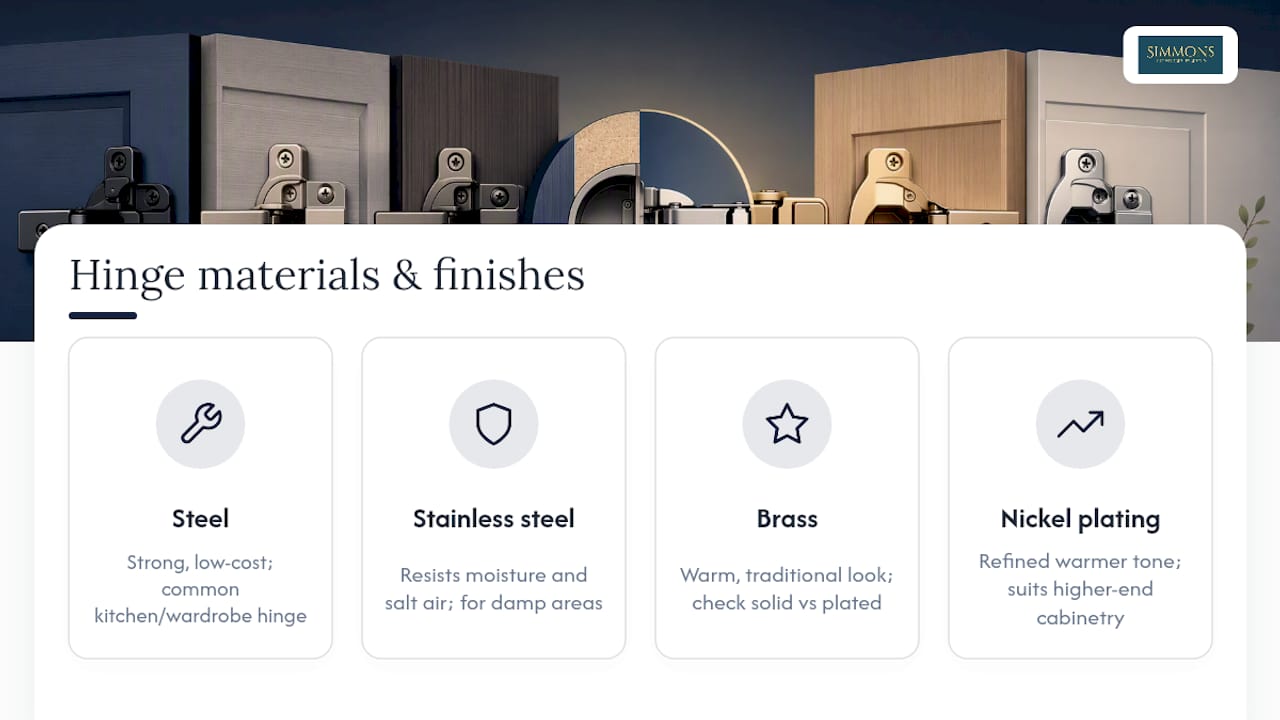
Stainless steel steps up where moisture or salt air is a factor, holding its finish far longer without the pitting that plain steel can develop near sinks, dishwashers, or coastal properties. It costs more, but for anywhere routinely damp, that extra outlay pays for itself in longevity.
Brass hinges bring a warmer, more traditional look and suit period furniture or joinery where a bright chrome finish would feel out of place. They're less common in modern soft-close ranges, and quality varies considerably between solid brass and brass-plated alternatives, so it's worth checking which you're actually buying.
Nickel plating, in both bright and satin finishes, sits between steel and brass aesthetically, giving a refined, slightly warmer tone than chrome without brass's cost. It's a popular choice on higher-end cabinetry where the hinge itself might occasionally be glimpsed through a glass-fronted door.
Whichever finish you choose, match it to the door's other hardware; a mismatched hinge against polished handles is one of those small details that undermines an otherwise well-finished piece of furniture.
Are soft close hinges more durable than traditional hinges?
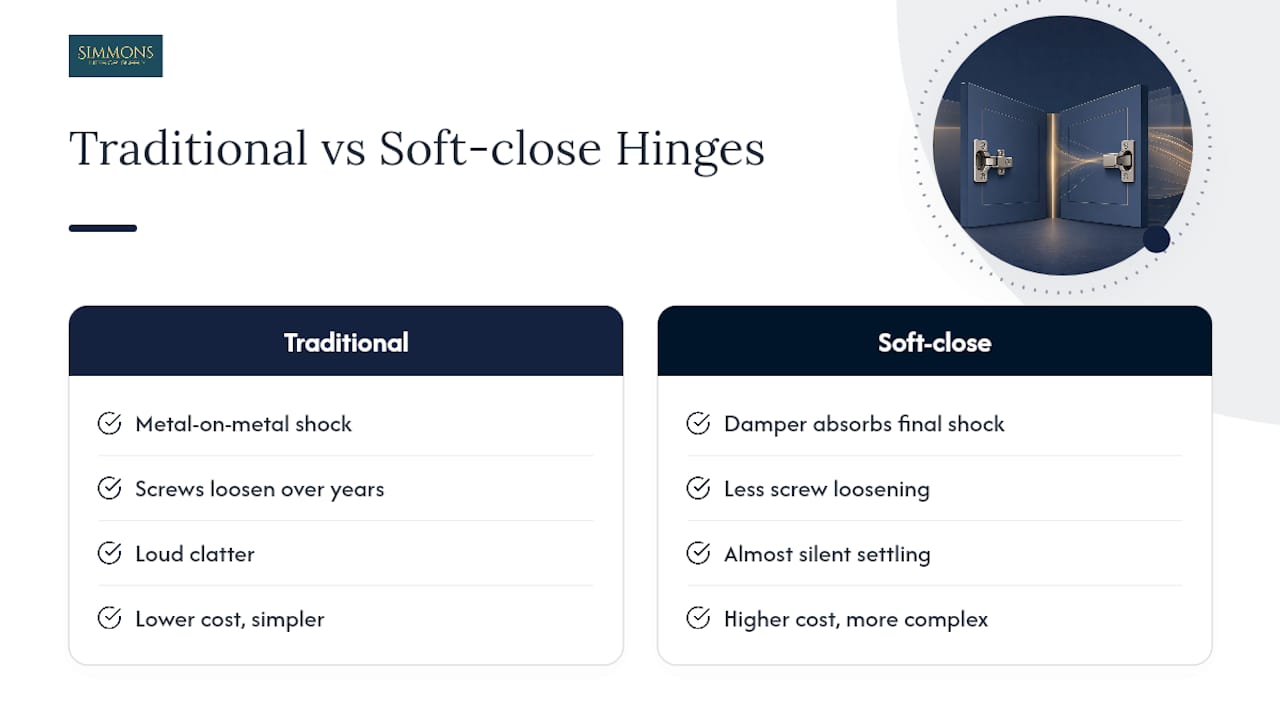
Traditional hinges rely purely on spring tension to hold a door shut, which means every closing motion ends in metal meeting metal at full force. Over months and years, that repeated impact loosens screws, stresses the door panel, and eventually leads to sagging or misalignment, particularly on heavier doors.
Soft close hinges absorb that final impact through the damper instead of transferring it into the cabinet structure. Less shock reaching the screws and carcass generally means less loosening over time, which is precisely why professionals increasingly treat soft-close as the sensible default on new cabinetry rather than an optional upgrade.
The noise difference is the part most people notice first, but it's really a symptom of the same underlying mechanical change. A traditional hinge announces every closed door with a clatter; a soft-close hinge lets the door settle almost silently. In a kitchen used from early morning to late evening, that difference in daily wear and tear, and in household peace, adds up considerably over the years.
Where traditional hinges still hold an edge is upfront cost and simplicity; there's less to go wrong mechanically because there's no damper to eventually wear out. But dampers on quality ranges are typically rated for tens of thousands of cycles, which comfortably outlasts most kitchens before a refit becomes necessary anyway.
Do temperature and humidity affect soft close hinge performance?
Hydraulic dampers rely on fluid viscosity, and viscosity shifts with temperature. In a cold utility room or an unheated garage conversion, a hydraulic soft-close hinge can feel noticeably slower to close in winter than it did in summer, simply because the fluid inside thickens slightly in the cold.
Spring-based dampers sidestep that particular issue, since they don't depend on fluid behaviour, though extreme cold can still make any metal components marginally stiffer.
Humidity plays a different role, acting less on the hinge mechanism itself and more on the door and cabinet timber around it. Solid wood doors expand and contract with seasonal moisture changes, and that movement can throw off a previously perfect hinge alignment, doors that closed flush in a dry summer might bind slightly once winter humidity sets in. This is exactly where three-way cam adjustment earns its keep, giving you the scope to correct seasonal movement without removing the hinge.
Coastal or bathroom-adjacent installations face an additional consideration: moisture in the air accelerates corrosion on lower-grade steel components, which is the practical case for stainless steel or well-plated finishes in those settings, discussed further above.
Practical note from a bespoke furniture supplier
Standard hinge ranges cover most cabinetry well, but bespoke doors don't always play by standard rules. A solid-timber door built thicker than typical for structural or aesthetic reasons, or an unusually large panel on a statement wardrobe, sometimes needs a hinge arm length or loading capacity that off-the-shelf ranges simply don't offer.
Agreeing hinge specifications before a piece goes into production saves everyone time later. Trade clients ordering made-to-measure furniture tend to prefer this approach, specifying cup position, overlay, and hinge type upfront rather than discovering a mismatch after delivery. If you're planning a custom piece and want to talk through hinge options for non-standard door thicknesses, it can be helpful to discuss these details upfront. Our bespoke furniture collection shows the kind of custom sizing and detailing where these conversations usually happen.
— Luke
Authoritative technical and buying resources
For specifications, tolerances, and testing standards, the specifier's guide to soft-close hinges is a solid technical reference. For buying advice and installation tips, see the soft-close hinge buying guide and wardrobe soft-close benefits overview. Hinge packs and cup spacers are widely stocked by hardware retailers including B&Q, and hinge specialists such as Furnica and Blum, whose BLUMOTION range is one of the most established damping systems on the market.
Sources
- A specifier's guide to soft-close cabinet hinges: types, tolerances and test standards | Titus Plus
- What are soft-close hinges and how do they work? | Monroe Engineering
- The best soft-close cabinet hinges | Bob Vila
FAQ
Can you add soft close hinges to existing cabinets?
Yes, retrofitting is common and usually straightforward if your existing hinge cup matches the standard 35mm diameter and sufficient depth. If the cup is shallower than around 13mm, a spacer can often solve the problem without re-boring.
What are the common problems with soft close hinges?
The most frequent issues are a failed damper causing the door to slam again, a cam that's drifted causing an uneven gap, or screws that have loosened on a heavier door. Most misalignment problems are fixed with the three-way adjustment cams rather than a full hinge replacement.
How do I fit soft close hinges?
Check your cup depth first, then remove the old hinge, test-fit the new one, attach the mounting plate to the cabinet, and clip or screw the hinge body to the door before adjusting the cams for a flush fit. A 35mm jig helps keep new cup holes accurate if you're drilling from scratch rather than reusing existing holes.
How do I know what soft close hinges I need?
Start by measuring your door's overlay type (overlay, half-overlay, or inset), its thickness, and your existing cup diameter and depth. Match those measurements against the hinge specification, and prioritise three-way adjustment so minor errors can be corrected without redrilling.