
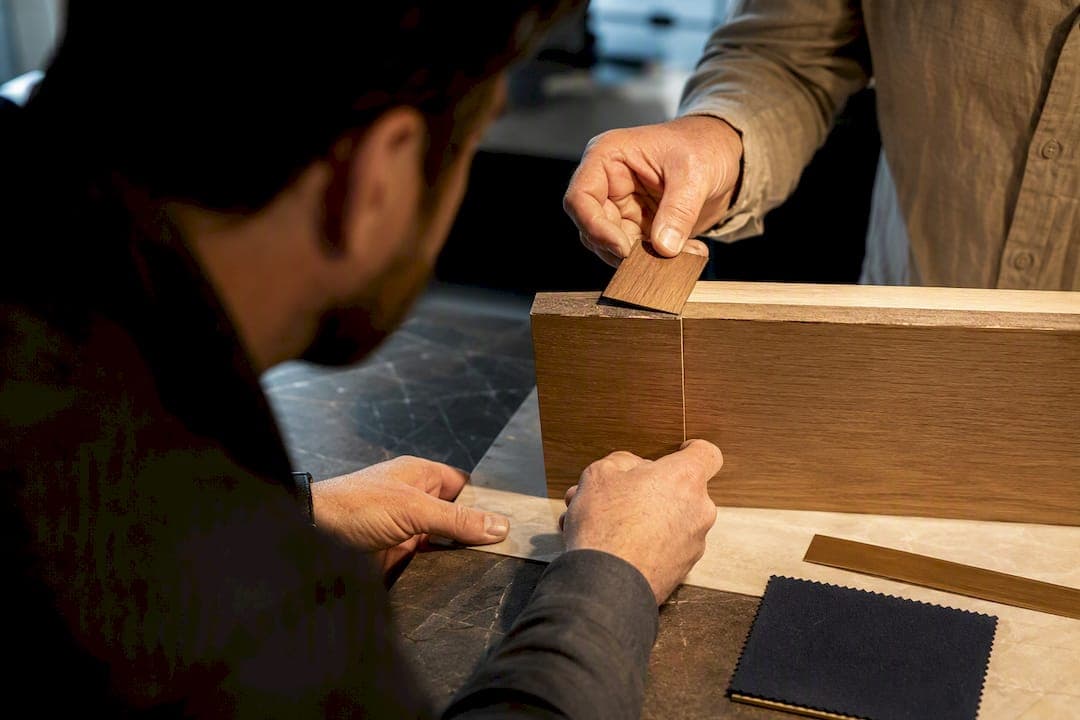
A furniture maker brief must state five things clearly: the piece's purpose and where it will live, exact dimensions with tolerances, materials and finishes with performance expectations, a target price with packaging and delivery notes, and visual references or technical drawings. Get those five right and a maker can quote accurately, sample quickly, and build without guessing at what you actually meant.
TL;DR:
- Providing precise overall dimensions, clearances, and component depths prevents costly rework and ensures accurate quoting for bespoke furniture.
- Naming materials with exact specifications and including performance data ensures durability and helps avoid substitutions that compromise quality or compliance.
- Clearly stating the target price, order volume, and production staging upfront allows manufacturers to plan resources and deliver within realistic timelines.
- Including detailed installation, assembly requirements, and site access information prevents delays and reduces the risk of damage during delivery.
- Stating specific sustainability standards and product provenance early in the brief facilitates sourcing compliant, eco-friendly materials without project delays.
Table of Contents
- The core furniture maker brief checklist: eight essentials
- What measurements and drawings should you actually provide?
- How do you specify materials and finishes correctly?
- Setting a realistic price target and order plan
- What is a realistic timeline from brief to finished piece?
- How Simmons Interior Supply works from a brief
- Who owns the design once a piece is commissioned?
- How do you specify assembly and installation requirements?
- How should sustainability requirements appear in the brief?
- A note on keeping briefs usable and collaborative
- Ready to turn your brief into finished furniture?
- Sources
- FAQ
The core furniture maker brief checklist: eight essentials
A brief that skips a section forces the maker to guess, and guessing is where budgets and timelines quietly fall apart. Before anything else, treat this as a document you will hand across a workshop table, not an email thread you patch together over weeks.
MPP Furniture's recommended structure for briefing a custom furniture manufacturer organises information the way a production team actually reads it, from concept through to packaging. Build your own furniture maker brief around these eight elements:
- Cover page with project name, primary contact, and a version number, so revisions never get confused with the original.
- Collection concept explaining the intended market, room setting, or hospitality context the piece serves.
- Itemised product list with priorities flagged, useful when a workshop needs to sequence sampling.
- Dimensions and drawing references, cross-linked to any CAD files or sketches you're supplying.
- Materials and finishes, plus any acceptable substitutes if your first choice is unavailable.
- Functional requirements and quality standards, covering how hard the piece will actually be used.
- Price target, MOQ, and order plan, so the maker knows whether you need one prototype or fifty units.
- Packaging, labelling, and logistics instructions, particularly important for hospitality rollouts or export.
A design brief for furniture that covers all eight rarely needs a second round of clarifying questions. That's the whole point: one document, one read, one accurate quote.
What measurements and drawings should you actually provide?
Vague dimensions are the single biggest cause of rework in bespoke commissions. A maker cannot quote joinery accurately from "roughly 1.8 metres long." Supply the following, every time:
- Overall dimensions (height, width, depth) at their maximum points, not approximations.
- Clearances, such as under-table knee room or door swing space in a fitted piece.
- Functional heights, including seat height, arm height, and table height where seating is involved.
- Component depths, like drawer internal depth or shelf spacing, wherever storage matters.
- Scale and labelling conventions on any drawing, with a clear north point or front elevation marked.
- File formats, ideally PDF for review and DWG or DXF for anything going to CNC production; native CAD files help when a workshop needs to adapt your design.
Tolerances vary by construction type. Solid joinery typically holds to around ±3mm, while upholstered pieces are usually quoted at ±5 to 10mm because foam and fabric compress differently across a run. Annotated photos or a rough sketch alongside your drawings catch ambiguities that measurements alone miss, particularly around junctions where two materials meet. A supplier-ready furniture brief with example ±3mm specifications shows how this looks in practice, and a technical drawing checklist for architects offers a useful parallel standard if you're drawing pieces yourself.
How do you specify materials and finishes correctly?
Name materials precisely, not generically. "Oak" leaves too much open; "European oak, rift sawn, matt lacquer finish" leaves nothing to chance. List an acceptable alternative alongside your first choice wherever supply is uncertain, particularly for imported hardwoods or discontinued fabric runs.
Describe finishes by appearance and application method together. "Hand rubbed oil finish, satin sheen, visible grain" tells a workshop far more than "natural wood look." Where the piece will see heavy use, ask for the performance data that matters:
- Rub counts for upholstery fabric, particularly on anything destined for hospitality seating.
- Abrasion and load ratings for surfaces that will take daily wear.
- Test certificates where you need documented proof rather than a verbal assurance.
- Provenance or certification, such as FSC chain of custody for timber or UK fire safety ratings for upholstery foam and fabric.
Usage profile changes the whole specification. A decorative side table and a hotel lobby console might share a design, but the second needs thicker material and reinforced joinery to survive years of contact, which is exactly why the brief should state expected use before finish is even discussed. A wood species selection guide is worth reading before you lock in a species, especially for pieces that will sit in direct sunlight or high humidity.
Pro Tip: Photograph the closest existing finish you can find, in the room's actual lighting, and attach it. A finish sample under workshop lighting rarely matches what a client sees at home.
Setting a realistic price target and order plan
Manufacturers price faster and more accurately when a brief states money and quantity upfront rather than leaving it as a follow-up question after the first quote lands. Cover these points directly in the document:
- Target unit price, and whether that figure is ex-works or includes delivery, since the gap between the two can be substantial on large or fragile pieces.
- Sample expectations, including whether you're paying for a full prototype or a smaller material sample first.
- Volume staging, moving from a single sample through a small trial run to full production, so the workshop can plan material ordering in phases.
- Confidentiality or exclusivity requests, flagged before design work starts, not after a design has already been shared elsewhere.
A vague budget range invites a vague quote. A specific target, even a rough one, gets you a specific answer.
What is a realistic timeline from brief to finished piece?
Bespoke furniture production typically runs 8 to 12 weeks from a finished brief to delivery, and building checkpoints into the brief itself keeps that window honest rather than aspirational.
- Weeks 1 to 2: Brief review and technical drawings, with the maker raising any queries against your specification.
- Weeks 3 to 5: Sampling, the stage most likely to slip if a material has a long lead time, so flag scarce materials early.
- Weeks 6 to 9: Production, once the sample is approved and signed off in writing.
- Weeks 10 to 12: Finishing, quality control, packaging, and delivery scheduling.
Build approval points into the brief itself, not as an afterthought once samples arrive. State who signs off each stage and how quickly, because a sample sitting unapproved on a desk for three weeks eats directly into the production window. If installation is involved, note site access and lift or stair dimensions now, not the week the piece is due to arrive.
How Simmons Interior Supply works from a brief
Our workshop reads a brief in a particular order: intended usage first, exact dimensions second, materials and finish third. That sequence exists because usage dictates construction method, and construction method dictates almost everything else in the quote.
Once a brief is complete, we typically follow this path:
- Concept validation against the brief before any drawing work begins, catching mismatches early.
- Sample approval, with photographs and, where needed, a physical sample sent for sign off.
- Production scheduling, confirmed only once the sample is approved in writing.
- Trade resources, including a downloadable briefing template and ongoing posts on our trade blog covering commissioning practice for designers.
The pattern holds across every commission we take on: a brief that states usage and dimensions clearly moves through concept and sampling with far fewer revisions than one built around aesthetics alone.
Who owns the design once a piece is commissioned?
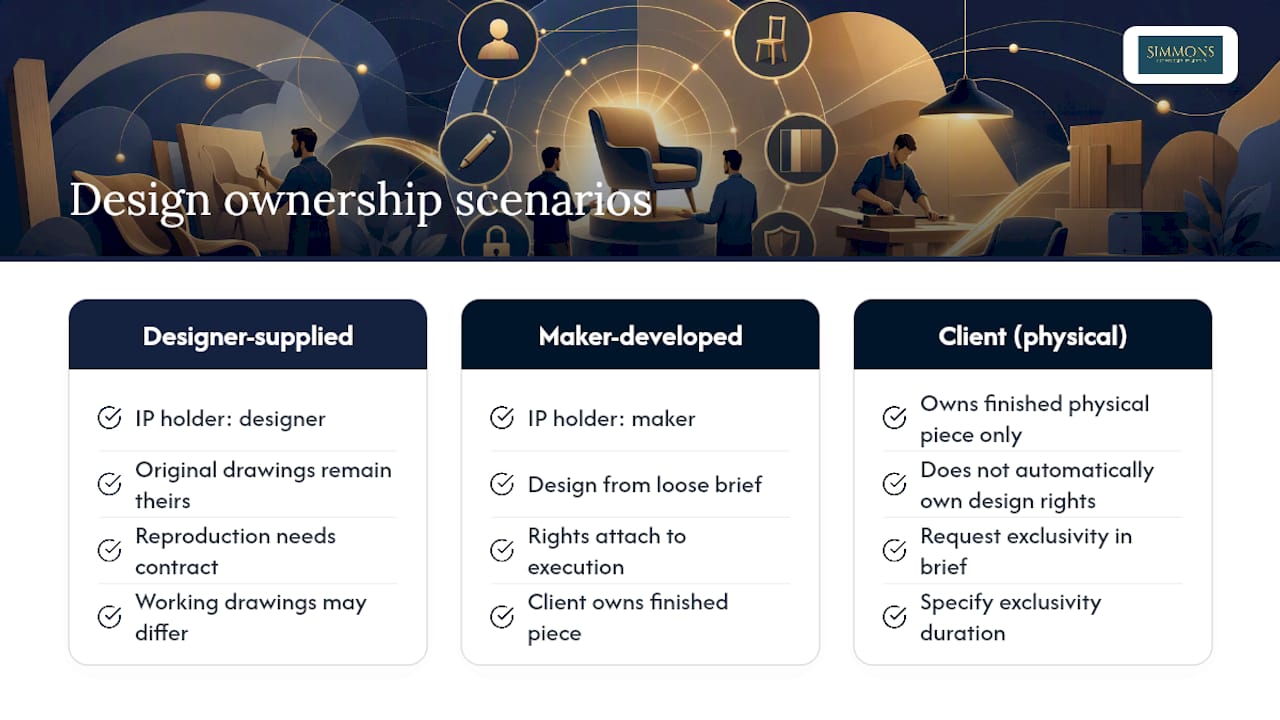
Intellectual property in bespoke commissioning is not automatically assumed by either party, and this is worth settling in writing before design work starts, not after a dispute arises.
If a designer supplies original drawings, sketches, or a distinctive silhouette, that design work generally remains the designer's intellectual property unless a contract states otherwise. If a maker develops the design from a loose brief, using their own detailing, proportions, and construction knowledge, the maker typically holds rights to that specific execution, even though the client owns the finished physical piece. These are separate things: owning a chair does not automatically mean owning the design rights to reproduce it.
State explicitly in the brief whether the design may be reproduced for other clients, whether it is exclusive to your project, and for how long any exclusivity holds. Hospitality clients commissioning a signature piece for a flagship property often need contractual exclusivity; a one-off residential commission usually does not require it. Also clarify who owns technical drawings once a project completes, since a maker's working drawings often differ from the concept sketches a designer originally supplied, and both can carry separate rights.
None of this needs a lengthy legal clause. A short paragraph in the brief, agreed before sampling begins, prevents almost every dispute that would otherwise surface only once a similar piece appears somewhere unexpected.
How do you specify assembly and installation requirements?
If a piece needs to be built on site rather than delivered whole, the brief has to say so explicitly, along with every constraint that affects how it gets there. Leaving this until delivery day is the single most avoidable cause of a stalled installation.
State whether the piece ships fully assembled, partially knocked down, or fully flat packed, and specify the fixing method for anything that assembles on site, whether that's concealed cam locks, bolted joints, or a bracket system. Note any tools the installation team will need and whether your maker is expected to supply them or assume the client's team already has them.
Site access details belong in the brief too: door widths, staircases, lift dimensions, and whether the piece needs to travel through a tight corridor or up a narrow stairwell before it reaches its final position. A large dining table that clears every doorway on paper can still fail to turn a tight stairwell corner, and that's a measurement problem the brief should have caught, not a surprise for the delivery team.
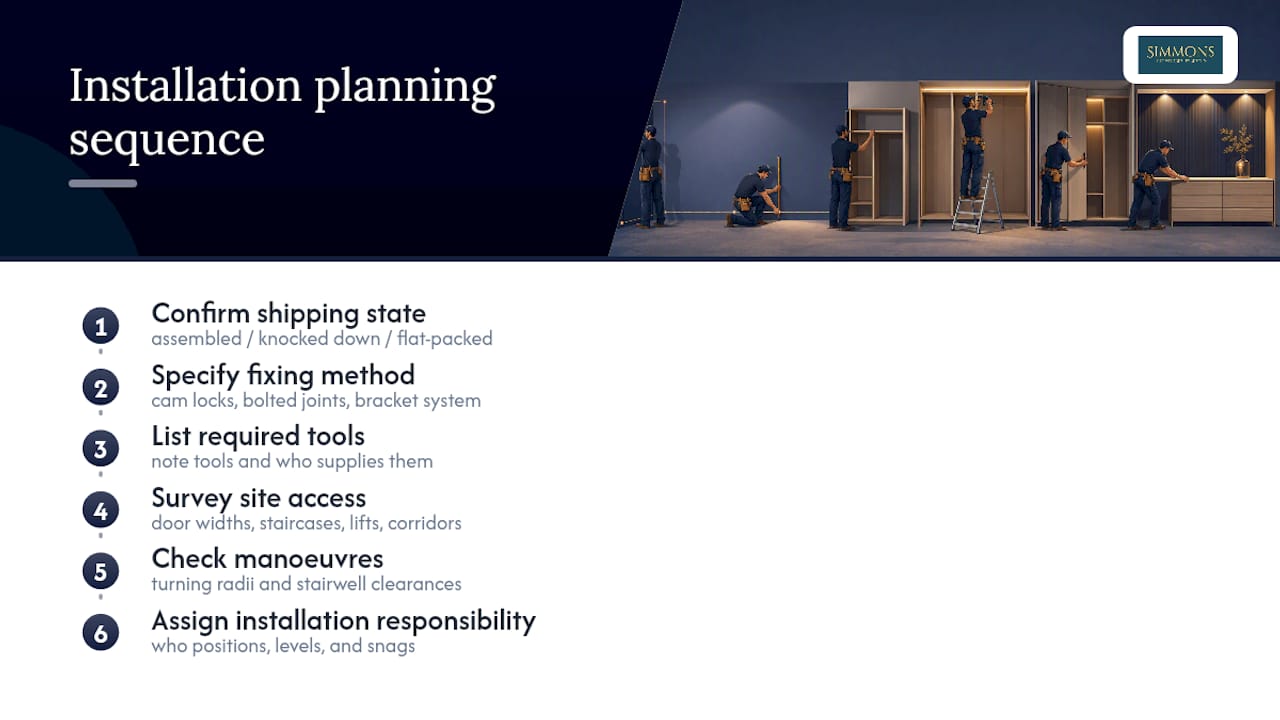
If professional installation is included, state who is responsible for final positioning, levelling, and any snagging once the piece is in place. Our white glove delivery guide covers this in more depth, particularly for larger commissions where delivery and installation are handled as separate stages rather than one continuous job.
How should sustainability requirements appear in the brief?
Sustainability specifications belong in the same section as materials and finishes, stated as requirements rather than preferences, since a preference gets dropped the moment it adds cost or lead time.
If timber provenance matters, state the certification standard you require, such as FSC chain of custody, rather than simply asking for "sustainable wood," a phrase with no fixed meaning a maker can quote against. If you want recycled or reclaimed material considered, say so explicitly and note whether visible character marks like historic nail holes or colour variation are acceptable or should be minimised.
For finishes, ask about the type of coating being used, since water based lacquers and low VOC oils behave differently from solvent based alternatives in both application and durability. If packaging waste is a concern, particularly for hospitality clients managing multiple deliveries, state a preference for reusable blankets or recyclable packaging over single use foam, and raise it early enough that logistics costs can be built into the quote rather than negotiated afterwards.
None of this needs to slow a project down. A workshop that knows your sustainability requirements from the first brief can source accordingly from the start, rather than substituting materials midway through production because nobody asked the question sooner.
A note on keeping briefs usable and collaborative
The best briefs I've seen favour clarity over completeness. A short document with one honest sketch beats twelve pages of specification nobody reads properly. Start simple, then let the maker's questions shape the detail that actually matters for your piece.
Document every revision and approval as you go. Version numbers on drawings and a dated sign off email cost nothing and save real arguments later.
— Luke
Ready to turn your brief into finished furniture?
Once your brief is written, the harder part is finding a workshop that reads it properly rather than quoting from a generic catalogue. Simmons Interior Supply builds every commission from scratch with skilled artisans, working directly from your dimensions, materials, and usage notes rather than adapting a stock design to fit.
If you've already drafted a brief using the checklist above, send it across and we'll confirm feasibility and timeline within days, not weeks. Browse our gallery of finished commissions for reference points on scale and finish, or look at a piece like the bespoke nest of coffee tables to see how customisable sizing works in practice. For trade accounts and quote requests, get in touch through our main enquiry page and one of our team will walk your brief through sampling and production together.
Sources
Start with FIRA's Upholstered Furniture Design Brief Template for upholstery specific projects, alongside MPP Furniture's guidance on briefing a custom furniture manufacturer. For UK trade standards more broadly, FIRA International is worth bookmarking, and our own commissioning guide covers the process from a workshop's point of view.
- How you should brief a custom furniture manufacturer
- From design brief to finished piece: the 8-12 week bespoke furniture timeline explained
FAQ
What is a furniture maker called?
A person who designs and builds furniture by hand is usually called a furniture maker or cabinetmaker, with the latter term traditionally referring to those working primarily in casegoods like cabinets and drawers rather than upholstered seating.
How much does a furniture maker earn?
Earnings vary widely by specialism, experience, and whether the maker runs an independent workshop or works within a larger studio, so current figures are best checked against UK trade and salary sources directly rather than a single fixed number.
Which British furniture maker has gone into administration?
Several well known UK furniture retailers and manufacturers have entered administration in recent years amid rising material and energy costs, though the specific companies affected change year to year, so check current trade press for the latest names.
What tools does every furniture maker need?
Core tools typically include measuring and marking equipment, chisels, hand planes, saws, clamps, a workbench, and power tools like a router and table saw, though the exact list depends heavily on whether the work is primarily joinery or upholstery.
What should a furniture maker brief always include, at minimum?
At minimum, a furniture maker brief needs the piece's intended use, exact dimensions with tolerances, material and finish specifications, a target price, and at least one visual reference or drawing, which together let a skilled workshop quote accurately on the first attempt.