

"To the trade" means products, pricing and showrooms reserved exclusively for verified design professionals, granting access to wholesale-style pricing, bespoke configurations and a level of service retail customers never see. For interior designers and architects, it is the gateway to sourcing furniture, rugs and mirrors that simply are not available on the open market, at rates built for people who specify, not shop.
TL;DR:
- Trade discounts typically range from 10 to 20% off list price, reflecting volume commitments and ongoing relationships rather than simple loyalty rewards.
- Access to designer-only ranges allows for bespoke, project-specific dimensions, early previews of new collections, and materials tailored for high durability.
- Setting up a trade account requires standard business documentation, with new accounts usually paying on proforma before establishing credit terms.
- Lead times for bespoke furniture generally span 2 to 16 weeks, with minimum order values varying widely and often dropping to zero to attract design firms.
- Prioritizing supplier relationships over discount percentages ensures better project support, quality, and support services like dedicated account management.
Table of Contents
- What does "to the trade" mean in practice: how trade pricing actually works
- Why trade access matters beyond the discount
- How to open a trade account and get verified
- Lead times, minimums and the tax details that catch people out
- Practical tips from Simmons Interior Supply
- What the trade discount debate misses
- How Simmonsinteriorsupply supports trade customers
- Sources
What does "to the trade" mean in practice: how trade pricing actually works
Trade pricing is not a loyalty discount bolted onto retail prices. It is a distinct commercial tier, built on the assumption that a designer behaves like a distribution partner rather than a one-off shopper. Manufacturers treat the designer relationship as a form of specification and volume commitment, which is why the numbers differ so sharply from anything a homeowner would see on a showroom floor.
The ranges vary by category and supplier type, but the pattern is consistent. Retail brands offering a trade programme typically discount 10 to 20% off list price.
That pricing exists because the buyer is different. Designers specify quantities, commit to projects, and bring repeat business a single retail sale never could. In return, trade-only ranges typically include:
- Customer's own material (COM) upholstery options unavailable through retail channels
- Bespoke dimensions to fit architectural constraints rather than showroom standards
- Contract-grade construction built for commercial durability, not domestic light use
- Finish and hardware choices tailored to a specific project brief
Why trade access matters beyond the discount
The price cut gets the attention, but it is rarely the strongest argument for going trade. Designers who source this way gain something retail buyers cannot: pieces that are made to fit the project, not the other way round.

Access to designer-only ranges means specifying items a client will never spot in a neighbour's living room, and often getting early sight of new collections before they reach a wider market. That exclusivity has real currency when a client is paying for something distinctive.
The less glamorous benefit is support. A dedicated account manager who understands lead times, material limitations and installation logistics removes a huge amount of friction from a project timeline. And build quality tends to hold up: contract-grade materials and joinery are engineered for durability in ways that retail furniture, priced for a different lifespan, generally is not. The combined effect, according to practitioners who work this way, is better fit and cohesion across a scheme than piecing a room together from retail stock ever achieves.
- Exclusive or early-access ranges for genuinely unique specifications
- Account-level support that shortens the distance between a query and an answer
- Contract-grade materials suited to high-use hospitality and residential projects
- Custom sizing that solves problems retail furniture cannot
How to open a trade account and get verified
Getting set up with a trade supplier is far less bureaucratic than most new designers expect, provided the paperwork is ready before you apply. Documentation requirements are fairly standard across suppliers, which makes the process repeatable once you have assembled it once.
- Gather your business documentation. Company registration details, a VAT number where applicable, a business website or card, and something that demonstrates active interior design work, such as a portfolio or recent project list.
- Decide your starting payment terms. New accounts almost always begin on proforma, paying before dispatch, rather than on credit. Treat this as normal, not a red flag on your business.
- Complete the supplier's application fields accurately. Expect to provide a resale or VAT number, a description of your business type, and the categories of goods you intend to purchase. Trade references only come into play if you are applying directly for a credit account.
- Prepare a concise pitch for outreach. A tight project portfolio, one or two recent client references, and a clear sense of procurement timelines make a supplier's decision easier. Ask directly about minimum order values and sample policies before you commit to a first order.
Our guide to designer trade accounts walks through the paperwork in more detail if you are setting one up for the first time.
Pro Tip: Apply to two or three suppliers in the same category at once. Trade references build faster when you have parallel account histories, and it gives you a fallback if one supplier's lead time does not suit a live project.
Lead times, minimums and the tax details that catch people out
Bespoke trade orders are not a same-week affair, and treating them as one is the fastest way to break a client's timeline. Lead times for made-to-order pieces commonly run from 2 to 16 weeks, depending on stock availability and the complexity of the customisation. A bespoke mirror in a standard finish moves faster than a fully custom sofa in customer's own material.
Minimum order values vary widely by supplier, and it is worth noting that some suppliers have dropped minimums entirely to win design firm loyalty. Do not assume a minimum exists until you have asked.
On payment, the pattern holds across most trade suppliers:
- New accounts start on proforma, paid in full before production or dispatch
- Established relationships can graduate to net 30 or net 60 terms
- Deposits are common on bespoke commissions, with balance due before delivery
For UK-based designers, VAT is chargeable on trade purchases in the same way as any standard commercial transaction. Your VAT number identifies you as a business buyer during account setup, but it does not exempt the purchase itself. Logistics matter too. White-glove delivery and coordinated installation, particularly for mirrors and larger case goods, often shape which supplier gets the order, not just the unit price. Our notes on white-glove furniture delivery cover what to build into a client quote.
Practical tips from Simmons Interior Supply
Luke handles trade accounts and bespoke commissions at Simmonsinteriorsupply day to day, with particular focus on mirror installation and white-glove delivery scheduling. The recurring problem he sees is not pricing confusion. It is incomplete paperwork or a timeline set before lead times were confirmed.
Both are avoidable. Get your VAT and business documentation sorted before you contact a supplier, and ask about lead time before you promise a client a date. For technical specification work, our guide to custom furniture CAD drawings and the custom mirror installation guide both cover the detail that tends to trip up a first bespoke order.
What the trade discount debate misses
Most advice on trade pricing treats the discount as the entire story, and that framing does designers a disservice. The percentage off list price is the easiest number to quote, so it dominates the conversation, but it tells you nothing about whether a piece will actually fit the room, survive contract use, or arrive when the client expects it.
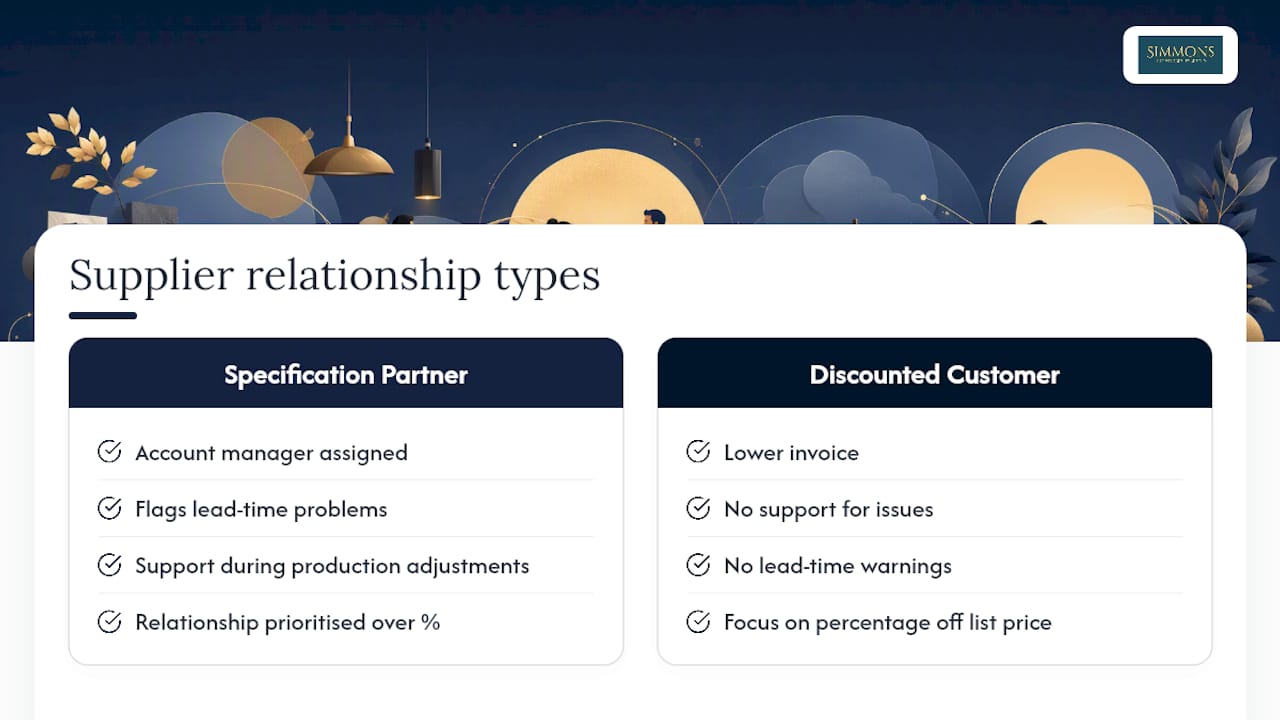
The more useful question is whether a supplier treats you as a specification partner or simply a discounted customer. Those are different relationships. One gives you an account manager who flags a lead-time problem before it becomes your problem. The other gives you a lower invoice and no support when the bespoke dimensions need adjusting three weeks into production.
Prioritise the supplier relationship over the headline percentage. That is the calculation experienced designers make, even when it is not the one most guides encourage.
— Luke
How Simmonsinteriorsupply supports trade customers
If you have read this far, you already know the mechanics. Some suppliers build specifically for the part most trade suppliers treat as an afterthought: bespoke manufacturing done properly, with configurable sizes and finishes made to fit your project rather than a standard catalogue size.

What a trade account with a supplier can give you:
- Handcrafted furniture, rugs and mirrors made to order in your specified dimensions and finish
- Trade account access with pricing and terms suited to project-based procurement
- White-glove delivery coordinated around your installation schedule
- Direct collaboration with the artisans making the piece, not a call centre
To start, browse a live example of configurable trade work on our bespoke nest of coffee tables page, or head to our trade account page to request access. We will ask for the same basics covered above: business registration, VAT details and a note on the kind of project you are sourcing for. From there, it is a conversation about dimensions, finishes and delivery, not a form to disappear into.
Sources
For deeper detail on discount structures, account setup and the cost trade-offs behind bespoke sourcing, these three sources back the figures used throughout this guide:
- Trade Discount Programs for Interior Designers (2026 Guide)
- Everything you need to know about setting up your trade discounts