
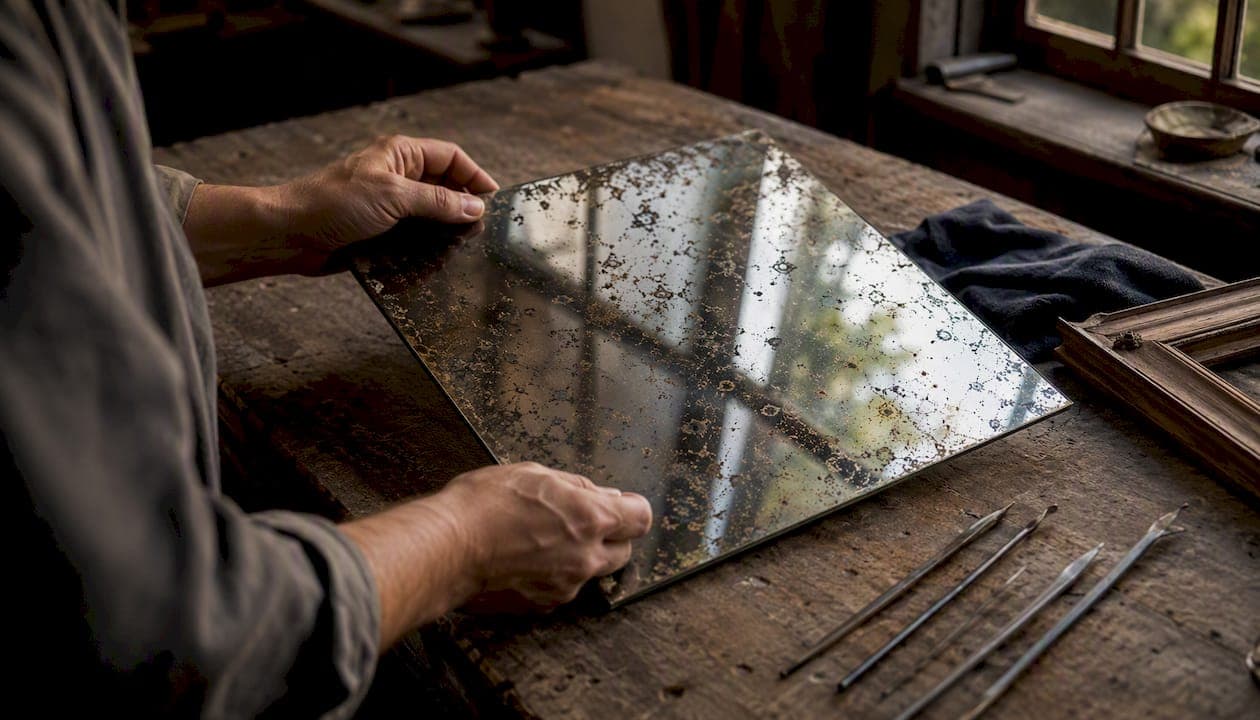
For bespoke cut-to-size antique mirror glass in the UK, Simmonsinteriorsupply is the go-to partner for trade clients and designers who need artisan-finished panels made to exact dimensions. For the majority of projects — splashbacks, feature walls, framed mirrors — a foxed or vintage hand-antiqued finish on 4mm or 6mm clear glass is the right starting point. Hand-antiqued glass carries a warmth and optical depth that manufactured ranges cannot fully replicate, though industrial antique products suit commercial settings where consistency and cleanability take priority.
Before you commit to a full order, three steps will save you time and disappointment:
- Order a physical sample swatch to assess the finish under your actual site lighting.
- Confirm the thickness you need (4mm for most framed mirrors; 6mm for splashbacks and furniture tops).
- Ask explicitly whether toughening is available, particularly for any splashback or worktop application.
Key takeaways
Bespoke hand-antiqued glass, cut to size and toughened where required, is the most versatile choice for residential and hospitality projects where finish character matters.
Table of Contents
- What does 'antique mirror glass' actually include?
- Which finishes can you actually order?
- What dimensions and technical specs should you give your supplier?
- How do you place a correct order, step by step?
- How are antique effects made, and how do you spot a genuine original?
- When bespoke hand-antiqued glass is the right call
- Simmonsinteriorsupply: bespoke antique mirror glass for trade clients
- Sources
What does 'antique mirror glass' actually include?
The term covers three distinct product categories, and confusing them leads to misspecified orders.
Reclaimed original antique glass refers to genuine mirror plates removed from period furniture or frames. These are mercury-silvered, typically pre-1900, and carry the authentic foxing and silvering irregularities that no modern process fully reproduces. Supply is unpredictable, sizes are fixed by the original piece, and cutting is risky because the silver layer is fragile. Restorers and conservators working on period furniture are the primary buyers.
Hand-antiqued (hand-silvered and hand-distressed) glass is new glass treated by skilled artisans using chemical silvering and controlled oxidation. Each panel is unique. This category is the right choice for bespoke furniture, feature walls, and framed mirrors where you want the character of aged glass without the constraints of reclaimed supply. Suppliers in this category will cut to size and can offer toughening for structural applications.
Industrial antique ranges — such as the Miralite® Antique family from Saint-Gobain — are produced with a permanent vintage effect applied during manufacture by varying the metal deposits in the silvering process. Available in 4mm and 6mm factory sheet sizes, they offer consistent patterning across large runs and are engineered for standard glass fabrication and cleaning regimes. They suit commercial hospitality interiors where repeatability matters more than the subtle irregularities of a hand finish.
Hand-antiqued panels are individually treated to create unique results — no two sheets are identical, and finish appearance shifts noticeably with lighting angle and distance. Always assess a physical sample under the conditions of the installation space before specifying a full order.
Pro Tip: When specifying for a hospitality project with multiple identical panels, industrial antique ranges are the pragmatic choice. For a residential feature wall or bespoke furniture piece where character is the brief, hand-antiqued glass is worth the premium and the slightly longer lead time.
Which finishes can you actually order?
The market offers more variety than most buyers realise, and the names are not always standardised between suppliers. Here is a working guide to the finishes you are most likely to encounter.
Foxed is the most widely recognised antique mirror style. It mimics the dark, spidery oxidation that forms on original mercury-silvered plates over decades, with irregular patches of grey-brown discolouration spreading across the silver. The effect reads as aged and intimate — well suited to framed mirrors, cabinet interiors and panelled walls in residential settings.
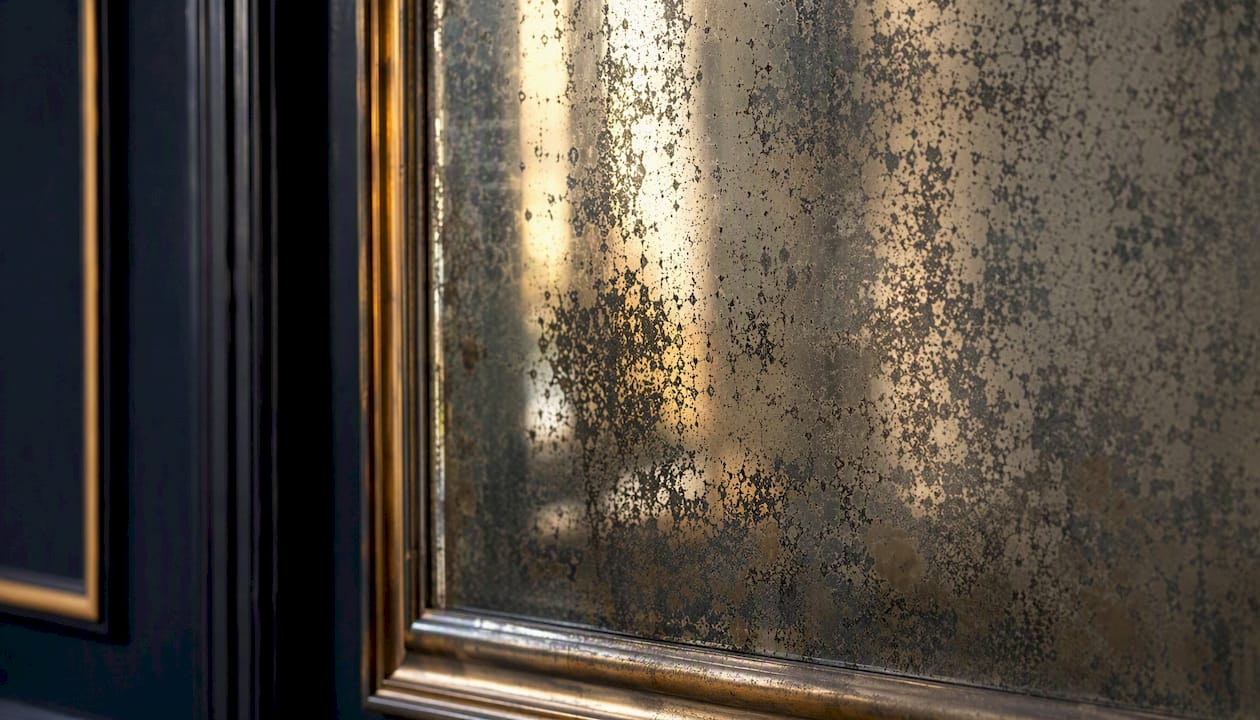
Vintage finishes are lighter and more diffuse than foxed, with a soft, patchy silver that retains good reflectivity. The glass still functions as a mirror while carrying a gentle sense of age. This is the most versatile finish for feature walls and splashbacks where you want atmosphere without sacrificing too much clarity.
Mercury sparkle (sometimes listed as heavy mercury or light mercury) introduces a warm, slightly golden tone to the silver, evoking the look of original mercury-silvered plates. The sparkle effect comes from deliberate variation in the silver deposit, creating a shimmering, dimensional quality that reads beautifully under warm artificial light.
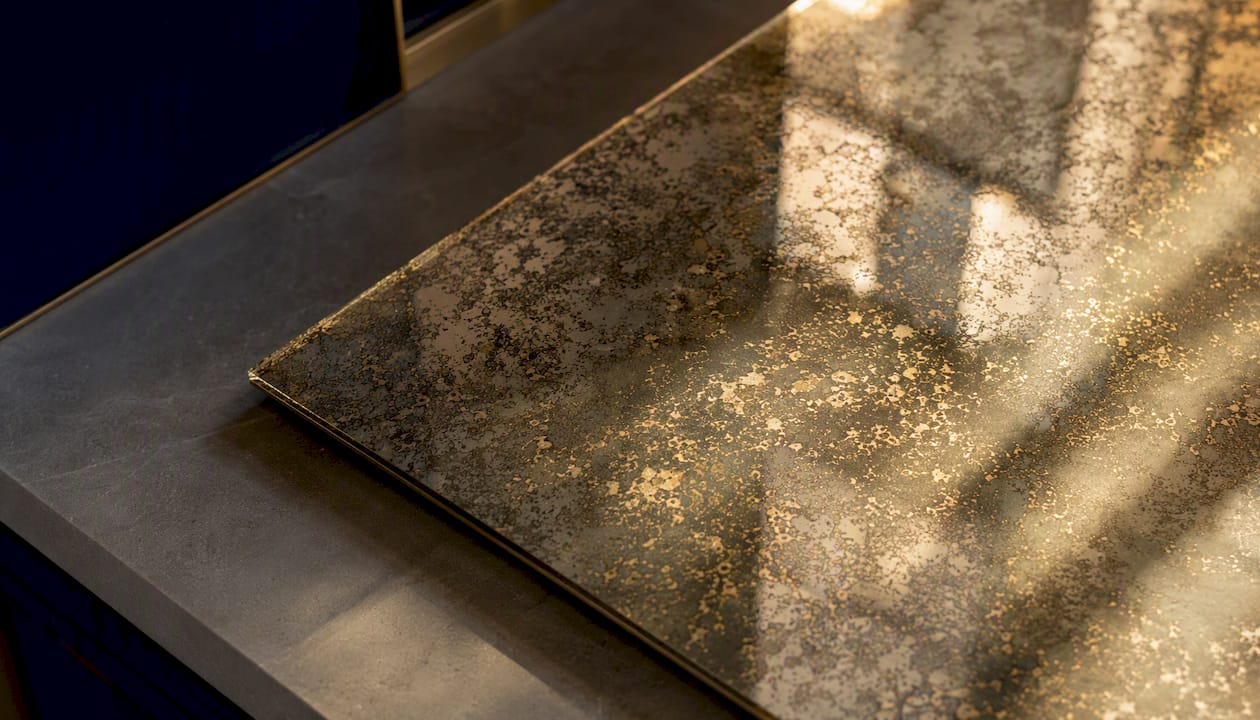
Versailles-style (also written Versaille) is characterised by a more formal, symmetrical distressing pattern, often with a heavier silver ground and pronounced aged borders. It suits classical interiors, ornate frames and period-style joinery.
Bronze antique and tinted antique use a warm bronze or grey-tinted base glass rather than clear, shifting the overall tone of the reflection. Bronze antique reads as particularly warm and flattering in dining rooms and hotel lobbies.
Finish depth and reflectivity vary considerably. Hand-silvered panels tend to appear more 'alive' than printed or surface-etched effects because the oxidation sits within the silver layer itself, creating genuine optical depth rather than a surface pattern.
When requesting samples, ask for a panel of at least 200mm × 200mm, hold it at the angle it will be installed, and assess it under both daylight and the artificial lighting planned for the space.
- Check for evenness of distressing across the sample (or deliberate variation, if that is the brief).
- Look at the edges: the silver should be sealed and show no lifting or delamination.
- Tilt the panel to check reflectivity — a good hand-antiqued finish still reflects cleanly in the undistressed areas.
Pro Tip: When briefing a supplier, avoid vague descriptors like "quite aged" or "a bit distressed". This gives the artisan a measurable target and reduces the chance of a panel arriving that misses the brief.
What dimensions and technical specs should you give your supplier?
Accurate specification prevents costly remakes. The table below covers the key parameters to include in every request for quotation.
| Parameter | Standard options | Notes |
|---|---|---|
| Thickness | 4mm, 6mm | 4mm for framed mirrors; 6mm for furniture tops and splashbacks |
| Thicker panels | Up to 12mm | Available from specialist fabricators for structural or heavy-use applications |
| Base glass | Clear, low-iron, tinted | Low-iron gives a truer silver; tinted shifts the overall tone |
| Toughening | Available on request | Mandatory for splashbacks; advisable for furniture tops and floor-level panels |
| Edge finish | Flat polished, bevelled, pencil | Specify per edge; bevels add cost and lead time |
| Cutouts | Dimensions and position | Socket boxes, tap holes — supply exact coordinates from a corner datum |
| Tolerances | Typically ±1–2mm | Confirm with fabricator before ordering |
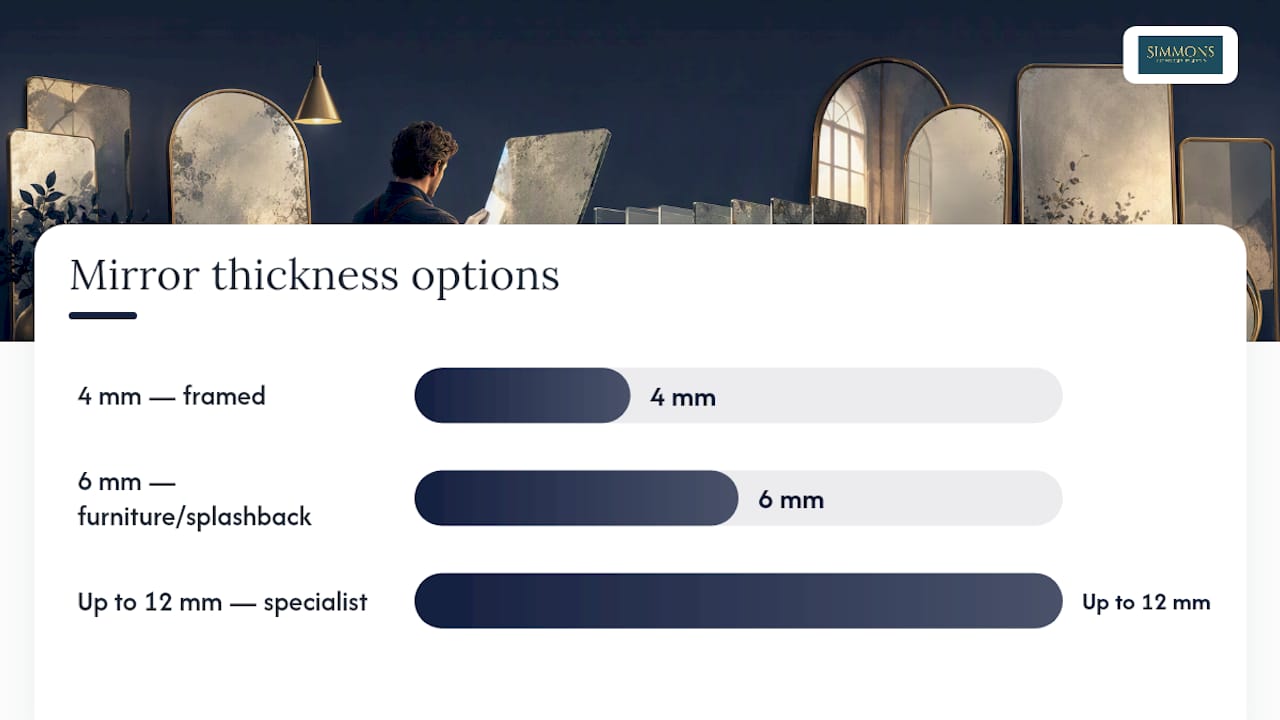
Handcrafted aged mirror glass is available in thicknesses from 4mm up to 12mm and can be toughened for splashbacks and feature-wall use. For most residential projects, 4mm is sufficient for framed mirrors and wall panels; 6mm is the sensible choice wherever the glass will be handled, leaned against, or fixed without a frame. Toughened antique mirror glass for splashbacks must comply with the relevant safety glazing requirements under BS 6206 and BS EN 12150.
When measuring for a replacement or new installation, always measure the aperture in at least three places (top, middle, bottom for width; left, centre, right for height) and supply the smallest dimension. Glass cut to the largest measurement will not fit. For detailed guidance on measuring and specifying exact dimensions, the custom mirror sizing guide covers tolerances and fitting allowances in full.
How do you place a correct order, step by step?
A well-structured order avoids the two most common problems: panels that arrive in the wrong finish and panels that do not fit.
- Request a physical sample. Specify the finish name and ask for a minimum 200mm × 200mm panel. Assess it on site before proceeding.
- Confirm the substrate and finish. Agree the base glass (clear, low-iron, or tinted), the finish name, and the approximate distressing coverage.
- Supply exact overall dimensions and all cutouts. Include the datum corner for cutout coordinates. Attach a dimensioned sketch or CAD file for anything non-rectangular.
- Specify thickness and toughening. State 4mm or 6mm (or thicker if required) and confirm whether toughening is needed.
- Agree edge treatment. Flat polished is standard; request bevels or other profiles explicitly.
- Confirm packing and delivery method. Antique mirror glass should travel in purpose-built timber crates or A-frames with foam separation. Ask whether the supplier uses a specialist glass courier or a standard pallet network, and whether residential delivery is available.
- Get a written lead time confirmation. Bespoke hand-antiqued panels typically carry a lead time of 4–6 weeks because of the silvering and distressing processes involved.
Pricing for cut-to-size antique mirror glass is commonly calculated per m², with additional fees for cutting, toughening and special edgework. Sample panels are usually charged at a modest fixed cost, often refundable or credited against a full order — always ask.
Red flags to watch for: a supplier who refuses to provide a physical sample, who cannot state a tolerance, or who offers no toughening option. For non-standard shapes and cutout positions, the custom mirror shapes guide sets out what fabricators need to price and produce complex panels accurately.
How are antique effects made, and how do you spot a genuine original?
Understanding the manufacturing process makes it far easier to evaluate what you are buying.
Industrial permanent antique coatings — the Miralite® Antique and Miralite® Versailles approach — achieve their vintage effect during production by varying the metal deposits in the silvering layer. The result is consistent, durable, and compatible with standard glass fabrication. These products are engineered for commercial interiors where cleanability and batch consistency matter.
Hand-silvering and chemical distressing involves applying silver nitrate solution to the glass surface and then deliberately introducing oxidising agents to create foxing, patching and tonal variation. Because each panel is treated individually, no two sheets are identical. The oxidation sits within the silver layer, giving genuine optical depth. Printed or surface-etched effects, by contrast, sit on top of the glass and lack that sense of dimension.
Authentic foxing on an original antique mirror plate is the product of decades of mercury oxidation. Experts note that genuine foxing has an irregular, spidery quality and a depth that manufactured distressing cannot fully replicate — the dark patches appear to recede into the glass rather than sitting on its surface.
Authentic oxidation on original mercury-silvered glass has an optical depth and irregularity that printed or surface-etched patterns lack. The genuine effect appears to recede into the silver layer; manufactured distressing, however skilled, tends to read as a surface pattern when viewed at an oblique angle.
When assessing a claimed original antique mirror, check these four things:
- The backing. Original plates have a dark, often flaking backing of mercury amalgam or early chemical silver. Modern reproductions use a clean, uniform grey or copper-coloured backing.
- The silver layer. Genuine mercury silvering has a slightly warm, uneven tone. Modern silver nitrate silvering is cooler and more uniform.
- The frame joinery. Period frames use hand-cut mortise-and-tenon or wooden-peg joints; modern reproductions use staples or modern adhesives.
- Provenance. A credible original will have a documented history, auction record, or dealer attribution.
Pro Tip: For conservation projects, always prefer a reclaimed original where the plate is intact and the brief is restoration. Where the original plate is too damaged to restore, a faithful hand-antiqued replacement panel is the correct choice — it preserves the spirit of the piece without the compromises of a poor-quality original. Never use an industrial antique range for restoration work; the consistency of the pattern will read as wrong against period joinery.
When bespoke hand-antiqued glass is the right call
Most projects that cross my desk fall into one of two camps: those where the designer has already decided on hand-antiqued glass and needs help specifying it correctly, and those where the brief says "antique mirror" but the budget and timeline quietly point toward an industrial range. Knowing which camp you are in early saves everyone time.
Bespoke hand-antiqued glass earns its place on residential feature walls, bespoke furniture pieces, and any project where the mirror is a focal point rather than a background material. The variation between panels, which some buyers initially worry about, is precisely what gives a multi-panel feature wall its life.
For large feature walls with multiple panels, join lines are unavoidable. The best approach is to treat them as a design element: align them with architectural features, use consistent edge profiles, and ensure every panel is fixed at the same plane. A 1mm step between adjacent panels will catch light and read as a mistake; a deliberate shadow gap, by contrast, can look intentional and elegant.
Working closely with your framer or joiner from the outset matters more than most designers anticipate. The fixing method, the rebate depth, and the adhesive choice all affect whether the finished installation looks considered or compromised. For large panels and heavy assemblies, the safe installation guide is worth reading before you finalise the fixing specification.
Simmonsinteriorsupply: bespoke antique mirror glass for trade clients
Simmonsinteriorsupply works with skilled artisans to produce made-to-measure mirror panels in a range of hand-antiqued finishes — foxed, vintage, mercury sparkle, Versailles-style and bronze antique — cut to your exact dimensions and toughened where the application demands it. Every panel is crafted individually, which means the finish has the optical character that mass-produced ranges cannot match.
Trade clients and interior designers can request physical sample panels to assess finish and reflectivity under real site conditions before committing to a full order. Simmonsinteriorsupply also provides fabrication notes, lead time estimates and trade pricing on request, making it straightforward to include bespoke antiqued glass in a project specification from the earliest design stage. To view finish examples and past bespoke mirror projects, the Simmonsinteriorsupply gallery is a good starting point. When you are ready to discuss dimensions, finish and lead times, contact the team directly to request a sample or a trade quotation.
Sources
The following manufacturer pages and product datasheets are worth consulting when specifying antique mirror glass for a UK project.
- MIRALITE ANTIQUE A vintage look for interior decoration (SGG / Saint-Gobain)
- Antique Mirror Glass with Mercury Sparkle
- 53 Slightly Distressed Aged Mirror Glass - Devlin In Design
- Vintage Finish Antiqued Mirror | Hand Silvered on Clear Glass | Rough Old Glass
- Antique Mirror - General Glass