
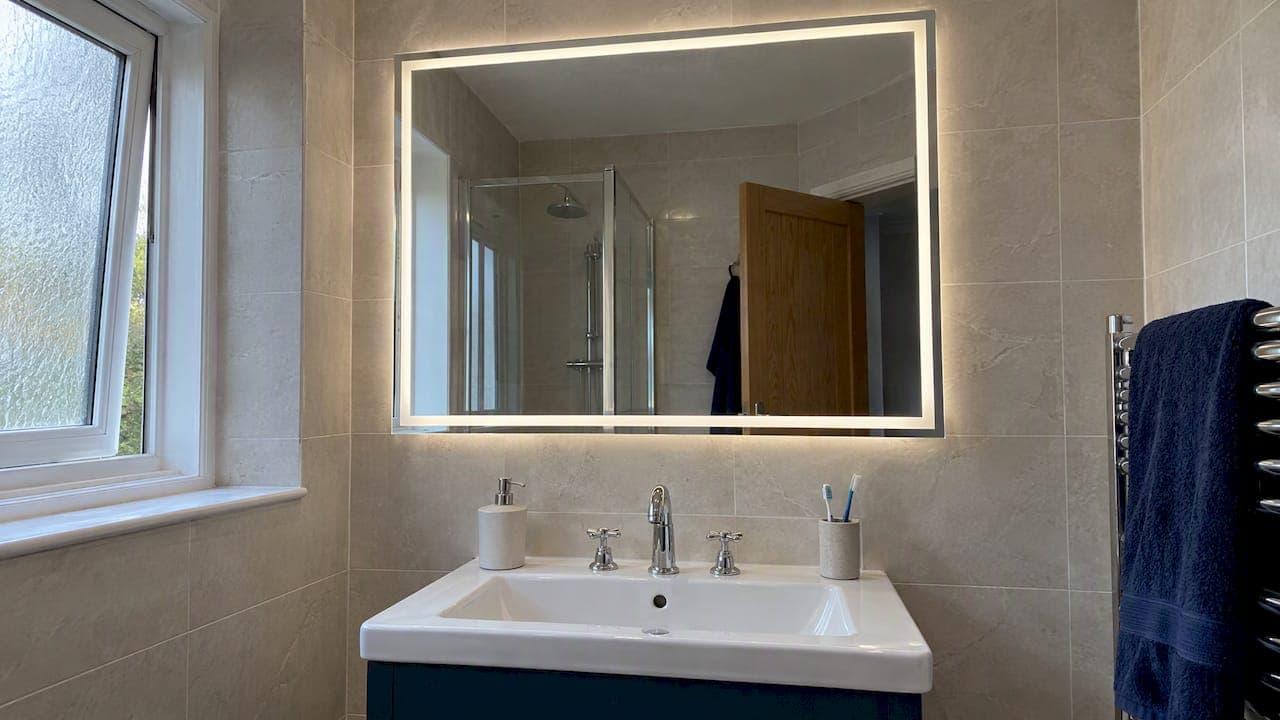
The minimum protection a bathroom mirror needs is IPX4, required for anywhere in zones 1 and 2 under Section 701 of the wiring regulations. Before buying, check the manufacturer's datasheet for that figure alongside UKCA or CE conformity, and bring in a registered installer wherever the work touches a circuit in these special locations. Where a new circuit is involved, the work may also be notifiable under Part P.
TL;DR:
- A mirror within 0.6 metres of a basin falls in Zone 2, even if it sits well beyond the bath or shower.
- Water jet cleaning raises the requirement to IPX5; Zone 2 shaver supply units covered by a separate product standard are exempt from the IPX4 minimum.
- Check whether the LED driver sits inside the mirror or remotely outside the bathroom zones, since its location affects compliance and heat clearance.
- For custom mirrors, request written confirmation that the tested rating still applies after changes to dimensions or driver placement, and follow stricter supplier zone instructions.
- Bathroom wiring changes, particularly work involving a new circuit, may require Part P notification through a registered installer or Building Control.
Table of Contents
- How IP ratings work and how to read them for bathroom fittings
- Bathroom zones and the UK rules that determine minimum IP protection
- Specifying LED bathroom mirrors in the UK: what to check before buying
- Installation checklist and safe placement for bathroom mirrors
- Practice perspective from Simmons Interior Supply and trade tips
- Our honest take on bathroom mirror compliance
- Compliant, bespoke mirrors built with your bathroom in mind
- FAQ
- Sources
How IP ratings work and how to read them for bathroom fittings
An IP, or Ingress Protection, rating is a two-digit code that tells you exactly what a fitting can withstand, and nothing more. The first digit covers protection against solid objects and dust, running from 0 (no protection) to 6 (fully dust-tight). The second covers water, from 0 (no protection) to 8 (continuous submersion). When you see an "X" in place of a digit, such as IPX4, it means that particular form of ingress was not tested or is not relevant to the claim, not that protection is absent.
For bathroom mirrors, the second digit is what matters most. A handful of common ratings crop up again and again in product listings:
- IP20: no meaningful water resistance, fine for a hallway but not for a bathroom wall.
- IP44: protected against splashing water from any direction, the realistic baseline for most mirror positions.
- IP65: protected against low-pressure water jets, a level reserved for wet zones or shower enclosures.
A line in the marketing copy claiming a mirror is "suitable for bathrooms" tells you nothing on its own. Only an explicit IP figure, backed by UKCA or CE conformity on the datasheet, confirms that the fitting has actually been tested and rated for the conditions you're installing it in.
Bathroom zones and the UK rules that determine minimum IP protection
Before you can match a mirror to the right rating, you need to know which zone it sits in, and bathrooms are divided into three that matter for electrical equipment:
- Zone 0: inside the bath or shower tray itself, where only low-voltage, fully submersible fittings belong.
- Zone 1: the area above the bath or shower up to 2.25 metres from the floor, directly over the water source as defined in Approved Document P.
- Zone 2: a further 0.6 metres horizontally beyond the edge of the bath or shower, and also the space around a basin within 0.6 metres.
Section 701 sets the minimum degree of protection for equipment in zones 1 and 2 at IPX4, rising to IPX5 wherever water jets might be used for cleaning, a shower room in a hotel bathroom being a typical example. There's one notable exception: shaver supply units designed to BS EN 61558-2-5 are permitted in zone 2 without needing the full IPX4 figure, because their construction is already covered by that separate standard.
Most mirrors over a basin fall within zone 2 simply by virtue of sitting within 0.6 metres of the taps, so measure outward from the basin edge, not just from the bath or shower, before assuming a mirror is outside the regulated area. And always cross-check the manufacturer's own statement against the IP figure itself. A supplier's installation guidance sometimes narrows the permitted zone further than the IP rating alone would suggest, and that instruction takes precedence on site.
Specifying LED bathroom mirrors in the UK: what to check before buying
LED mirrors bring an extra layer of complexity because the light source, driver and glass form a single assembly, and each element has its own tolerance for moisture and heat. Before committing to a purchase, work through a short specification checklist:
- Confirm the IP rating and UKCA or CE conformity are stated explicitly on the datasheet, not implied by marketing language.
- Identify whether the mirror runs from a fixed 230 V supply or a low-voltage circuit via a remote transformer, since this affects where it can sit relative to the zones.
- Establish where the LED driver is housed: a driver built into the mirror body needs a rating that matches its zone, while a remotely mounted driver outside the special location can simplify compliance considerably.
- Check the manufacturer's thermal guidance, since drivers enclosed within a sealed mirror cavity can run hot and may have specific ventilation or spacing requirements.
Where the supplier's documentation leaves any of this unclear, ask for a site-specific recommendation rather than guessing from a generic datasheet. BS 7671 confirms that 230 V fittings can be installed above a bath or shower provided they carry at least IPX4 and are of a design suited to those conditions, but the wiring route and isolation method still need proper planning. If the installation involves a new circuit or alters existing wiring in the bathroom, that work is likely notifiable under Part P, which means either a Competent Person Scheme registered installer or a Building Control notification, as set out in Gov.
Pro Tip: Ask your supplier to confirm driver location and IP rating in writing before you commit to a bespoke size, since altering the mirror depth can sometimes change how the finished assembly performs in practice.
Installation checklist and safe placement for bathroom mirrors
A methodical sequence on site prevents the kind of oversight that only surfaces once the mirror is fixed to the wall:
- Before installation: verify the IP figure, the datasheet, UKCA or CE marking, and the recommended mounting method against the wall type you're working with.
- On site: measure the zones properly, confirming the mirror sits at least 0.6 metres clear of the bath or shower edge where required, and respecting the 2.25 metre vertical limit that defines zone 1 under Approved Document P.
- Electrical work: check the supply matches the fitting, confirm switching is positioned outside the special location, and verify earth continuity and supplementary equipotential bonding where the circuit requires it.
- Notification and handover: decide whether a registered installer or Building Control notification applies under Part P, and leave the datasheet and installation instructions with the homeowner for future reference.
Our guide to installing a large mirror safely walks through fixing methods for heavier bespoke pieces in more depth.
Practice perspective from Simmons Interior Supply and trade tips
The most common mistake we see in specification queries is a reliance on vague "bathroom safe" language instead of a proper IP figure and conformity statement, and it's an easy trap because the marketing copy often sounds reassuring enough to skip the datasheet entirely. Custom proportions change the calculation too:
- A bespoke width or depth can shift the driver position relative to a zone boundary.
- Safety backing specification affects both compliance and how the mirror is fixed to the wall, covered in our guide to mirror safety backing.
- Glass choice and thickness, discussed in our trade notes on bronze mirror glass, interact with mounting method and weight limits.
Our City of London trade guide covers these specification details for bespoke installations in more depth.
Our honest take on bathroom mirror compliance

The IP rating conversation tends to stop at a single number, as if IPX4 were a badge rather than the floor of an acceptable specification. In our view, that's where most buying decisions go wrong: a mirror can carry the right rating on paper and still be unsuitable once you account for driver placement, mounting method and the specific geometry of a bespoke piece. The datasheet tells you what was tested, not whether your particular wall, zone and wiring route add up to a safe installation.
What gets underestimated is how much a custom size changes the picture. A standard off-the-shelf mirror has been tested as a fixed unit, but a bespoke mirror with a relocated driver or altered depth needs the same scrutiny applied fresh, not assumed from the base product's rating. If you take one thing from this guide, let it be this: treat the IP figure as the starting question, not the final answer, and always ask your supplier how that rating holds up once the mirror is the exact size and configuration you actually want.
— Luke
Compliant, bespoke mirrors built with your bathroom in mind
We supply bespoke mirrors to interior designers, architects and trade customers who need a specification they can stand behind, not just a size and finish that look right on paper. Every enquiry comes with the documentation to back it up.

- We provide manufacturer datasheets and UKCA or CE conformity confirmation alongside every bespoke mirror order.
- We offer site-specific recommendations where driver placement or zone positioning needs clarifying before you commit to dimensions.
- We work directly with trade accounts on commercial and hospitality projects requiring tailored sizing and finishes.
If you're specifying a bespoke mirror for a bathroom project, get in touch through our trade enquiries page to request a datasheet and a recommendation suited to your site.
FAQ
Can I put IP20 in a bathroom?
An IP20-rated fitting has no tested resistance to water, so it isn't suitable for zones 1 or 2 as defined by Section 701. It may be acceptable outside those zones, for example well beyond 0.6 metres from a basin, but checking the manufacturer's own guidance first is always worthwhile.
Is IP24 ok for bathrooms?
IP20 offers minimal protection against solid objects and water resistance below the IPX4 baseline required for zones 1 and 2 under Section 701. It's generally suitable only if the fitting's documented zone compatibility matches where you intend to install it.
Is an IP65 rating suitable for bathrooms?
Yes, IP65 exceeds the minimum IPX4 requirement for zones 1 and 2 and meets the higher IPX5 standard needed where water jets might be used for cleaning. It's a safe choice for almost any bathroom position, including wetter areas near a shower.
What is the minimum IP rating required for a bathroom in Zone 1?
The minimum is IPX4, as set out in Section 701, rising to IPX5 where the fitting may be exposed to water jets during cleaning. Shaver supply units built to BS EN 61558-2-5 are the one recognised exception to this rule.
Sources
- Section 701 - Locations containing a bath or shower
- Gov
- Electrical safety – Dwellings, Approved Document P (extract)