
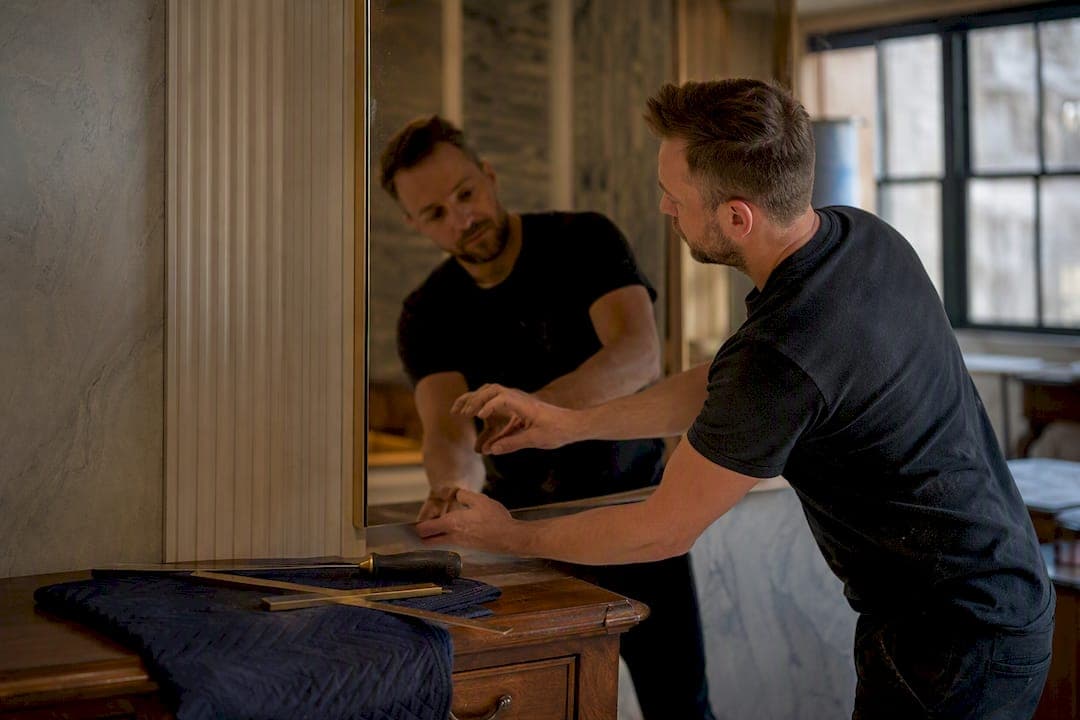
Bronze mirror glass is a bronze-tinted reflective flat glass used for decorative and architectural mirrors, prized for the warmth it lends to a reflection that standard silver mirror simply cannot offer. It typically comes in 5mm to 6mm gauges and is commonly cut to size for bespoke installations. The one constraint every specifier must plan around: it usually cannot be toughened, so safety backing or lamination becomes essential wherever impact risk exists.
TL;DR:
- Bronze mirror glass typically comes in 5mm and 6mm gauges, with 6mm preferred for larger or commercial applications due to increased strength and stability.
- It usually cannot be toughened, making safety backing or lamination essential for impact resistance in high-traffic or impact-prone areas.
- Consistency in color and appearance varies by manufacturer, batch, and process, so physical samples are crucial before ordering full sheets.
- Antique and patterned finishes add textured or oxidized effects that require gentle cleaning and are usually applied to 6mm sheets for durability and visual impact.
- Proper edge sealing, safety backing, and correct sizing are key to ensuring longevity and safety, especially in bathrooms, kitchens, or public spaces.
Table of Contents
- What is bronze mirror glass and how is it made?
- What thicknesses and sheet sizes should you specify?
- What decorative finishes and antique effects are available?
- Where does bronze mirror glass work best?
- What are the fabrication and installation limits?
- Do you need safety backing on bronze mirror glass?
- How do you order samples and specify for procurement?
- What trade expertise should you look for in a supplier?
- How does bronze mirror compare with grey and other tinted mirrors?
- What are the environmental considerations of bronze mirror glass?
- What does the evidence actually tell specifiers to prioritise?
- How to commission a bespoke bronze mirror through Simmons Interior Supply
- Sources
What is bronze mirror glass and how is it made?
Bronze mirror glass starts life as ordinary float glass before a tinting process alters its optical character. Manufacturers introduce metallic oxides into the glass batch, or apply a coloured coating during the silvering process, producing a consistent amber-bronze cast that carries through the full thickness of the sheet rather than sitting as a surface film. The effect is chemical, not cosmetic, which is why the tone stays stable under normal light exposure over years of use.
The practical result in a room is a mirror that reflects warmer, softer light than a conventional silvered mirror. Standard mirror glass reflects close to the full visible spectrum, giving a cool, almost clinical brightness. Bronze mirror absorbs a portion of the blue end of that spectrum, so skin tones read warmer, timber and brass finishes glow rather than glare, and a space avoids the slightly sterile look that acres of plain silver mirror can create in a bathroom or lift lobby.
That warmth is exactly why bronze mirror is used as a tinted alternative to standard silver mirrors in projects where atmosphere matters as much as function. It reads differently in a north-facing room with cool daylight than it does under warm tungsten lighting in a hotel corridor, which is precisely why a swatch on a desk tells you very little compared with a sample held against the actual wall.
Three things drive variation between suppliers and even between batches from the same supplier:
- The base glass quality (float glass clarity varies, and low-iron glass produces a cleaner bronze tone)
- The tinting or coating process each manufacturer uses, which affects consistency sheet to sheet
- Batch-to-batch colour drift, more noticeable in hand-finished or antiqued ranges than in standard tinted stock
Bronze mirror glass typically ships in 5mm and 6mm thicknesses, the two gauges that cover the overwhelming majority of decorative and architectural applications. Always request a physical sample cut from current stock rather than trusting a printed swatch or a photograph on a supplier's website. Colour that looks right on screen can shift noticeably once it is sitting under your actual light fittings.
What thicknesses and sheet sizes should you specify?
Specification starts with thickness, and for bronze mirror glass the choice is narrower than for clear glass. 5mm suits smaller decorative panels, furniture inserts, and wall-mounted pieces where the mirror is fully supported and unlikely to face knocks. 6mm is the safer default for anything larger, anything wall-hung without a full backing panel, or any commercial application, since it carries more mass, resists flex better, and gives fabricators more material to work with at cut edges. Made2Measure specifically recommends 6mm bronze tinted mirror for most commercial applications, and that guidance holds well beyond hospitality and retail projects.
Stock sheet sizes vary between suppliers, and this matters more than it first appears. Ordering a mirror close to a supplier's maximum stock dimension often means paying for an entire sheet with heavy wastage, while a size just under that threshold can be cut far more economically. Product specifications for bronze tinted mirror list defined stock sheet sizes alongside available safety options, so it pays to ask for the stock sheet dimensions before finalising a layout, particularly for feature walls built from multiple panels.
Cut-to-size ordering is standard practice across the trade, but a few details separate a smooth order from a delayed one:
- Tolerances: expect a standard cutting tolerance of a few millimetres on overall dimensions; anything tighter needs to be flagged explicitly at order stage
- Edgework: polished edges suit exposed installations, bevelled edges add a decorative shadow line for framed or free-hanging pieces, and raw or arrissed edges are acceptable only where a frame will conceal them entirely
- Cut-outs and holes: fixing holes, socket cut-outs, and slots all need minimum edge distances specified by the fabricator, since positioning a hole too close to an edge on non-toughened glass invites cracking
- Minimum panel size: very small cut pieces (under roughly 150mm on a side) are often uneconomical or structurally risky to produce, so consult your fabricator before locking in a design that relies on slim inserts
Our own guidance on custom mirror sizing goes further into tolerance negotiation for bespoke commissions, which is worth a read before you issue a cutting list to any workshop.
What decorative finishes and antique effects are available?
Plain bronze tint is only the starting point. The decorative end of the range includes antique finishes that mimic decades of oxidation, foxed effects with irregular dark patches, and patterned textures such as tweed or stria that add a woven or linear surface interest to the reflection. Antique and patterned bronze mirror finishes are commonly supplied in 6mm cut-to-size sheets for hospitality and high-end residential work, and it is these ranges, more than the plain tint, that tend to define the character of a bar, restaurant, or period-property bathroom.
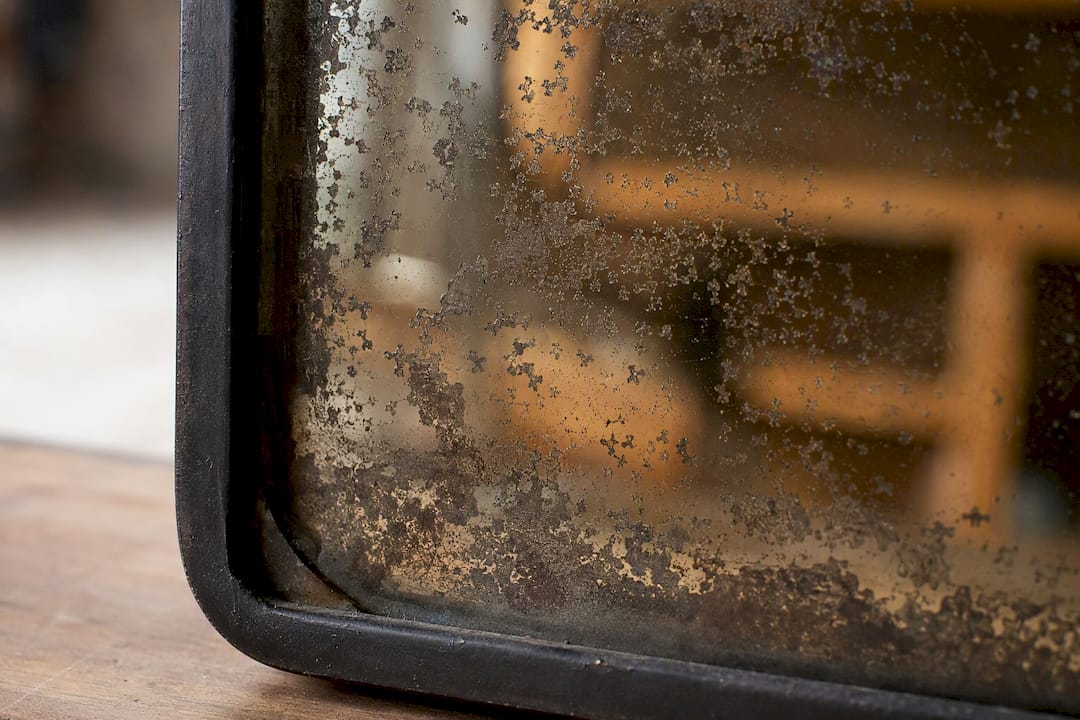
Surface treatments change more than looks. Antiquing and foxing typically involve chemical or mechanical distressing of the reflective backing, which reduces overall reflectivity slightly and introduces genuine texture you can feel under a fingertip in places. That texture holds dust differently to a smooth mirror surface and needs a gentler cleaning approach, covered further on. Patterned finishes such as stria or tweed are usually applied as a rolled or etched texture to the glass itself before silvering, so the pattern is permanent and consistent across the sheet rather than randomly distributed the way foxing is.
Choosing between a decorative finish and plain bronze tint comes down to the role the mirror plays:
- A feature wall or statement piece in a lobby or dining room benefits from an antique or patterned finish, where imperfection is the point
- A functional mirror in a dressing room or bathroom, where clarity of reflection matters for daily use, usually calls for plain bronze tint
- Furniture inlays and cabinet doors often suit a subtler foxed edge rather than an all-over antiqued surface, keeping practicality at the centre while adding a decorative border
Because hand-finished and antiqued ranges vary noticeably between production runs, specialist suppliers offer purchasable samples so designers can check tone and pattern before committing to an order. Our own antique mirror glass guide covers sourcing these finishes in more depth for anyone building a full specification document.
Where does bronze mirror glass work best?
Bathrooms and kitchens are the obvious starting points, since bronze mirror's warmth softens the often cold, tiled palette of these rooms and flatters skin tone under vanity lighting far better than plain silver. Feature walls in hospitality interiors, from hotel corridors to restaurant bars, use bronze mirror at scale to create depth and a sense of low-lit glamour that a room of clear mirror rarely achieves. Furniture makers increasingly specify bronze mirror as an inlay for cabinet doors, table tops, and shelving backs, where a smaller reflective surface still carries the warmth of the finish without overwhelming the piece.
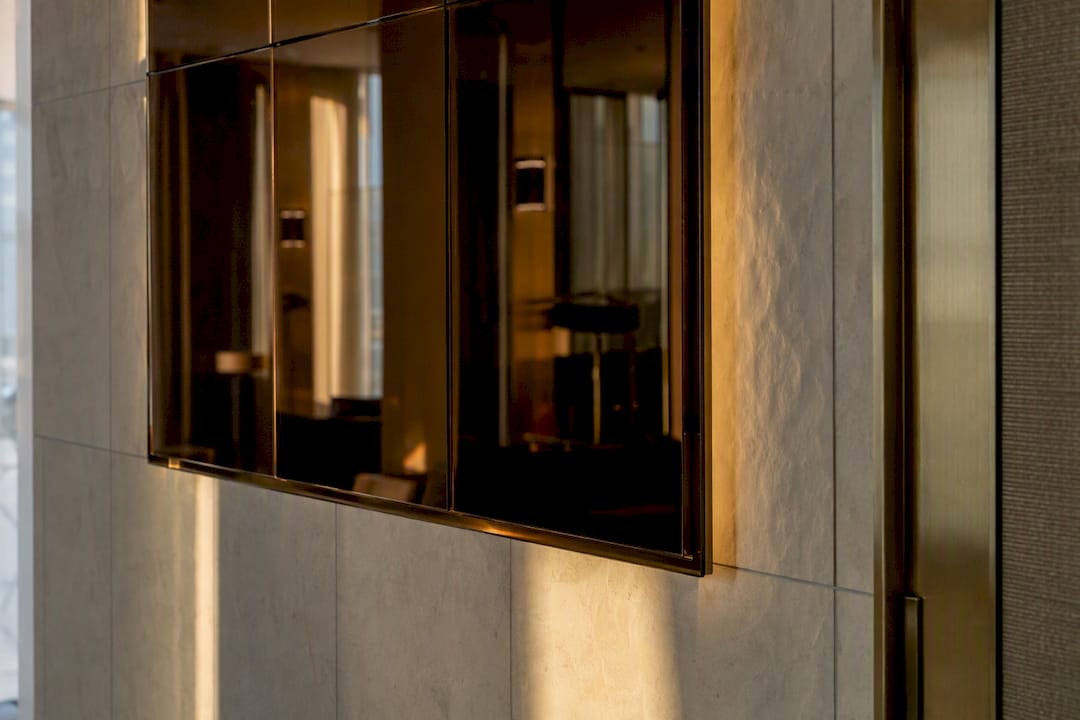
Lighting and adjacent materials do a lot of the work here. Bronze mirror paired with brushed brass or aged bronze hardware creates a coherent metal palette that reads as considered rather than accidental, while the same mirror against cool chrome fittings can look slightly at odds. Warm dimmable lighting amplifies the tint's best qualities; harsh cool LED strip lighting can fight against it, flattening the warmth the tint is meant to deliver.
Durability deserves a straight answer. Bronze mirror performs well in bathrooms and kitchens provided the backing and edge sealing are specified correctly, since moisture ingress at unsealed edges is the main cause of premature silvering failure, known in the trade as "black edge." High-traffic commercial corridors need the safety backing discussed later in this guide, not just for impact resistance but because unprotected edges see far more incidental contact over years of use.
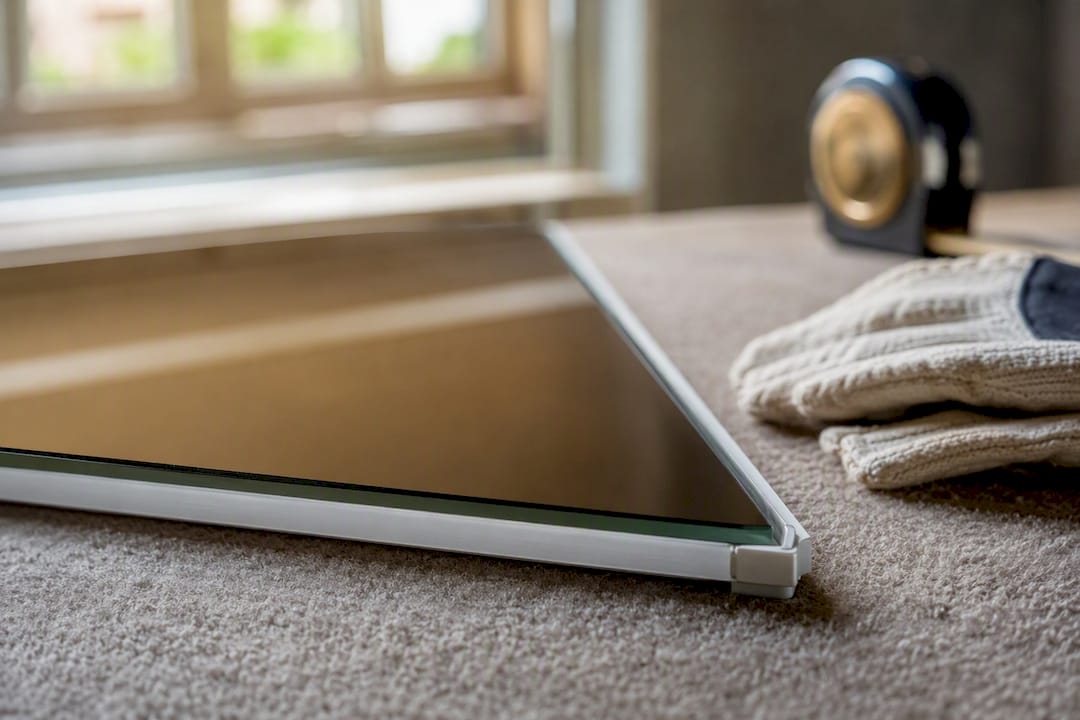
Pro Tip: Order your bronze mirror sample and hold it directly against the wallpaper, tile, or paint sample you intend to use, under the actual light fitting planned for the room. Bronze reads very differently under warm 2700K lighting than under a cooler 4000K commercial fitting, and that difference is far easier to catch on-site than after installation.
What are the fabrication and installation limits?
Fabrication of bronze mirror glass follows the same broad rules as any annealed decorative glass, with a few constraints specific to the tint and finish. Getting the brief right before cutting begins saves far more time than correcting it afterwards.
- Confirm cutting tolerances upfront. Standard tolerances apply to overall dimensions, but bevelled or polished edgework needs its own separate tolerance discussion, since edge finishing removes material and can shift final dimensions by a millimetre or two.
- Choose edgework to suit exposure. Polished edges for any exposed installation, bevelled edges for framed or free-hanging feature pieces, and raw arrissed edges only where a frame will fully conceal them, since raw bronze mirror edges are more visually obvious than raw clear glass edges.
- Accept the toughening limitation. Bronze mirror glass generally cannot be toughened, which rules out heat-strengthening as a safety route. Shower enclosures, low-level glazing, and any high-impact commercial location need an alternative safety strategy rather than a tempered pane.
- Specify holes and slots with generous clearance. Any fixing hole, cable cut-out, or slot needs a minimum edge distance agreed with the fabricator, because non-toughened bronze mirror is considerably more prone to cracking from a hole positioned too close to an edge than toughened clear glass would be.
- Plan bonded and adhesive installations carefully. For complex framed mirrors or large feature walls, allow a small expansion gap and specify the exact adhesive or mechanical fixing method with the fabricator, since small deviations in substrate flatness or fixing technique can introduce stress that cracks non-tempered bronze mirror over time.
- Brief your installer as precisely as your fabricator. A cutting list without an installation method statement leaves too much to chance on site, particularly for heavy or oversized panels.
Our installation guide for the City of London trade covers fixing methods in more detail, and is worth sharing directly with your installer alongside the cutting specification.
Do you need safety backing on bronze mirror glass?
The short answer: assume you do, unless your fabricator confirms otherwise for your specific gauge and finish. Bronze mirror glass generally cannot be toughened, which removes the most common route to impact safety used for clear glazing. UK suppliers are explicit that tinted bronze mirror cannot be toughened, which pushes the safety burden onto backing, lamination, or adhesive film rather than the glass itself.
Three alternative safety measures cover most situations:
- Laminated safety backing: a resin or film interlayer bonded to the rear of the mirror, holding fragments together on breakage; the standard choice for wall mirrors in bathrooms and communal spaces
- Safety film applied post-installation: a practical retrofit option for existing mirrors where full lamination wasn't specified originally, though generally a lower standard of protection than factory lamination
- Adhesive-bonded fixing to a rigid substrate: bonding the mirror fully to plywood or MDF backing rather than mechanically fixing at isolated points, reducing the risk of a shattered panel falling as a single sheet
A pragmatic and commonly recommended approach is specifying 6mm bronze mirror with laminated safety backing, which balances the decorative tint against genuine impact resistance in bathrooms and commercial fit-outs. This is the specification worth defaulting to unless a project's budget or design genuinely rules it out.
Which measure suits which location isn't a matter of preference:
| Location type | Recommended safety approach |
|---|---|
| Domestic wall mirror, low traffic | Adhesive-bonded fixing to rigid backing, minimum |
| Domestic bathroom | Laminated safety backing |
| Commercial or public-facing space | Laminated safety backing, no exceptions |
| Any shower enclosure or low-level glazing | Laminated backing plus fully bonded fixing |
On-site checks matter as much as the specification itself: confirm the backing material hasn't been substituted at fabrication stage, check that fixing points sit clear of any cut-out or hole, and inspect edge sealing before final handover. Our mirror safety backing guide and large mirror installation checklist both expand on these checks for anyone specifying at scale.
How do you order samples and specify for procurement?
Procurement for bronze mirror glass runs smoothly when the specification document does the thinking before the workshop ever picks up a cutting tool. A handful of steps separate a straightforward order from one that comes back wrong.
- Request a physical sample before anything else. Photographs and printed swatches consistently misrepresent bronze tint, and antiqued or patterned finishes vary enough between batches that a sample from current stock is the only reliable check. Hold it against your actual materials, under your actual lighting, before signing off.
- Ask for samples from the same production batch wherever possible. Ordering samples from the same batch matters most with antique or hand-decorated finishes, since visual variation sheet to sheet can be significant enough to throw off a matched installation.
- Build realistic lead times into your programme. Suppliers typically quote longer lead times for decorative finishes and cut-to-size fabrication than for standard clear glass, so factor sample approval time and fabrication time separately rather than assuming they overlap.
- Check minimum order quantities early. Some patterned or antiqued ranges are sold only as full sheets or in minimum runs, which affects budgeting for smaller bespoke commissions.
- Write the specification in full, covering thickness (5mm or 6mm), finish (plain tint, antique, foxed, or patterned), edgework, safety backing method, exact dimensions with tolerance, and delivery or installation notes. A specification missing even one of these invites a fabricator to guess, and guesses on non-toughened glass are expensive to correct.
What trade expertise should you look for in a supplier?
Specifying bronze mirror glass well means working with people who have actually fabricated and fitted it, not just sold it off a price list. At Simmons Interior Supply, our experience with bespoke mirror commissions runs through the same workshops that craft our furniture, which means sizing, finish selection, and trade coordination happen under one roof rather than across three separate suppliers.
Getting the gauge right for the installation, matching an antique finish across multiple panels on a feature wall, and briefing safety backing correctly for a commercial commission are all judgement calls that come from having done it before, not from a catalogue. That is the value a trade-focused fabricator brings over a generic glass merchant.
We work directly with interior designers, architects, and hospitality procurement teams on bespoke sizing and finishing, coordinating with fabrication partners so specifications translate accurately from drawing to installed piece. For anyone weighing up finish options more broadly, our custom mirror shapes guide covers briefing fabricators for non-standard profiles, a natural companion to the specification detail covered here.
How does bronze mirror compare with grey and other tinted mirrors?
Bronze sits at the warm end of the tinted mirror spectrum, while grey occupies the cool, contemporary end. Grey-tinted mirror reduces reflectivity and adds a smoky, industrial quality that suits minimalist interiors, exposed concrete, and cooler metal palettes such as brushed steel or matt black. Bronze does the opposite job entirely, amplifying warmth and suiting timber, brass, and richer colour schemes.
The "bronze versus bronze-coated" distinction matters more than it sounds. True bronze-tinted mirror carries the colour through the tinting process itself, either in the glass batch or the reflective coating applied during silvering, giving a stable tone that doesn't wear away. A bronze-coated or bronze-film product, by contrast, applies colour as a surface layer over a standard silvered mirror, which can be more prone to visible wear at edges or high-contact points over time. When specifying, ask explicitly which category a product falls into, since suppliers don't always volunteer the distinction unprompted.
Compared with antique mirror, which deliberately introduces imperfection and irregular oxidation patterns, plain bronze tint offers a clean, consistent, and highly repeatable reflection, useful when matching multiple panels across a wide feature wall. The choice ultimately comes down to whether the brief calls for warmth with clarity, or warmth with character. Both are valid design decisions, but they solve different problems, and conflating them at specification stage is one of the more common sources of client disappointment on delivery day.
What are the environmental considerations of bronze mirror glass?
Bronze mirror glass shares most of its environmental profile with standard silvered mirror, since both start from float glass and use similar coating processes. Glass manufacturing is energy-intensive at the melting stage, and the metallic backing layer, whether silver or an alternative reflective coating, adds a further environmental cost beyond the base glass itself.
Longevity works in bronze mirror's favour. A well-installed panel with proper edge sealing and correct backing can last decades without silvering failure, which matters more for sustainability than any single manufacturing statistic, since the environmental cost of a mirror is spread across its entire service life. A mirror that fails after five years due to poor edge sealing carries a far worse environmental footprint than one that lasts thirty, regardless of how it was originally made.
Disposal is the less comfortable part of the conversation. Mirror glass with a metallic backing generally cannot go through standard glass recycling streams, since the reflective coating contaminates the recycling process for clear glass. Specialist glass recyclers exist in most regions and can separate or process coated glass appropriately, but standard household or commercial glass collection typically cannot. Specifying durable installation, proper backing, and realistic lifespan expectations from the outset does more for a project's environmental footprint than any claim about the manufacturing process itself.
What does the evidence actually tell specifiers to prioritise?
Most guidance on bronze mirror glass treats it as a colour decision. The research doesn't support that framing. The genuinely consequential choices are gauge, safety backing, and batch consistency, and all three get decided before anyone discusses whether the tone reads warm enough under a particular light fitting.
Conventional advice underplays the toughening limitation badly. It gets mentioned as a footnote on most supplier pages, when it should shape the entire specification conversation from the first meeting. A designer who locks in a bronze mirror choice on colour alone, then discovers at installation stage that safety backing wasn't costed in, has a genuine problem on their hands, not a minor adjustment.
Prioritise in this order: confirm the safety strategy first, lock the gauge second, and treat finish selection as the final decision, made against a physical sample and not a swatch. Get those three right and the aesthetic choice becomes the easy part of the brief, exactly as it should be.
— Luke
How to commission a bespoke bronze mirror through Simmons Interior Supply
Simmons Interior Supply is the practical route to a bronze mirror that fits your exact brief, rather than the nearest stock size a standard supplier happens to hold. We work directly with trade clients on custom dimensions, finish selection between plain tint, antique, and patterned options, and the safety backing method appropriate to the installation, all coordinated through the same craft process behind our bespoke furniture commissions.
That trade-level coordination matters most when a project involves multiple matched panels, an unusual size, or a finish that needs checking against a physical sample before commitment, exactly the situations where a generic glass merchant tends to fall short. Browse examples of finished commissions in our project gallery to see the range of bespoke work we've delivered for designers and hospitality clients alike.
To start a bronze mirror commission, get in touch through our Trade-Only Interior Design Showroom in Westminster | Faura for a quote, or request samples directly so you can check tone and finish against your own project materials before ordering.
Sources
- Bronze Mirror | Walker Glass
- 6mm bronze tinted mirror - cut to size | Made2Measure
- Bronze Tinted Mirror (product spec) | FGDGlass
- Antique mirror glass | Architectural Glass
- Flat tinted antiqued mirror finishes | Rough Old Glass