
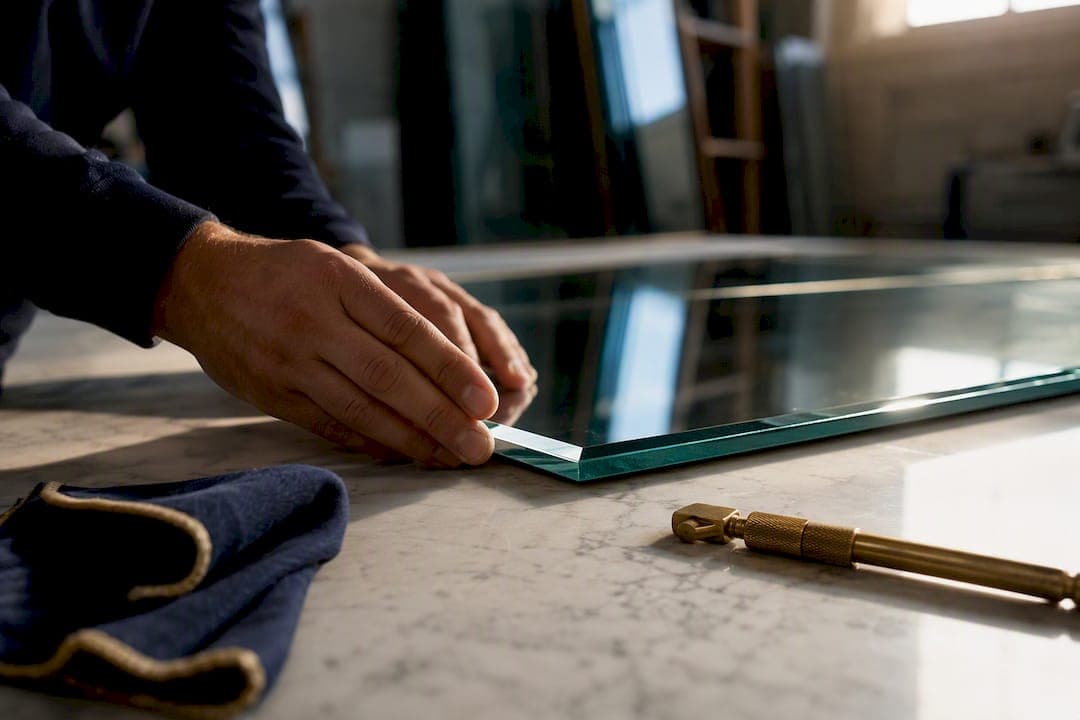
Bespoke, trade-grade mirrors in the UK typically run from around £150 for a small feature piece to £900 or more for a full-length or wall-sized commission, before installation extras. That headline band usually covers glass, cutting and a standard edge finish. It rarely includes wall reinforcement, decorative gilding, eglomisé work or specialist fixings, which sit as separate line items once the design brief moves beyond a simple rectangle.
TL;DR:
- Non-standard mirror shapes, like arches or freeforms, increase costs by 20 to 40 percent due to extra cutting and finishing time.
- Decorative finishes such as eglomisé or gilding can double the base price, especially for detailed, hand-applied effects.
- Installation costs rise significantly for oversized panels requiring wall reinforcement, specialist fixings, and site-specific preparation.
- Detailed site surveys or templates are essential to prevent costly re-fabrication caused by out-of-square walls or measurement inaccuracies.
- Lead times for complex commissions, including decorative finishes, can extend from weeks to several months depending on customization intensity.
Table of Contents
- Bespoke mirror pricing UK: what the cost bands actually look like
- What drives custom mirror prices up or down?
- How long does a bespoke mirror commission take?
- Specifying mirrors for hotels and trade projects: the RFQ checklist
- Do custom mirror prices vary across the UK?
- What warranty and after-sales costs should you expect?
- A trade perspective on avoiding cost creep
- Commissioning a bespoke mirror through Simmons Interior Supply
- Primary sources for cost and technical guidance
- Sources
- FAQ
Bespoke mirror pricing UK: what the cost bands actually look like
Trade quotes for bespoke mirrors tend to scale with size, shape and finish rather than following one flat rate. A small vanity or feature mirror, roughly up to 60cm across with a simple bevel or polished edge, sits at the lower end of the commonly cited £150 to £900+ range. A medium decorative piece for a hallway or bedroom, often framed or with a shaped top, moves toward the middle of that band. Full-length panels and wall-sized hospitality commissions, particularly those specified in bronze or antiqued glass, regularly reach the upper end and beyond once framing and installation are added.
Shape is where budgets start to shift. Non-standard cuts, arches, freeform edges, sculptural forms, typically add 20 to 40% over a standard rectangle because of extra cutting time, wastage and edge finishing. Designers briefing anything beyond a straight edge should factor that premium in from the outset rather than discovering it at quote stage. Our guide to custom mirror shapes covers which forms carry the steepest multipliers.
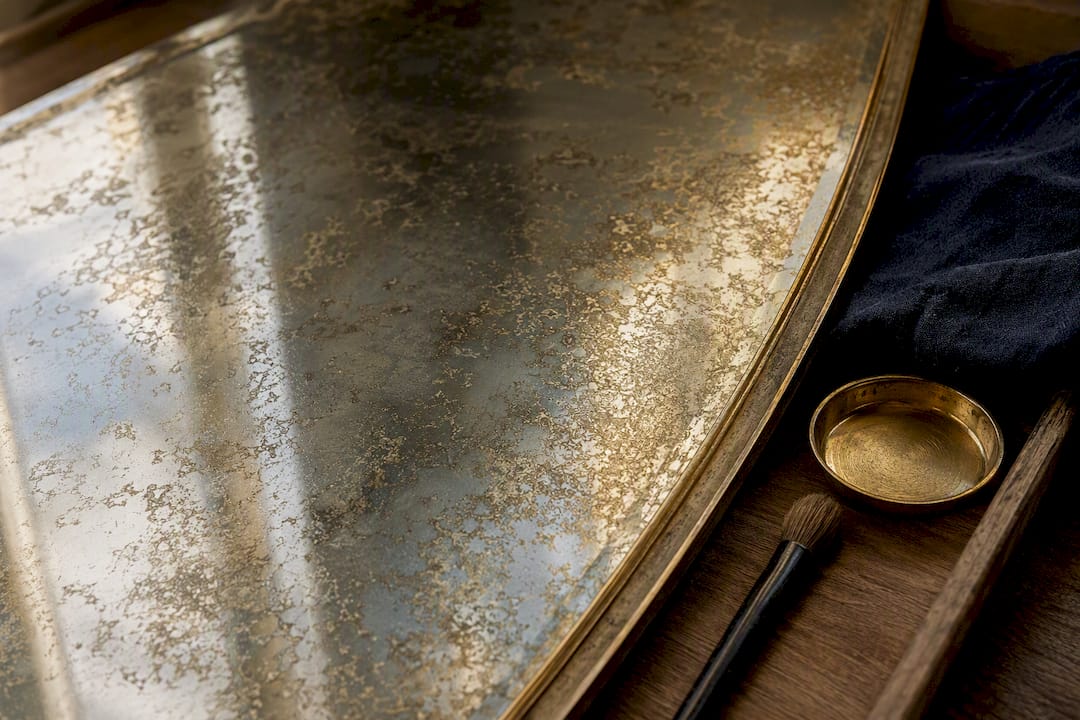
Decorative finishes carry their own premium tier. Gilded surrounds and hand-applied eglomisé, the reverse-glass gilding technique favoured in hotel lobbies and period-style interiors, are made to order and carry a longer lead time alongside a significantly higher price than a plain silvered panel. Antiquing a mirror to give it an aged, foxed patina sits somewhere between the two, adding character without the full cost of hand gilding.
A typical hospitality budget line might break down like this:
- Glass and cut: base cost for size and shape, roughly £150 to £500 depending on dimensions.
- Finish: standard bevel adds little; eglomisé or gilding can double the base figure.
- Backing and safety film: a modest addition, higher for bathroom or public-area specification.
- Basic installation: separate from the glass cost, and higher again for oversized or reinforced walls.
Buyers commissioning bespoke work should budget for delivery, installation and any specially ordered materials as additions to the headline glass price, not as afterthoughts.
What drives custom mirror prices up or down?
Glass type is the first lever. Standard float glass is the cheapest base material; low-iron glass, which strips out the greenish tint you get on thicker standard panels, costs more but gives a cleaner reflection prized in high-end bathrooms. Bronze or bronzed mirror glass, popular in boutique hotel schemes, sits higher again, and our trade notes on bronze mirror glass specification cover recommended thicknesses of 5mm to 6mm for most applications. Antique or eglomisé finishes sit at the top of the material tier.
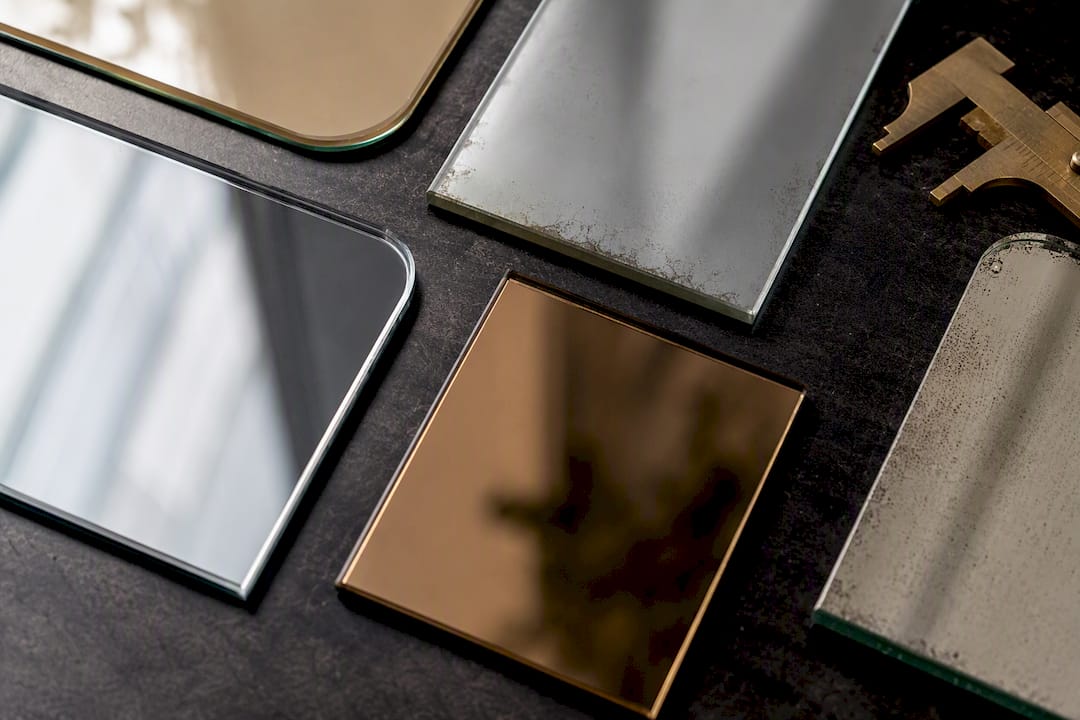
Shape and edge work compound from there. A simple polished edge is the cheapest option; bevelled, faceted or hand-finished edges cost more, and every non-rectangular cut adds machining time.
Safety backing is not optional in most settings. Bathroom-grade and fire-rated specifications, relevant wherever mirrors sit near heat sources or in escape routes, add cost but are non-negotiable in commercial and hospitality projects. Our guide to mirror safety backing sets out which backing types suit which environments.
Installation complexity is the final variable, and often the most underestimated one. Larger panels frequently need wall reinforcement and specialist mounting systems, which add both labour and time to a project.
- Standard float glass: lowest cost baseline
- Low-iron or bronze glass: moderate premium for clarity or tone
- Antique/eglomisé finish: highest material and labour premium
- Fire-rated or bathroom-grade backing: fixed but necessary addition
- Reinforced fixings for oversized panels: adds both cost and lead time
Pro Tip: Specify your backing and edge finish on the drawing itself, not in a covering email. Quotes built from incomplete drawings are the single biggest source of price disputes once manufacture is underway.
How long does a bespoke mirror commission take?
A standard bespoke mirror, rectangular, single finish, no gilding, generally moves from brief to install within a matter of weeks. Elaborate commissions involving eglomisé, sculptural shapes or large-format hospitality panels commonly stretch into months once survey, finishing and installation logistics are factored in.
The milestone sequence rarely varies:
- Brief: dimensions, finish, location and intended use confirmed.
- Survey or template: a physical template, often cut from plywood or cardboard on site, is taken to capture the exact opening.
- Sign-off: the client approves the template and finish samples before glass is cut.
- Manufacture: cutting, edging and any decorative finishing take place in the workshop.
- Finishing: gilding, antiquing or backing is applied and cured.
- Install: the finished piece is fitted on site, with any reinforcement work completed beforehand.
Skipping the survey stage is the costliest shortcut a project can take. UK walls are frequently out of square, and a mirror cut to paper measurements alone often needs refabricating once it reaches site. Physical templating, rather than tape-measure figures, is standard trade practice for exactly this reason. For sizing tolerances specific to your project, our guide to custom mirror sizing is worth reading before the brief goes out. Installation notes on scaffolding, access and fixings are covered in our custom mirror installation guide.
Specifying mirrors for hotels and trade projects: the RFQ checklist
A quote is only as accurate as the brief behind it. Drawings should carry precise dimensions with stated tolerances, a note on the wall substrate (masonry, stud, tiled), and confirmation of any load the wall can bear. Suppliers pricing by exact millimetre dimension can only be accurate if the measurements they receive are accurate too.
Glass, backing and finish need to be stated explicitly, not implied. "Mirror to match sample" is not a specification; "6mm bronze float glass, polished edge, fire-rated backing" is.
Installation scope needs deciding before the PO is raised, not after: who supplies fixings, who preps the substrate, and who signs off structural adequacy for oversized panels. For furniture-integrated mirrors, this coordination matters even more. Installation should sit alongside the joinery programme, so pieces fit either finished furniture frames or pre-prepared studwork, rather than being patched in afterwards.
- Confirm dimensions and tolerances on the drawing, not by email.
- State glass type, thickness, edge finish and backing explicitly.
- Agree fixing and substrate responsibility before manufacture starts.
- Request sample approval before full production.
- Ask about staged payments and lead-time guarantees in writing.
| Ask for | Why it matters |
|---|---|
| Physical site survey or template | Prevents re-fabrication from inaccurate paper measurements |
| Named account manager | Reduces specification errors on complex trade orders |
| Sample approval stage | Confirms finish and tone before full production runs |
| Staged payment schedule | Protects cash flow on longer, multi-month commissions |
Trade channels that offer account management and reviewed lead times tend to reduce these friction points considerably, and a dedicated point of contact who understands bespoke glass specification is worth insisting on for any project above single-item scale.
Do custom mirror prices vary across the UK?
Regional variation exists, though it is driven more by workshop capacity and installation labour rates than by the glass itself. London and the South East generally carry the highest installation labour costs, reflecting wider trade rates across the capital, while manufacturing costs for the glass itself vary less by region since most bespoke workshops serve nationally.
Hospitality and high-end residential projects concentrated in London, and increasingly in regional cities such as Manchester, Edinburgh and Bristol, tend to specify higher-tier finishes such as bronze glass or eglomisé more often, which pushes the average project cost up in those markets, independent of any true regional price difference on materials. Rural and semi-rural projects sometimes carry a hidden premium too: access logistics for oversized panels, narrow lanes, limited parking, older properties with restricted entry points, can add to installation cost regardless of postcode.
For trade buyers working across multiple sites, the practical takeaway is to price installation labour separately by region rather than assuming a single national day rate, particularly for hotel groups with properties spanning both London and provincial locations.
What warranty and after-sales costs should you expect?
Most bespoke mirror suppliers offer a workmanship warranty covering manufacturing defects, silvering failure and backing degradation, typically for a defined period after installation, though exact terms vary by supplier and should be confirmed in writing before the order is placed. This is separate from any glass breakage cover, which is rarely included and usually falls to the client's own building or contents insurance once the piece is installed.
After-sales costs to budget for including re-sealing or backing touch-ups if a mirror is installed in a consistently humid bathroom environment, and resilvering, which is a full replacement of the mirrored surface rather than a repair, for any panel that develops silvering blooms years down the line. Eglomisé and gilded finishes carry a higher after-sales consideration too, since hand-applied decorative surfaces are harder to touch up invisibly than a plain silvered panel.
Trade and hospitality clients placing recurring orders should ask suppliers directly what the warranty period covers, whether it includes labour for any remedial work, and whether spare glass or matched finish samples are retained for future repairs. A supplier that keeps a finish record against your project reference will save considerable cost and colour-matching hassle if a single panel needs replacing years later.
A trade perspective on avoiding cost creep
The costliest mistake on bespoke mirror projects is not choosing an expensive finish. It is under-specifying the brief and letting the workshop guess. Vague instructions like "similar to the last one" or measurements taken by tape rather than template are what generate variations, and variations are where budgets quietly blow out.
If you need to save money without diluting the design, cut the shape complexity before cutting the finish quality. A rectangular panel in bronze glass often reads more expensively than a sculptural shape in standard float. Bring a trade supplier or account manager in at brief stage, not quote stage. Early access to account-managed procurement catches specification gaps before they become site-visit problems.
— Luke
Commissioning a bespoke mirror through Simmons Interior Supply
Trade clients can source handcrafted mirrors working from their actual drawing and site conditions rather than a standard size chart. Every commission typically starts with a proper brief, moves through a site survey or template stage, and is manufactured to order in the specified glass, edge finish and backing, whether that is a plain bevelled panel or a gilded eglomisé feature for a hotel lobby.
Trade and hospitality procurement teams often work with a dedicated account manager throughout, from initial specification through sample approval and staged payment, using an account-managed model to help reduce errors on complex bespoke orders. Our gallery of completed commissions shows the range of finishes we have delivered, and our bespoke furniture collection demonstrates the same made-to-order craftsmanship applied across furniture as well as mirrors. If a project also involves a wider refurbishment budget, our finance partner's guide to bathroom renovation costs is a useful companion read.
To start a trade enquiry, visit Simmons Interior Supply and submit your brief with rough dimensions and finish preferences. A member of the team will arrange a survey and follow up with a firm quote before any manufacture begins.
Primary sources for cost and technical guidance
- Bathroom Mountain's mirror cost guide sets out the £150 to £900+ trade pricing bands referenced throughout this article.
- Mirror Installers' survey process page explains why physical templating is standard UK trade practice.
- Plumbworld's guide to large bathroom mirrors covers wall reinforcement and mounting requirements for oversized panels.
- Altitude Glass's eglomisé mirror service illustrates premium decorative finish specification for hospitality projects.
- Fitted Mirrors and Glass's commissioning guide outlines the extra costs buyers should plan for beyond the glass itself.
Sources
- Mirror cost guide — Bathroom Mountain
- Mirror installers — our processes
- Large bathroom mirrors — Plumbworld blog
FAQ
How much does a bespoke mirror cost in the UK?
Trade-grade bespoke mirrors typically fall between £150 and £900 or more, depending on size, shape and finish, before installation extras.
Why do non-standard shapes cost more?
Non-standard cuts and freeform shapes add roughly 20 to 40% to the base cost because of extra cutting time, higher wastage and additional edge finishing.
How long does a bespoke mirror take to make?
Standard bespoke commissions usually take a matter of weeks, while elaborate eglomisé, gilded or large-format hospitality pieces can take several months once survey, finishing and installation are included.
Is a site survey always necessary?
Yes, for any bespoke installation. UK walls are commonly out of square, and a physical template or site survey prevents the glass being cut to inaccurate measurements and needing re-fabrication.
Does the headline price include installation?
No. Standard trade pricing usually covers glass, cutting and a basic edge finish; installation, wall reinforcement, delivery and specialist fixings are typically budgeted separately.
Can Simmons Interior Supply manage a full hotel mirror commission?
Yes. Simmonsinteriorsupply works with trade and hospitality procurement teams through a dedicated account manager, from initial brief through site survey to final installation, on made-to-order mirrors alongside its bespoke furniture collections.