
For heavy-traffic hotel areas, hand-knotted or dense loop-pile wool constructions specified to 80–100 kpsi knot density, 6–8mm pile height and roughly 3.5–4.5kg/m² deliver the strongest durability and fire compliance available. Before signing off any purchase order, insist on abrasion test evidence (Wyzenbeek or Martindale), fire test certification, and a written maintenance schedule. The procurement checklist further down sets out exactly how to request each figure.
TL;DR:
- Hand-knotted wool rugs with knot densities of 80-100 kpsi and pile heights of 6-8mm are essential for maximizing durability in high-traffic hotel zones.
- Regular maintenance, including quarterly extraction cleaning and immediate spill blotting, can extend a hand-knotted wool rug’s lifespan beyond 15 years.
- Synthetic fibers, especially ECONYL nylon and similar high-performance materials, perform well in moisture-prone areas like spas and pool decks.
- Construction quality, including backing and underlay, is crucial to prevent delamination, buckling, and fraying, especially under concentrated trolley and furniture pressure.
- RFQs for hotel rugs should specify minimum abrasion resistance, appropriate weight, fire certification, and a lead time of 18-22 weeks for bespoke pieces.
Table of Contents
- What determines hotel rug durability, exactly?
- Which fibres and constructions actually survive hospitality use?
- Which rug suits each zone of the hotel?
- How maintenance schedules extend a rug's working life
- What to put in every hotel rug RFQ
- A trade view on getting the specification right
- Do humidity and sunlight shorten a hotel rug's life?
- What wear patterns show up first, and how to stop them
- How long should a hotel rug actually last, and what should the warranty cover?
- Why specification beats a retail buy for hospitality
- Commission a bespoke rug built for your property's traffic
- Sources
- FAQ
What determines hotel rug durability, exactly?
Every rug in a hotel is living a compressed version of a normal rug's life, played at ten times the speed. A lobby centrepiece might absorb the footfall of a small town in a single year, and the traffic class of each zone should dictate the specification long before anyone chooses a colourway.
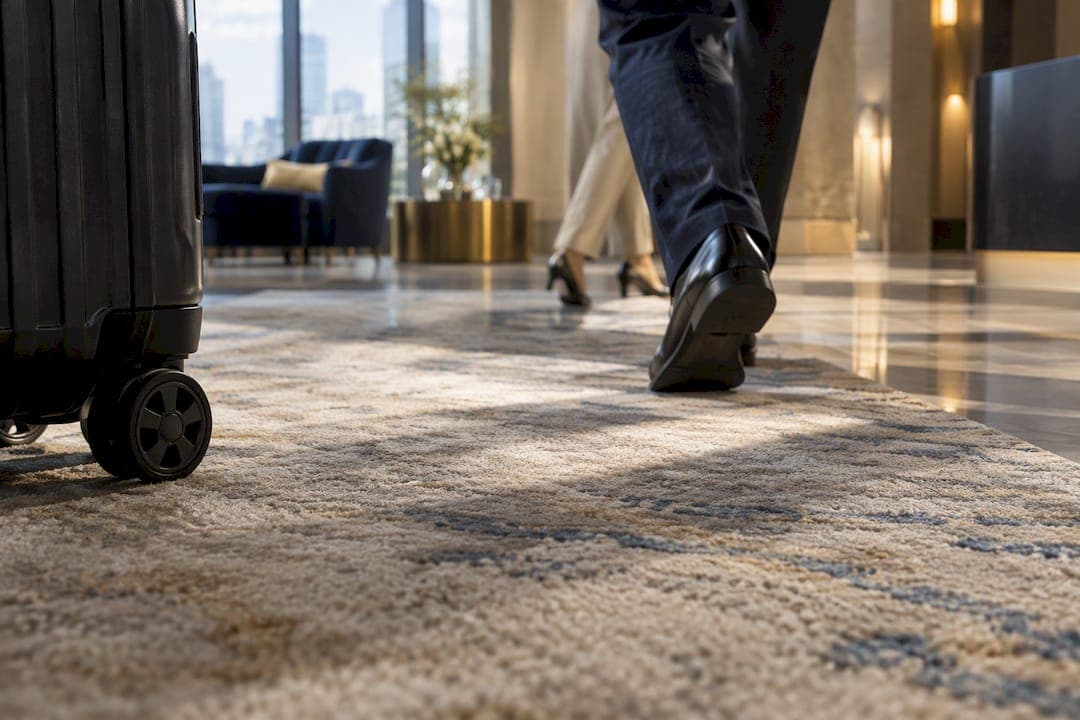
Lobbies and entrance runners see the heaviest, most abrasive traffic, luggage wheels, wet soles, grit tracked in from pavements. Corridors carry constant, directional foot traffic with housekeeping trolleys adding concentrated point pressure. Dining rooms see a mix of foot traffic and chair drag, which chews at pile from an angle rather than straight down. Guest room rugs live the easiest life, but still need to survive years of cleaning crews and rolling luggage.
Abrasion testing gives that intuition a number. Kapetto's trade guide treats 50,000 Wyzenbeek double rubs or 40,000 Martindale cycles as the working minimum for heavy contract zones, a threshold well above anything sold for domestic use. Ask any supplier quoting below that range to explain why.
Construction matters just as much as fibre. Hand-knotted rugs tie each knot directly to the warp and weft, so wear happens gradually and evenly rather than through sudden failure. Tufted constructions rely on a secondary backing and adhesive to hold pile in place, and that adhesive is precisely where delamination starts under sustained heavy use, according to Kapetto's specification research.
A few structural factors decide whether a rug buckles, curls or delaminates well before its fibre wears out:
- Insufficient weight per square metre lets large rugs shift and ripple under trolley traffic.
- Thin or poorly bonded backing accelerates edge fraying and corner curl.
- Missing or unsuitable underlay transfers subfloor movement straight into the pile.
- Undersized rugs relative to footfall patterns concentrate wear into a narrow, visible path.
Kevin Francis Design's guidance on hotel public spaces recommends a weight per square metre generally recommended for large lobby rugs paired with commercial non-slip underlay, a combination that keeps a heavy rug anchored under exactly the kind of concentrated traffic a check-in desk generates.
Which fibres and constructions actually survive hospitality use?
Wool remains the default contract fibre for good reason. It chars and self-extinguishes rather than melting or feeding a flame, which means it often satisfies fire-safety expectations without added chemical treatment, a point Kevin Francis Design raises directly when discussing BS 4790 and NFPA 253 evidence. Wool also hides soil naturally within its crimped fibre structure and springs back after crushing, which matters enormously under a reception desk or dining chair.
Synthetic contract fibres have earned their place too, particularly where moisture and staining dominate the risk profile. A case study on Curran's SynSisal® installation at The Pinch Charleston showed a synthetic sisal alternative made from ECONYL nylon meeting heavy Class 33 contract ratings while outperforming natural sisal on stain and moisture resistance, a useful reference point for atria, bars and any space where spills are routine rather than occasional.
Silk, cashmere and other delicate natural fibres are generally the wrong answer for public circulation. Kevin Francis Design notes that silk content under 30% can work as an accent detail without meaningfully compromising durability, but anything higher belongs in a private suite, not a corridor.
Construction ranks fibre choice for expected service life:
- Hand-knotted wool offers the longest service life and the best repairability, because individual knots can be re-tied rather than replaced wholesale.
- Loom-knotted wool trades some longevity for faster production while keeping most of the durability benefit.
- Hand-tufted wool or wool-blend sits in the middle, durable enough for moderate zones but more exposed to backing failure over time.
- Machine-tufted synthetic suits budget-conscious guest rooms or short-lease properties, with the shortest realistic lifespan of the four.
For heavy-traffic zones, NPRugs' contract buyer's guide specifically recommends knot densities recommended generally between 80 and 100 knots per square inch with pile heights within 6 to 8mm, a combination that balances durability against slip and trip risk. Anyone commissioning a bespoke piece should read our notes on the custom rug design process before finalising a construction brief.
Which rug suits each zone of the hotel?
A single specification standard rarely fits an entire property. The lobby, the corridor and the spa each demand different trade-offs between abrasion resistance, moisture tolerance and how the rug feels underfoot.
- Lobby and entrance: dense hand-knotted wool at 80–100 kpsi, 6–8mm pile, 3.5–4.5kg/m², installed over commercial non-slip underlay to resist buckling from trolleys and constant footfall.
- Corridors and runners: loop pile or flat-weave wool, chosen for even wear along a directional path, with reinforced edge binding to stop fraying at the most trafficked centre line.
- Guest rooms: medium-pile wool or wool-blend is appropriate here, since traffic is lighter and the priority shifts towards comfort and visual softness rather than raw abrasion resistance.
- Restaurants and bars: prioritise stain tolerance and pair the rug with door mats and a prompt spot-cleaning protocol; wool blends with some synthetic content resist spills better than pure wool underfoot near dining tables.
- Spa and pool-adjacent areas: avoid absorbent natural fibres entirely; synthetic or washable constructions cope far better with sustained moisture without mildewing or shrinking.
Guest room specifiers weighing lower-pile options for dining nooks or breakfast areas within the room may find our piece on dining room rug materials useful for narrowing pile height against practical wear.
How maintenance schedules extend a rug's working life
A rug specified perfectly on paper still fails early without a maintenance routine behind it. Daily vacuuming lifts grit before it works down into the pile and starts cutting fibres from the inside, which is the single most common cause of premature wool wear. Spills need an immediate blot-and-lift response rather than a scrub, since scrubbing drives liquid deeper into the pile and backing.
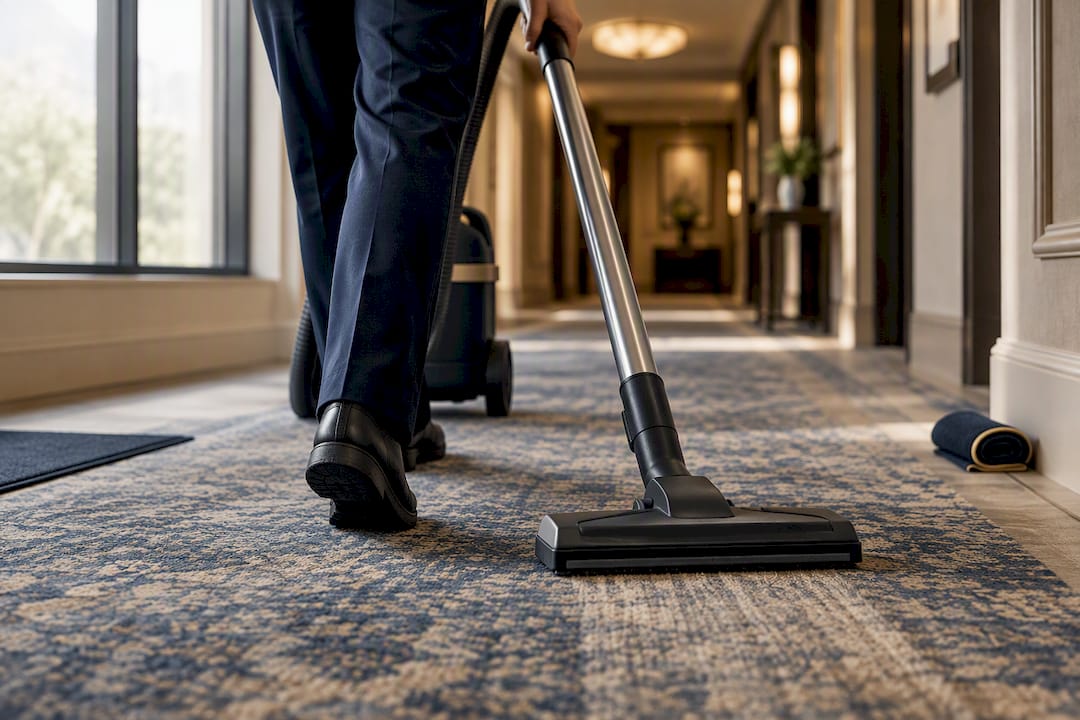
Professional cleaning intervals depend on construction and traffic. Extraction cleaning suits most contract carpets on a quarterly basis in heavy zones, while wool rugs generally benefit from a full professional wet wash every 12 to 18 months, a schedule Kapetto's specification guide ties directly to realistic lifespan outcomes.
Maintained well, the numbers speak for themselves:
- Hand-knotted wool: 15–20+ years in high-traffic public areas.
- Hand-tufted commercial wool or wool-blend: 5–12 years, depending on quality and traffic volume.
- Machine-tufted synthetic: shorter still, and most cost-effective where replacement cycles are already planned.
Pro Tip: Budget for pile restoration and edge re-binding at the five-year mark on hand-knotted pieces. A partial restoration typically costs a fraction of full replacement and can add several years of usable life to a rug that has already earned its keep.
Repair and restoration deserve a line item in every facilities budget, not just replacement. Pile restoration rebuilds worn traffic paths, while edge repair stops fraying before it spreads into the field of the rug, both cheaper than a full replacement and far less disruptive to guest-facing spaces.
What to put in every hotel rug RFQ
A well-written RFQ removes almost all the guesswork from a hospitality rug order, and it costs nothing to include the numbers that actually protect the investment.
- Knot density: 80–100 kpsi for heavy-traffic zones.
- Pile height: 6–8mm for lobbies and public areas.
- Weight per square metre: 3.5–4.5kg/m² for large lobby pieces.
- Abrasion minimum: 50,000 Wyzenbeek double rubs or 40,000 Martindale cycles.
- Fire evidence: certificates referencing BS 4790 or NFPA 253, or supplier-equivalent test data, plus smoke density results where the project requires them.
- Lead time buffer: bespoke hand-knotted pieces typically need 18 to 22 weeks from order to delivery, so build in a buffer beyond that for finishing and freight, a point covered in more detail in our guide to custom rug lead times.
- Handover documentation: underlay specification, a written maintenance schedule, and contact details for restoration should the pile need attention later.
| RFQ item | Target figure |
|---|---|
| Knot density | 80–100 kpsi |
| Pile height (heavy zones) | 6–8mm |
| Weight per m² (large lobby) | 3.5–4.5kg/m² |
| Abrasion minimum | 50,000 Wyzenbeek or 40,000 Martindale |
| Bespoke lead time | 18–22 weeks |
Trade programmes that supply samples and finish swatches ahead of a full order, similar to the approach outlined in One Day Doors & Closets' designer trade programme, reduce the risk of a costly mismatch once the rug lands on site.
A trade view on getting the specification right
Simmons Interior Supply works alongside interior designers and hospitality procurement teams who need bespoke rugs sized and finished to fit a specific space, rather than adapted from a stock range. That collaborative process, described in more depth in our custom rug design guide, means specification numbers like knot density and pile height are agreed with the artisan workshop before a single knot is tied, not discovered after delivery.
One practical habit worth borrowing from trade experience: verify a supplier's abrasion and fire test evidence before committing to a bespoke run, and ask for the handover documentation, underlay recommendation, maintenance schedule and restoration contact, in writing, alongside the finished rug.
Do humidity and sunlight shorten a hotel rug's life?
Environmental exposure wears a rug down quietly, often faster than foot traffic alone. Sustained humidity, common near spas, pools and coastal properties, encourages mildew growth in natural fibres and can weaken jute or cotton backings over time, even when the visible pile still looks intact.
Direct sunlight causes a different kind of damage. UV exposure fades dye colour unevenly across a rug's surface, most visibly where furniture or a reception desk casts a permanent shadow over part of the piece. Wool resists UV fading better than many synthetics, but no fibre is immune, and atria with large glazed roofs are the properties most likely to see this problem within a few years rather than a decade.
Ventilation and rotation solve most of the problem cheaply. Rugs near pool decks or spa entrances benefit from being lifted and aired periodically, and any lobby piece sitting under strong natural light should be rotated on a schedule so fading spreads evenly rather than concentrating in one visible patch. Where humidity is a constant rather than occasional issue, synthetic constructions similar to the SynSisal® approach used at The Pinch Charleston hold up considerably better than natural plant fibres, which absorb and retain moisture within their structure.
What wear patterns show up first, and how to stop them
Certain damage patterns repeat across almost every hospitality property, and each has a fairly predictable cause. Traffic lanes, the worn paths running from entrance to reception desk or from corridor to lift, are the most visible sign of underspecified pile density; a rug rated for moderate traffic simply cannot resist that concentrated, repetitive footfall.
Edge fraying and corner curl usually trace back to backing quality or missing underlay rather than the pile fibre itself, which is why weight per square metre and underlay specification belong in the RFQ alongside knot density. Crushing under furniture legs, particularly under heavy reception desks or dining tables, flattens pile permanently in constructions that lack the resilience wool naturally provides, and rotating furniture periodically limits how deep that crush becomes.
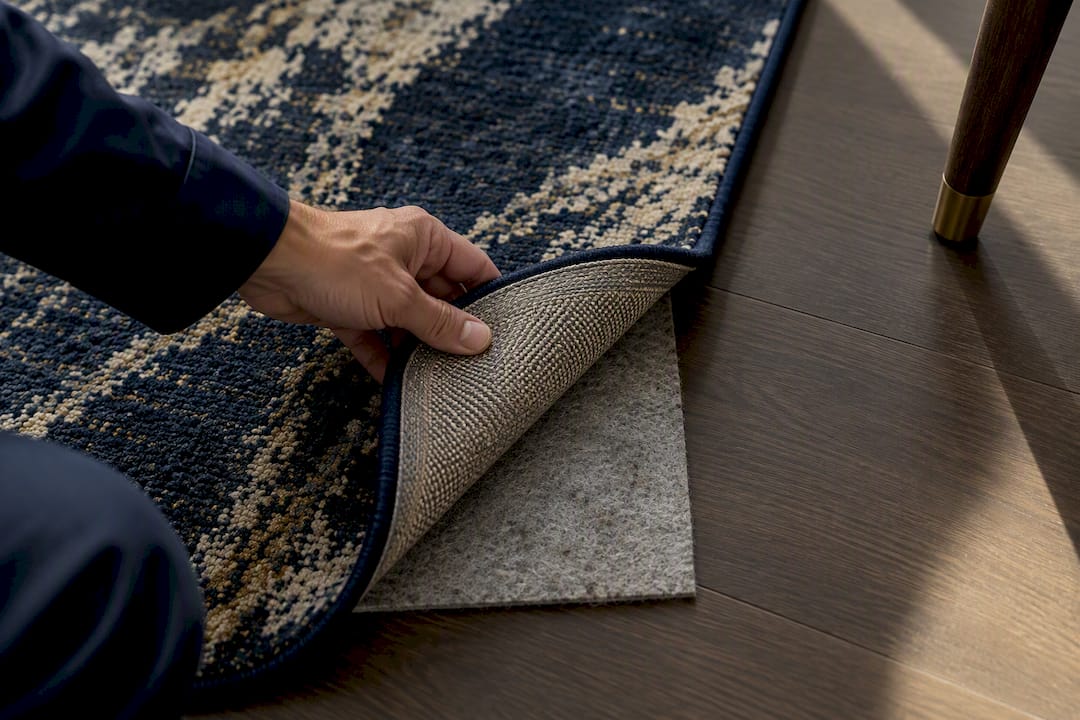
Stains from spilled drinks or trolley grease are the most preventable damage type on this list, provided housekeeping responds within minutes rather than hours; a blot-and-lift protocol paired with a doormat at every entrance point removes most of the risk before it reaches the rug at all. Delamination, the pile separating from its backing, is almost exclusively a tufted-construction problem, and it is one of the strongest arguments for specifying hand-knotted pieces in the heaviest traffic zones, where the knot itself carries the load rather than an adhesive layer.
How long should a hotel rug actually last, and what should the warranty cover?
Longevity expectations should be set at the specification stage, not discovered years later through disappointment. A well-maintained hand-knotted wool rug can reasonably be expected to serve 15 to 20 years in a high-traffic hotel setting, while tufted commercial alternatives typically run 5 to 12 years depending on construction quality and how heavy the traffic actually is.
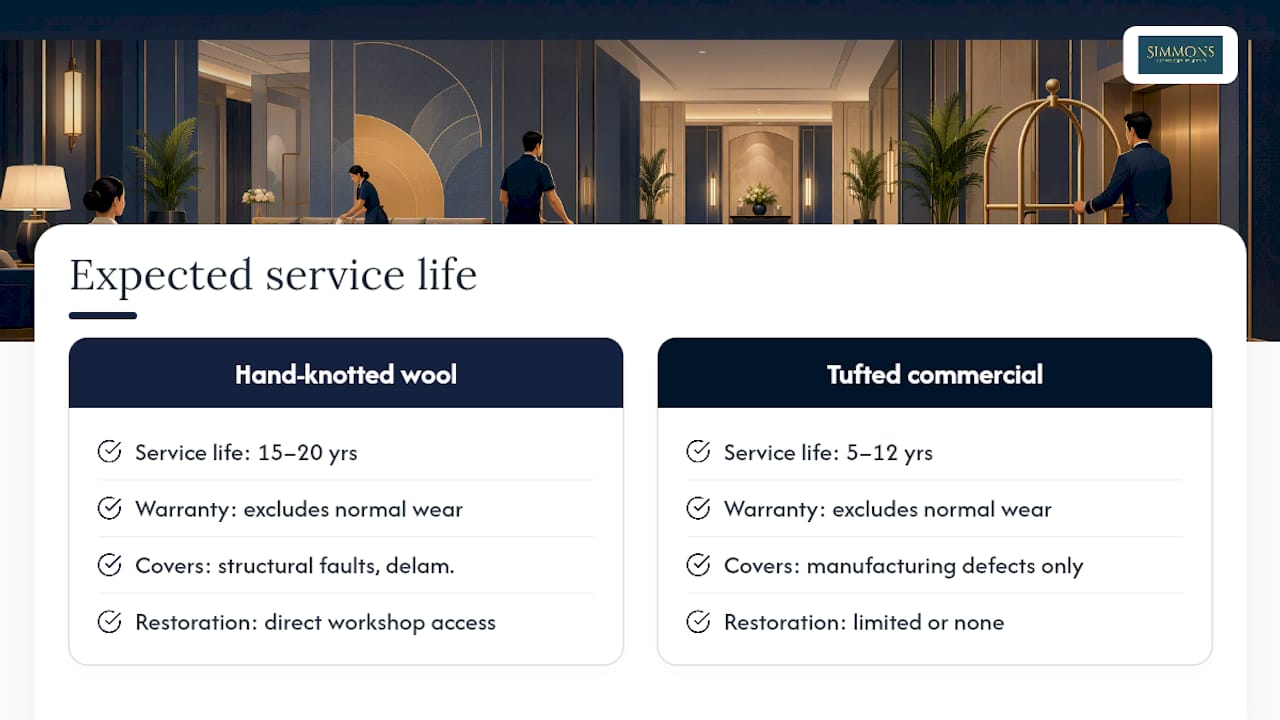
Warranty terms in this category rarely cover normal wear, and buyers should read the fine print for exactly what counts as a manufacturing defect versus expected ageing. A meaningful warranty distinguishes between structural faults, delamination in the first few years, dye migration, backing failure, and the gradual pile wear that any rug accumulates through legitimate use. Ask suppliers directly what their warranty excludes, since the exclusions usually reveal more about expected service life than the headline warranty period does.
Bespoke pieces commissioned through a trade relationship often come with more direct access to restoration support than a retail purchase, simply because the workshop that made the rug can also repair it. That single point of contact, from order through to any future restoration, is worth weighing against a marginally cheaper stock alternative with no such relationship behind it.
Why specification beats a retail buy for hospitality
Retail rugs are built to a price point for domestic footfall, and they fail early in a hotel because that was never the job they were designed for. Contract specification costs more upfront but spreads that cost over 15 to 20 years of hand-knotted wool life rather than a handful of years before replacement. Bespoke commissioning earns its price when durability, repairability and brand impression all matter at once, which in hospitality is almost always. For complex or highly customised projects, loop in a trade partner early rather than after the first rug fails.
— Luke
Commission a bespoke rug built for your property's traffic
A specialist supplier can provide hotel procurement teams with a single point of contact for bespoke rugs sized and finished to the exact specification a project needs, rather than a compromise pulled from a stock range. Every piece is handcrafted to order, with sizing and finish agreed directly with artisan partners, which means the knot density, pile height and weight figures covered in this guide can be built into the brief from day one rather than negotiated after a poor-fitting delivery arrives.
Before reaching out, gather your zone-by-zone traffic assessment, target abrasion and fire test requirements, and rough dimensions for each space, the same checklist covered above. From there, our Signature rug collection from Colbourns offers a trade-only starting point for hospitality-grade construction, with sample finishes available before you commit to a full bespoke run. Visit the trade landing page to start a conversation about your project's specification.
Sources
- Specifying Rugs for Hospitality Projects: A Trade Guide | Kapetto
- Specifying bespoke rugs for hotel public spaces | Kevin Francis Design
- Hand-knotted rugs for hotel lobbies: Contract buyer's guide | NPRugs
- The Pinch Charleston | SynSisal® Hospitality Rug Case Study | Curran
FAQ
How long do hotel rugs typically last?
Lifespan depends heavily on construction and maintenance. A well-maintained hand-knotted wool rug can last 15 to 20 years in high-traffic hotel areas, while tufted commercial alternatives typically run 5 to 12 years depending on quality and traffic volume.
What kind of carpet or rug do hotels use in high-traffic areas?
Hotels generally specify hand-knotted or dense loop-pile wool constructions for lobbies and corridors, chosen for wool's natural resilience and fire-safety behaviour. Kevin Francis Design recommends knot densities of 80 to 100 kpsi and pile heights of 6 to 8mm for these zones.
What type of rug lasts the longest in hospitality settings?
Hand-knotted wool rugs last longest because each knot is tied directly to the warp and weft, avoiding the backing adhesives that cause tufted rugs to delaminate under heavy use. Loom-knotted wool comes close, trading a small amount of longevity for faster production.
What are the disadvantages of a 100% wool rug in a hotel setting?
Pure wool can be more prone to staining from oil-based spills than certain synthetic blends, and it requires more careful moisture management in areas near pools or spas. It also carries a higher upfront cost than synthetic alternatives, though its 15 to 20-year service life usually offsets that over the ownership period.
How often should hotel rugs be professionally cleaned?
Wool rugs generally need a full professional wet wash every 12 to 18 months, alongside quarterly extraction cleaning in the heaviest traffic zones. Daily vacuuming and immediate spill response between professional cleans do the most to prevent premature wear.