
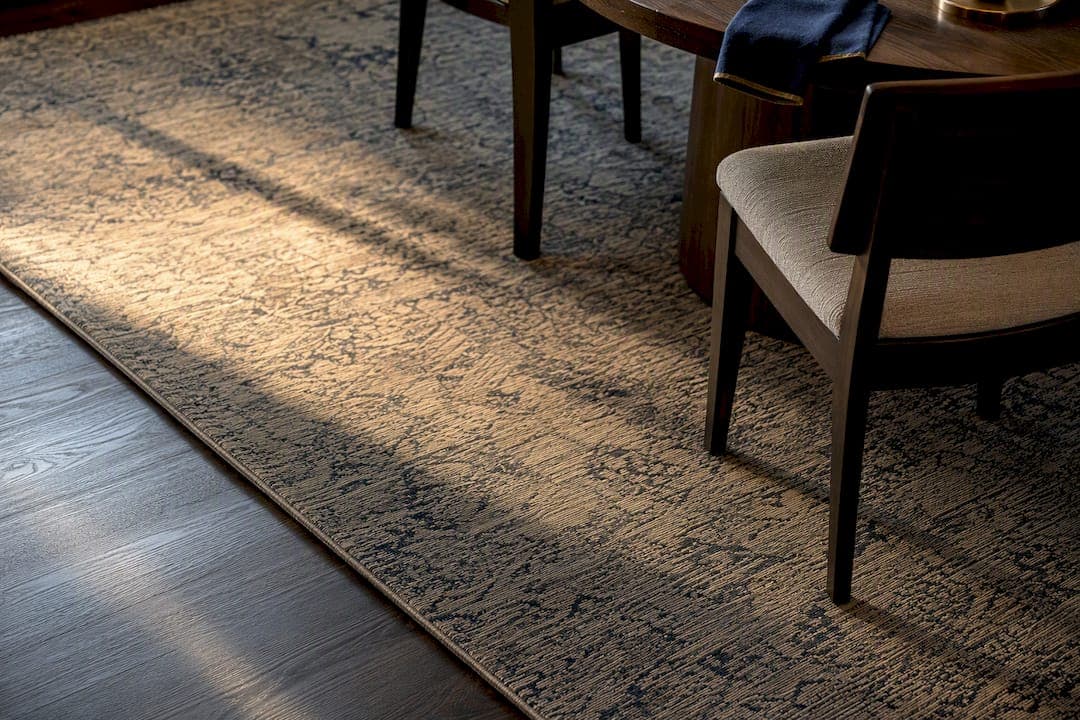
For most dining rooms, the smart choice is low-pile polypropylene or a tightly woven, low-pile wool flatweave. Both resist stains, cope with chairs scraping back and forth, and clean up with little fuss. Steer clear of high-pile weaves, silk, viscose, and untreated jute anywhere red wine and gravy are regular guests. The reasoning is simple: dining rooms punish fibres that trap moisture or crush under repeated chair movement.
TL;DR:
- Low-pile polypropylene or tightly woven wool flatweaves are best suited for dining rooms due to their stain resistance and durability against chair movement.
- Pile height should stay below 12mm to prevent snagging, crushing, or crumbs becoming trapped, making flatwoven or loop pile rugs ideal.
- Natural fibres like wool resist flattening and have built-in liquid resistance, but cotton and jute require more frequent replacement and are less stain-resistant.
- Proper rug backing and a suitable pad are essential to prevent slipping, protect the floor, and accommodate underfloor heating systems.
- Custom-sized rugs tailored to specific room dimensions and table footprint are recommended to maximize performance and aesthetic compatibility.
Table of Contents
- What makes a dining room rug material actually work?
- Which rug materials work best under a dining table?
- How pile height and backing affect everyday wear
- How do you clean a dining room rug properly?
- Which rug material suits your household best?
- Specifying a bespoke dining rug: what to brief in
- What the conventional dining rug advice misses
- How Simmons Interior Supply builds a dining rug to last
- Sources
What makes a dining room rug material actually work?
A rug under a dining table lives a harder life than any other rug in the house. Chair legs scrape across it several times a day, crumbs grind into the pile, and spills happen the moment you relax. Judging a material properly means weighing five practical factors, not just how it looks in a showroom.
Durability comes down to how the fibre handles friction. Chairs being pushed back from the table create constant abrasion along the same paths, so a weak pile flattens and frays in exactly those spots within a year or two.
Stain resistance and cleanability matter more here than in any other room bar the kitchen. A rug that shrugs off a splash of olive oil earns its keep; one that holds onto every mark becomes an eyesore fast.
Pile height is the detail most buyers overlook. Anything above roughly 12mm starts causing problems: chair legs snag in the fibres, crumbs vanish into the depths, and vacuuming becomes a wrestling match. Low-pile or flatwoven constructions let chairs glide rather than catch.
Pro Tip: A busy, textured pattern in mid to dark tones hides everyday wear and crumb debris far better than a flat, pale solid colour ever will.
Floor type matters too. On hardwood or engineered boards, a felt pad protects the finish; on luxury vinyl plank or vinyl, check the pad is labelled floor-safe before laying anything underneath.
Which rug materials work best under a dining table?
Choosing the right fibre is less about trend and more about matching performance to how your household actually eats and lives. Here is how the main options stack up in daily use.
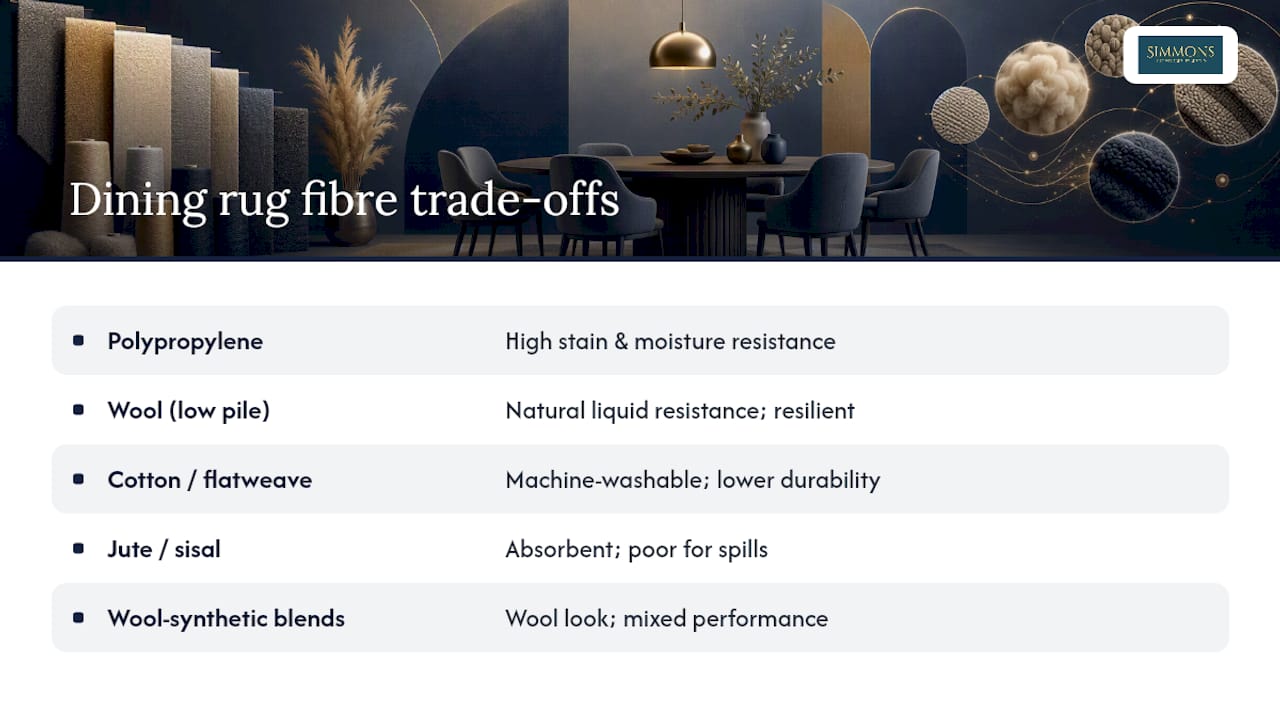
Polypropylene (olefin) is the most practical all-rounder for busy dining rooms. It resists staining, tolerates moisture, and holds its colour under sunlight far longer than most natural fibres. Retailer guides consistently rate it highly for exactly this reason: it can be scrubbed with mild soap and water without drama.
Wool, specified as a tight, low-pile weave rather than a plush pile, earns its place as the standout natural option. Designers favour it because natural lanolin gives the fibre a degree of built-in liquid resistance, and wool bounces back from compression rather than flattening permanently under chair legs.
Cotton and washable flatweaves suit a more relaxed household. Many are genuinely machine-washable, which removes the fear factor around red wine. The trade-off is durability: cotton wears faster than wool or polypropylene and tends to need replacing sooner in heavy-use homes.
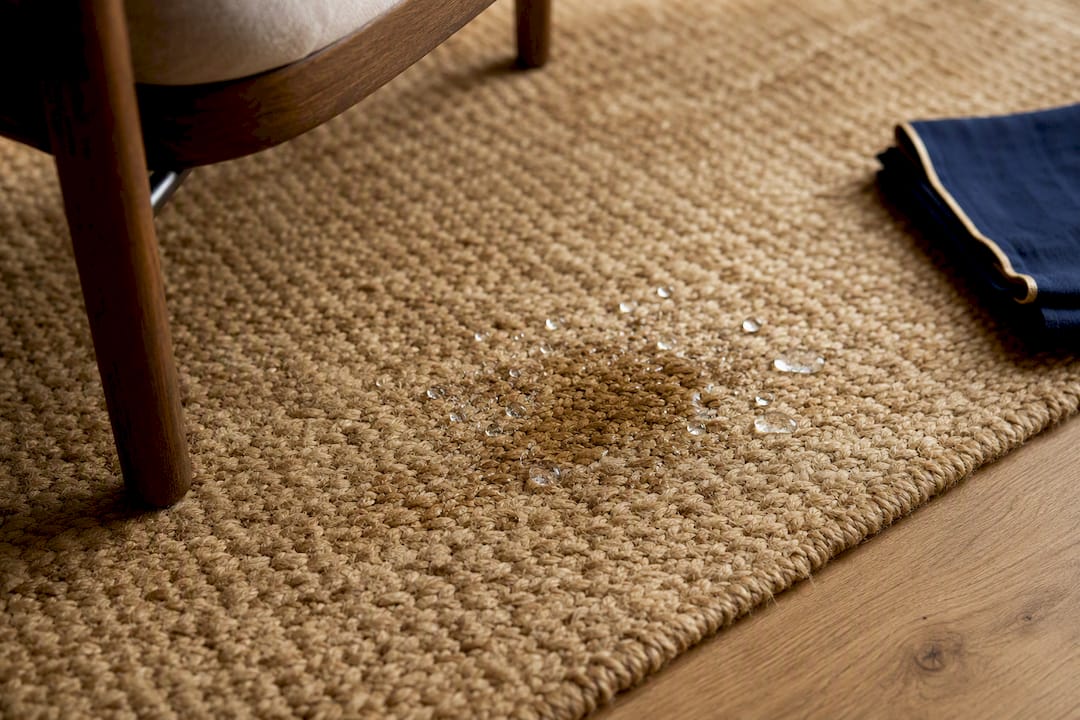
Jute and sisal bring warmth and texture that synthetics cannot fully replicate, but both fibres are absorbent. Editorial guides rightly flag that a spilled glass of water left unblotted can leave a permanent watermark, so these belong in low-spill dining spaces only.
Blends of wool and synthetic fibres can offer a compromise: the visual depth of wool with some of the stain resistance of a manufactured fibre, though performance varies by construction.
Materials to avoid entirely: silk and viscose are too delicate for friction and moisture, and high-pile shag rugs trap crumbs and catch chair legs, undoing much of the practicality you are trying to build in.
How pile height and backing affect everyday wear
Low pile and flatweave constructions consistently outperform higher piles in dining settings. A tall, plush pile might feel luxurious underfoot in a lounge, but under a table it means chair legs sink in, catch on the return stroke, and eventually crush the fibres into permanently uneven patches.
Weave type shapes performance as much as fibre choice:
- Flatwoven rugs (like a kilim) have no pile to crush and clean easily, though they show less cushioning underfoot.
- Loop pile wears well and resists crushing but can snag on chair castors if the loops are loose.
- Cut pile looks plush but performs worst under a dining table unless kept genuinely low.
Backing matters just as much as the face fibre. A stable, non-slip backing paired with a proper rug pad keeps the whole thing anchored, protects the floor finish underneath, and stops the rug creeping every time a chair moves. Before buying, check the pile height, the tightness of the weave, the backing material, and whether the manufacturer recommends a specific pad. Anyone specifying over underfloor heating should also check tog rating compatibility before finalising a material.
How do you clean a dining room rug properly?
Speed matters more than technique the moment something spills. Blot immediately with a clean cloth, working from the outside of the stain inward, and resist the urge to rub, which only pushes liquid deeper into the fibres. A mild detergent diluted in water handles most everyday marks on synthetic and wool rugs alike.
Routine care matters as much as spill response. Vacuum the under-table zone at least twice a week, since crumbs and grit act like sandpaper on the fibres every time a chair moves across them.
- Wash washable rugs strictly to the manufacturer's instructions; not every "washable" product tolerates a full machine cycle.
- Send wool rugs for professional cleaning periodically rather than attempting deep stain removal yourself.
- Check that any rug pad is labelled floor-safe before use on LVP or vinyl, since some pads cause discolouration or leave residue.
Which rug material suits your household best?
Match the fibre to how the room actually gets used, not how it photographs.
- Families with children: polypropylene or a washable cotton flatweave handles daily chaos without punishing you for one bad Tuesday.
- Pet households: low-pile synthetics or a tightly woven wool strike the best balance between comfort and cleanup.
- Formal dining rooms used occasionally: low to medium-pile wool brings warmth and refinement where spills are rare events, not weekly occurrences.
- Casual, coastal-style rooms: jute or sisal work only where the household accepts higher maintenance in exchange for that natural texture.
Specifying a bespoke dining rug: what to brief in
Off-the-shelf sizing rarely suits an awkward dining space, a refectory table with an unusual footprint, or a room where the pattern needs to run a particular way against the grain of the floorboards. That is precisely where a made-to-measure commission earns its cost: you specify the fibre, the pile height, the backing, and the edge finish to match how the room is actually used, rather than compromising on a standard size.
A useful brief for a trade enquiry covers:
- Exact room and table dimensions, including the recommended overhang beyond the table edge so chairs stay on the rug when pulled out.
- Preferred fibre and pile height, with a stated maintenance tolerance (low fuss versus willing to hand-wash).
- Backing requirements, including whether the rug sits over underfloor heating.
- Style reference images and any pattern-matching needs across an irregular floor plan.
Sharing these details upfront with a specifier turns a vague idea into a rug that performs as well as it looks.
What the conventional dining rug advice misses
Most rug guidance treats material choice as a purely aesthetic decision, wool for warmth, jute for texture, sisal for the coastal look, with practicality mentioned almost as an afterthought. That gets the priority backwards. In a room where chairs move dozens of times a day and spills are a statistical certainty, cleanability should be the first filter, not the last.
The bigger blind spot is pile height. Buyers fixate on fibre type while ignoring the far more decisive variable: anything creeping past 12mm starts fighting the furniture rather than supporting it. A mediocre fibre in a disciplined low-pile flatweave will consistently outperform a beautiful fibre in a plush, high pile.
What I'd prioritise differently: pick the weave and pile height first, then choose the fibre that suits your spill tolerance within that constraint. Wool lovers should not abandon the fibre, they should insist on a tight, low construction rather than the deep-pile version that looks appealing in a showroom but fights every meal thereafter. That single adjustment solves more real-world complaints than switching fibres ever does.
— Luke
How Simmons Interior Supply builds a dining rug to last
Off-the-shelf rugs force compromise, on size, on pile height, on a fibre that almost fits the brief. Made-to-measure rugs from partner artisan brands allow the pile height, fibre, backing, and edge finish to be specified around your actual dining room rather than a standard product run.

That matters most for awkward table footprints, pattern matching across an irregular floor, or a household with a very specific maintenance tolerance a catalogue size simply cannot solve. If you already know the room dimensions and how the space gets used, our custom rug design guide walks through how a commission comes together from brief to finished piece. Trade professionals and homeowners ready to talk specifics can start a conversation through Simmons Interior Supply to scope a bespoke dining rug built around your table, your floor, and your household's daily use.
Sources
- DIY — rugs by material: polypropylene
- IKEA — How to choose a rug for your dining table
- Kapetto — Custom rugs for dining rooms: a designer's specification guide