
Irregular-shaped rugs are the quickest way to make your floor read like art while anchoring furniture with a softer, more flexible outline than any rectangle allows. They suit rooms where you want a sculptural focal point that eases rigid architecture and defines a zone without a hard edge. Before you buy, check your furniture's footprint, leave breathing room around the rug's most expressive curve, measure the maximum length and width, and budget for a properly trimmed pad. Tape a template to the floor first: it tells you in minutes whether the shape actually works.
TL;DR:
- Irregular-shaped rugs, especially trending amoeba and melting-edge styles, better soften architectural lines and create sculptural focal points in modern interiors.
- Accurate measurement, including full outlines and furniture placement, is essential to ensure the rug's shape functions well and complements the room layout.
- Styling should emphasize the rug's most expressive curve, with minimal surrounding decor to keep complex shapes from looking chaotic or accidental.
- Hand-tufted wool blends and flatweave synthetic materials suit irregular shapes based on usage, with precise underlay and tailored trimming to prevent slipping or wear.
- Custom commission processes are recommended for exact fits in unconventional spaces, while ready-made options suit quick updates on standard sizes.
Table of Contents
- What are the common irregular rug shapes?
- How do you size and measure for an irregular rug?
- How do you style an irregular rug so it looks intentional?
- Which materials and construction suit irregular rugs?
- How do you fit an underlay safely under an odd outline?
- Where can you buy or commission an irregular rug?
- What is the honest verdict on choosing bespoke?
- Commission a bespoke irregular rug with Simmons Interior Supply
- Sources
- FAQ
What are the common irregular rug shapes?
"Irregular rug" is the everyday term, but the trade calls this category organic shape rugs or non-traditional rug styles, distinct from the standard rectangles, squares, rounds and ovals most retailers stock. Within it, a handful of silhouettes recur again and again, each with a distinct personality on the floor.
- Amoeba or blob: a single flowing outline with no straight edges, softening angular, contemporary rooms.
- Kidney-bean: a gentler curve with one concave side, useful for wrapping around a sofa corner.
- Scalloped: a rounded or oval body edged with repeating half-circles, reading as more decorative and formal.
- Melting-edge: a rectangle or oval whose border appears to dissolve, a favourite for bridging modern and organic decor.
- Splash or pour: irregular, asymmetric pools that mimic spilled paint or water, strongly sculptural.
- Botanical cut-out: leaf, petal or branch-inspired silhouettes, popular in bohemian and maximalist schemes.
Amoeba and melting-edge shapes are trending for 2026, largely because designers use them to soften rectilinear architecture and create a floor piece that behaves more like a sculpture than a floor covering. Minimalist rooms tend to suit a single dominant curve with no lobes; bohemian and maximalist interiors can carry scallops and cut-outs without looking busy. Look at the dominant curve first, then check how many lobes or tapering extensions the design has. More lobes generally mean more visual energy and more careful furniture planning.
How do you size and measure for an irregular rug?
Getting the dimensions right matters more here than with a standard rectangle, because two rugs sharing the same maximum length and width can cover very different amounts of floor once lobes and cut-ins are accounted for.
- Record the rug's maximum length and maximum width, not just a nominal size label.
- Map your usable floor area and the paths people actually walk, rather than assuming the bounding rectangle is fully covered.
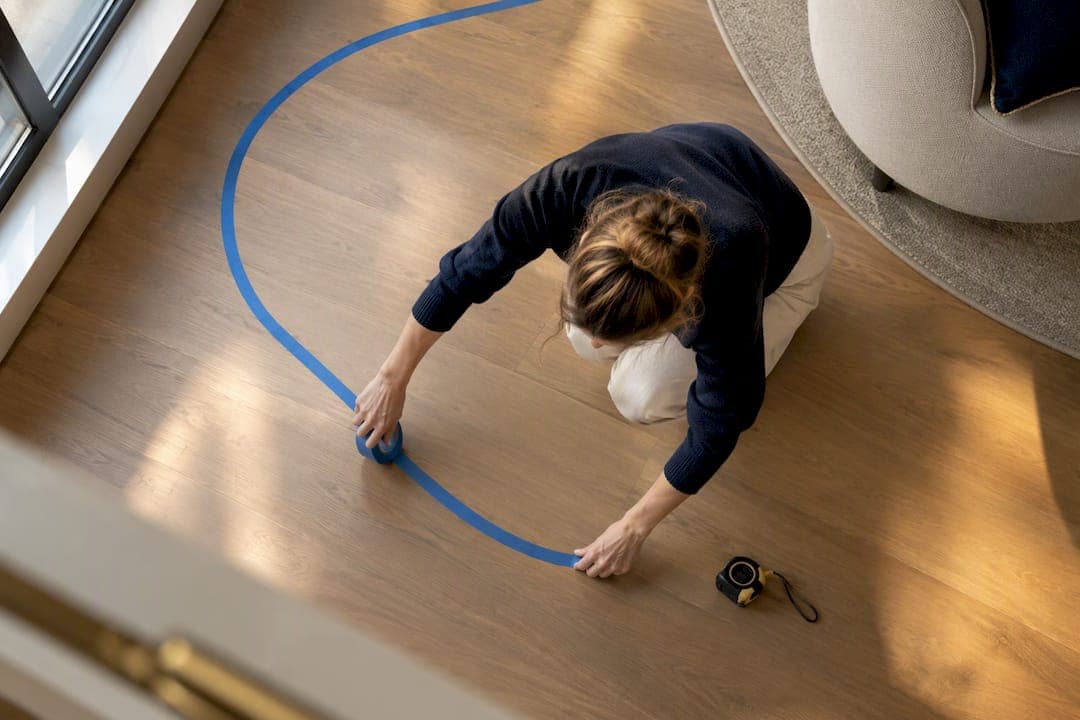
- Cut a full-scale paper or cardboard template, or mark the outline directly on the floor with tape.
- Move your furniture into position on the template and check where legs land and how doors swing.
- Apply rough rules of thumb: front sofa legs should rest comfortably on the rug for stability, and dining chairs require sufficient clearance when pulled out to remain fully on the rug, and any narrow lobe should have enough width to support a leg without it hanging off the edge.
This taping step is not optional guesswork. Practitioners routinely test complex outlines on site before ordering, precisely because a rug that meets its nominal size on paper can still fail functionally once real furniture sits on it. If your room has an awkward bay, a chimney breast, or built-in joinery, a rug size guide helps with the basics, but genuinely unusual layouts are where professional measurement or a bespoke commission earns its cost.
Pro Tip: Photograph your taped template from directly above on a stepladder or balcony. A straight-down shot shows you instantly whether the curve reads as intentional or simply odd once furniture is added.
How do you style an irregular rug so it looks intentional?
The line between "considered design choice" and "accidental leftover offcut" comes down to a handful of composition rules, not luck.
Start with the furniture footprint, not the rug. For a living room, place the coffee table centrally and make sure at least the front legs of your main seating sit on the rug, leaving the most distinctive part of the curve visible rather than tucked under a sofa arm. Off-centre placement is fine and often better than forcing symmetry onto an asymmetrical shape.
- Give the rug's most expressive edge genuine negative space; retail styling guidance consistently warns against cramming an organic outline into a tight corner, where its silhouette simply disappears.
- Echo one visual cue from the rug in a coffee table, mirror, lamp base, or cushion. Repeating a curve, angle or colour ties the room together without needing a second bold statement piece.
- Keep the rest of the room calm when the rug shape is complex. A scalloped or splash-form rug paired with equally busy furniture competes with itself.
- Layer sparingly: a small hide or sheepskin over a rectangular base rug can work well, but avoid stacking rubber-backed rugs, which create uneven surfaces and a real slipping hazard underfoot.
Design studios are near-unanimous on one point: a busy silhouette needs simple surroundings. The more lobes, scallops or tapering points your rug has, the plainer your sofa fabric, wall colour and lighting should be. Save the pattern-on-pattern layering for a plain oval or round.
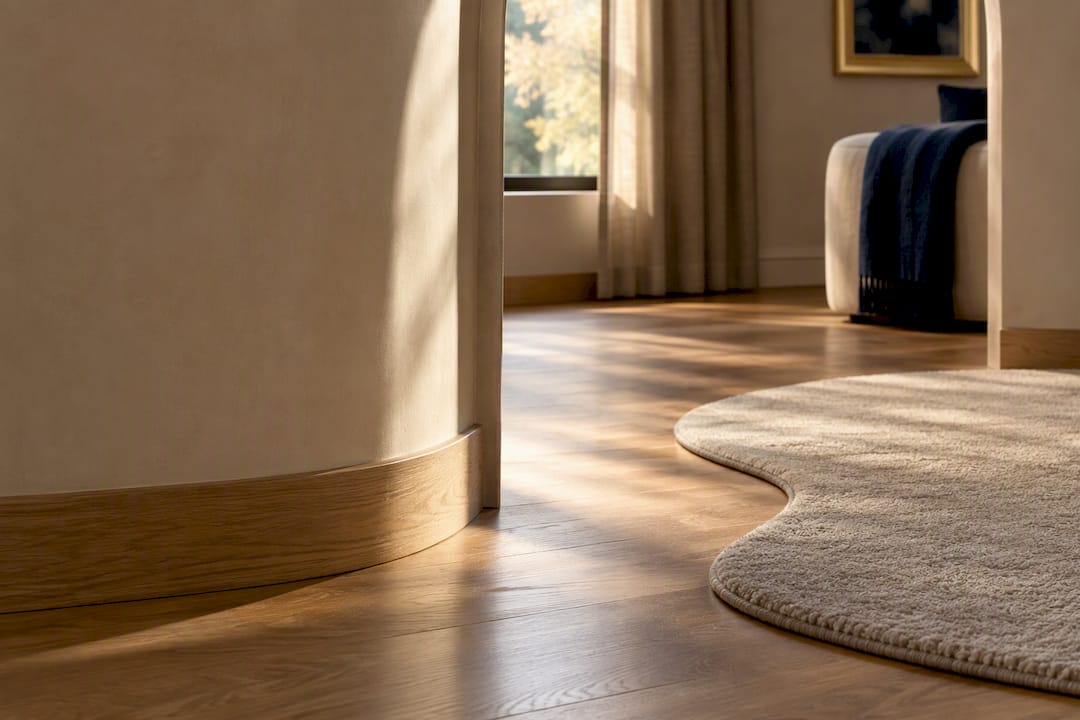
If you like the idea of coordinating curves further than the rug itself, matching an organic floor shape with softer architectural lines, such as rounded interior door profiles, can carry the theme through a whole room rather than stopping at the floor.
Which materials and construction suit irregular rugs?
Construction determines whether a complex outline stays crisp or starts to look ragged within a year. Hand-tufted pieces with carved pile are the standard choice for sculptural borders, since the pile can be cut and shaped to emphasise the outline itself rather than just filling a flat shape. Flatweave constructions hold a crisper, lower profile and suit high-traffic zones where a deep pile would flatten unevenly around curves.
- Wool blends: warm, durable, and forgiving underfoot for living rooms and bedrooms.
- Flatweave or synthetics: better for hallways, kitchens or anywhere the outline sees heavy footfall.
- Jute or sisal: suit rustic or coastal schemes, though they handle tight curves less gracefully than woven wool.
For maintenance, vacuum along the contours rather than in straight passes, spot-test any cleaning product on an offcut first, and rotate the rug periodically for even wear. Thicker pile heights need extra checking against door clearance and furniture stability before you commit to a final position.
How do you fit an underlay safely under an odd outline?
A non-slip pad trimmed precisely to shape, or a good universal grip pad, stops an irregular rug creeping across a hard floor. Never let the pad extend beyond the rug's edge; a visible lip of exposed pad is both unsightly and a trip risk.
- Trim or buy a pad cut to the rug's exact silhouette, not a rectangular one hidden underneath.
- Secure narrow lobes with rug grippers or by anchoring furniture legs directly onto the thinnest sections.
- Walk the full circulation path and test every door swing before you call the placement final.
For large bespoke shapes or commercial installations, involve a fitter or order a custom-cut pad alongside the rug itself. Pro Tip: If a lobe tapers to a point narrower than about 20cm, ask your supplier whether reinforced backing is available there. Unsupported points are the first place an irregular rug wears through.
Where can you buy or commission an irregular rug?
Ready-made collections are the faster route: you choose from existing amoeba, scalloped or splash-form designs in set sizes, typically shipping within days or weeks. Bespoke commissioning takes longer, often requiring a template and careful edge finishing, but delivers a precise fit for an unusual room, a specific colourway, or a cut-out that no retailer stocks.
- Ready-made suits a quick style refresh or a standard-sized room without awkward obstructions.
- Bespoke suits bay windows, curved staircases, or any floorplan where a stock size leaves an ugly gap.
- Custom suppliers generally accept diagrams or templates and cut to specification, though loom widths and production limits still cap the maximum dimensions available.
- Trade buyers commissioning for hospitality or commercial projects should confirm pile density and durability specs upfront, since footfall requirements differ sharply from a private sitting area.
To commission through Simmons Interior Supply, start with the custom rug design process, supplying your floor template, preferred pile height, and edge finish before lead times and delivery are agreed.
What is the honest verdict on choosing bespoke?
Run through it fast: room purpose, furniture footprint, the silhouette you actually want, material, pad, and a proper measurement step. Off-the-shelf suits a quick refresh. Bespoke earns its price when you need an exact fit, an unusual cut-out, or a specific pile spec that stock sizes cannot give you.
— Luke
Commission a bespoke irregular rug with Simmons Interior Supply
Simmons Interior Supply solves the one problem every irregular rug shopper eventually hits: no retailer stocks the exact curve your room needs. Rather than compromising on a near-fit ready-made shape, you commission the outline itself, handcrafted to your template with a choice of pile, finish and edge treatment, through a documented custom rug design process built for exactly this kind of tailored order.
Start by browsing the Signature rug collection and bespoke options, then send through your taped floor template or a rough sketch of the outline you have in mind. From there, we talk through pile height, material and edge finishing, and confirm lead times before anything goes into production. If you want inspiration first, the gallery shows past bespoke shapes and how they were placed in real rooms. Trade customers and interior designers can request quotations directly for larger or multiple-piece commissions.
Sources
For deeper reading on measuring and commissioning, consult the rug size guide and the custom rug design process for lead-time and production detail. For styling reference, the 2026 shaped rug trend guide covers construction and edge finishing in more depth.
- How to style irregular rugs (Chairish)
- Best irregular shaped rugs and styling (ScallopedRugs)
- Irregular & shaped rugs: the 2026 trend guide (Beyond Rugs)
- Custom shaped area rugs (Sisal Rugs Direct)
FAQ
What are the common shapes for irregular rugs?
The main families are amoeba or blob, kidney-bean, scalloped, melting-edge, splash or pour, and botanical cut-out shapes. Each suits a different interior style, from minimalist amoeba curves to maximalist botanical silhouettes.
What are some unusual rug shapes worth considering?
Beyond the standard organic curves, some suppliers produce clipped-corner rectangles, L-shapes for awkward alcoves, and asymmetric splash forms mimicking spilled paint. Custom suppliers can cut to a diagram if none of the standard names match what your room needs.
What are the different types of rug shapes overall?
Rug shapes split broadly into traditional forms (rectangle, square, round, oval) and irregular or organic forms (amoeba, kidney-bean, scalloped and cut-out designs). The traditional shapes suit predictable room layouts, while irregular shapes work best where you want a sculptural, non-rectilinear floor feature.
Where can I buy or commission irregular rugs?
Ready-made irregular rugs are available from specialist rug retailers in set sizes and colours. For a precise fit or unusual outline, commissioning a bespoke piece through Simmons Interior Supply's custom rug design process lets you supply a template and choose pile, finish and edge treatment directly.