
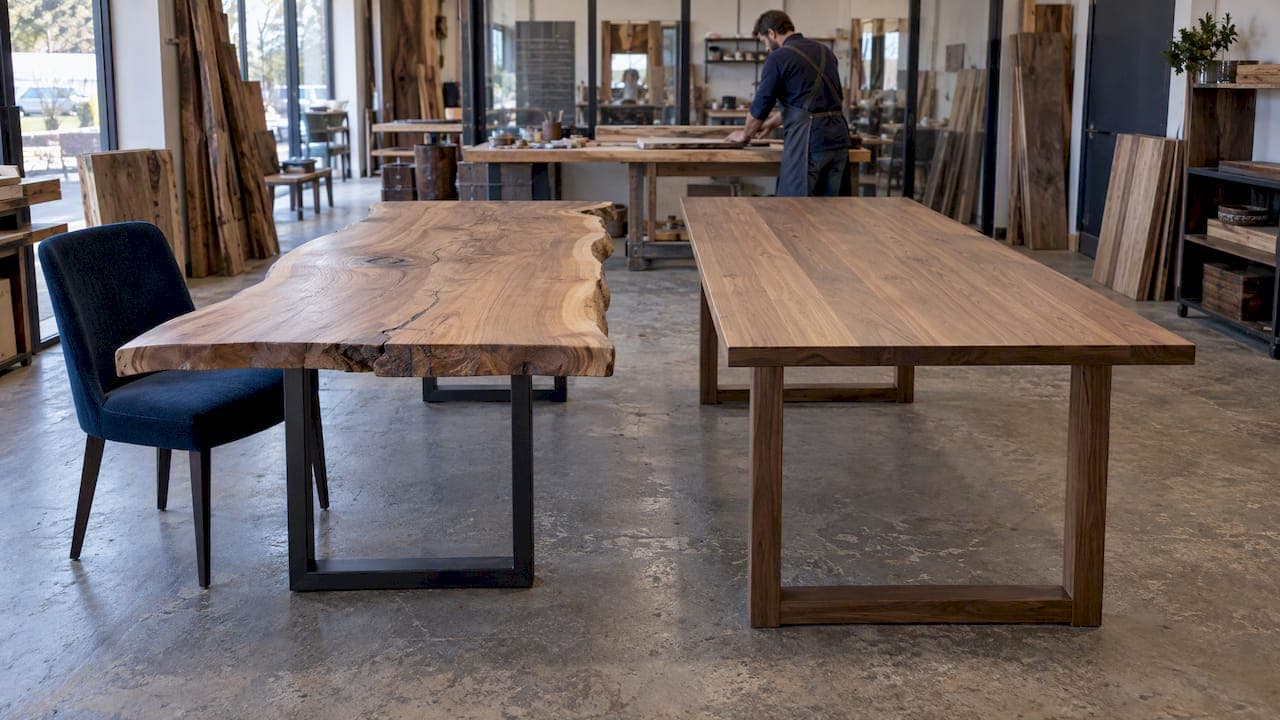
Choose straight edge when precise, predictable dimensions matter most, perhaps for a built-in dining run or a space with tight clearances. Choose live edge when you want an organic, singular statement piece and have room to accommodate natural variation in width. The practical difference shows up immediately in planning: live edge demands measuring the widest point of a slab, while straight edge gives you a fixed number to work from.
TL;DR:
- Live edge ordered width can vary by approximately 5 cm along a slab, so measure its widest point and allow extra clearance around walkways and furniture.
- Target wood moisture around 8% at 40 to 45% relative humidity; live edge slabs may need several months to a year of seasoning before machining.
- Live edge crevices typically need weekly brushing, and hard wax oil may need reapplication once or twice yearly; flat straight edge tops wipe clean quickly.
- For outdoor use, either style needs suitable specification: choose timber treated to Use Class 3 and BS 8417, or modified timber.
Table of Contents
- How live edge and straight edge pieces look and change a room
- Space, sizing and the slab reality: nominal width, variance and seating layout
- Moisture, drying and long-term stability
- Maintenance, durability and outdoor use
- A concise decision guide: which edge to pick for your priorities
- Impact of edge choice on furniture customization and design flexibility
- Cost comparison and pricing factors influenced by edge style
- Durability and longevity differences related to edge types
- Common artisan techniques used to create live edge furniture versus straight edge
- Publisher perspective: why bespoke live edge work is a signature offering
- How Simmons Interior Supply can help
- FAQ
- Sources
How live edge and straight edge pieces look and change a room
Live edge furniture keeps the natural contour of the tree intact along one or both sides of the slab, so bark pockets, knots and the sweep of the grain become the visual anchor of the piece. When selecting a slab, we look for figure that tells a story along its length, rather than a flat, uniform grain that could belong to any tree. The undulating boundary between wood and air is the whole point: no two edges are alike, and a well-chosen slab reads almost sculptural before a single finish coat goes on.
Straight edge furniture does the opposite. Milled, jointed edges remove the tree's silhouette entirely, which shifts attention to grain, figure and the precision of the joinery itself. A book-matched top with a crisp mitred edge rewards clean lines and symmetry, and it tends to recede politely into a room rather than demanding the first glance.
Base choice changes how either style reads. A live edge slab on slender black steel legs feels contemporary and architectural, while the same slab on a heavy timber trestle leans rustic. Straight edge tops pair comfortably with both classic turned legs and ultra-modern cantilevered frames, which is part of why they integrate so easily into mixed-style interiors. Our gallery shows both directions worked through in bespoke commissions.
- Live edge suits open-plan, nature-adjacent interiors where the table is meant to be the focal point.
- Straight edge suits formal dining rooms, boardrooms and any layout where repeatable proportions matter.
Pro Tip: Pair a live edge top with a minimalist base if you want the natural silhouette to feel considered rather than rustic.
Space, sizing and the slab reality: nominal width, variance and seating layout
A straight edge table's quoted width is its actual width, end to end, which makes seating plans and room clearances simple arithmetic. Live edge is different: the width you order is a nominal figure, and the slab's true width can vary along its length by as much as approximately 5cm, depending on how the tree grew and how the slab was cut. That swing matters once you are measuring doorway widths, walkway clearance or the gap between the table edge and a sideboard.
The practical fix is to always measure and plan from the slab's widest natural point, never from the nominal order size. For a dining table, that means allowing a touch of extra clearance on every side rather than cutting the room plan to the exact ordered dimension. For console tables and narrower pieces, the margin for error shrinks, so our sizing guide is worth a look before committing to a tight corridor placement.
Seating spacing follows the same logic. A straight edge table's uniform width lets you calculate chair positions with confidence; a live edge table's irregular perimeter means some diners will sit slightly closer or further from the centreline than others, which some clients find part of the charm and others find worth avoiding.
If your layout is a fitted alcove, a built-in banquette or any space with fixed walls on two or more sides, straight edge is almost always the safer commission.
Before committing to a live edge piece, ask your maker:
- What is the widest measured point of this specific slab, not the average?
- How much tolerance is built into the final dimensions after drying and finishing?
- Will the base be fixed to the actual slab, or built to a standard template?
Moisture, drying and long-term stability
Wood is hygroscopic: it absorbs and releases moisture in response to the air around it, swelling and shrinking as it does. For interiors, a practical target is an equilibrium moisture content of around 8%, achieved at roughly 40 to 45% relative humidity, which keeps movement small enough that joints and finishes stay stable through the seasons.
Live edge slabs are especially demanding here. Large, irregular sections of wood dry slowly and unevenly, and The Wood Database notes that experienced makers cut green wood oversized, seal the endgrain immediately and allow several months to a year of seasoning before final machining. Skip that patience and a slab can check, cup or split along the very contours that made it desirable.
Grain orientation plays a part too. Shrinkage is not uniform in any board: tangential shrinkage is typically about double the radial figure, which is why quartersawn lumber is noticeably more stable than plainsawn material, especially in wide live edge sections.
When commissioning either style, it is worth asking:
- Was the timber kiln dried or air dried, and for how long?
- Is the endgrain sealed, and when was that done relative to cutting?
- What allowance has been made for seasonal movement in the joinery or base fixings?
Maintenance, durability and outdoor use
Day-to-day care differs more than most buyers expect. Straight edge tops have flat, continuous planes that wipe clean in seconds. Live edge pieces have bark pockets, fissures and undulating crevices that collect dust and need a soft brush or a slightly more deliberate cleaning pass, typically weekly rather than an occasional wipe.
- Dust flat planes with a dry or barely damp cloth; live edge crevices respond better to a soft brush.
- Reapply oil or wax finishes on live edge pieces a little more often, since the irregular surface wears unevenly.
- Check endgrain and bark-retained areas periodically for any sign of lifting or checking.
Pro Tip: A hard wax oil finish, reapplied once or twice a year, protects live edge contours far better than a film finish that can crack along the natural undulations.
Outdoor use is where the two styles converge on the same rule: untreated wood of either style is not suitable outside without proper specification. Use Class guidance and BS 8417 set out the treatment required for timber exposed to weather, and Use Class 3 covers external, non-ground-contact applications such as a garden table under cover. Achieving the organic look outdoors safely usually means specifying modified timber, which offers enhanced durability and dimensional stability without relying on repeated biocide treatment, or choosing properly treated timber built to the relevant standard.
A concise decision guide: which edge to pick for your priorities
- Precision and fit: pick straight edge if your layout, built-ins or seating plan demand exact dimensions.
- Uniqueness: pick live edge if you want a piece that no one else will own in quite the same form.
- Maintenance tolerance: straight edge if you want minimal upkeep; live edge if you are happy to clean crevices and reapply finish more often.
- Budget and timeline: live edge slabs often need longer lead times for drying and selection.
- Scale of the project: for hospitality or multi-piece commercial fits, straight edge usually simplifies replication across units.
When a project calls for a genuine one-off centrepiece, commissioning bespoke live edge work lets a maker select the slab, control the drying schedule and match the base to the room, which removes most of the risk that comes with buying a live edge piece off the shelf.
Impact of edge choice on furniture customization and design flexibility
Straight edge furniture is, by nature, easier to replicate and adjust. A joiner can lengthen a table, widen a bench or produce six identical dining chairs from the same cutting list without the design shifting character. That repeatability makes straight edge the practical choice for hospitality fit-outs, matched suites and any commission where consistency across multiple pieces matters more than individuality.
Live edge furniture works the opposite way: every slab is a one-off, which means customisation happens around the wood rather than to it. A maker can choose which face shows, how much bark stays on, and how the base frames the natural contour, but the slab itself sets the boundaries. That constraint is often the appeal. Clients who want a table that could not be reordered from a catalogue tend to gravitate towards live edge precisely because the design flexibility lies in interpretation rather than replication.
Both approaches benefit from thoughtful species selection, since grain character, colour and figure all shift how much customisation feels possible within either edge style. A heavily figured walnut slab leaves little room for a busy base design, while a quieter oak straight edge top can carry a more elaborate leg or trestle without competing for attention.

Cost comparison and pricing factors influenced by edge style
Pricing for either style depends on species, dimensions, finish and the complexity of the base, but live edge pieces carry additional cost drivers that straight edge tops do not. Slab selection itself takes time, since a maker is choosing a specific piece of wood rather than cutting from standard stock. Extended drying periods, careful endgrain sealing and the extra labour involved in working around natural irregularities all add to the build time, which is typically reflected in the final price.
Straight edge furniture benefits from more predictable material usage and faster machining, since boards are jointed and dimensioned to a standard template rather than shaped around a single slab's contours. That efficiency tends to make straight edge the more cost-effective route for multi-piece orders or projects on a fixed budget.
For a bespoke commission, we price each piece individually based on species, scale and finish, so the fairest way to understand cost for your specific project is to request a quote through our bespoke furniture collection rather than relying on a generic figure, since no two commissions use identical materials or labour.
Durability and longevity differences related to edge types
Both edge styles can last for generations when the timber is properly dried, finished and maintained, but the failure points differ. Live edge slabs retain bark and natural fissures, which are the areas most likely to need attention over time: a bark pocket can lift, and a natural crack can widen slightly with seasonal humidity changes if the endgrain was not sealed thoroughly during drying.
Straight edge furniture, by contrast, concentrates its long-term stress at the joints rather than within the material itself. A well-cut mortise and tenon or a properly fitted mitre will outlast the finish several times over, provided the wood was dried to an appropriate moisture content before construction. Our guide to furniture joinery types covers the tolerance considerations that affect how long a straight edge piece holds its shape.
In practice, neither style is inherently more durable than the other. Longevity comes down to how well the timber was dried and sealed before the piece was built, which is precisely why commissioning from a maker who controls that process end to end matters more for live edge work than for straight edge.
Common artisan techniques used to create live edge furniture versus straight edge
Live edge work begins at the sawmill, where a slab is cut to preserve the tree's natural boundary rather than squared off. From there, a maker typically kiln dries or air dries the slab slowly, seals the endgrain to slow moisture loss from the most vulnerable surfaces, and may stabilise any cracks with butterfly joints or resin fills before final sanding and finishing. Bark is either retained and treated to prevent insect activity, or removed entirely depending on the desired look.

Straight edge construction relies on a different skill set: precise milling, jointing and dimensioning to produce flat, square boards, followed by joinery techniques such as mortise and tenon, dovetail or mitred corners to assemble the final piece. The craft here lies in tight tolerances and invisible joints rather than in selecting and preserving a single natural form.
Finishing techniques differ too. Live edge pieces often use a hard wax oil that settles into natural texture without obscuring it, while straight edge tops can carry a wider range of finishes, from lacquer to oil, since the surface is uniform throughout.
Publisher perspective: why bespoke live edge work is a signature offering
The received wisdom treats live edge as simply "buy a slab and build a frame around it". That underestimates how much of the result depends on decisions made months before assembly: which tree, which cut, how long it dried, whether the endgrain was sealed on day one. Straight edge forgives a rushed process far more readily than live edge does.
At Simmons Interior Supply, every piece is handcrafted to order, which means the slab selection, drying schedule and base design are decided together rather than assembled from whatever happens to be in stock. That collaboration with skilled artisans is what turns a promising slab into a piece that holds its shape for decades.
— Luke
How Simmons Interior Supply can help

Whichever direction suits your space, we build both live edge and straight edge pieces to order, matched in size and finish to the room they are going into. For project presentation support, our partner Forefront Industries works with luxury builders and contractors on the digital side of procurement.
- Request a quote through our bespoke furniture collection.
- Set up a trade account to discuss a project directly with our team.
FAQ
Can you use live edge wood outside?
Untreated live edge wood is not suitable for permanent outdoor use without proper specification. Exterior pieces need treatment meeting Use Class 3 guidance and BS 8417, or a modified timber option that achieves durability without repeated biocide treatment.
How much is live edge wood worth?
Live edge pricing depends on species, slab size, drying time and finish, so there is no single market figure that applies across projects. For a specific piece, the most reliable way to understand cost is to request a quote based on your chosen species and dimensions.
Are live edge tables still popular?
Live edge remains a widely chosen style for statement dining and occasional tables, particularly in open-plan and nature-inspired interiors. Demand tends to follow broader interior trends towards natural materials and one-off pieces rather than mass-produced furniture.
What does live edge cutting board mean?
A live edge cutting board retains the natural, uneven boundary of the tree along one or more sides rather than being trimmed to a straight rectangle. It is typically cut from a smaller offcut of the same slab material used for larger live edge furniture.
Which edge style is better for a small dining room?
Straight edge is generally the safer choice for a small or tightly laid out dining room, since its fixed width makes clearance and seating calculations predictable. Live edge can still work if you measure from the slab's widest point and allow extra margin around walkways.
Sources
- Drying wood at home | The Wood Database
- Understanding Use Class 3 (Metsä / WPA guidance)
- Timber cladding wood types | TDCA
- WPA / Wood Preservation guidance (excerpt)