
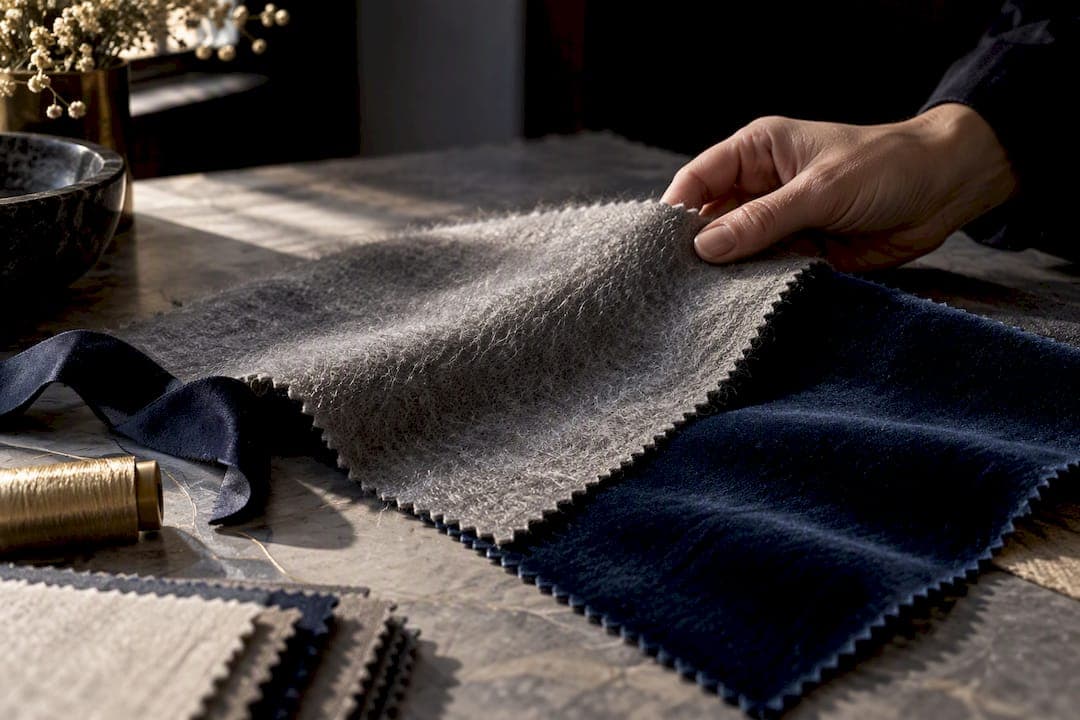
Choose mohair when upholstery needs to survive decades of hard use and still catch the light beautifully; choose it, too, when you want a natural fibre with genuine resilience against crushing. Choose a synthetic or cotton velvet when the brief calls for machine-washable practicality, a tighter budget, or a softer, less structured hand. The right answer depends entirely on wear, budget and how the piece will be lived with, and the sections below give you the standards and specification questions to settle it.
TL;DR:
- Mohair velvet offers superior durability with Martindale rub counts often between 50,000 and 100,000, making it suitable for high-traffic and long-lasting applications.
- Synthetic velvets can match or surpass mohair's rub count, but they may lack mohair’s natural sheen and pile recovery, influencing the final aesthetic and performance.
- For contract use, fabric certificates for fire resistance standards like BS 5852 Crib 5 are essential, and only specific fabric ranges with independent test results qualify.
- Mohair typically requires solvent-based cleaning, while water-tolerant synthetic velvets are more forgiving for everyday maintenance and spills.
- The choice depends on wear, lifestyle, and fire certification needs, with synthetics preferred for practicality and mohair for luxury and resilience.
Table of Contents
- Mohair vs velvet: fibre origin and pile construction
- Appearance and hand: sheen, colour depth and ageing
- Durability and performance: Martindale, crush resistance and real-world wear
- Fire safety and contract specification: what UK buyers need to check
- Care and maintenance: cleaning codes and everyday habits
- How to choose: a decision checklist by room and brief
- Why we still specify mohair on our hardest-working commissions
- How Simmons Interior Supply helps you specify with confidence
- Sources
- FAQ
Mohair vs velvet: fibre origin and pile construction
Mohair comes from the Angora goat, and its fibre has a hollow, medullated core that gives it natural spring and a lustre few other materials match. That structure is the whole story behind why mohair velvet resists crushing so well, and why designers reach for it on pieces meant to hold their shape for years, not seasons.
"Velvet" is not one fabric. It is a construction method, a pile woven over a base and then cut, and it can be executed in almost any fibre.
- Cotton velvet: soft, matte, decorative, but relatively fragile under sustained rubbing.
- Silk velvet: exquisite depth of colour, best reserved for cushions or occasional chairs rather than daily seating.
- Viscose and wool-blend velvets: mid-range durability, variable hand depending on backing.
- Synthetic velvets (microfibre, Trevira CS, other engineered constructions): built for durability and easier cleaning, often at a lower price point.
Pile height, the density of the backing weave, and how tightly the pile is set all shift crush resistance and drape, so two fabrics both labelled "velvet" can behave very differently once a sofa sees regular use.
Appearance and hand: sheen, colour depth and ageing
Mohair velvet has a directional two-tone sheen. Stroke it one way and it glows; stroke it against the grain and the same chair reads a shade darker. That shift in tone as light and hand movement change is part of mohair's appeal for statement pieces, particularly bespoke sofas where the fabric itself becomes a design feature rather than a backdrop.
Other velvets split into two aesthetic camps.
- High-sheen synthetic velvets throw light back almost like satin, which suits contemporary interiors but can look brash in a period room.
- Matte cotton and viscose velvets absorb light for a softer, more muted colour depth, though they are more prone to visible nap reversal, the shiny patches that appear where the pile has been flattened by repeated sitting.
- Lightfastness varies sharply by fibre. Mohair's fibre properties give it strong resistance to fading, while some dyed synthetics and cheaper cotton velvets can shift colour noticeably in a sun-facing bay window within a couple of years.
Durability and performance: Martindale, crush resistance and real-world wear
The number that actually matters here is the Martindale rub count, and mohair velvet performs at the top of the natural fibre range. Independent testing commonly places genuine mohair velvet between 50,000 and 100,000 Martindale cycles, with some specifier-grade ranges verified at 80,000 to 100,000 rubs. For comparison, cotton and silk velvets often sit closer to lower double rub counts typical of occasional-use armchairs, but not suitable for a family sofa in daily service.
What those figures mean in practice:
- 10,000 to 25,000 rubs: suitable for light domestic use, low-traffic bedroom chairs or decorative cushions.
- 25,000 to 50,000 rubs: general domestic sofas and dining chairs with moderate daily contact.
- 50,000 to 100,000 rubs: heavy domestic use, family rooms, and light contract settings.
- 100,000+ rubs: hospitality lobbies, hotel lounges, and other high-traffic contract seating.
Mohair's advantage is not purely about the raw number. Its hollow fibre structure gives it genuine pile recovery, meaning the pile springs back after someone stands up rather than staying flattened. That same fibre can hold moisture equivalent to around 30 percent of its own weight without feeling damp, which helps it resist the clammy, matted look that afflicts lesser velvets in humid rooms.
Engineered performance velvets close the gap in some ways. A well-built synthetic can match or exceed mohair's rub count and clean far more easily, but it rarely matches mohair's natural sheen or its long-term resilience against permanent shiny wear. That trade-off, luxury and recovery against budget and easy maintenance, is the real decision most specifiers are making, whatever the spec sheet says.

Fire safety and contract specification: what UK buyers need to check
Contract and hospitality work brings statutory obligations that domestic upholstery does not. The relevant benchmarks are BS 5852 (ignition source testing, including the Crib 5 test for high-risk environments) and BS 7176 or BS 7177, which set ignition resistance levels for contract furniture. Under UK guidance, the Responsible Person for a venue must determine the correct ignition resistance level and specifiers need documentary proof that the finished upholstery combination meets it.
Mohair velvet can sometimes achieve an inherent Crib 5 pass without any topical chemical treatment, but that is a property of the specific range and its backing, never a guarantee of the fibre alone. Before you specify anything for contract use:
- Request the supplier's independent test certificate for the exact fabric range, not a generic fibre datasheet.
- Confirm which foam and interliner combination the certificate covers, since changing either can invalidate the result.
- Quote the precise standard (BS 5852 Crib 5, BS 7176, or BS 7177) in the purchase contract rather than a vague reference to "fire rated" fabric.
- Keep a copy of every certificate on file for the life of the installation, in case of inspection.
As FIRA's own guidance stresses, construction and backing determine the fire performance as much as the fibre does. A certificate for the specific range in front of you is the only reliable proof, whichever fabric you choose. Our Crib 5 specifier's guide covers the paperwork trail in more detail.
Care and maintenance: cleaning codes and everyday habits
Cleaning code matters more than most buyers realise at the point of sale. Genuine mohair velvet typically carries an S code, meaning solvent-based cleaning only; water can leave permanent watermarks and matte the pile if it is used carelessly. Many synthetic velvets carry a W or WS code, tolerating water-based cleaning and making them far more forgiving around children, pets or spilled wine.
- Vacuum weekly using a soft brush attachment, working in the direction of the pile.
- Brush occasionally to lift crushed areas and restore the two-tone sheen.
- Blot fresh spills immediately with a dry cloth; never rub.
- Keep natural mohair velvets away from direct water unless the supplier confirms otherwise.
- Book professional dry-cleaning for ground-in stains rather than attempting a home fix.
Pro Tip: Test any cleaning method on an unseen patch, such as the underside of a cushion, before treating a visible stain. Mohair's pile can react differently to solvents depending on the dye batch.
Our guide to caring for textured pile fabrics covers similar principles for bouclé, useful if your project mixes pile types.
How to choose: a decision checklist by room and brief
Match the fabric to how hard the piece will actually work, not how it looks in the showroom.
- Decorative or low-use pieces (occasional chairs, cushions): cotton or silk velvet, prioritising colour depth over rub count.
- Everyday domestic seating (sofas in a living room used daily): mohair or a mid-to-high-spec synthetic velvet.
- Family rooms with children or pets: a W-coded performance velvet, or mohair if the household accepts solvent-only cleaning.
- Contract and hospitality settings: mohair or Trevira CS-type synthetics, always backed by an independent Crib 5 or BS 7176 certificate.
Before signing off any fabric, ask the supplier these four questions:
- What is the Martindale rub count for this exact range, not the fibre generally?
- What lightfastness grade does the fabric carry, and has it been tested for this specific colourway?
- Can you provide the BS 5852 or BS 7176 test certificate for this fabric with the foam and interliner we intend to use?
- What is the recommended cleaning code, and does it match the client's lifestyle?
Our Martindale rub count guide walks through how to interpret the answer to that first question in full.
Why we still specify mohair on our hardest-working commissions
Working across bespoke commissions, we test fabric performance the same way every time: we ask for the range-specific certificate, not the fibre's reputation. Mohair earns its premium price on pieces where a client wants both longevity and a fabric that photographs beautifully, a hotel lobby sofa, a dining chair collection that will see twenty years of use, a statement armchair in a sun-facing bay.
That said, we choose performance synthetics just as readily when the brief genuinely calls for washable practicality over heirloom sheen, a nursery snug or a busy family playroom, for instance. Neither fabric is universally "better." The brief decides, and the certificate confirms it.
— Luke
How Simmons Interior Supply helps you specify with confidence
Simmons Interior Supply is the route to bespoke upholstery built around a fabric decision that actually holds up, not a showroom sample that looks right on day one and shows its wear by year two. Every piece from our bespoke furniture collection is handcrafted to order in the size and finish your project needs, and we work directly with artisans to match the fabric, whether that's mohair, a performance velvet, or a fibre we source through trade channels, to the exact wear pattern and fire specification your brief demands.
If you're weighing mohair against a synthetic velvet for a current commission, get in touch through our trade enquiry page for sample handling and specification support, or browse our project gallery to see how past commissions resolved similar fabric decisions. We're always happy to talk through certificates, cleaning codes and cost before you commit to a range.
Sources
Before specifying, request Martindale results and BS 5852 or BS 7176 contract certificates from your supplier, and consult Kothea's velvet specifier guide for wider fabric comparisons.
- Velvet types compared: specifier guide — KOTHEA
- Hart Textile materials guide — Mohair wool
- FIRA contract flammability guide — FIRA
- The science behind mohair and its properties — Capricorn Socks
FAQ
Is mohair better than velvet for upholstery?
Mohair is a type of velvet construction, so the real comparison is mohair against cotton, silk or synthetic velvets. Mohair generally outperforms them on abrasion resistance, with figures commonly ranging from 50,000 to 100,000 Martindale rubs, but synthetic performance velvets can match that durability at a lower price with easier cleaning.
What is the difference between mohair and velvet?
Velvet describes any pile fabric cut from a woven base, regardless of fibre. Mohair is a specific fibre, Angora goat hair, that can be woven into velvet form, giving it a hollow fibre structure that resists crushing better than cotton or silk velvet.
How does mohair compare to polyester velvet?
Polyester velvet is generally cheaper, easier to clean with water-based methods, and often carries a W or WS cleaning code, while mohair typically requires solvent-only S-code cleaning. Mohair usually wins on natural lustre and long-term pile recovery, though a well-built polyester range can rival its Martindale performance.
Which fabric is easier to clean, mohair or velvet?
It depends on the velvet type: many synthetic velvets carry W or WS cleaning codes and tolerate water-based cleaning, while natural mohair velvet typically carries an S code requiring solvent-only cleaning. Cotton and viscose velvets sit somewhere in between, depending on the specific finish.
Can mohair velvet be used in contract or hospitality settings?
Yes, provided the specific range carries an independent certificate confirming it meets BS 5852 Crib 5 or BS 7176 requirements for the exact foam and interliner combination used. The fibre alone never guarantees compliance, so always request the range-specific test certificate before specifying.