
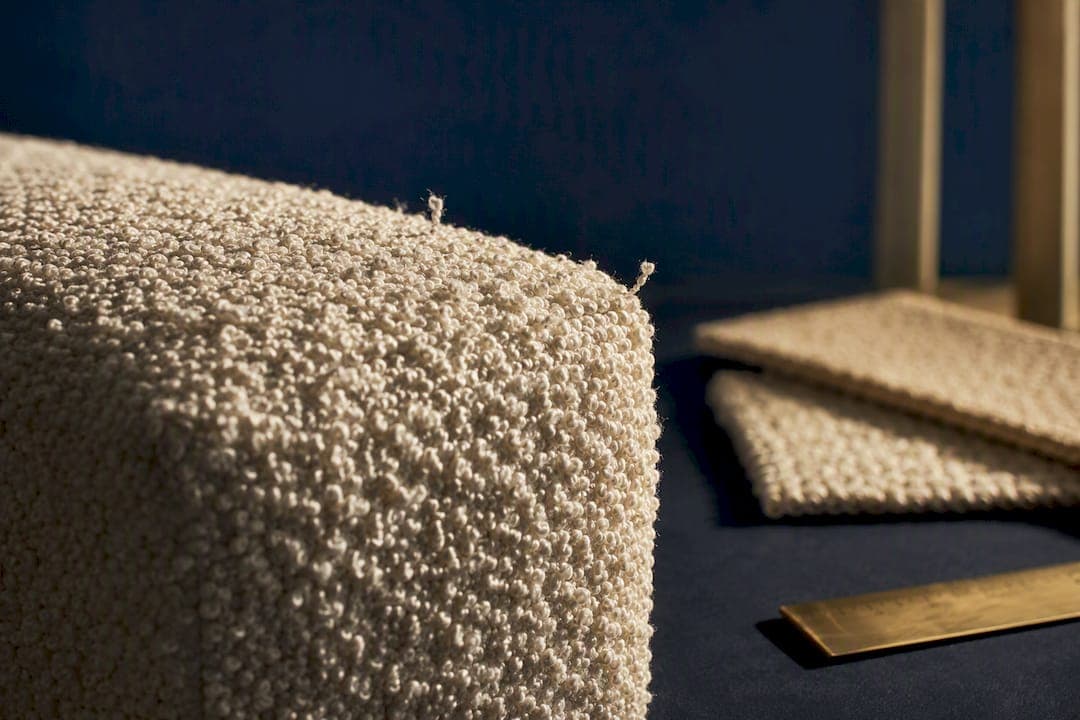
Boucle can be durable for upholstery if it is well specified. Its suitability depends on factors such as rub count, loop tightness, backing quality, and fibre content, which you should check before purchase. When properly chosen, boucle offers both texture and durability.
TL;DR:
- A boucle fabric rated at 30,000 Martindale rubs is suitable for standard domestic furniture, while ratings above 40,000 are designed for heavier use or contracts.
- Tight, consistent loops, heavier fabric weight, and reinforced backing significantly increase boucle's long-term durability and resistance to snagging or unraveling.
- Wool bouclés offer better abrasion resistance and develop character over time but require gentle cleaning; synthetics are easier to maintain but often less tactile.
- Households with pets, especially cats, should specify higher rub counts and tighter loops, and consider additional protective measures to prevent snagging or damage.
- Always verify detailed specifications, including fibre content, backing, and care instructions, and request full swatch panels for accurate assessment before purchase.
Table of Contents
- Boucle fabric durability: what construction and fibre choices really determine
- How is boucle fabric durability actually tested?
- How to choose and specify boucle for upholstery
- Caring for boucle fabric and repairing snags
- Which households and rooms suit boucle upholstery?
- The bottom line on boucle fabric durability
- Specifying boucle in bespoke projects
- Bespoke boucle upholstery, specified properly
- Sources
Boucle fabric durability: what construction and fibre choices really determine
Boucle isn't a fibre, it's a construction. The name describes a looped, curled yarn woven or knitted into the base cloth, and those loops are precisely why the fabric divides opinion among people specifying furniture. Loops create depth, shadow and a tactile softness that flat weaves can't match, but they also raise a snag risk that a plain weave simply doesn't carry. A loose thread on a smooth chenille lies flat; a loose loop on boucle catches on a belt buckle or a cat's claw and pulls.
Fibre choice governs how the cloth ages under that stress. Wool boucle resists abrasion well and develops a lived-in character over years, but it demands gentler cleaning. Polyester and synthetic-blend bouclés typically shrug off spills and sunlight with less fuss, trading some of that tactile depth for easier upkeep. Blends split the difference, and the split usually shows up in the price.
Beyond fibre, three construction factors decide whether a boucle survives a decade of family life or unravels within a season:
- Loop tightness — tighter, more consistent loops resist snagging and hold their shape under repeated pressure.
- Fabric weight — heavier cloths generally wear better on high-contact surfaces like arms and seat fronts.
- Backing reinforcement — a stabilised backing stops loops pulling loose at the base and limits seam stress.
Manufacturer datasheets show how much these variables move the needle. The Everyday Boucle digital binder from Luum lists 36,000 Wyzenbeek double rubs alongside a Class 5 pilling result, while Zinc Textile's Très Bouclé collection and Dedar's Lupo sit at the more technical end of the market, built specifically to survive heavier domestic and light contract use.
How is boucle fabric durability actually tested?
Two industry tests dominate upholstery specification: Martindale and Wyzenbeek. Martindale rubs a fabric sample against an abrasive surface in a figure-of-eight motion and counts the cycles until visible wear appears. Wyzenbeek uses a back-and-forth rubbing action instead, common on datasheets from North American mills. Neither number tells you everything, but both give you a comparable benchmark across fabrics.
Industry guidance breaks Martindale results into rough usage bands:
| Martindale rub count | Suggested use |
|---|---|
| — | Decorative or occasional-use pieces only |
| 15,000 to 25,000 | Light domestic seating |
| 25,000–40,000 | Standard domestic use |
| 40,000+ | Heavy domestic or light contract use |
A boucle rated at 30,000 Martindale, like Zinc Textile's Betty, sits comfortably in the standard domestic band, while premium technical bouclés reaching 40,000 to 80,000+ are built for heavier family use or contract seating.
None of that guarantees performance on its own. A high rub count on a fabric with weak backing or loose loops can still fail early through snagging or seam pull, which is why a Martindale rating should always be read alongside construction details, not instead of them.
How to choose and specify boucle for upholstery
Turning the numbers above into a buying decision is straightforward once you know what to ask for.
- Match the rub count to the furniture's role. A rarely used accent chair can sit at 15,000 to 25,000 Martindale; a family sofa or hospitality seat needs 30,000 or higher.
- Ask for backing and seam performance data, not just the abrasion figure, since a weak backing undermines even a high rub count.
- Request the cleaning code and warranty terms in writing before you commit to yardage.
- Confirm fibre content and weight, since these affect both feel and long-term wear.
- Check the flame standard if the piece is destined for a hotel, restaurant or other public space, alongside contract-grade upholstery requirements.
A proper technical data sheet should state the Martindale or Wyzenbeek score, fibre percentage, weight, flame standard and care code without you having to chase the supplier for it. Vague specifications, unusually light fabric weight, or loops that look uneven from batch to batch are all reasons to walk away.
Pro Tip: Always request a full swatch panel rather than a small cutting, and where possible, ask for a small on-site mock-up. Boucle can drape and catch light very differently at chair-arm scale than it does on a palm-sized sample.
Caring for boucle fabric and repairing snags
Boucle rewards a light, consistent maintenance routine far more than occasional deep cleaning. Vacuum weekly or fortnightly with a soft brush attachment on low suction, working in the direction of the nap so loops aren't dragged against their lay. Left too long, dust and grit work their way into the loops and accelerate wear from the inside out, a point Stamps Home Furniture makes clear in its maintenance guidance.
Spills need a quick, calm response:
- Blot immediately, don't rub, and work from the outside of the mark inwards.
- Test any cleaning product on a hidden area first, since wool bouclés often restrict water-based cleaning to avoid felting.
- Avoid soaking the fabric, which can distort the loops permanently.
Many high-end wool bouclés require professional dry cleaning rather than home spot treatment. If a stain persists after gentle blotting, call a specialist rather than experimenting further.
Snags are inevitable eventually. The correct technique is to never cut a pulled loop. Cutting creates a permanent hole that unravels further over time. Instead, work the loop back through to the reverse side using a blunt needle or even a toothpick.
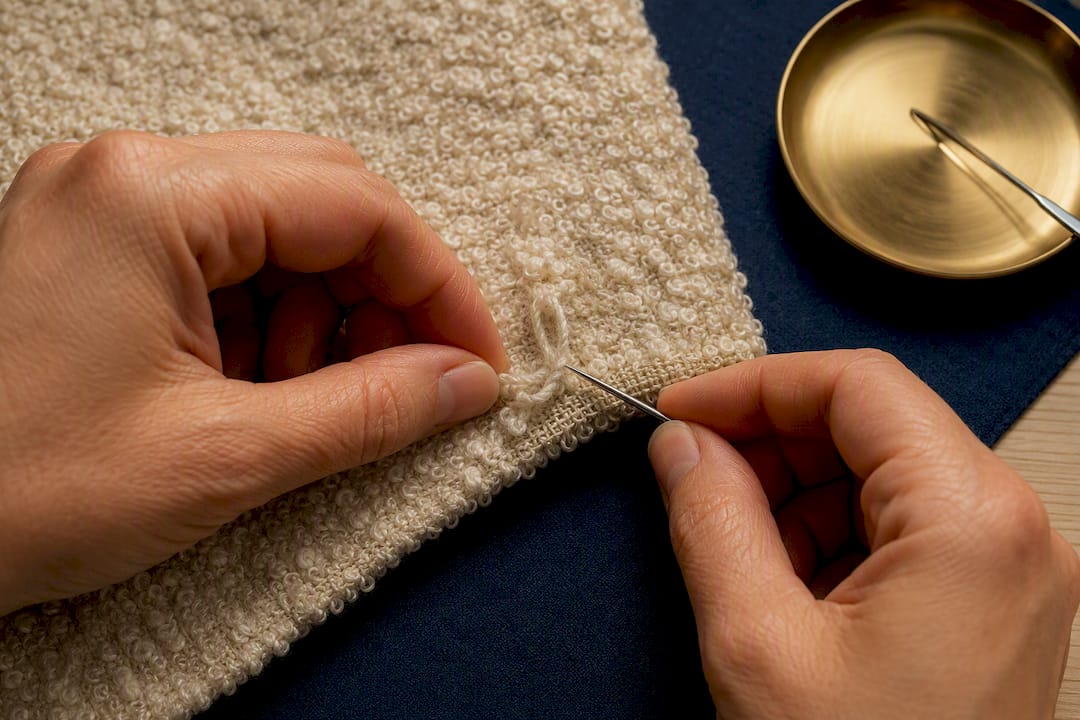
Pro Tip: Keep a blunt tapestry needle in a kitchen drawer near your boucle furniture. Fixing a snag within minutes of noticing it takes seconds; leaving it for a week invites someone to tug at it and make things worse.
Which households and rooms suit boucle upholstery?
Boucle suits adult-only households and formal living rooms particularly well, where foot traffic is lighter and there's less risk of sharp claws or crayons meeting the loops. Families can still choose boucle successfully by specifying higher rub counts, tighter loop constructions and darker or patterned colourways that hide everyday wear.
Pets change the calculation more than children do. Cats in particular are prone to catching claws in loops during play or scratching, so mitigation matters:
- Choose tighter-loop, higher rub-count specifications for pet households.
- Keep a washable throw over frequently used seating areas.
- Provide scratching alternatives near the furniture to redirect claw behaviour.
Where the household risk is simply too high, performance synthetics or leather are worth considering instead, since both resist claws and spills more forgivingly than any looped weave. Well-specified boucle in an appropriate setting typically lasts seven to fifteen years of regular domestic use, which puts it comfortably alongside most mid-to-premium upholstery fabrics.
The bottom line on boucle fabric durability
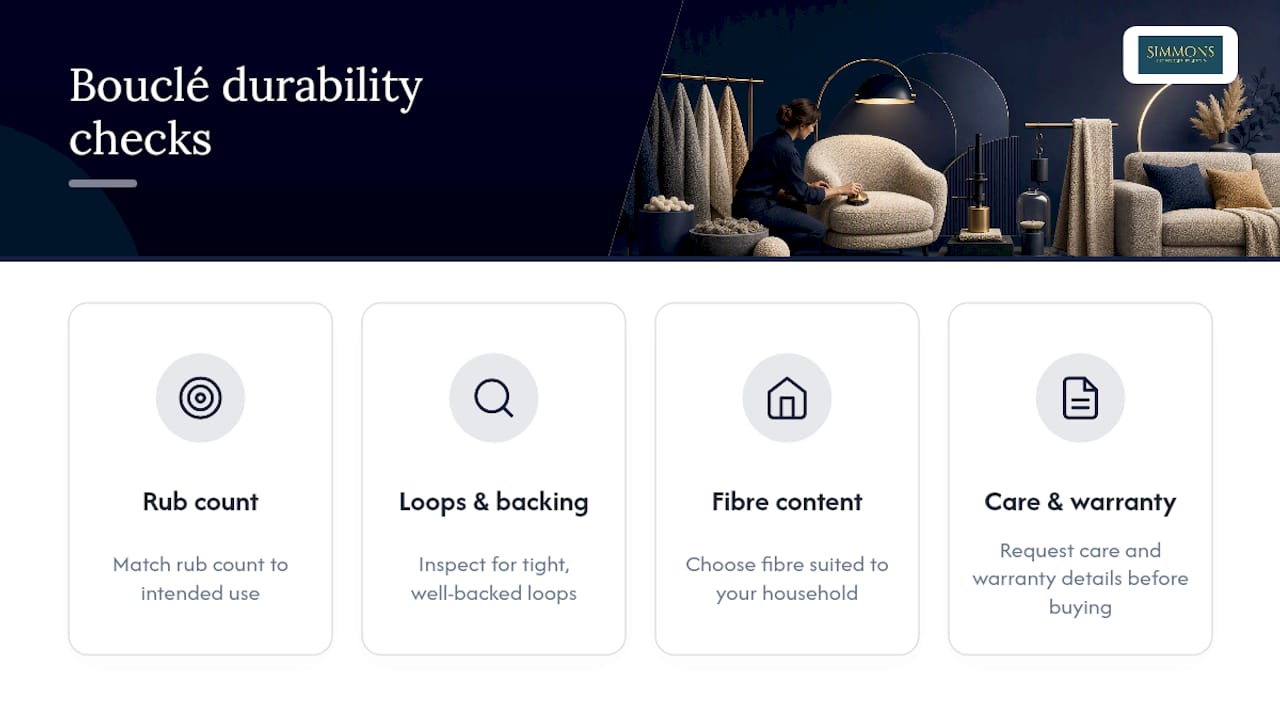
Boucle earns its reputation for durability only when the specification backs it up: a rub count matched to the furniture's use, tight and well-backed loops, and a fibre content suited to your household. Check the rub count, inspect the loops and backing in person, and request the care and warranty details before you buy. For deeper reading on any of these checks, our bouclé fabric care guide covers the specification detail in full.
Specifying boucle in bespoke projects
Boucle has become one of the most requested fabrics in bespoke seating briefs over the past few years, and the reason is simple: clients love the texture in photographs and then ask hard questions about longevity once they understand what they're paying for. Good specification is craftsmanship in itself, no different from choosing the right timber or joint for a frame. The right loop density, backing and fibre blend, matched properly to the piece and the household, is what separates furniture that ages gracefully from furniture that looks tired within a year. If you're weighing boucle against another fabric for a commissioned piece, get in touch with our trade team for sample swatches and honest guidance.
— Luke
Bespoke boucle upholstery, specified properly
Simmons Interior Supply builds upholstered furniture to order, which means the boucle on your sofa or chair is chosen for your household and your room, not pulled from a generic run. Every piece is handcrafted with artisans who work fibre, loop density and backing together rather than treating fabric as an afterthought once the frame is built.
Where a mass-market retailer offers a fixed fabric list, we work with you and your design brief to source or specify boucle that matches the rub count and care requirements your project actually needs, from a formal adult living room to a heavier-use hospitality seat. Our bespoke nest of coffee tables and hammered coffee table show the same made-to-order approach we bring to upholstered seating. Trade buyers can also view samples through our showroom partner network, including Faura's Westminster showroom, for hands-on fabric assessment. Get in touch through our trade enquiries page to request boucle swatches and start a specification conversation for your next commission.
Sources
For deeper technical reading, the Everyday Boucle datasheet shows a real Wyzenbeek and pilling result in context. The Hart Design Selection guide explains rub-count thresholds clearly, while D and G Flooring covers seam and flame-standard specification for contract use.
- Everyday Boucle digital binder (Teknion / Luum)
- Is bouclé fabric durable? Pros, cons, how to choose and price guide — Hart Design Selection
- Is Boucle Fabric Durable? Real-World Performance Guide — Stamps Home Furniture
- Boucle fabric 101 — how to care for and sew the modern interior favourite — Classic Modern Fabrics