
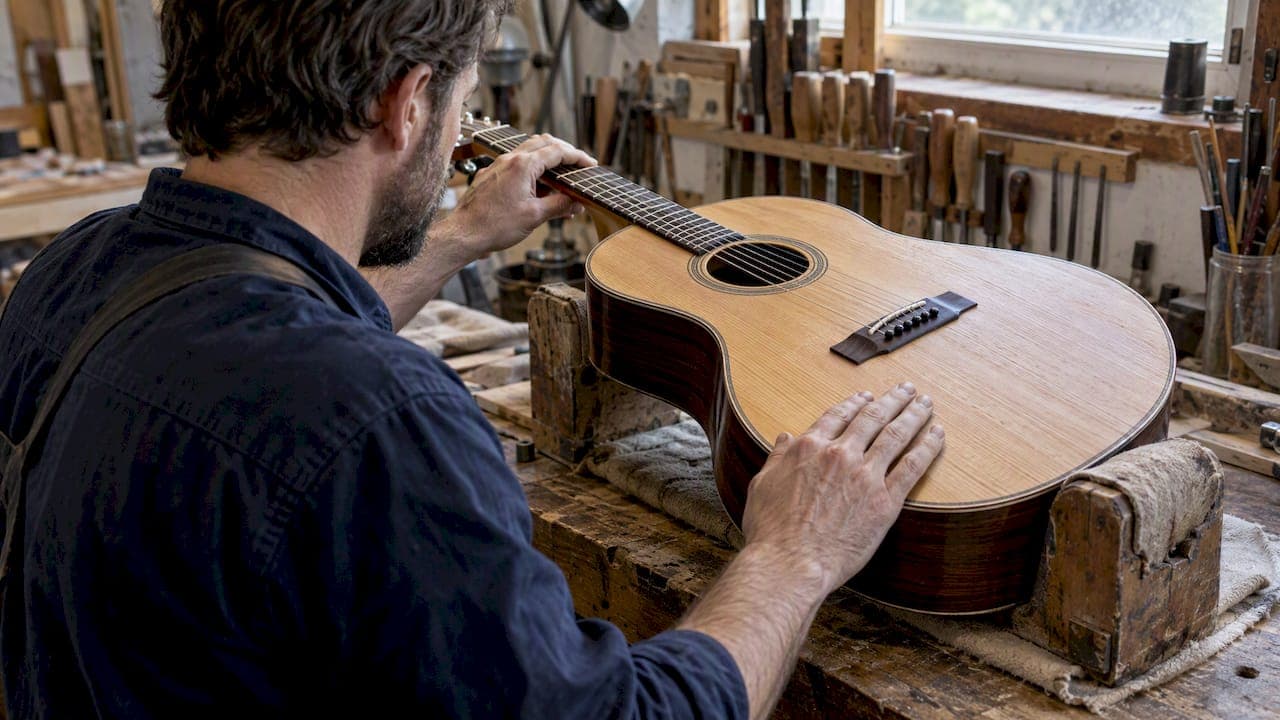
An open pore finish leaves the natural texture of the wood's grain visible and touchable beneath a thin coat of lacquer, oil or shellac, rather than burying it under layers of filler. Choose it when you want a guitar that feels alive under the hand and takes gentle, local repairs with ease. Avoid it when your priority is maximum resistance to spills, sweat and knocks, since the thinner film offers less of a shield.
TL;DR:
- Open pore finishes highlight natural wood texture, especially on species like mahogany, ash, koa, and walnut, with visible pores and a matte sheen.
- They typically use fewer coats, such as a sealant plus two topcoats, which results in a thinner film that ages gracefully but offers less protection against spills and grime.
- Nitrocellulose lacquer remains the classic choice for repairability and aging character, while polyurethane increases durability but feels firmer and less "alive."
- Daily care requires gentle wiping, careful dust removal, and avoiding harsh solvents or abrasive cleaners that can cloud or strip the thin finish.
- Refinishing involves cleaning, scuffing, and either sealing to preserve or filling and sanding to convert into a smooth, fully filled surface, with attention to proper curing times.
Table of Contents
- What open pore look and feel means in practice
- Pros and cons: protection, tone, maintenance and ageing
- Finish systems that produce an open pore result
- How to care for an open pore guitar day to day
- Refinishing workflow for preserving or converting open pore guitars
- Specialist finishing notes from the bench
- When I advise keeping an open pore finish
- How we handle bespoke finishing requests
- FAQ
- Sources
What open pore look and feel means in practice
Run a finger along an open pore neck or body and you will feel faint ridges and dips tracing the grain itself, rather than a glassy, uniform plane. Visually, the surface tends towards matte or semi-satin, with the wood's natural texture reading through the finish instead of sitting beneath a mirror-like film.
Not every timber shows this character equally. Mahogany, ash, koa and walnut have large, open vascular cells that create visible pore texture when left unfilled, while maple and ebony are tight-grained enough that they look smooth with almost no finish at all.
- Mahogany, ash, koa and walnut show pronounced pore structure and are the woods most associated with open pore builds.
- Maple and ebony are naturally closed-grained, so filling makes less visual difference on these species.
- Many boutique builders leave pores unfilled deliberately, favouring the tactile, "wood you can feel" quality over a showroom-polished look.
Pros and cons: protection, tone, maintenance and ageing
The appeal of an open pore finish is a thinner film: it lets you feel the neck's actual wood, it ages with character rather than cracking in sheets, and small dings are easier to spot-touch without refinishing the whole instrument. The trade-off sits in daily resilience. Because the film is thinner and the pores stay exposed, these finishes generally offer less abrasion and liquid resistance than their filled, closed-pore counterparts, and dust or grime can settle into the open grain over time, demanding more careful cleaning habits.
Open pore builds typically carry a film of one sealer coat plus two topcoats, a much lighter build than a fully filled, glossy finish, which is why they trade some everyday toughness for feel. Tone discussions around open pore finishes often overstate the pore-filling question: finish thickness, not whether the pores themselves are filled, is what most affects resonance and perceived tone.

Finish systems that produce an open pore result
Different finish chemistries behave quite differently once pores are left exposed, and the choice shapes both feel and future repairability.
- Nitrocellulose lacquer stays thin and traditional, ages with a soft patina, and is the easiest chemistry to spot-repair, which is why it remains the classic choice for a vintage, open-grain feel.
- Polyurethane and polyester cross-link into a much harder film that resists everyday knocks better, though an open pore look is still achievable; the tactile result reads firmer and less "alive" than nitro.
- Shellac and French polish, along with natural oil finishes, give a thin, repairable surface that many players prefer on necks for its warmth and quick touch-up potential.
- Modern pore-fill products, including paste fillers and UV-cure gels, exist for builders who want the open-grain aesthetic eliminated in favour of a glass-smooth, fully closed surface.
Nitrocellulose's reputation for repairability against polyurethane's greater resistance to everyday wear is the clearest way to frame the decision: pick nitro or shellac for feel and easy upkeep, poly for day-to-day toughness on a working instrument.
How to care for an open pore guitar day to day
Open pore surfaces reward a gentler routine than a glossy, fully filled finish, mostly because grime has somewhere to hide.
- Wipe the body and neck with a soft microfibre cloth after each session to lift sweat and oils before they settle into the grain.
- Use a soft brush, such as one intended for guitar bodies, to clear dust from pore texture around the edges and binding.
- For stubborn grime, dampen the cloth very lightly rather than wetting it, and dry the surface immediately afterwards.
- Keep the instrument away from high humidity and direct heat, both of which stress a thin film more than a thick one.
- Book a professional touch-up once you notice bare wood, deep scratches through the sealer, or a persistent sticky residue that cleaning will not shift.
Avoid solvent-based polishes, silicone sprays and abrasive compounds; these can strip or cloud a thin finish that was never designed to resist aggressive chemistry.
Pro Tip: Keep a dedicated, slightly damp microfibre for open pore instruments only, separate from the cloth you use on gloss finishes, so you never transfer polish residue into open grain.
Refinishing workflow for preserving or converting open pore guitars
Deciding whether to preserve an open pore character or convert to a fully filled surface starts with a conversation, not a sanding block. Ask whether the player values the current feel, whether the instrument has sentimental or vintage value worth protecting as-is, and whether the end use calls for heavier daily resistance.
Preparation is identical either way: remove all hardware, clean the surface thoroughly, scuff sand to remove old wax and contamination, and confirm the substrate is free of oils that could cause fisheye in the new finish.
From there, the two routes diverge.
- Preserve route: apply a thin washcoat, often a diluted shellac or tack coat, to seal the existing surface, then build light topcoats without introducing filler, keeping the grain visible throughout.
- Convert route: choose a pore-fill method, paste filler, oil slurry, or a UV-cure gel, and force it into the grain with a plastic squeegee before wiping excess across the grain.
Cure timing matters more than most refinishers admit. Oil-based paste fillers need roughly 48 hours to a week for solvents to escape before sealing, while UV gels cure almost instantly under a wand and can move straight to scuff sanding. Large open-grained timbers may need the fill-and-sand sequence repeated more than once to reach a genuinely glass-smooth surface, as detailed in step-by-step pore-filling guidance.
- Assess the instrument and the client's priorities before touching sandpaper.
- Strip hardware, clean, scuff sand and remove wax.
- Apply a washcoat to preserve, or force filler into the grain to convert.
- Observe the correct cure window for the chosen filler.
- Sand level, then build topcoats and buff to the desired sheen.
The most common pitfalls are trapped solvents under a sealed coat, sanding through a thin film before the finish has fully cured, and rushing the wait time on oil-based fillers, all of which surface weeks later as clouding or witness lines.
Specialist finishing notes from the bench
A washcoat earns its place whenever the goal is preservation rather than transformation: a thin shellac or vinyl sealer locks the surface without hiding a single pore. As a rule of thumb, give solvent-based products their full escape window before sealing over them, since trapped solvent is the single most common cause of a finish clouding months later.
Squeegee application, forcing filler across the grain rather than along it, gives the most even fill, and sealing binding channels before spraying prevents bleed-through that is miserable to correct afterwards.
Pro Tip: When touching up a small ding on an open pore neck, feather the new finish edge with 1000-grit paper under a loupe rather than relying on touch alone; it is the difference between an invisible repair and a visible halo.

When I advise keeping an open pore finish
I lean towards open pore whenever a player values feel over showroom gloss, particularly on boutique or one-off builds. For instruments headed into heavy commercial use or frequent handling, I recommend filling the pores for durability instead.
— Luke
How we handle bespoke finishing requests
We understand the pull of a finish that lets wood speak for itself, and our furniture collection is built on that principle: handcrafted pieces made to order, with sizes and finishes specified to match your space rather than a factory default. Whether you are drawn to a tactile, open-grain character or a fully filled, mirror-smooth surface, skilled artisans can help specify the result before a single coat goes on.

- Collaboration on finish selection, wood species and sheen is available, whether preserving natural texture or achieving a closed, glass-like surface.
- This approach suits designers and trade clients who need a specific finish character reproduced reliably across a commission.
- Additional offerings include rug and mirror collections from partner brands for projects needing finishing pieces beyond furniture.
If you are planning a commission and want a finish specified to your exact brief, visit our bespoke furniture collection to start the conversation, or browse our gallery for examples of finish work before you request a specification consultation.
FAQ
What does an open pore look like?
An open pore finish shows visible texture tracing the wood's grain, usually with a matte or semi-satin sheen rather than a glossy, uniform surface. You can often see faint pits or lines where the grain's natural pores remain unfilled beneath the coating.
What does open pore wood mean?
Open pore wood refers to timber with large, visible vascular cells, such as mahogany, ash, koa or walnut, that show distinct texture unless filled. Tight-grained woods like maple and ebony are considered closed-pore by comparison, since their cell structure is too fine to show the same texture.
What is meant by open pores?
Open pores are the small natural openings in certain wood species where the grain structure leaves gaps that a thin finish does not fill in. Left unfilled, these pores stay visible and touchable under the finish layer, giving the surface its characteristic texture.
What is the best finish for an acoustic guitar?
There is no single best finish for every acoustic guitar, since nitrocellulose favours repairability and a thin, resonant feel, while polyurethane trades some tactile warmth for greater resistance to everyday wear. Shellac and oil finishes remain popular thin, repairable options where feel matters more than heavy-duty protection.
Sources
- Tips du jour: UV pore fill demo (StewMac video)
- Filling wood grain for perfect finishing (Wood Magazine)
- Nitrocellulose lacquer versus polyurethane finish (Fibonacci Guitars)
- Finishing open‑grain wood without the plastic look (Target Coatings)