
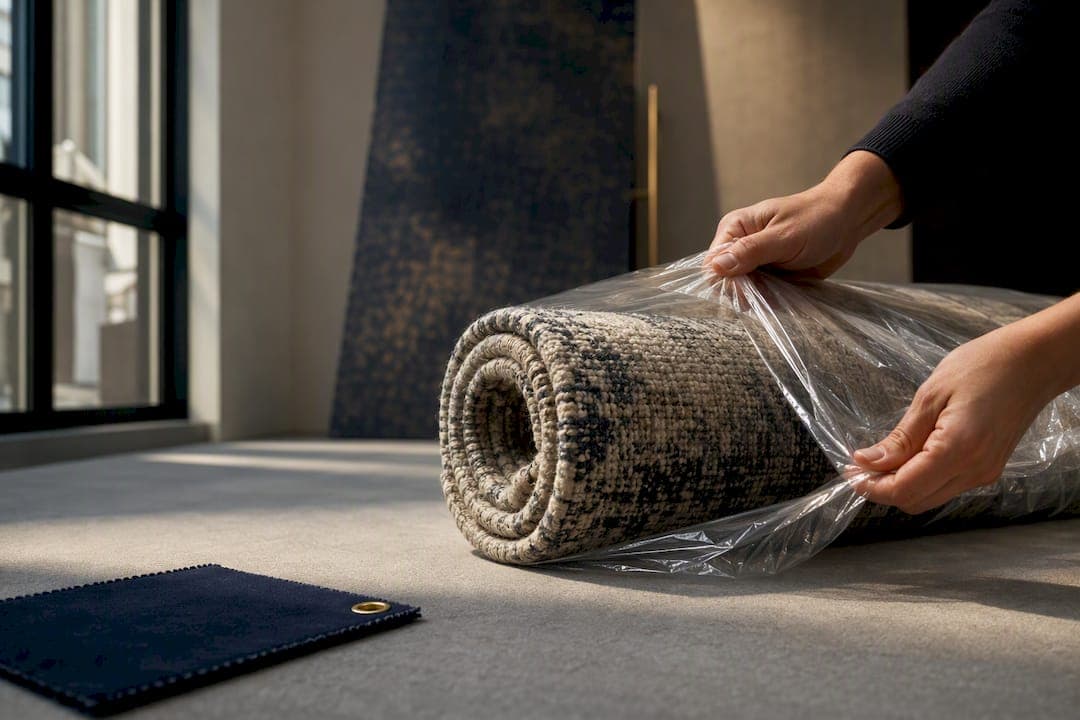
Yes, some rugs release volatile chemicals soon after unwrapping, and the sensible first response is simple: ventilate the room, air the rug outdoors where possible, and keep it away from bedrooms until any odour fades. Risk varies by fibre, backing and finish, a point reflected in GUT test criteria and in a UK Health Security Agency review of household chemicals. Isolate the rug if anyone in the home reacts to the smell, and use odour absorbers while it settles.
TL;DR:
- Synthetic fibers and plastic backings tend to off gas more VOCs than natural materials like wool or jute, especially if bonded with solvent-heavy adhesives.
- Most emissions peak in the first days after unwrapping and decline over weeks, but plastic-backed rugs can release measurable VOCs for longer periods.
- The primary health risks involve odour, eye and throat irritation, headaches, and worsening of asthma or eczema symptoms, which improve with proper airing.
- Proper ventilation, removing packaging immediately, and using odour absorbers usually resolve initial smells within two weeks, unless persistent symptoms or odour remain.
- Test certificates indicating specific TVOC levels at 3 and 28 days help identify low-emission rugs, while natural fibers with natural backings are generally safer choices.
Table of Contents
- What "off gassing" means and which chemicals are involved
- Which rugs, backings and treatments off gas the most
- What off gassing means for your health, and where the evidence runs out
- How long rug odour and off gassing typically last
- A step by step plan for a smelly new rug
- How to choose a rug that will not off gas as much
- A specifier's checklist for lower emission rugs
- A homeowner's honest take on rug smells
- Choosing a bespoke rug with documentation you can trust
- Sources
- FAQ
What "off gassing" means and which chemicals are involved
Off gassing is the release of volatile organic compounds, or VOCs, as fibres, adhesives and finishing agents slowly evaporate after manufacture. New rugs are sealed in plastic for shipping, which traps chemical vapours until the packaging comes off and air finally reaches the material.
The chemicals involved tend to fall into a few families: aldehydes such as formaldehyde, aromatic solvents left over from dyeing or backing processes, phthalates used to soften plastics, and residues from stain protection or flame retardant treatments. Some of these compounds are true VOCs, evaporating quickly at room temperature, while others are semi volatile organic compounds, or SVOCs, which release more slowly and settle into household dust rather than air.

There is a secondary complication worth knowing about. Carpets and rugs can absorb ozone and other gases already present indoors, then release new compounds, including formaldehyde, through reactions inside the fibres themselves. That means a rug's emissions profile is not fixed the day it arrives. It can shift depending on what else is happening in the room around it.
Which rugs, backings and treatments off gas the most
Synthetic pile fibres, such as polypropylene and nylon, generally carry a higher emissions burden than untreated wool, jute or cotton, largely because of the solvents and stabilisers used during manufacture. Plastic backings compound the problem: a rug bonded to a PVC or latex foam base has far more surface area of synthetic material to release vapour from than a woven natural backing.
Adhesives are often the overlooked culprit. Many broadloom carpets and some rugs use latex or foam bonding agents that off gas independently of the pile fibre, and chemical finishes layered on top, stain guards, anti microbial treatments, flame retardants add another source entirely.
Construction details matter too. A low pile rug generally has less fibre volume to release chemicals from than a thick, dense high pile equivalent, though a tightly packed high pile rug that has sat rolled in plastic for weeks can concentrate vapours before it ever reaches your home. How a rug was stored and packaged, warm, sealed, airless, shapes how strong that first smell will be.

What off gassing means for your health, and where the evidence runs out
The short term effects people report are fairly consistent: a chemical odour, eye or throat irritation, headaches, and in sensitive individuals, a flare-up of asthma or eczema symptoms. These reactions usually ease as the rug airs out and ventilation improves.
There are currently no universal health based guideline values for individual VOCs in indoor air in the UK. A UK government review of indoor air quality found the evidence linking specific indoor VOC concentrations to health outcomes remains limited, which is why regulators point to total volatile organic compound (TVOC) measures and World Health Organization indoor air guidance as practical stand ins rather than firm thresholds for any one chemical.
That gap in the evidence does not mean the risk is invented. It means caution is the rational response rather than panic or dismissal. A UK Health Security Agency review of chemicals found in European homes identifies building materials and consumer products, rugs among them, as significant indoor VOC sources, while noting that consistent health based limits for most individual compounds simply do not exist yet.
The practical threshold for escalating beyond airing the rug is straightforward: persistent symptoms in a vulnerable household member, such as a child, someone pregnant, or a person with respiratory illness, or an odour that refuses to fade despite proper ventilation. At that point, professional air testing or returning the product becomes the sensible next step.
How long rug odour and off gassing typically last
Emissions follow a fairly predictable curve. They peak in the first days after unwrapping, taper over the following weeks, and by a month or so the strongest chemical smell has usually gone. Measurable TVOC levels, however, can linger longer than the nose detects, particularly with plastic backed products, which is part of why test protocols measure emissions at both 3 days and 28 days rather than relying on a single snapshot.
Several factors stretch that timeline out. Warm, sealed storage before purchase concentrates vapours. Plastic or foam backings hold onto solvents longer than natural fibres and jute backing. A closed room with little airflow lets concentrations build rather than disperse.
The practical check is simple: track whether the smell noticeably fades over a few days of proper airing. If it plateaus rather than declines, or if symptoms in the household follow the same pattern, that is the point to consider professional air quality testing rather than waiting it out.
A step by step plan for a smelly new rug
Most odour problems resolve with a methodical approach rather than any single trick. Work through these steps in order.
- Unbox immediately and ventilate. Remove all plastic wrapping the moment the rug arrives, since sealed packaging is what concentrates the vapour in the first place.
- Air it outdoors if you can. A garage, garden or balcony with good airflow lets early, strongest emissions disperse before the rug enters a living space.
- Keep the room clear while airing indoors. If outdoor airing is not possible, open every window, run an extractor fan, and keep occupants, especially children or anyone with respiratory sensitivity, out of the room for a few hours at a time.
- Treat the surface. Sprinkle bicarbonate of soda across the pile, leave it for a few hours, then vacuum thoroughly; activated charcoal placed nearby can also draw down lingering odour.
- Clean gently if needed. A light steam clean can help, but check first whether the fibre and backing tolerate moisture and heat, since heat can accelerate the release of some compounds rather than dissipate them.
- Support the air itself. Continue opening windows daily and consider a HEPA purifier with an activated carbon stage, which handles both particulates and gaseous compounds.
- Know when to escalate. If odour or symptoms persist beyond a few weeks of consistent airing, contact the retailer about a return, or arrange professional VOC air testing, particularly where vulnerable occupants are involved.
Pro Tip: Avoid underfloor heating for the first fortnight after a new rug arrives, since warmth speeds up chemical release exactly when levels are already at their highest.
How to choose a rug that will not off gas as much
The most reliable signal is a proper test certificate rather than a marketing label. GUT test criteria set specific TVOC limits for textile floor coverings, including 3 day TVOC at or below 250 micrograms per cubic metre and 28 day TVOC at or below 100 micrograms per cubic metre for the lowest emission products, measured using EN 16516 or ISO 16000 series test chamber methods. Ask any retailer claiming "low VOC" to show the actual report.
Useful questions to put to a retailer before buying:
- Does the product carry GUT certification or an equivalent EN/ISO test chamber result?
- Can you provide the TVOC figures for both the 3 day and 28 day test points?
- Which laboratory carried out the testing, and can you name the test method used?
- What is the backing material, and was a separate adhesive used to bond it?
Natural fibres such as wool, sisal and jute, left unbacked or backed with woven natural material rather than latex foam, carry the lowest inherent risk, making them the sound default for indoor fabrics tested by Afrokoptiki and ideal for dining rooms and other high use spaces where a family spends real time.
A specifier's checklist for lower emission rugs
Trade specification gives more control over inputs than buying off a shelf, because backing, adhesive and finish can all be chosen deliberately rather than accepted as a fixed bundle. Natural jute or cotton backings, bonded without solvent heavy adhesives, generally outperform latex foam on emissions, and asking a supplier for their test data before committing to a finish is standard practice on any commercial specification.
Pile density and construction interact with both durability and emissions. A tightly woven, high density pile suited to heavy footfall needs different backing considerations to a lighter domestic weave, and where a rug will sit over underfloor heating, that heat exposure should factor into which backing and adhesive get specified from the outset. Simmons Interior Supply can supply documentation and trade guidance on these points where a project calls for it.
A homeowner's honest take on rug smells
Most rug odour problems are ordinary and solvable: air the thing properly, give it a fortnight of ventilation, and the worst of it passes. What deserves more attention than it gets is packaging, a rug stored warm and sealed for weeks before it reaches your door will smell far stronger than one that travelled quickly and openly. Escalate to testing or a return only if symptoms persist or a vulnerable person in the house cannot tolerate the room.
— Luke
Choosing a bespoke rug with documentation you can trust

Buying off a shelf means accepting whatever backing, adhesive and finish the manufacturer chose, with little room to ask questions before the rug is already in your home. Commissioning through Simmons Interior Supply works differently: every piece in the Signature rug collection from Colbourns is made to order, which means finish, backing and dimensions get discussed and specified before production begins, and documentation or test information can be requested as part of that conversation.
That level of input matters most where a household is sensitive to chemical odours or where a rug needs to sit over underfloor heating for years, not just weeks.
- Bespoke sizing and finish options discussed directly with the supplier before manufacture
- Specification and test documentation may be available on request for trade and residential clients
- Account access may be provided for interior designers, architects and hospitality procurement teams
Get in touch through the Simmons Interior Supply site to start a trade enquiry or ask about documentation for a specific rug.
This article is general information, not a substitute for advice from a qualified doctor. Consult a qualified healthcare professional about your own circumstances before acting on anything here.
Sources
FAQ
How long does it take for a rug to off gas?
Emissions are strongest in the first days after unwrapping and generally taper off over a few weeks with proper ventilation. Some measurable TVOC can persist longer, which is why lab tests check both 3 day and 28 day marks rather than a single reading.
How bad is carpet off gassing?
It varies significantly by material: synthetic pile with a plastic or latex backing tends to release more VOCs than natural fibre, unbacked options. There is no single severity score, since no universal UK guideline values exist for individual VOCs, so retailers and buyers rely on TVOC test results as the practical comparison point.
How can I tell if a rug is releasing harmful chemicals?
Look for a chemical smell that lingers well beyond the first week of airing, or symptoms such as headaches or irritation that ease when you leave the room and return when you're back. Ask the retailer for GUT certification or an equivalent EN/ISO test chamber report rather than relying on a "low VOC" label alone.
Is an old carpet still a health concern?
An older carpet has typically finished its initial off gassing phase, but it can still hold onto dust, allergens and semi volatile compounds that settled into the fibres over years. The UKHSA's review of SVOCs in European homes notes that phthalates and flame retardants persist in household dust, so regular cleaning matters at any carpet age, not only when it is new.