
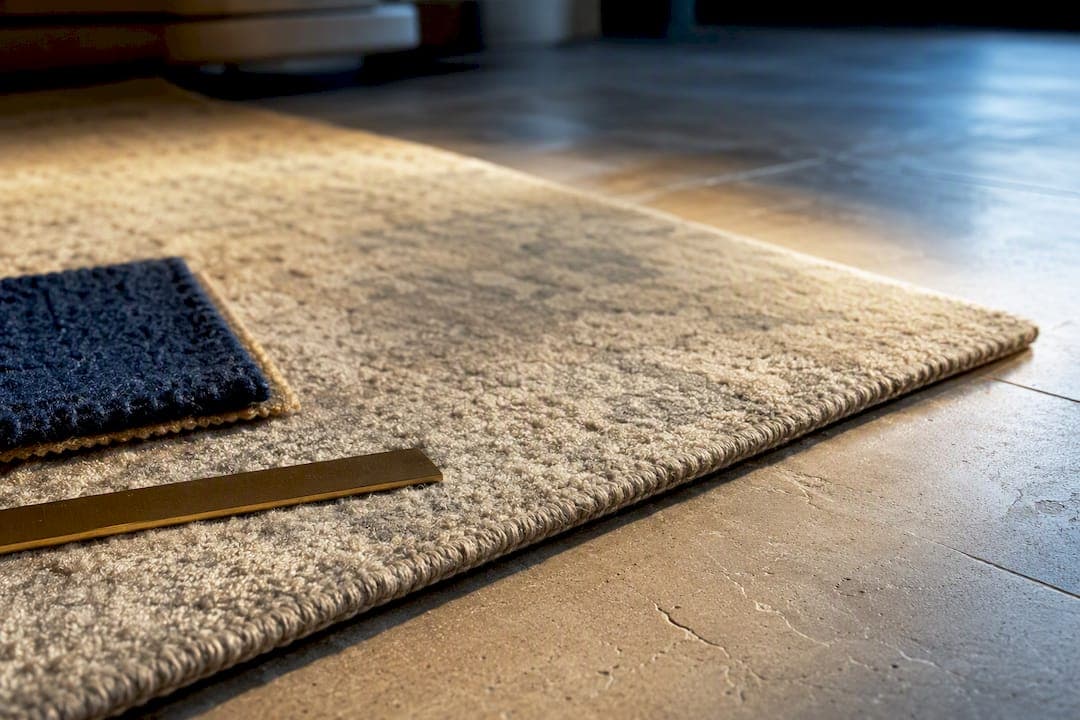
Yes, rugs and underfloor heating work well together, provided the combined tog of the rug and any underlay stays within recommended limits. Industry guidance sets 2.5 tog as the upper ceiling, with 1.0–1.5 tog preferred for the most responsive, efficient performance. The one hard rule: never choose rubber, latex or thick foam backings, and never let a rug sit over a floor sensor.
TL;DR:
- Rugs should have a combined tog of no more than 2.5, ideally around 1.0 to 1.5, to ensure efficient underfloor heating performance.
- Low-pile wool, cotton flatweave, or kilim rugs without synthetic backing are best for heat conduction and system longevity.
- Placing rugs directly over floor sensors or covering most of the heated surface can impair temperature accuracy and system efficiency.
- Synthetic backings such as latex or foam can degrade and off-gas under sustained heat, reducing rug lifespan and air quality.
- Custom-made rugs with specified backing and pile height offer better compatibility and durability over heated floors.
Table of Contents
- Choosing rugs for underfloor heating: materials, pile and backing
- Matching your rug to your floor type
- How to check the combined tog of your rug and underlay
- Underlay and pads that won't fight your heating system
- Common mistakes that cause heat problems or damage
- Caring for rugs on heated floors
- A trade view on specifying rugs for heated floors
- Does a rug actually affect your heating bills?
- Will your rug last as long over underfloor heating?
- VOC emissions and fire safety: what to check before you buy
- The trade-informed take on underfloor heating and rugs
- Get a rug built for your exact heating setup
- Sources
Choosing rugs for underfloor heating: materials, pile and backing
Getting this right starts with what the rug is made from, not how it looks in a room. Heat needs to pass through the fibre and backing with minimal resistance, so density and thickness matter more than fashion.
Low-pile wool, cotton flatweave, kilim and thin synthetic blends all conduct warmth efficiently because they hold little trapped air. A deep-pile shag rug, by contrast, behaves like an extra layer of insulation, exactly what you don't want between a heat source and the room above it. Most rugs suit warm water underfloor heating systems as long as overall thermal resistance stays within limits, but problems consistently trace back to overly thick or foam-backed constructions.
Backing matters as much as pile. Rubber, latex and thick foam backings insulate, and some can soften or off-gas under sustained low-level heat. Hand-knotted and flat-woven constructions without synthetic secondary backing tend to perform far more predictably.
When shopping, look for:
- Manufacturer-stated tog or thermal resistance values on the label
- Flatweave, kilim, or low-pile wool and cotton constructions
- No rubber, latex, or foam backing anywhere in the build
- Confirmation from the retailer that the specific rug (not just the range) is rated for underfloor heating
Retailers increasingly flag certain lines as suitable for underfloor heating within their flatweave and low-pile collections, which is a useful starting filter, though it is never a substitute for checking the actual tog figure yourself.
Pro Tip: Ask the retailer for the combined tog of the rug alone, then add any underlay separately; a rug that's fine on its own can tip over the limit once a thick pad goes underneath it.
Matching your rug to your floor type
Tiled floors conduct heat best of all, which means they're the most forgiving surface for rugs, provided you stick to thin, low-tog options. Tiles pair especially well with thin rugs because the floor itself does most of the thermal work, leaving little margin for the rug to disrupt.
Engineered wood behaves differently. Manufacturers set a maximum surface temperature, usually because sustained heat above that threshold risks cupping, gapping or discolouration in the boards. Always check that figure before laying anything on top, and lean towards thinner rugs with no insulating pad if the floor is engineered wood.
Laminate carries its own caveat: it expands and contracts more than wood underfloor, so breathable, non-adhesive pads matter more than usual, and rugs should sit loosely rather than being taped or stuck down.
Whatever the floor type:
- Never position a rug directly over a floor sensor or thermostat probe
- Avoid rugs that cover most of the heated area. A little exposed floor helps heat escape evenly
- Leave a gap at room edges where sensors typically sit, rather than pushing rugs wall to wall
If you're weighing up flooring finishes more broadly, it's worth reading wider guidance on flooring materials and finishes before committing to a rug plan for the whole room.
How to check the combined tog of your rug and underlay
Tog measures thermal resistance, in plain terms, how much a material resists heat passing through it. The higher the tog, the more it insulates, and the less warmth reaches the room above your underfloor heating.
Combined tog is what actually matters: rug tog plus underlay tog, added together. Here's how to work it out:
- Check the rug's label or product specification sheet for a stated tog value.
- Check the underlay or pad separately. Many pads state their tog rating clearly; if not, ask the supplier directly.
- Add the two figures together to get your combined total.
- Compare that total against 2.5 tog as the absolute ceiling, aiming for 1.0–1.5 tog if the room relies on underfloor heating as its main heat source.
If no tog figure is available anywhere, treat that as a warning sign rather than a gap to guess around. Choose a flatweave or low-pile construction and skip the underlay altogether unless you need it for grip.
Underlay and pads that won't fight your heating system
An underlay's job is grip and comfort, not insulation, so the wrong choice quietly undoes all the care you put into selecting the rug itself. Thin, open-weave, heat-rated non-slip pads, sometimes labelled as perforated mesh or breathable TPE alternatives, add grip without meaningfully raising combined tog.
Felt, memory foam, and rubber or latex pads are the ones to avoid. They insulate heavily, and several can degrade or lose their non-slip properties once exposed to sustained warmth from below.
- Tiled floors: a thin mesh pad is usually enough, since the tile itself conducts so efficiently
- Wood or laminate floors: minimise added insulation and avoid any pad that uses adhesive strips or full-contact glue
- Any floor: if a pad doesn't state a tog value, assume it's designed for standard flooring, not heated
Rugs sit decoupled from the floor structure, unlike fitted carpet, which is exactly why the wrong underlay causes trapped pockets of heat rather than an even spread.
Common mistakes that cause heat problems or damage
The single biggest error is covering a floor sensor or thermostat probe with a rug. That misreads the room's actual temperature, which either wastes energy or leaves cold spots elsewhere.
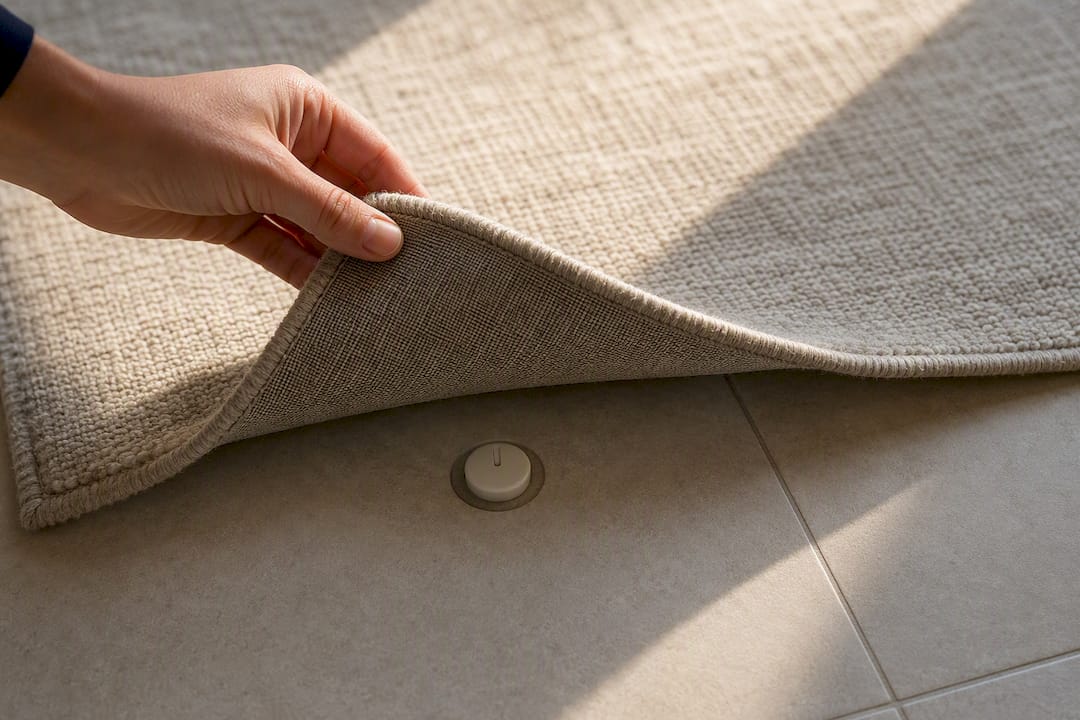
Adhesive-backed and latex-backed rugs cause a slower, less obvious problem: the backing can soften or degrade under sustained low-level heat, sometimes leaving residue on the floor beneath. If a single rug covers most of a room's heated area, be ready to adjust or rebalance the thermostat, since so little exposed floor changes how the system reads and responds.
Check periodically for:
- Backing residue or tackiness where the rug meets the floor
- Discolouration on the floor finish beneath the rug
- Pad flattening, crumbling, or brittleness
Pro Tip: Lift the rug fully once a season, ideally when you switch the heating on for the year, and inspect both sides. Problems caught early rarely mean replacing the whole rug.
Caring for rugs on heated floors
Regular vacuuming keeps fibres from matting, but match the method to the material. Wool and natural fibres shouldn't be blasted with high heat from a steam cleaner or tumble dryer, since sustained heat exposure from above and below compounds fibre stress.
Lift rugs occasionally, particularly after a long heating season, to check the floor and backing for any changes. Replace pads or rugs the moment you spot cracking, brittleness or a persistent smell, since these usually signal heat-related breakdown rather than ordinary wear.
- Vacuum on a low setting suited to the pile
- Air-dry after any spot cleaning; skip high-heat drying methods entirely
- Rotate or lift the rug seasonally to inspect both sides
A trade view on specifying rugs for heated floors
Trade specification tends to favour a narrower set of choices than the retail market suggests. Hand-knotted or flat-woven rugs in natural fibres, wool, cotton, with pile kept deliberately low and no synthetic secondary backing, avoid most of the compatibility failures that show up further down the line.
Bespoke production gives control that off-the-shelf buying simply can't. Pile height, backing construction and finished tog can all be specified before a single knot is tied, which removes the guesswork entirely for a room where underfloor heating is the primary heat source. That's a meaningfully different starting point to buying a stock rug and hoping the label is accurate.
For designers working across multiple rooms or a full property, this kind of control matters even more when floor types vary between tile, engineered wood and laminate. Specifying construction to the room rather than trying to make one rug work everywhere tends to produce far fewer callbacks.
Does a rug actually affect your heating bills?
A rug sitting over underfloor heating changes how efficiently that system delivers warmth into the room, and the effect is measurable rather than theoretical. Every extra tenth of a tog between the heat source and the air above it means the system works a little harder to reach the same room temperature, because it's pushing heat through more resistance to get there.
This matters most in rooms where underfloor heating is the sole heat source, rather than a supplement to radiators. In that setup, a rug with combined tog creeping towards or past 2.5 forces the system to run at higher output for longer to compensate, which shows up as slower response times when you adjust the thermostat and higher running costs over a heating season.
The fix isn't avoiding rugs altogether, since a well-chosen flatweave or low-pile wool rug at 1.0 to 1.5 tog barely registers as a drag on performance. Design practice increasingly favours several smaller rugs rather than one large one across a heated floor, which preserves more exposed floor area for even heat distribution and reduces the risk of the system compensating unevenly around a single large covered zone.
Homeowners who notice their underfloor heating feels "sluggish" after adding a new rug are usually seeing this exact effect play out in real time, not a fault with the heating system itself.
Will your rug last as long over underfloor heating?
Rugs on heated floors face a different ageing process to rugs on unheated floors, even when the surface temperature feels barely warm to the touch. Sustained, low-level heat over months of a heating season accelerates certain kinds of wear that wouldn't show up as quickly elsewhere in the house.
Natural fibres, wool especially, tend to hold up well because they're naturally resilient to gentle warmth and don't rely on adhesives to stay structurally sound. Hand-knotted and flat-woven constructions age particularly gracefully here, since there's no backing layer to degrade separately from the pile.
Synthetic backings and adhesive-bonded constructions are the ones that show their age fastest. Repeated heat cycles, warm, then cool, then warm again, as the thermostat responds to daily temperature changes, can gradually stiffen or crack certain backing materials over a few heating seasons. That's a slower failure than most homeowners expect, which is exactly why periodic lifting and inspection matters more for rugs over underfloor heating than for rugs anywhere else in the home.
Density plays a role too. A tightly woven flatweave distributes the gentle heat cycling more evenly across its structure than a loosely tufted rug, where individual heat-affected fibres can work loose from the backing over time. If longevity matters as much as day-to-day comfort, favour construction quality over pile depth every time.
VOC emissions and fire safety: what to check before you buy
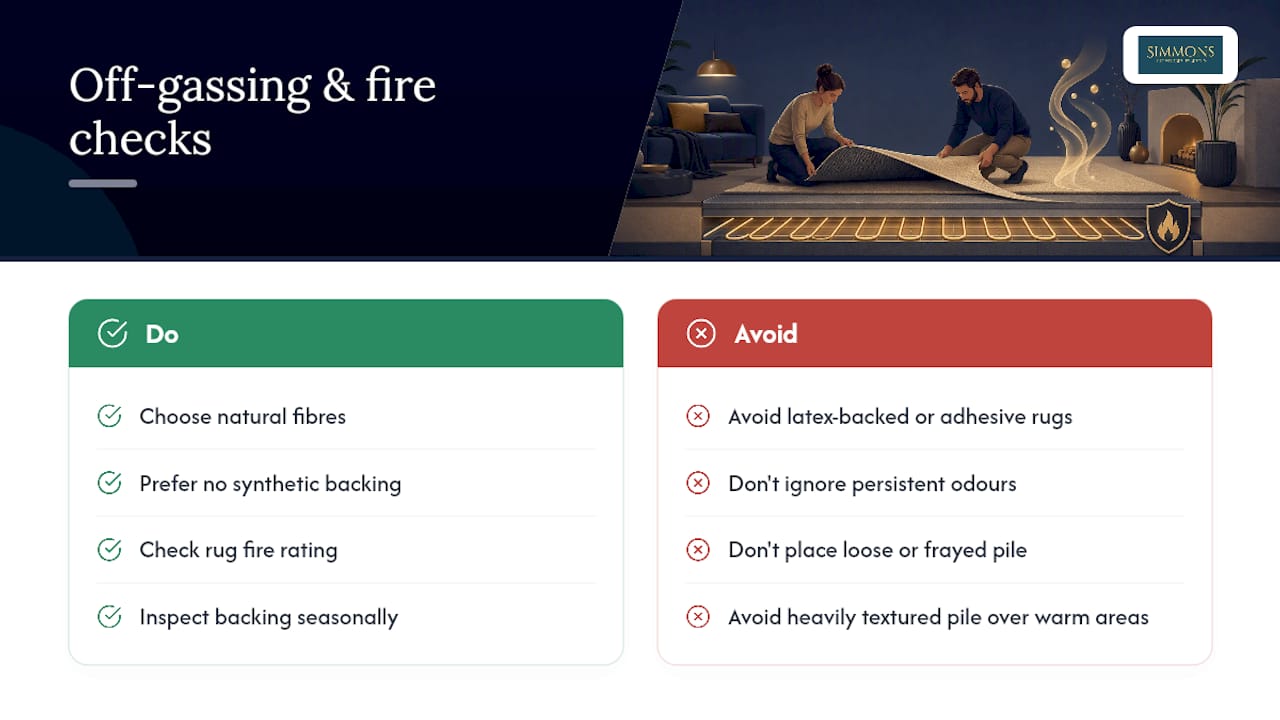
Heat accelerates off-gassing from certain materials, which makes rug selection for underfloor heating a genuine air-quality consideration, not just a performance one. Synthetic backings, adhesives and some foam underlays release volatile organic compounds more readily once warmed, even at the modest surface temperatures typical of residential underfloor heating.
This is one of the clearer reasons trade guidance steers away from latex-backed and adhesive-bonded constructions specifically for heated floors. Adhesives and latex backings can degrade or off-gas under sustained low-level heat, and that process is gradual rather than immediate, which means it's easy to miss until you notice a persistent smell months into the heating season.
Natural fibres with no synthetic backing carry a much lower risk profile here, since there's no adhesive layer to break down in the first place. Wool also carries a natural degree of fire resistance compared with many synthetic pile materials, though this varies by construction and isn't a substitute for checking a rug's specific fire rating where one is provided.
Fire risk from underfloor heating itself is low given the moderate surface temperatures involved, but it's still sensible to avoid rugs with loose, frayed or heavily textured pile directly over any area that could run warmer than the rest of the floor, and to keep an eye on backing condition as part of your seasonal inspection.
The trade-informed take on underfloor heating and rugs
Most of the advice circulating on this topic treats tog limits as the whole story, and that's where I think the conventional wisdom falls short. Tog matters, but it's a number on a label, not a guarantee. I've seen far more compatibility problems trace back to backing degradation and poor pad choice than to a rug that was simply too thick.
The real priority, in order, should be construction first, backing second, tog figure third. A hand-knotted or flat-woven rug in wool or cotton with no synthetic backing will almost always outperform a synthetic rug that happens to carry a lower stated tog value, because the backing is where the hidden failures happen, softening, off-gassing, residue, none of which show up on a spec sheet.
What I'd tell any homeowner or decorator weighing this up: stop hunting for a perfect number and start asking about construction. A retailer who can't tell you what the backing is made from probably can't tell you whether it belongs on a heated floor either. That's the question that actually protects your flooring, not the tog figure alone.
— Luke
Get a rug built for your exact heating setup
Off-the-shelf rugs ask you to gamble on a label. Simmons Interior Supply removes that gamble entirely, because every piece is made to order, which means pile height, backing construction and finished tog can be specified before production even begins, not discovered after the rug arrives.

That control matters most when a room mixes floor types, or when underfloor heating is the sole heat source and there's no margin for a backing that degrades under sustained warmth. We work in hand-knotted and flat-woven constructions using natural fibres, with no synthetic secondary backing, built to the dimensions your room actually needs rather than the nearest stock size. If you're planning a custom rug design for a heated floor, we'll talk through tog estimates, backing options and material samples before anything is woven.
Browse recent bespoke work in the gallery, or get in touch through Simmons Interior Supply to start a specification for your space.
Sources
- Understanding the tog rating and R‑value of carpets
- Can you put rugs on underfloor heating?
- Are rugs suitable for underfloor heating?
- Rugs on radiant heated floors: what you need to know