
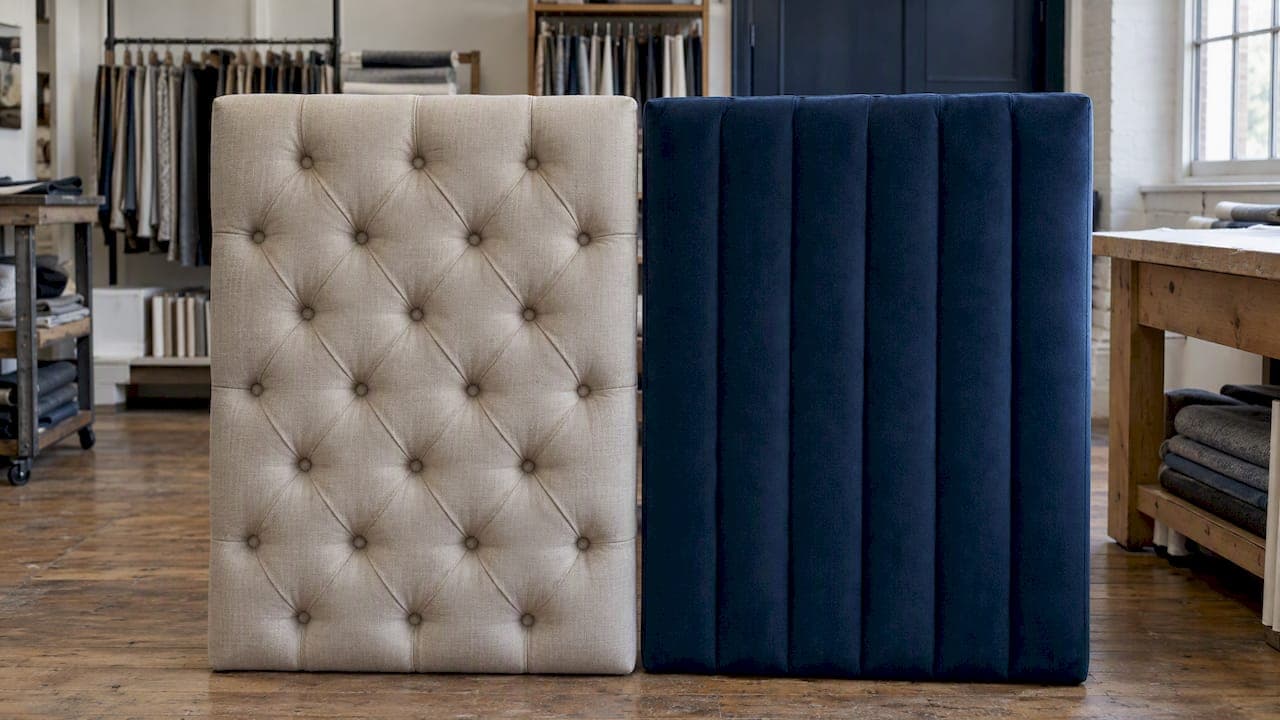
Button tufting pulls the cover down into the padding at individual points, each held by a button, so the surface becomes a field of soft dimples. Channel tufting divides the surface into long, padded ribs separated by recessed lines, so it reads as rhythm and structure rather than as dots. Button tufting feels tailored and historic; channel tufting feels cleaner, taller and more architectural. The two are not strictly like for like, though, and understanding why will help you brief a maker properly.
TL;DR
- Button tufting is a fastening method: the cover is drawn into the filling at set points and anchored. Channel tufting is a pattern: parallel ribs, vertical or horizontal, running the width or height of a panel.
- Button work suits traditional, Chesterfield-inspired and richly layered schemes. Channel work suits contemporary, art deco and hospitality interiors, where long lines flatter the room.
- Tufting changes how a seat or back feels and how it is cared for. Specify the filling and the cover with the same care as the pattern.
- For a bespoke commission, settle the tufting style, fill, ticking and fabric together, because each affects the others.
Table of Contents
- What tufting actually is
- Button tufting: tailored depth and classic character
- Channel tufting: clean rhythm and sculptural lines
- Button vs channel tufting: the key differences
- Tufting without buttons
- How tufting changes comfort, support and care
- Fillings: spring-down, foam and everything between
- What to specify for a bespoke tufted piece
- Matching tufting to the piece and the room
- Perspective: why we lean on conversation, not catalogue
- Commissioning a tufted piece with us
- Frequently asked questions
- Sources
What tufting actually is
Tufting is the overarching process of pulling fabric down into the padding to create indentations. House & Garden's upholstery glossary describes it in just those terms, and notes that buttoning is one way of anchoring those indentations. That small distinction explains most of the confusion around this subject.
It also helps to know why buttons exist at all. The same glossary suggests that buttoning was originally functional, holding traditional fillings such as horsehair in place, and is now often primarily aesthetic. Today a button is as likely to be a design decision as a structural one, which is exactly why you have so much freedom in how you use it.
Button tufting: tailored depth and classic character
In button tufting, the cover is drawn deep into the padding at marked points, and the fabric puckers and folds around each one. The points can be arranged in several ways:
- Diamond, where the points sit on a staggered grid and the folds form diamonds across the surface.
- Biscuit, where the points sit in a square grid and the padding between them puffs into soft squares.
These pattern names, along with channel, come from DIY Doctor's guide to tufting styles, which separates the patterns from the finishes used to complete them: button and blind. That is the key to the comparison. Diamond, biscuit and channel describe the shape of the surface. Button and blind describe how each pull point is finished.
The look
Button tufting is the language of the library, the club and the country house. It adds shadow and depth to a surface, which makes a single headboard or chair back feel layered and considered. Fabric-covered buttons in the same cloth keep the effect quiet. Contrasting buttons, in leather or a different colour, turn each point into a small decorative detail.
Where it works best
Classic roll-arm sofas, deep-buttoned chairs, headboards, ottomans and banquette backs. It also gives a restrained, quietly traditional note to a modern room, particularly in a rich velvet or a hard-wearing mohair. If you are weighing cloths for a buttoned piece, our guide to four fabric questions to ask before choosing mohair or velvet is a useful companion, since the way a pile catches light in each fold changes the effect considerably.
Channel tufting: clean rhythm and sculptural lines
Channel tufting creates elongated padded sections divided by recessed lines. Where button tufting produces points, channel tufting produces ribs. The ribs can run vertically, which draws the eye upward and lends height to a headboard or a banquette back, or horizontally, which widens and calms a piece.
How it is built
DIY Doctor explains that channel work can be constructed in two ways: with long, narrow upholstered sections placed next to or stacked against one another, or by tucking the fabric between narrow lengths of foam and securing it to the board beneath. In practice, a skilled workroom chooses between these according to the piece, its size and the finish required. Either way, each channel is a distinct, deliberately shaped roll of padding, rather than a surface pulled in at intervals.

The look
Channel tufting is crisp and graphic. A bank of evenly spaced ribs in velvet gives an art deco air; the same ribs in a quiet, textured weave look contemporary and calm. It is a favourite in hospitality, where a long banquette or a full-height headboard wall needs a pattern that reads well from across a room.
Where it works best
Headboards, banquettes, bar and restaurant seating, curved sofa backs, bedends and the backs of dining chairs. Because the lines are continuous, channel work flatters curves in particular: the ribs follow the shape and emphasise it.
Button vs channel tufting: the key differences
| Button tufting | Channel tufting | |
|---|---|---|
| What it is | A finish: the cover is anchored at individual points | A pattern: parallel ribs, vertical or horizontal |
| Typical patterns | Diamond, biscuit | Straight channels, sometimes curved to follow a form |
| Visual effect | Tailored, historic, richly detailed | Clean, tall, architectural |
| Best with | Roll arms, wingbacks, headboards, ottomans | Banquettes, curved backs, headboards, bedends |
| Fabric behaviour | Cloth folds and puckers at each point, so pattern and pile matter | Cloth runs in long panels, so stripes and directional pile need planning |
| Can be done without buttons? | Yes, using a blind finish | Generally yes: the recesses themselves form the pattern |
The last row is worth a moment, which brings us to a question we hear often.
Tufting without buttons
It is entirely possible to tuft without buttons. DIY Doctor lists blind tufting as a finish alongside button tufting: the pull points are still anchored, but the fixing is hidden rather than capped with a visible button, so the surface is left with a clean dimple. Channel tufting needs no buttons at all, as the recessed lines between ribs do the visual work.
For a bespoke piece, ask your maker which they recommend for the frame and the cloth. A heavily patterned fabric may look busier with buttons, while a plain velvet can carry them beautifully. A blind finish suits a minimal scheme, where a visible button would add one detail too many.
How tufting changes comfort, support and care
We will be candid here: tufting is primarily a decision about appearance, and the comfort of a piece depends much more on what is inside it. Even so, the pattern has practical consequences worth weighing.
Seats. Deep tufting across a seat can create ridges that some people find noticeable when sitting. For that reason, many tufted sofas keep the seat cushions plain and reserve the tufting for the back, arms or sides. Tufting a seat is possible, but discuss it with your maker before committing.
Backs and headboards. Tufted backs are forgiving. Button depth makes a back feel softer and more enveloping, while channel ribs give a more structured, supportive impression.
Care. Any recess can gather dust and crumbs, and a soft brush attachment is the sensible tool for working into folds. Pile fabrics such as velvet and mohair may show pressure marks where the cloth is pulled tight, so choose a cloth suited to the use. If the piece is for a busy commercial space, our specifier's checklist for bouclé fabric durability shows the sort of questions to put to any cloth before it is tufted.
Fillings: spring-down, foam and everything between
People researching tufting often go on to ask about cushion fillings, and rightly so, because the filling behind the tufting decides how a piece feels on day one and in year ten.
Feather and down
The Cushion Warehouse notes that feather and down blends have a medium-soft, sink-in feel and need regular plumping to maintain their shape and comfort. That is the luxurious, relaxed seat many clients want, and it asks for a little daily attention in return.
Foam
A high-resilience foam core holds its shape and resists bottoming out. Era Interiors, in its fill and material specification guidance, says that the core prevents bottoming out, while the comfort layer decides how the seat feels at first contact. It also advises judging a fill system by its long-term performance rather than its first impression.
Spring-down: the usual compromise
A spring-down seat combines a supportive core with a softer down-rich wrapping. It is the traditional choice for a seat that feels generous without collapsing, and it is what most clients mean when they ask for something between firm and sink-in. The spring unit gives support and the down blend gives the soft, lived-in surface. As a rule, expect more maintenance than with foam alone, since down needs regular plumping.
Which should you choose?
| Filling | Feel | Upkeep | Suits |
|---|---|---|---|
| Foam (high resilience) | Firmer, consistent | Low | Busy homes, hospitality, banquettes |
| Spring-down | Supportive with a soft top | Regular plumping | Main living-room sofas |
| Feather and down | Soft, sink-in | Regular plumping | Relaxed, deep seating |
For tufted backs and headboards, the filling matters differently. A tufted back needs padding that will hold the folds cleanly, which is why makers often use a resilient foam or fibre base with a softer wrapping above it.
What to specify for a bespoke tufted piece
Era Interiors suggests specifying the ticking, structural core, comfort layer and wrapping, and we agree. When a tufted piece goes wrong, it is rarely the pattern that fails. It is usually a vague brief. Cover these points with your maker:
- Tufting style and pattern. Button or channel; if button, diamond or biscuit; if channel, vertical or horizontal; and the finish, whether covered button, contrast button or blind.
- Scale. The spacing between points or the width of each channel. Tight spacing looks formal; generous spacing looks relaxed.
- Core and comfort layer. A high-resilience foam core helps prevent bottoming out, while the comfort layer sets the feel.
- Ticking. Era Interiors notes that down and feather fills need tightly woven, down-proof ticking, or the feathers will work their way out.
- Traditional or modern methods. House & Garden's glossary notes that modern upholstery usually relies on more synthetic materials, while traditional methods use horsehair, cotton, felt and wool, carefully hand-stitched. Tell your maker which tradition you are commissioning in.
- Fire safety and materials. The same glossary quotes an upholsterer who recommends natural fibres with a wool interliner in place of chemical flame retardants, citing environmental and health concerns. If this matters to your project, raise it at the start, and confirm what the relevant UK furniture fire regulations require for your use.
- Fabric. Pile direction, stripe alignment and pattern repeat all behave differently across channels and folds. Ask for a strike-off or a sample panel.
- Finish of the frame. Exposed legs and trims should complement the cloth. See our guide to custom finish options for how to specify with confidence.
If you are commissioning a sofa specifically, our trade commissioning guide to bespoke sofas walks through the process from brief to delivery, and how to commission bespoke furniture covers the wider steps.
Matching tufting to the piece and the room
There is no right answer, only a right answer for the piece. A few pairings we return to:
- A roll-arm sofa in a period house. Button tufting, in diamond or biscuit, in a heritage velvet or leather. It belongs.
- A tall headboard in a contemporary bedroom. Vertical channels in a quiet weave. The lines add height and the pattern stays calm.
- A hotel banquette. Horizontal channels, a resilient foam core and a cloth chosen for traffic. The lines read well from across the room, and the structure suits heavy use. Our guide to making hotel furniture design last ten years goes deeper on durability.
- A curved sofa back. Channel tufting, because the ribs follow the curve.
- A minimalist scheme that still wants softness. Blind-finished tufting, or a gentle channel in a tone-on-tone cloth.
When in doubt, mix with care. One tufted statement piece in a room tends to work better than several competing ones.
Perspective: why we lean on conversation, not catalogue
We make bespoke furniture, so we are naturally biased towards the idea that the right pattern depends on the room, the person and the piece. Having worked alongside skilled artisans on commissions for designers, architects, homeowners and hotels, we find the tufting question is rarely the real one. It is the doorway to a better conversation about proportion, filling, cloth and use.

Our advice is to resist choosing the tufting first. Start with how the piece will be used and how it should feel, then let the pattern follow. Button tufting, with its depth and shadow, is wonderful where you want warmth and a sense of history. Channel tufting, with its long lines, is wonderful where you want calm and structure. Either can be exquisite and either can be heavy-handed, depending on scale and restraint.
And because every piece is made to order, in a size and finish chosen with you, there is room to adjust spacing, channel width and button finish until it feels exactly right. We are always happy to work with you on that.
— Luke
Commissioning a tufted piece with us
Every piece in our bespoke furniture collection is handcrafted to order, with size and finish tailored to your space, and we work closely with you and our artisans from first sketch to delivery. If you are specifying a tufted headboard, banquette or sofa for a client, or for your own home, explore our bespoke furniture and the gallery of our work, then get in touch with your brief.
Frequently asked questions
What is the main difference between button and channel tufting?
Button tufting anchors the cover at individual points, creating dimples, usually in a diamond or biscuit arrangement. Channel tufting forms long parallel ribs separated by recessed lines. Strictly, button is a finish and channel is a pattern, which is why the two can overlap.
Can you tuft without buttons?
Yes. A blind finish anchors the pull points without a visible button, and channel tufting relies on the recessed lines rather than buttons. Which suits you depends on the cloth and how minimal you want the surface to look.
Is a tufted sofa less comfortable?
Not necessarily. Comfort depends mostly on the frame, the core and the comfort layer. Tufting shapes the back and sides well, while many makers keep seat cushions plain so that the ridges are not felt when sitting.
Is spring-down better than foam?
It depends on use. Spring-down gives a supportive seat with a soft, lived-in top, but the down needs regular plumping. A high-resilience foam core is lower maintenance and resists bottoming out, which suits busy homes and hospitality.
Sources
- The upholstery glossary: the jargon you need to know, House & Garden
- Different Styles of Tufting and Tufting Finishes for Upholstery, DIY Doctor
- Cushion Fillings Guide, The Cushion Warehouse
- Fill, Fabric & Material Specification, Era Interiors