
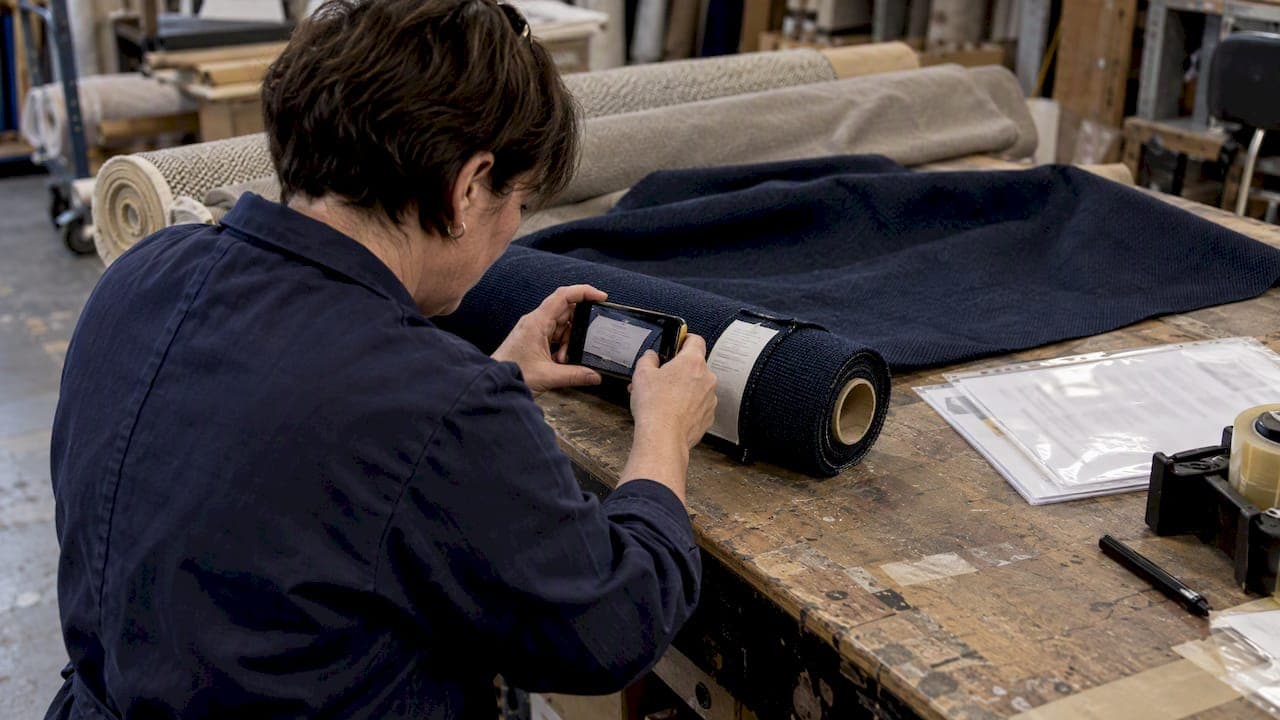
COM stands for Customer's Own Material: it means you supply the cover fabric for a bespoke upholstered item, rather than choosing from a maker's own stock ranges. As the supplier of that fabric, you take on responsibility for three things: evidence that it will meet the required fire tests, a sufficient labelled quantity, and clear order referencing. A reputable manufacturer retains the right to refuse material that cannot demonstrate compliance.
TL;DR:
- Ordering at least 15% more fabric than required helps cover pattern repeats, waste, and railroading issues that commonly cause yardage shortfalls.
- Providing clear, UK-standard fire test certificates and matching lot numbers before shipping prevents delays and rejections once the fabric arrives.
- Supplying mounted swatches with orientation and pattern details ensures accurate pattern matching and layout planning during production.
- Fabrics with unfamiliar or foreign lab certificates may need additional composite testing, adding one to two weeks and extra costs to the project timeline.
- Interliners offer a reliable compliance route when natural or untreated fabrics cannot pass ignition tests on their own, especially for customer-supplied materials.
Table of Contents
- What COM covers in practice and why manufacturers care
- Regulatory essentials: fire safety responsibilities and tests you must provide
- Practical COM specification checklist: what to send and how to label it
- How manufacturers typically handle COM at production
- Common pitfalls, red flags and how to avoid delays or rejections
- Trade perspective on supplying your own fabric
- How we support your next COM commission
- FAQ
- Sources
What COM covers in practice and why manufacturers care
When we talk about COM in a bespoke workshop, we mean the physical fabric you send us, together with everything that proves where it came from and what it is rated to do. We are not assessing fibre content or weave structure at this stage: that conversation happens when you choose the fabric. Our focus, once it arrives, is whether the roll in front of us can be traced, verified and safely applied to the frame you have commissioned.
Fabric reaches us in a few accepted forms:
- A full, uncut roll with the manufacturer's original end labels intact.
- Cut lengths, each labelled with colourway, lot number and your order reference.
- Mounted swatches for smaller trims or accent pieces, pinned with orientation and nap clearly marked.
On arrival, we check the fabric visually for flaws, cross-reference the batch or lot number against any certificate you have provided, and review whatever burn or ignition history accompanies the delivery. A roll that turns up without labelling, or with a lot number that does not match its paperwork, stalls production before a single cut is made.
Regulatory essentials: fire safety responsibilities and tests you must provide
In the United Kingdom, the Furniture and Furnishings (Fire) (Safety) Regulations 1988 set the baseline ignition resistance requirements for upholstered furniture. When you supply your own cover fabric, the responsibility generally sits with you as buyer or specifier to provide evidence that the finished piece will meet those tests, not with the maker who simply cuts and sews what arrives.
Any fabric supplied for covering furniture must either pass the appropriate match tests or be used with a compliant interliner, and suppliers are advised to have fabric tested for cigarette resistance over standard polyurethane foam to indicate its likely performance in the finished article.
That guidance from Trading Standards sits alongside the technical detail in Schedule 3 of the 1988 Regulations, which sets out interliner construction, conditioning and the BS 5852 ignition source testing used in composite assessments. BS 5852 and BS 7176 remain the test standards most often cited by UK labs, usually alongside Schedule 1 Part 1 combustion-modified foam as the reference composite. A manufacturer commonly tests your cover fabric over 35 kilograms per cubic metre Schedule 1 Part 1 foam to produce a standardised worst-case comparison, since the filling in your finished piece may differ from the lab's reference foam.
If you are specifying for a hotel, restaurant or other non-domestic interior, the premises' Responsible Person under fire safety law has their own duty to ensure furnishings meet contract-grade requirements, which can mean a stricter testing route than a purely domestic commission. Our guide to Crib 5 upholstery sets out when that higher ignition source applies and what certification it demands.

Practical COM specification checklist: what to send and how to label it
A little discipline at the ordering stage saves weeks later. Before you send a roll anywhere, work through this sequence:
- Calculate yardage generously, adding an allowance of roughly 10 to 15% over the base requirement to cover pattern repeats, railroading and any waste from directional nap.
- Pack rolls on a sturdy core, wrapped to prevent crushing, with the order reference, colourway and lot number visible on the outer label.
- Attach documentation, including a test certificate tied to a UK standard or demonstrable lab equivalence, a supplier declaration of composition, and the batch number that matches the roll.
- Send mounted swatches, at least 20cm square, clearly marked for orientation so our workshop can see which edge runs up the piece.
- Confirm the intended use, domestic or contract, since that single detail changes which test route applies.
Our furniture design brief gives a template for recording pattern repeat and fabric orientation to the millimetre, which removes most of the back-and-forth once cutting begins.
Pro Tip: Photograph the roll label and certificate before you courier the fabric, and send both images to your maker in advance so any gaps in paperwork surface before the parcel is even in transit.

How manufacturers typically handle COM at production
Once fabric clears our checks, the technical decisions begin. Striped and geometric patterns rarely wrap a curved arm or a sculptural leg without some compromise, and a 'V' match, where two pattern lines meet at an angle rather than flow continuously, is standard practice on many curved forms rather than a fault in the making.
- On naturally fire-resistant or treated fabrics, we may apply an interliner as an alternative compliance route, particularly for fine natural weaves that would otherwise fail a match test on their own.
- Interliners are themselves tested against BS 5852 ignition sources as part of a composite with the cover fabric, so the pairing matters as much as either material alone.
- Where your documentation leaves a gap, or the fabric is unusual enough that existing certificates do not obviously apply, we will commission additional composite testing, which typically adds one to two weeks and a testing fee to the project.
Specifying pattern layout and accepting these production realities early keeps a bespoke commission on schedule rather than paused at the cutting table.
Common pitfalls, red flags and how to avoid delays or rejections
The same handful of errors account for most COM delays we see. Insufficient yardage is the most frequent, usually because pattern repeat was never factored into the original quantity. Missing or non-UK-referenced test evidence is the second: a certificate from an overseas lab using an unfamiliar method needs independent verification before we can rely on it. A coated or laminated finish applied after the original fabric was tested can also quietly invalidate that certificate, since the coating changes how the fabric behaves in a flame test.
- Order at least 15% above the calculated base yardage to absorb repeat and railroading losses.
- Have any foreign lab report checked against BS 5852 equivalence before dispatch, rather than after rejection.
- Where a fabric genuinely cannot pass on its own, budget for an interliner, a predictive composite test, or the manufacturer's standard testing charge as a remedial step rather than a setback.
Trade perspective on supplying your own fabric
I'm Luke, and most of what follows comes from years spent on the workshop floor at Simmons Interior Supply, where COM orders land on the cutting table most weeks of the year. The two issues that recur are yardage shortfalls on pattern-heavy fabrics and certificates that do not quite match the roll in front of us. We have walked clients through commissioning a predictive composite test when a beautiful but untested fabric arrived without paperwork, and we have talked others into an interliner rather than a fabric substitution when the original choice mattered to the whole scheme. The commissions that run smoothest are the ones where the designer rings us before the fabric ships, not after.
— Luke
How we support your next COM commission
We accept Customer's Own Material on bespoke commissions across our furniture collection, and our team works through specification, testing coordination and labelling with you before a single piece of fabric is cut, supported by ALXR Workspace which offers examples of upholstered contract seating and technical product details useful for illustrating production outcomes and layout constraints. If you hold a trade account with us, or are ready to open one, we can talk through yardage, pattern placement and the right testing route for your project from the first conversation.
| What you send us | What we check | What we provide |
|---|---|---|
| Labelled fabric roll or cut length | Lot number against certificate | Confirmation of acceptance or additional testing requirement |
| Test certificate or supplier declaration | BS 5852 / BS 7176 equivalence | Guidance on interliner needs |
| Mounted swatch with orientation marked | Nap direction and pattern repeat | Pattern matching and layout plan |
Pro Tip: Send your fabric details to us before ordering the full yardage: a quick check against our COM checklist can save a reorder later.
Get in touch through our trade and bespoke landing page to request a COM checklist or start a trade enquiry on your next commission.
FAQ
What does COM mean in upholstery?
COM stands for Customer's Own Material: fabric that you source and supply to a manufacturer for use on a bespoke upholstered piece, rather than choosing from the maker's own stock. You take on responsibility for its compliance, quantity and labelling, while the manufacturer handles the cutting, testing coordination and construction.
Who is responsible for fire safety testing on COM fabric?
Under the Furniture and Furnishings (Fire) (Safety) Regulations 1988, responsibility for providing evidence that customer-supplied fabric meets the required ignition tests generally falls to the buyer or specifier rather than the manufacturer. A reputable workshop will still check that evidence on arrival and can refuse fabric that cannot demonstrate compliance.
How much extra fabric should I order to allow for pattern matching?
A common allowance is roughly 10 to 15% above the base yardage calculation, which covers pattern repeat, railroading and waste from directional nap. Striped or geometric patterns on curved forms may still produce a 'V' match, which is standard production practice rather than an error.
Does Simmons Interior Supply accept Customer's Own Material?
We accept COM on bespoke commissions and support clients through specification, labelling and testing coordination as part of that process. Pricing for bespoke work is confirmed per commission through the trade enquiry process rather than published as a fixed rate.
What happens if my fabric fails the required fire test?
If a composite test shows the fabric does not meet the required standard on its own, the usual remedial routes are adding a compliant interliner, commissioning a predictive composite test, or accepting the manufacturer's standard testing charge to verify an alternative route. Addressing this before fabric is dispatched avoids delays once production has begun.
Sources
- Schedule 3 text, Furniture and Furnishings (Fire) (Safety) Regulations 1988
- A guide to the Furniture and Furnishings (Fire) (Safety) Regulations — Trading Standards
- Fire safety of furniture and furnishings in the contract and non‑domestic sectors — BFC guide