
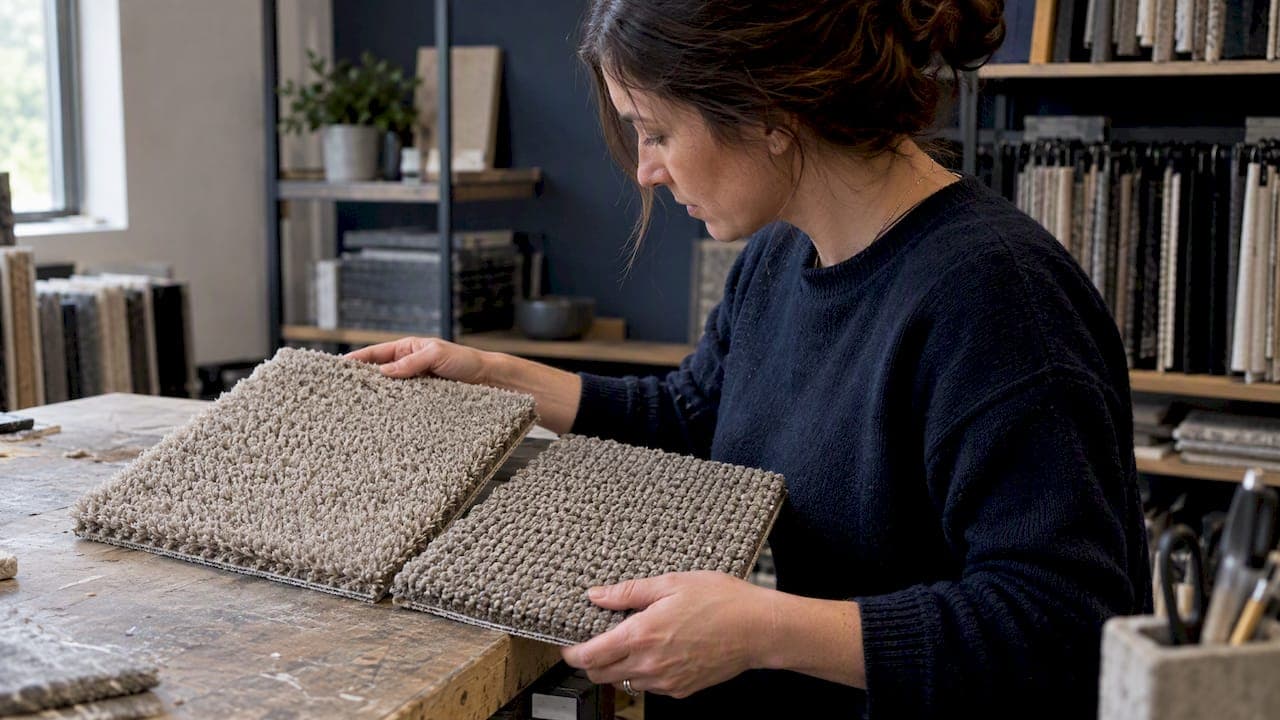
Choose cut pile when softness, pet safety and sculptural detail matter most; choose loop pile when you need a hardwearing surface for stairs, halls or busy corridors. The simplest rule of thumb bends the moment yarn twist, density or backing quality enters the picture, so the label alone never tells the whole story.
TL;DR:
- Loop pile carpets have a significantly higher minimum tuft bind requirement of 8 to 10 pounds, making them more resistant to yarn pull and shedding.
- Cut pile is more prone to crushing and flattening under traffic, but tight twist and higher density improve its durability and resilience.
- Loop pile is vulnerable to snagging and zippering from pet claws or sharp objects, whereas cut pile cannot zipper in the same way, reducing pet-related damage risks.
- High-quality construction—twist, density, backing—can override the typical performance expectations based on pile type alone.
- Proper installation, vacuuming, and prompt repair are crucial to maintaining each pile's integrity and longevity.
Table of Contents
- What cut pile and loop pile are: construction and variations
- Performance comparison: tuft bind, crushing, snagging and cleaning
- Which to choose by room, household and tufting project
- Installation and maintenance: pad choice, seaming and repair
- How specifiers and trade professionals choose pile for projects
- A rule of thumb worth keeping
- Bespoke rugs and expert pile guidance from Simmons Interior Supply
- FAQ
- Sources
What cut pile and loop pile are: construction and variations
Every tufted carpet or rug begins the same way: yarn is pushed through a backing cloth by a needle, forming a loop on the underside. What happens to that loop afterwards decides everything else. In loop pile, the loop stays intact, creating a dense, even surface of uncut fibre. In cut pile, a blade slices the loop at its peak, leaving upright tufts that fan out into a softer, more textured finish. A third family, cut-and-loop, combines both techniques within the same piece, often sculpting pattern or texture by varying pile height across the surface.
Within cut pile, several familiar subtypes exist. Plush or velour pile is cut short and dense, giving a smooth, almost velvet-like surface that shows footprints readily. Saxony pile uses longer, heavily twisted yarn for a slightly textured, forgiving finish that hides marks better than plush. Frieze pile takes twist further still, curling the yarn so dramatically that the surface reads as informal and naturally camouflages wear patterns. Loop pile has fewer well-known variants, though Berber style, with its characteristic fleck and multi-level loop height, remains the most recognisable.
Tufting machines govern much of this at the manufacturing stage. A looper attachment holds yarn in its loop form, while a cut-pile hook feeds yarn to a rotating blade that trims it to height as the machine passes. According to craft-level guidance from tufting industry specialists, cut-pile machines demand more blade maintenance, since a dull blade frays fibre ends and dulls the surface finish, whereas loop-pile machines rely more heavily on consistent tension control to keep loop height even across a run.
Spotting the difference in a showroom takes only a moment once you know what to look for:
- Loop pile shows small, continuous rounded ridges across the surface, almost like tiny beads in a row.
- Cut pile shows individual upright fibre ends, often with visible twist if you part the pile with your fingers.
- Cut-and-loop reveals a mixed surface, with some areas standing higher or lower than others in a visible pattern.
- Frieze curls so tightly that the pile direction looks almost random when viewed from different angles.
Performance comparison: tuft bind, crushing, snagging and cleaning
The most telling technical difference between cut and loop pile sits in a measurement most shoppers never hear about: tuft bind. This is the force needed to pull a single tuft free of its backing, and it matters because a carpet with weak tuft bind sheds fibre, bald patches and, eventually, loose threads that catch on shoes and vacuum heads.
The minimum average tuft bind for loop pile is significantly higher than for cut pile, reflecting different construction demands: loop pile typically requires a minimum average tuft bind of 8 to 10 pounds, while cut pile's minimum average is lower, around 3 pounds, according to the model specification for commercial carpet published by the Carpet and Rug Institute. That gap exists because loop pile relies entirely on backing adhesion to keep its continuous fibres locked in place, whereas cut pile's individual tufts are inherently less prone to the kind of mechanical pulling that threatens loop construction. In practice, this means loop pile is engineered to resist yarn pull far more aggressively than cut pile ever needs to, simply because of how each fails under stress.

That failure mode is where the two constructions properly diverge. Cut pile tends to fail through compression fatigue: fibres flatten under repeated foot traffic, furniture legs or rolling office chairs, and once crushed, a low-twist cut pile rarely springs back. Twist rate and density are the levers that resist this. A tightly twisted, heat-set saxony or frieze holds its shape far longer than a loosely twisted plush, because the twist itself stores energy that pushes the fibre back upright after each footstep. Density matters just as much: more tufts per square inch mean more fibres sharing the load, so crushing takes longer to show.
Loop pile fails differently, through mechanical snagging, sometimes called zippering. Because the fibre runs in a continuous loop rather than ending at the surface, a single snag, from a pet claw, a stiletto heel or a dropped object with a sharp edge, can pull an entire run of loops loose in one motion, unravelling several inches in seconds. Cut pile simply cannot zipper in the same way, since each tuft is already a discrete fibre with nothing further to pull. This is the single clearest reason cut pile tends to suit households with pets better than loop pile, particularly where claws are a daily reality rather than an occasional visitor.
Cleaning habits need to adjust for each construction too. Loop pile is fairly forgiving of vacuum settings on the whole, but a rotating brush bar set too aggressively can catch and pull loops exactly as a claw would, so a setting with reduced brush contact or a suction-only head is the safer default. Cut pile tolerates brush bars more readily, since there is no loop to catch, though very plush cut pile shows vacuum and footprint marks more visibly than a textured frieze, simply because flattened fibres on a smooth surface catch the light differently to upright ones. Stain response tends to favour tighter, denser constructions of either type, since there is less surface area for spills to spread across before they can be lifted.
Which to choose by room, household and tufting project
Matching pile to room comes down to how much traffic a space sees and how forgiving you need the surface to be.
- Bedrooms suit cut pile, particularly plush or saxony, since bare feet and low traffic reward softness over resilience.
- Living rooms work well with either, though a textured cut pile or cut-and-loop hides everyday wear better than smooth plush.
- Halls and stairs favour loop pile, thanks to its higher tuft bind and resistance to the crushing that repeated footfall on a narrow path causes.
- Home offices benefit from loop pile or a tight, heat-set cut pile, both of which resist the flattening caused by a rolling chair.
- Entryways suit loop pile for the same reason as halls, with the added benefit of hiding grit and debris within its denser surface.
Household circumstances shift this further. Homes with cats or dogs generally do better with cut pile, since there is no continuous loop for claws to catch, though a short, tightly looped Berber can work if snagging risk is managed through trimming any pulled fibre promptly. Families with young children tend to prefer cut pile underfoot for comfort, while households that entertain formally often lean toward a denser loop or cut-and-loop for its tidy, structured appearance under furniture. Minimal-maintenance households, meanwhile, usually fare best with a tightly twisted frieze or a dense loop, both of which disguise everyday wear between cleans.
For tufters, the choice becomes creative as much as practical. Cut pile supports carving, where varying pile heights with a blade creates three-dimensional texture and sculptural relief within a single design, a technique well documented in craft-level tufting guidance. Loop pile, by contrast, holds crisp pattern lines more reliably and suits beginners, since tension control is more forgiving to learn than blade handling. Mixing both within one piece, a cut-and-loop hybrid, gives contrast between sculpted highlight areas and a flatter, more durable base.
Before buying yarn or ordering a carpet sample, run through this short checklist:
- Identify the room's traffic level and whether pets or children will use it daily.
- Check the tuft bind rating if it is listed, and favour higher figures for high-traffic zones.
- Feel the sample for twist: a tightly twisted yarn resists crushing better than a loose one.
- Decide whether sculptural texture matters enough to justify cut pile's lower tuft bind.
- Confirm backing type, since a weak backing undermines either pile construction equally.
Pro Tip: Order a sample larger than a swatch card where possible: twist and density are far easier to judge across a full hand-sized piece than a postage-stamp cutting.
Installation and maintenance: pad choice, seaming and repair
Getting the cushion or pad right matters more for loop pile than most buyers expect. The CRI standard for installation of commercial carpet warns that soft, thick padding under loop pile increases delamination risk, since excess give beneath the backing flexes the carpet more than loop construction is designed to tolerate, straining the very tuft bind that keeps loops anchored. Cut pile is more forgiving here, though neither benefits from padding so thick that it undermines the backing's structural support, and installers typically work to tighter pad thickness and density limits for loop constructions specifically.

Seaming calls for care regardless of pile type, but the tools differ slightly in approach. Loop pile seams benefit from a seaming iron and adhesive tape applied with minimal pressure, so as not to crush loops along the join, while cut pile tolerates a sharper trim at the seam edge since there is no loop profile to preserve. Recommended practice follows the tool and technique guidance set out in CRI's installation standard, which both professional fitters and informed trade buyers can reference directly.
Cleaning frequency and settings follow naturally from everything above:
- Vacuum loop pile with reduced brush-bar contact or a suction-only setting to avoid catching and pulling loops.
- Vacuum cut pile normally, since a rotating brush bar helps lift crushed fibre back upright.
- Treat fresh spills on cut pile promptly, blotting rather than rubbing, since rubbing can distort twist and flatten the pile permanently.
- Vacuum high-traffic loop areas, such as halls and stairs, more frequently than low-traffic rooms to prevent grit from working into the backing.
A pulled loop is rarely a crisis if you catch it early. Trim the loose loop flush with surrounding fibre using sharp scissors, which halts further zippering immediately and rarely needs anything further. Only when an entire run has unravelled across several inches, or when the backing itself looks exposed, does the repair move beyond a home fix and into professional reweaving territory.
Pro Tip: Keep a small pair of curved embroidery scissors near any loop-pile rug specifically for this job: straight scissors make it far too easy to nick the surrounding loops by accident.
How specifiers and trade professionals choose pile for projects
Professionals working on hospitality or commercial projects rarely rely on the cut-versus-loop label alone. A specifier's checklist typically runs through tuft bind value, twist per inch, average pile yarn density (APYD), backing type and cushion specification before a single swatch is approved, because any one of these can override what the pile category alone would suggest. The Carpet Primer sets out the formulas behind APYD and pile height measurement that underpin this kind of evaluation.
A practical specifier checklist looks roughly like this:
- Confirm tested tuft bind value rather than assuming a figure based on pile type alone.
- Record twist per inch, since higher twist consistently predicts better crush resistance.
- Check APYD and backing delamination resistance for contract-grade durability.
- Specify cushion thickness and density limits appropriate to the pile construction chosen.
We cover these specification details further in our notes on hotel rug durability and custom rug design, both written for trade buyers weighing similar decisions on live projects.
A rule of thumb worth keeping
If you take one thing from all of this, let it be that pile type is a starting point, never a verdict. Cut pile for softness and pets, loop pile for traffic and structure, holds true often enough to guide a quick decision, but twist, density and backing quality can quietly overturn it in either direction. A beautifully specified loop pile will outlast a poorly made cut pile in almost every category that matters, and the reverse is equally true.
The habit worth building, whether you are furnishing a home or learning to tuft, is to ask about construction quality before you ask about pile type. The label tells you the shape of the fibre. The specification tells you how long it will last.
— Luke
Bespoke rugs and expert pile guidance from Simmons Interior Supply
Once you know which pile suits your space, choosing the right piece becomes a matter of craftsmanship rather than guesswork, and that is where we come in. We work closely with trade professionals and private clients to commission rugs tailored in size, material and pile construction to fit a specific room, rather than asking you to compromise on a standard off-the-shelf size.

Our Signature rug collection, made in partnership with Colbourns, gives designers and homeowners access to pile types and finishes suited to genuinely demanding spaces, from busy hallways to formal sitting rooms. We can talk through tuft bind, density and backing considerations alongside aesthetic choices, so the piece you commission performs as well as it looks.
- We commission rugs to custom dimensions rather than fixed standard sizes.
- We work directly with trade clients on material and pile specification for commercial and residential projects.
- We offer the Signature rug collection from Colbourns for projects needing considered pile performance.
Visit Simmons Interior Supply to start a conversation about a bespoke rug commission suited to your space.
FAQ
What are the downsides of loop pile carpets?
Loop pile is vulnerable to mechanical snagging, sometimes called zippering, where a single caught fibre, from a pet claw or a sharp heel, can pull an entire run of loops loose in seconds. It also needs gentler vacuum settings, since an aggressive rotating brush bar can catch and damage loops in the same way a snag would.
Is cut pile or loop pile more expensive?
Price depends far more on yarn quality, twist and density than on whether a carpet is cut or loop pile, so neither construction carries a consistent cost premium over the other. A tightly twisted, high-density loop pile can easily cost more than a loosely constructed cut pile, and vice versa.
Is cut pile carpet good?
Cut pile suits homes prioritising softness, comfort underfoot and pet safety, since its individual tufts cannot snag and unravel the way continuous loops can. Its main weakness is crushing under heavy traffic, which higher twist and density help resist considerably.
Is loop or pile carpet better?
Neither is universally better: loop pile generally resists crushing and suits high-traffic areas, while cut pile resists snagging and suits comfort-focused spaces and pet-owning households. The better choice depends on the room, the household and the quality of the specific construction rather than the pile category alone.
Sources
- Model specification for commercial carpet (Carpet and Rug Institute)
- Cut pile vs loop pile carpet: warranty fine print & real costs | Good Carpet Guide
- Cut pile vs loop pile tufting: differences & which to choose (Tufty)