
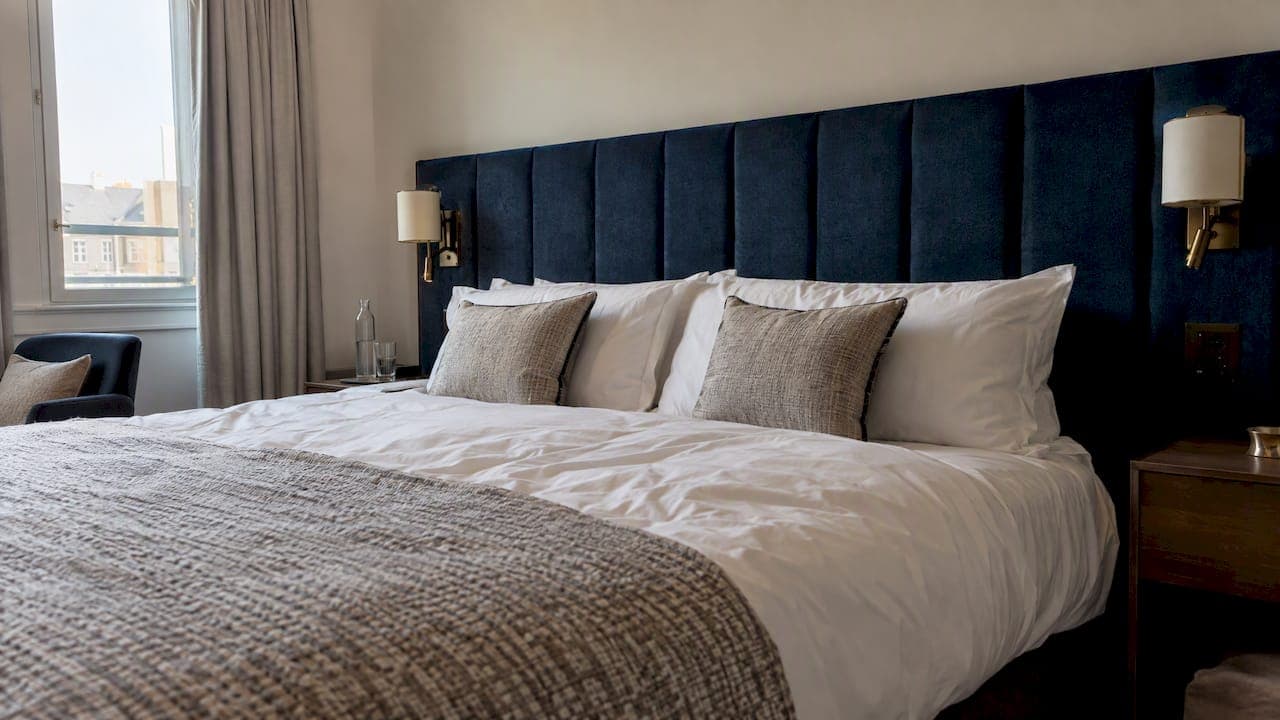
A fit-for-purpose hotel headboard does three jobs at once: it anchors the room's design identity, survives years of contract use, and carries documented fire-safety evidence that satisfies a specifier's file. We design and build bespoke headboards for exactly this brief, and the sections below walk through the materials, standards, sizing rules and procurement paperwork that make the difference between a beautiful headboard and a compliant one.
TL;DR:
- UK hotel upholstery needs medium hazard BS 7176 compliance, proven by composite cover and filling tests to BS 5852 Source 5, reports, and permanent labels.
- Check that the accredited report names the exact cover and foam combination being supplied, includes the test date, and matches the finished item’s label.
- Double and queen headboards typically rise from 1.1 to 1.4 metres above the mattress; wall panels should span the bedhead wall and accommodate lighting.
- Choose wall mounted fixings after checking the substrate and load; floor standing designs avoid wall capacity issues but need floor clearance and skirting coordination.
- Choose modular panels or replaceable covers, and specify abrasion, lightfastness, cleaning tolerance, low VOC finishes, and repairability to reduce premature replacement.
Table of Contents
- Design styles and headboard types for hotels
- Materials and finishes: textiles, veneers, laminates and sustainability
- Fire safety and UK standards: BS 7176, BS 5852 and your paperwork
- Sizing, proportions and lighting: getting the height right
- Installation and fixing: wall-mounted, floor-standing and built-in options
- Procurement and specification checklist for FF&E teams
- Maintenance, cleaning and life-cycle cost
- Customisation: tailoring dimensions, finishes and artistic detail
- Working with artisans and craftsmen without losing design intent
- Integrating headboards with the rest of the bespoke furniture scheme
- Matching headboard design to brand identity and theme
- What hotel headboards still get wrong
- How Simmons Interior Supply builds bespoke headboards for hotels
- FAQ
- Sources
Design styles and headboard types for hotels
The headboard sets the tone for the whole room before a guest notices anything else, and the style you choose should match both the brand and the practical demands of the space. Panel headboards, flat and framed, suit boutique properties wanting a sculptural, gallery-like statement without the upholstery maintenance burden. Upholstered headboards bring warmth and acoustic softening, ideal where comfort is the brand promise, though they demand the composite fire testing covered later in this guide. Wall-panel and integrated wall systems extend the headboard across the full bedhead wall, which often works best as a single anchoring gesture that also conceals services, reading lights and switch plates without extra clutter. Timber veneer and leather headboards suit properties leaning into a residential, lived-in aesthetic.
- Compact rooms benefit from slim panel headboards that avoid eating into usable floor area.
- Boutique suites can carry oversized, textured upholstered headboards as a focal feature.
- Economy rooms often do best with durable laminate or wall-panel systems that minimise soft furnishing upkeep.
Integrated systems are worth the extra coordination time at design stage, since retrofitting lighting or power behind a finished panel is far costlier than specifying service routes from the outset.
Materials and finishes: textiles, veneers, laminates and sustainability
Material choice is where design ambition meets contract reality. A fabric that feels luxurious on the showroom table can fail within a season under daily guest contact, so we specify against measurable performance criteria rather than hand-feel alone.
- Abrasion resistance: request Martindale rub counts appropriate to heavy contract use, not domestic-grade fabrics.
- Lightfastness: ask for a rating that suits the room's exposure to daylight, particularly for south-facing suites.
- Cleanability: specify finishes that tolerate standard hospitality cleaning regimes without staining or pilling.
Timber veneer and leather tend to outlast woven textiles in high-turnover rooms, while HPL and TFL laminates are increasingly specified as a durable, cost-effective alternative to natural materials in high-touch headboard areas, since they resist scuffing and hold a convincing finish far longer than delicate veneers in the same spot. Sustainability credentials are now a standard request rather than an optional extra: ask for low-VOC adhesives and finishes, recycled or responsibly sourced content, and genuine repairability, since 2026 hospitality trends prioritise circular, low-VOC materials over purely decorative choices.
Pro Tip: Ask for a swatch that has already been through the supplier's own abrasion and cleaning tests, not just a colour reference card.
Fire safety and UK standards: BS 7176, BS 5852 and your paperwork
Fire compliance is not a side note on a hotel headboard brief, it is the document that protects the operator and the specifier. For UK guest rooms, upholstered headboards are typically specified to the medium-hazard category of BS 7176:2007+A1:2011, which calls for composite testing of the cover and filling together, including BS 5852 Source 5, known as Crib 5. A fabric mill certificate on its own proves nothing about the finished item: compliance has to be demonstrated for the whole foam-and-cover composite, evidenced by an accredited test report and a permanent label.
One figure worth anchoring to your spec file: medium hazard under BS 7176 is the common baseline for hotel bedroom upholstery, and composite testing to Source 5 is the test method most frequently required to prove it.
The Regulatory Reform (Fire Safety) Order places the duty of care on the operator, but that duty is only discharged when the furniture itself carries evidence, which is why FIRA's contract flammability guidance recommends specifying by hazard category and labelling every piece accordingly. Our Crib 5 specifier's guide walks through how to read a test report line by line.
When a report lands on your desk, check for:
- An accredited laboratory name and test date.
- The exact cover and foam combination tested, matching what will ship.
- A permanent label reference that cross-checks against the report.
Sizing, proportions and lighting: getting the height right
Headboard height should feel generous without crowding the ceiling line or fighting with artwork and wall lights. As a working rule, standard double and queen headboards sit comfortably between 1.1 and 1.4 metres above the mattress top, while extended wall-panel treatments can run floor to near-ceiling for a more theatrical effect.
- Compact rooms: keep proportions tighter and let a single wall-panel do the visual work instead of bulky upholstery.
- Extended wall panels: scale width to the full bedhead wall rather than just the bed, which reads as more intentional.
- Backlighting and switches: route cabling during the design stage so fittings sit flush and remain accessible for bulb changes without dismantling the panel.
Installation and fixing: wall-mounted, floor-standing and built-in options
The fixing method you choose has to match the wall it's going on, not just the finished look. Wall-mounted headboards suit most refurbishments, provided the substrate, whether plasterboard on timber studs, blockwork or a party wall, can take the specified fixing load; floor-standing headboards sidestep substrate concerns entirely but need more floor clearance and careful skirting coordination. Built-in panels, integrated with the bedhead wall, give the cleanest line but demand earlier coordination with the services run.
- Check the substrate first. Specify fixings rated for the actual wall construction, not an assumed one.
- Confirm access to services. Lighting, switches and any audio points behind the panel need a route that survives redecoration.
- Request an installation pack. Fixing drawings, substrate checks and a maintenance plan reduce snagging at handover.
Our own wall-mounted headboard fixing guide sets out load calculations and fixing types by wall construction in more detail.
Pro Tip: Always request a site survey before finalising fixing drawings, since as-built walls rarely match the original architect's drawings exactly.
Procurement and specification checklist for FF&E teams
A headboard spec file is only as strong as the paperwork behind it. Before signing off any supplier, request the following:
- Composite test reports from an accredited laboratory, naming the exact fabric and foam tested.
- Permanent labelling confirming the hazard category and test standard on the finished item.
- Maintenance instructions covering cleaning agents, frequency and any chemicals to avoid.
- Warranty terms and lead times, stated clearly enough to plan a refurbishment programme around.
- Abrasion and stain-resistance ratings for the specific fabric or finish selected, not a generic range.
- Replacement-part availability, particularly for modular covers or panels.
Always insist on a physical sample approval and, for larger rolling programmes, an on-site mock-up before committing to full production. SATRA's guidance on hotel furniture recommends purchasers specify strength, durability and safety standards explicitly and request reports that demonstrate fitness for purpose, rather than relying on a supplier's general reputation.
Maintenance, cleaning and life-cycle cost
The cheapest headboard over a ten-year refurbishment cycle is rarely the cheapest one to buy. A repair-first approach, replaceable covers, modular panels and accessible fixings, keeps whole-life cost down and avoids full replacement when only the cover has worn.
- Clean to the supplier's instructions, since the wrong solvent can strip a fire-retardant finish without any visible sign.
- Spot-treat stains promptly rather than waiting for a full deep clean cycle.
- Favour modular or replaceable-cover designs that let housekeeping or maintenance teams swap a panel instead of the whole unit.
- Keep a copy of the product care data on file alongside the original test report, so any future contractor works from the same information.
Our guide on making hotel furniture design last ten years goes further into repair strategies that extend a headboard's working life well beyond a standard refurbishment cycle.
Customisation: tailoring dimensions, finishes and artistic detail
Bespoke headboard work starts with the brief, not the catalogue. Dimensions are set to the actual bed size and wall width on site rather than a standard template, which matters most in refurbishments where room footprints rarely match the original architect's drawings. Finishes follow the same logic: a fabric, veneer or leather chosen to sit within the property's existing palette rather than forcing the palette to accommodate a stock item.
Artistic detail is where a headboard moves from furnishing to feature. Stitched channelling, carved timber reliefs, inlaid brass detailing or a deliberately irregular upholstered silhouette can all be built into a single commission, provided the artistic ambition is balanced against the fire-testing and durability requirements covered earlier. A sculptural, hand-finished edge profile still has to pass composite testing in its finished form, so customisation conversations should happen alongside the compliance conversation, not after it.

We work directly with designers to translate a mood board or a single reference image into working dimensions and a materials schedule, adjusting proportions where a standard height would crowd a low ceiling or a wall-mounted light fitting. The result is a headboard built to the room it's going into, rather than a room rearranged to fit a standard product.
Working with artisans and craftsmen without losing design intent
The gap between a rendering and the finished headboard is where most disappointment happens, and closing it depends on how well the design brief survives contact with the workshop floor. Clear technical drawings, material samples approved in writing and an agreed tolerance for natural variation (grain pattern, leather texture, hand-stitching) all reduce the risk of a mismatch at delivery.
Early conversations with the makers themselves, rather than only with a sales contact, tend to surface practical issues before they become expensive ones: a carved detail that reads well on paper might not survive a Crib 5 composite test in that exact form, and an artisan who understands the brief from the outset can suggest an alternative that keeps the design intent intact. Sample approval stages matter here too, a physical swatch or a small mock-up panel catches finish and proportion issues that a digital render cannot.
Quality standards should be agreed before production starts, not inspected for afterwards: stitch density, seam placement, veneer matching and edge finishing are all things worth specifying in writing. We treat every commission as a collaboration between the designer's brief and the artisan's craft, which is why our own process keeps both parties in the same conversation from the first sample through to final sign-off.

Integrating headboards with the rest of the bespoke furniture scheme
A striking headboard loses impact if it sits in isolation against furnishings that were specified separately and look it. The strongest hotel bedrooms treat the headboard as the starting point for a coordinated scheme, with nightstands, seating and mirrors chosen to share a material language, whether that is a shared timber tone, a matching metal finish on hardware, or an echoed silhouette across pieces.
Nightstands are the most obvious pairing point, sitting directly alongside the headboard and visible in nearly every guest photograph of the room; a piece like our Hampton Nightstand shows how a complementary finish can extend a headboard's material story rather than compete with it. Mirrors and lighting fixtures, often sourced through trade-only collections, can repeat a curve or a frame detail from the headboard to tie the wall composition together.
The practical benefit runs alongside the aesthetic one: commissioning headboards and complementary pieces through the same bespoke process means finishes are matched at source rather than approximated later from separate suppliers' swatch books. That coordination also simplifies the procurement paperwork, since test reports, maintenance data and lead times can be tracked together rather than chased across multiple vendors.
Matching headboard design to brand identity and theme
A headboard should read as unmistakably part of its hotel, not as a generic hospitality product that happens to be in the room. A luxury property leaning into heritage might call for deep-buttoned leather or a carved timber frame with a traditional profile, where a boutique city-centre brand might want a sculptural, minimal panel in a single bold material. An eco-focused property has a different brief again: natural, low-VOC finishes, visible repairability and materials chosen for circularity and a genuine sense of place rather than purely decorative appeal.
Getting this right means starting from the brand guidelines, not the furniture catalogue: the headboard's silhouette, material palette and level of ornamentation should all trace back to the same adjectives a brand team would use to describe the property. A mismatch, an ornate headboard in an otherwise pared-back minimalist room, or a stark laminate panel in a heritage property, undermines the consistency guests notice even when they can't name what feels off.
This is ultimately why a bespoke approach earns its place in a hotel brief: a stock headboard range can only approximate a brand's identity, while a commissioned piece can be built to match it exactly, in dimension, material and detail.
What hotel headboards still get wrong
The industry's biggest blind spot is not the headboard's look, it is the paperwork behind it. Plenty of beautifully designed headboards reach site with nothing more than a fabric mill certificate standing in for proper composite fire testing, and that gap only surfaces when an auditor or insurer asks for the accredited report that should have existed from day one. Sustainability claims suffer from the same looseness: a finish described as "eco" without a specific low-VOC or recycled-content figure to back it isn't a sustainable choice, it's a marketing adjective.
The second underestimated factor is lifecycle thinking. Designers often specify for the opening photoshoot rather than the ten-year refurbishment cycle, which means replaceable covers and modular repair options get traded away for a slightly cleaner seam line. That trade rarely pays off once the first stain or tear forces a full headboard replacement instead of a cover swap.
— Luke
How Simmons Interior Supply builds bespoke headboards for hotels
Every headboard we build starts from your room dimensions and brand brief, not a fixed template, so finish, scale and artistic detail are set to the space rather than approximated to it.
We work through a trade account, with custom sizing, finish selection and technical guidance available throughout the commission, backed by fixing and durability guides for teams who need the installation detail in writing. Browse the bespoke furniture collection to see current capabilities, or view finished hospitality projects in our gallery before requesting a trade quote for your next refurbishment.
FAQ
What are the trends for headboards in 2026?
Sustainability and durability lead the brief for 2026, with low-VOC, repairable and circular materials replacing purely decorative choices. Layered textures, biophilic references and a stronger sense of local place are also shaping headboard finishes and detailing this year.
How do you decorate a bed like a hotel?
Hotel-style beds centre on a headboard that acts as a clear visual anchor, often extended into a wall panel that also houses lighting, paired with coordinated nightstands and layered, tactile textiles. Keeping the material palette consistent across the headboard, bedding and nearby furniture is what reads as considered rather than assembled.
What is the standard height of a hotel headboard?
Standard double and queen headboards typically sit between 1.1 and 1.4 metres above the mattress top, scaled up for extended wall-panel treatments that run closer to the ceiling. The right height depends on ceiling height, bed size and whether the panel also needs to conceal lighting or services.
What are the rules for headboards in hotel rooms?
UK hotel headboards are typically specified to the medium-hazard category of BS 7176, tested using BS 5852 Source 5, with compliance demonstrated through composite testing of the cover and filling together rather than a fabric certificate alone. Operators carry a duty of care under the Regulatory Reform (Fire Safety) Order, which is discharged by specifying furniture that carries accredited test reports and permanent labelling.
Sources
- Crib 5 fire regulations and furniture guidance
- FIRA: Guide to the flammability requirements for the non-domestic sector
- Hotel furniture – safe and fit for purpose?
- Hospitality materials trends 2026