
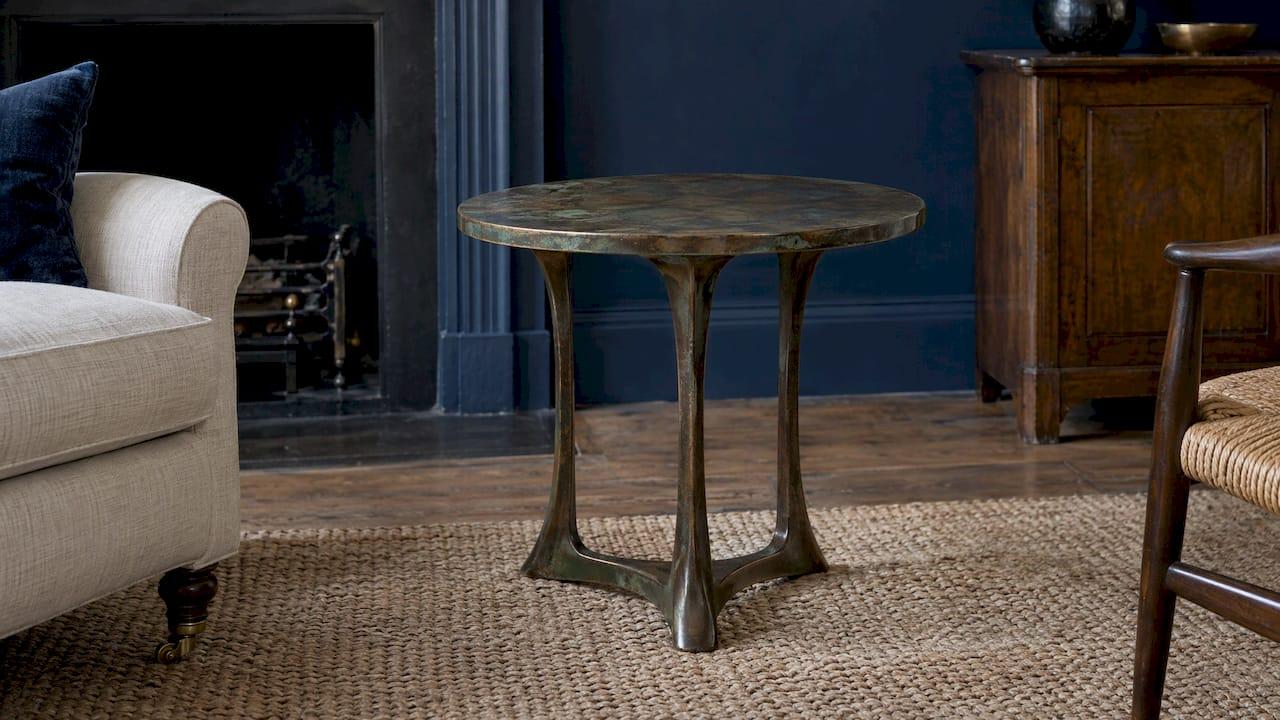
A patina on metal furniture is a surface layer, formed by chemistry, handling and time, that changes the colour of the metal and, on the right metals, helps protect it. It can be grown naturally or induced by hand, and the choice between a living finish and a fixed one is best made before the piece is made, not after. At Simmons Interior Supply, every bespoke piece is handcrafted to order with a size and finish chosen for your space, which is the ideal moment to decide how the metal should age.
TL;DR
- A patina is a thin weathered surface on metal. On copper, brass and bronze it can be a protective mineral layer; on any metal it changes colour and character.
- Patinas are either left to develop naturally or induced with chemicals, heat or mechanical work, then usually sealed with wax or lacquer.
- A living finish keeps changing and is cared for with gentle dusting and waxing; a lacquered finish stays closer to its first-day colour.
- Decide on the finish, a sample and the room's use before manufacture, particularly for hotels and high-traffic interiors.
- Made-to-order commissions let you set size, finish and ageing behaviour together.
Table of Contents
- What a patina on metal actually is
- How brass, bronze and copper age differently
- Natural patina or induced patina
- Sealed or unsealed: the decision that shapes everything
- Caring for patinated metal furniture
- What designers, architects and hotels should specify
- Why commission patinated pieces made to order
- Bespoke furniture for your next project
- FAQ
- Sources
What a patina on metal actually is
The word is used loosely, and that looseness causes specification mistakes. The Getty's technical guidelines for bronze sculpture explain that patina carries at least three meanings: a general, pleasing alteration of a surface that adds beauty and a sense of history; a strict chemical transformation of the metal surface into a mineral layer of a different colour; and an applied organic coating such as wax, varnish or lacquer that enhances colour and texture.
The conservation glossary of the Museum of Fine Arts, Boston describes a natural patina as a thin weathered surface built up through use, handling, cleaning, oxidation and environmental exposure. It adds that a uniform layer, such as the green carbonate on copper or bronze, can protect the metal beneath from further corrosion. Synthetically induced patinas, it notes, have a different microchemical structure from those that form naturally.
For a buyer, that gives three practical questions:
- Is the colour a chemical change in the metal itself, or a coating on top?
- Will it keep changing after delivery?
- What will it look like after ten years of hands, light and cleaning?
A designer who asks these at the brief stage rarely meets a surprise at installation.
How brass, bronze and copper age differently
Not every metal ages in the same way, and the alloy changes the colour you will get.
Copper is the classic example. It first reacts with oxygen to form a reddish-pink oxide, which darkens further, and then reacts with carbon dioxide and water to form the familiar blue-green layer. Research from the Australian science outreach site Curious explains that aerosol sulfates in larger cities push that green towards a darker, emerald shade. In other words, the same copper ages differently in a Mayfair townhouse than on a Cornish coast.
Brass is copper and zinc, golden when new, and it warms and darkens through honey and brown tones where it is handled. Bronze is copper and tin, a darker, denser metal that takes deep browns, greens and near-blacks very well. Both belong in the same family of tones, but they do not behave identically, and a finish that suits one will not necessarily transfer to the other. Steel behaves differently again: it can be blackened or browned, then waxed, and it needs a protective layer to stay stable.
If you want to read more on brass in particular, our notes on unlacquered versus lacquered brass and on antique brass versus brushed brass set out how each reads in a room.
Natural patina or induced patina
There are two routes to a patinated surface, and they suit different briefs.
A natural, living patina
Here the metal is left unprotected, or very lightly protected, and ages with the room. Handles darken, table edges burnish where hands rest, and no two pieces age alike. This is the finish for those who value a piece that records its own use. It asks for acceptance more than maintenance.
It is a quintessential choice for a dining table with a brass inlay or a console with bronze details. The surface will develop a story, and that is precisely the attraction.
An induced patina
An induced patina is created deliberately so the piece arrives with the depth of age already present. A bespoke patination specialist in Birmingham describes a five-stage professional process: preparing the surface, applying patina solutions, controlling their development, sealing, and inspecting the result. Common techniques include chemical treatment, heat from a torch, and mechanical work such as wire brushing.

The Getty's guidance adds two points worth knowing. First, chemical patinas are applied to clean metal and left to react, and the composition of the alloy beneath influences the final colour. Second, organic coatings such as wax, oil, resin or lacquer are usually chosen to protect rather than react, and are often laid over a chemically patinated surface.
The consequence is simple: an induced patina is a hand-applied process, so each result is individual. Two batches will never match exactly. That is part of its value, and it is why you should always approve a sample of the actual finish on the actual metal, and not a photograph of something similar.
Sealed or unsealed: the decision that shapes everything
The most useful single question in specifying metal is whether you want to see the metal change. If yes, leave it living and accept the marks. If no, seal it, typically with wax or lacquer, so the colour stays close to what you approved.
| Choice | What you see over time | Best suited to |
|---|---|---|
| Living, unsealed patina | Darkens, marks where touched, develops depth | Private homes, statement pieces, owners who enjoy ageing |
| Waxed patina | Soft, natural sheen; changes slowly if wax is renewed | Dining tables, consoles, decorative metalwork |
| Lacquered patina | Colour stays stable; surface feels more uniform | Busy rooms, projects needing consistency |
The Getty's authors make a point that is especially useful for specifiers: a continuous, smooth patina that preserves the original detail enhances a surface, whereas thick, uneven corrosion can obscure or distort it. When you review a sample, you are really judging which of these two you are looking at.
One more consideration is location. A finish that looks settled in a dry sitting room can behave differently beside a window that catches rain or in a coastal property. Mention the exposure at the brief stage.
Caring for patinated metal furniture
Care is gentle by design. The Institute of Conservation's furniture guidance recommends a stable environment, with relative humidity between 40 and 60 per cent, keeping pieces away from radiators and direct sunlight, and dusting with a clean, dry duster. For metal hardware it suggests buffing with a clean dry cloth rather than using metal cleaning products, which can harm the finishes around them.
For waxed patinas, the maintenance logic is the same as for sculpture. Rupert Harris, writing in Building Conservation, explains that artificial patinas on bronze are traditionally protected with wax and sometimes lacquer, and that if the wax is not maintained it is eventually lost, leaving the surface exposed to slow corrosion and a natural green tone. A light renewal of wax is therefore part of keeping a waxed finish as intended.
A sensible routine for an owner looks like this:
- Dust regularly with a clean, dry, soft cloth.
- Avoid abrasive pads, solvents, kitchen sprays and strong detergents on aged metal.
- Keep hot items and wet glasses off the surface; use coasters and mats.
- Keep the piece away from radiators and strong direct sun.
- Renew the protective wax occasionally if the piece was finished with one.
For brass specifically, our guide to five minute brass patina care is written for owners and designers alike.
What designers, architects and hotels should specify
A patinated finish is a decision about appearance and also about behaviour. For a residential brief, the owner can simply choose the look they love. For a hotel or other contract setting, where a piece is touched constantly and must look consistent across rooms, the specification needs to be tighter.
A reliable specification covers:
- The metal and alloy. Brass, bronze, copper or steel, because the base metal shapes the colour.
- The finish type. Living, waxed or lacquered, stated plainly.
- An approved sample. A physical sample on the same metal, signed off before manufacture.
- The tolerance for variation. Hand-applied patinas vary; agree what range is acceptable between pieces in a set.
- The room and its use. Handling, light, humidity and cleaning regime.
- Care instructions for the operator. Housekeeping teams need to know what not to use.
If the piece has a wooden element, the finish on the wood should be considered alongside the metal; our note on matching furniture finish types to use and wood helps with that pairing. And for the wider process of choosing and writing down a finish, see custom finish options.
The metal frame, plinth or base of a bespoke table is also where precision matters most before any patina is applied. Accurate fabrication, such as the CNC machining used in furniture and cabinetry manufacture, gives a clean, consistent surface, and a patina is only as good as the surface beneath it.
Why commission patinated pieces made to order

A patina is a hand process, so it works best when the person finishing the piece knows exactly what it is for. Off-the-shelf furniture offers a fixed finish in a fixed size. A made-to-order piece lets you decide the dimensions, the metal, the finish and how it should age, in one conversation.
That is how we work. Our furniture is handcrafted to order in collaboration with skilled artisans, with size and finish customised to suit the space, and we support designers, architects and hospitality clients on projects where the details need to be right. For a patinated detail, that means the finish is considered as part of the design and not added as an afterthought.
Our view
We have always believed that metal should be allowed to be what it is. A sculptural brass inlay or a bronze-toned edge is at its most beautiful when the finish is chosen with the piece, not applied to it. Because each of our pieces is made by skilled artisans from scratch, we can talk through size, finish and the way a surface should age before anything is cut.
For designers, we see the greatest confidence when the finish is agreed early and written into the specification. For homeowners, it is about deciding whether you want a surface that records your life or one that holds its first-day look. Either is a perfectly elegant answer, and we are always happy to work with you to find the right one.
Luke
Bespoke furniture for your next project
If you are planning a dining table, console, coffee table or hospitality piece with metal in it, our bespoke furniture collection is made to order, with the size and finish tailored to your interior. We also offer trade-only collections of made-to-order rugs and mirrors, including the Signature rug collection from Colbourns and the Ready to Hang collection from Simpsons London, for designers, architects and hotel teams working on a complete scheme.
Explore the bespoke furniture collection to begin, or look at the bespoke nest of coffee tables as an example of how a made-to-order piece takes shape.
FAQ
What is a patina finish on metal?
It is a surface layer on metal that changes its colour and character. It may form naturally through use and exposure, or be induced deliberately with chemicals, heat or mechanical work. On copper and bronze, a uniform patina can protect the metal beneath.
Which metal has the best patina?
Copper, brass and bronze are the metals most associated with rich, deep patinas, because their surfaces change colour in appealing ways. Which is best depends on the tone you want: honeyed and warm for brass, deep brown or green for bronze, blue-green for copper. A sample on the actual metal settles the question.
Does a patina protect the furniture?
On copper and bronze, a stable, uniform mineral layer can help protect the metal below. A waxed or lacquered patina adds a further protective layer, though wax needs occasional renewal to keep doing its job.
How do I look after patinated metal furniture?
Dust with a clean, dry, soft cloth, keep it away from radiators and direct sunlight, and avoid abrasive pads, solvents and strong detergents. Waxed finishes benefit from a light renewal of wax now and then.
Sources
- Patina, CAMEO, Museum of Fine Arts, Boston
- Guidelines for the Technical Examination of Bronze Sculpture, Getty
- Why does copper turn green? Curious, Australian Academy of Science
- Furniture care, Institute of Conservation
- Conserving Outdoor Metal Sculpture, Building Conservation
- Patination services, five-stage process