
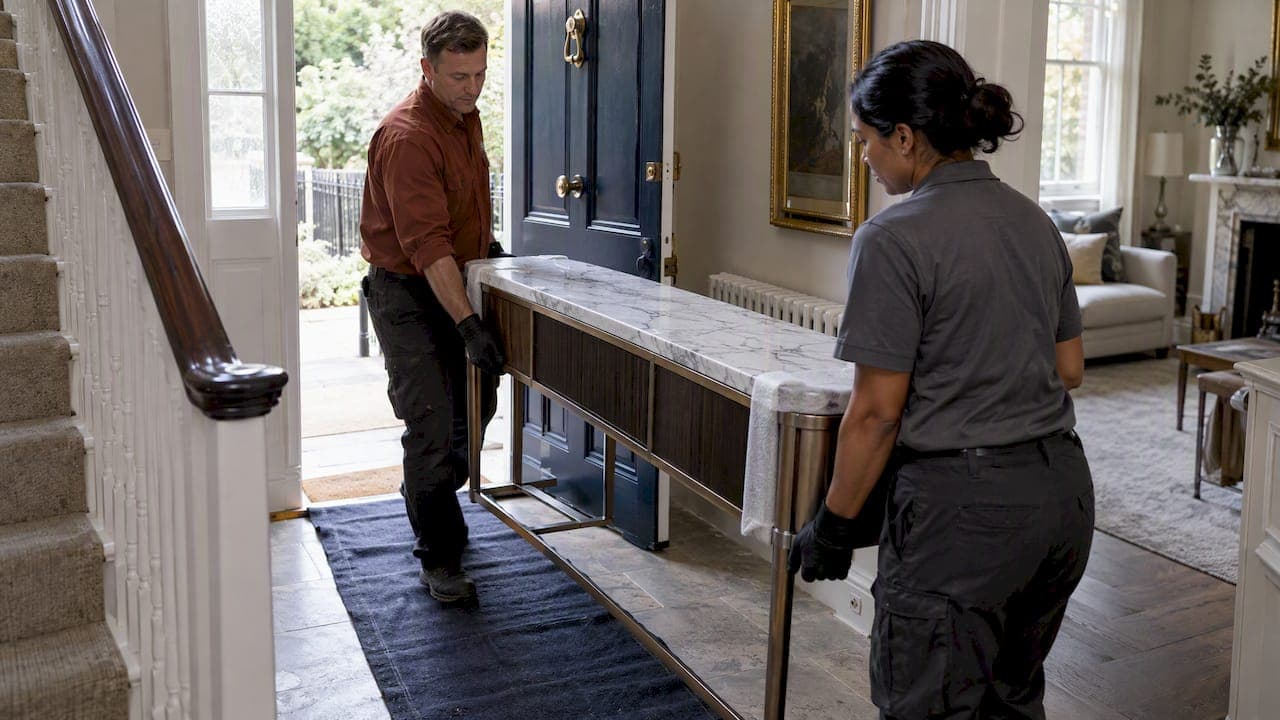
For a single piece of furniture in England, white glove delivery typically costs somewhere between £75 and £150 when access is straightforward. Stairs, long carries, assembly, several items or specialist handling push a quote towards £250 and beyond. There is no fixed national rate, because "white glove" describes a level of service rather than a regulated standard, so the figure you pay depends on what is written into your quote.
This guide sets out what moves the price, what the charge usually covers, what is commonly excluded, and what to check before you say yes. It is written for interior designers, specifiers and homeowners commissioning pieces that deserve better than a doorstep drop.
TL;DR
- Expect roughly £75 to £150 for one item with simple access and basic assembly, and £250 or more for complex, multi-item or specialist jobs, according to a UK buyer's guide to white glove furniture delivery.
- Price is driven by distance, crew size, stairs, carry distance, placement, assembly and waiting time.
- White glove has no legal definition, so list exactly what you expect: room of choice, unwrapping, assembly, packaging removal, disposal of the old piece.
- Declare the item's value before booking and get any insurance cover confirmed in writing.
- For bespoke pieces, agree the delivery brief at specification stage rather than after the piece is made.
Table of Contents
- What white glove delivery means for furniture
- How much white glove delivery costs in England
- What drives the price
- What a white glove charge usually includes
- What is commonly not included
- How to read a quote before you accept it
- Is it worth paying for?
- Planning delivery for bespoke and trade pieces
- Our perspective
- Commission a piece worth delivering well
- FAQ
- Sources
What white glove delivery means for furniture
Standard delivery usually ends at the kerb or the front door. White glove goes further: the item is brought inside, unpacked, placed where you want it and the packaging taken away. One UK fulfilment provider describes it as delivery into the room of choice, unpacking, light assembly or setup, and removal of packaging, usually with scheduled slots and tracking.
The term comes from the image of handlers who touch the piece with clean gloves, and it carries the same expectation today: nothing scuffed, nothing left behind. Secursus characterises it as the premium last-mile tier, adding inside placement, assembly and debris removal on top of a threshold drop.
The important point is that the phrase is a description, not a standard. Own Removals notes that customers should confirm whether assembly, packaging removal, old-furniture disposal, access work and storage are included, because one provider's white glove is another's room-of-choice service.
How much white glove delivery costs in England
The honest answer is a range, and the range depends on the job. The figures below come from published UK guidance rather than a single industry benchmark, so treat them as a guide for budgeting and always ask for a written quote.
| Type of job | Typical cost | What shapes it |
|---|---|---|
| Single item, easy access, basic assembly | Roughly £75 to £150 | Distance, two-person crew, simple placement |
| Two-person delivery services generally | Around £40 to £150 per delivery | Item size and weight, access |
| Complex job: stairs, assembly, long distance | Often £150 to £380 or more | Floors, carry distance, build time |
| Commercial fit-out, staged deliveries, warehousing | Quoted individually | Programme, number of visits, storage |
The first and last rows draw on the UK buyer's guide, which puts a straightforward single-item home delivery at about £75 to £150 and says complicated jobs can reach £250 or beyond. The middle rows draw on a UK fulfilment guide, which gives £40 to £150 for two-person services and £150 to £380 or more for higher-value or more complex jobs.
The same fulfilment guide suggests retailer checkout rates for furniture often sit around £75 for a single handler and £95 for a two-person team, rising to about £170 when disposal of the old item is included. These are market figures, not our prices, and your own quote may land outside them.

White glove against standard delivery
The gap is real. The same fulfilment guide estimates that room-of-choice delivery adds roughly 10 to 30 per cent over a basic threshold drop, while full white glove with assembly and debris removal can add 30 to 100 per cent. In practical terms, a piece that ships to your door for around £50 might cost double that to have it carried upstairs, built and cleared away.
What you are buying is time and people. A threshold driver works alone and leaves in minutes. A white glove crew works in pairs, protects floors and walls, and stays until the piece is in position.
What drives the price
A quote is built from a handful of variables. Taylor's Courier Service lists them as distance, vehicle, second-person handling, stairs, carry distance, placement, assembly and waiting time. Secursus gives a similar list: stairs, dimensions, distance and crew size.
Access
This is where most surprises arise. A ground-floor flat with a clear path and parking outside is a different job from a fourth-floor walk-up in a Georgian terrace. Narrow stairwells, tight turns, restricted parking, controlled loading bays and lifts with limited dimensions all add minutes, and minutes become pounds. In central London, congestion and parking restrictions can also shape the time a crew needs.
A good provider will ask for the details. Taylor's advises supplying item dimensions, weight, fragile parts, access, parking and lift details so the quote reflects the real job. If a quote arrives without a single question about access, treat it as provisional.
Size, weight and fragility
A sculptural console with a stone top, a refectory table in solid timber or a large mirror needs more hands and more protection than a side chair. Weight and awkward dimensions determine crew size and vehicle. Fragile elements such as glass, polished stone, gilding or delicate inlay may call for extra wrapping and slower handling.
Distance and location
Mileage from the depot or workshop matters, and remote areas attract surcharges. The UK buyer's guide notes that the Highlands, islands and Northern Ireland are typically priced separately from mainland zones. Within England the effect is smaller, but a delivery from the north of the country to a Cornwall address will cost more than a cross-town run.
Assembly and placement
Simple assembly, such as attaching legs, is often agreed within the quote. Anything more complex is usually a separate conversation. Placement also counts: leaving a piece in the hall is cheaper than positioning it, levelling it and moving it twice because the room layout changed.
Timing
Timed slots, same-week bookings and out-of-hours access cost more than flexible windows. For hotel and commercial projects, where loading bays and lifts are booked in advance, build the timing into the programme early.
What a white glove charge usually includes
As a baseline, Taylor's Courier Service says its arranged UK service can include:
- Two-person delivery
- Placement in the room of your choice, including upstairs
- Blanket wrapping and edge protection in transit
- Unwrapping on arrival
- Removal of packaging
- Simple assembly, as agreed in the quote
This is a sensible template for what to ask any provider, although your own supplier's service may differ. Put each line in writing, because verbal assurances do not help when a table leg is chipped.
What is commonly not included
The extras are where a £95 delivery becomes a £250 one. Taylor's excludes the following from its described service, and the list is a useful reminder of what to ask about elsewhere:
- Complex or bespoke assembly
- Plumbing, gas or electrical installation
- Wall fixing
- Hoisting
- Climate-controlled transport
- Bespoke crating
- Disposal of old furniture or appliances
For designers, wall fixing and hoisting matter most. A heavy mirror that must be fixed to a wall, or a large piece that has to go through a window, is rarely covered by a standard white glove rate. Flag these at the start so they are priced as part of the job.
How to read a quote before you accept it
Because the service is not standardised, your quote is the contract. Check it against this list.
- Scope in plain words. Does it say room of choice, unwrapping, assembly and packaging removal, or only "white glove"?
- Crew size. Confirm two people, or more for heavy items.
- Access assumptions. Does the price assume a certain number of floors, a lift or a parking space? What happens if the reality differs?
- Waiting time. Find out how long the crew will wait and what overruns cost.
- Exclusions. Ask directly about wall fixing, disposal, hoisting and complex assembly.
- Insurance. Taylor's says goods-in-transit cover has limits and exclusions and advises declaring the item's value before booking so applicable cover or additional insurance can be confirmed in writing. For a high-value bespoke piece, this step is not optional.
- Inspection on arrival. Agree how damage is recorded at the door, and who to contact, before the crew leaves.
If a provider cannot answer these clearly, the headline price is not the real price.
Is it worth paying for?
For a flat-pack bookcase, probably not. For a handcrafted piece that has taken weeks to make, a modest delivery premium protects a far larger investment. Consider the arithmetic: if a piece costs several thousand pounds, an extra £100 to £150 for a trained two-person crew is a small share of the total, and it removes the risk of a damaged finish, a gouged floor or a piece left in a hallway for the client to deal with.
It also protects your reputation. If you are a designer handing a finished room to a client, the delivery is the last thing they see before the reveal.
Planning delivery for bespoke and trade pieces
With made-to-order furniture, delivery is easiest when it is considered at the beginning rather than at the end. A few decisions made early prevent expensive surprises.
- Measure the route, not just the room. Doorways, stairwells, lift interiors and turning angles decide whether a piece arrives whole or has to be designed to separate.
- Share access details at brief stage. Floors, lift size, parking and building management rules belong in the brief. Our guides on writing a supplier-ready furniture brief and a copy-ready maker brief show where this information sits.
- Budget delivery as its own line. Alongside materials and making, it belongs in your cost plan. Our bespoke furniture cost guide explains how to frame the wider budget.
- Align delivery with the lead time. Bespoke work takes time, and the delivery window should follow the making schedule, not the other way round. See our guide to custom furniture lead times for planning.
- Agree what happens if something is damaged. Warranty and acceptance terms are worth setting in the contract, and our note on warranty clauses for contract furniture covers the points to lock in.
For a deeper look at the delivery process itself, our white glove furniture delivery guide for designers walks through it step by step.
Our perspective
We make furniture to order, and we have always believed a piece is not finished until it is standing in the right place, in the right room, without a mark on it. Craftsmanship does not end at the workshop door.
That is why we encourage our trade clients to talk about delivery while the design is still on paper. When a table is made in a particular size and finish, the route into the building is part of the brief. A refectory top that is a few centimetres too wide for a stairwell is a design problem, not a courier problem, and it is far cheaper to solve at the drawing stage.
Our approach is built on close collaboration with clients and the artisans who make each piece, and we are always happy to work with you on the practical details: access, timing, protection and the sequence of a project. For interior designers, architects and hospitality teams, that conversation tends to save more money than any single delivery quote.
Luke
Commission a piece worth delivering well
If you are planning a project and want furniture made to your dimensions and finish, our bespoke collection is handcrafted to order with customisable sizes and finishes for residential and hospitality interiors. We also offer trade-only made-to-order rugs and mirrors from partner brands, including the Signature rug collection from Colbourns and the Ready to Hang collection from Simpsons London.
Tell us about the space, the access and the timing, and we will take it from there. Explore the Simmons Interior Supply collections to begin.

Browse a made-to-order example such as the Hammered Coffee Table or the bespoke nest of coffee tables to see the level of finish we work to.
FAQ
How much does white glove delivery cost in the UK?
For one item with simple access, expect roughly £75 to £150, based on a UK buyer's guide. Complex jobs with stairs, assembly or several items can reach £250 or more, and commercial fit-outs are quoted individually.
What does white glove delivery mean?
It means the item is brought inside, unpacked, placed in your chosen room and the packaging is removed. Because there is no legal standard, confirm exactly what your provider includes, particularly assembly and disposal of the old piece.
Is white glove delivery worth it?
For high-value, fragile or heavy pieces, usually yes. The premium is small compared with the cost of repairing or replacing a damaged bespoke item, and a two-person crew protects both the furniture and your property.
What can add to a white glove delivery quote?
Stairs, long carries, poor parking, waiting time, complex assembly, wall fixing, hoisting and disposal of old furniture are the common extras. Taylor's Courier Service lists several of these as outside its standard service, so ask before you book.
Sources
- White Glove Delivery & Two-Person Furniture Delivery, Taylor's Courier Service
- White Glove Delivery: Service Tiers, Costs & Insurance, Secursus
- What Does White Glove Delivery Include in the UK?, Own Removals
- White Glove Delivery: What It Is and When Your eCommerce Brand Should Offer It, Green Fulfilment
- White glove furniture delivery: the UK buyer's guide