
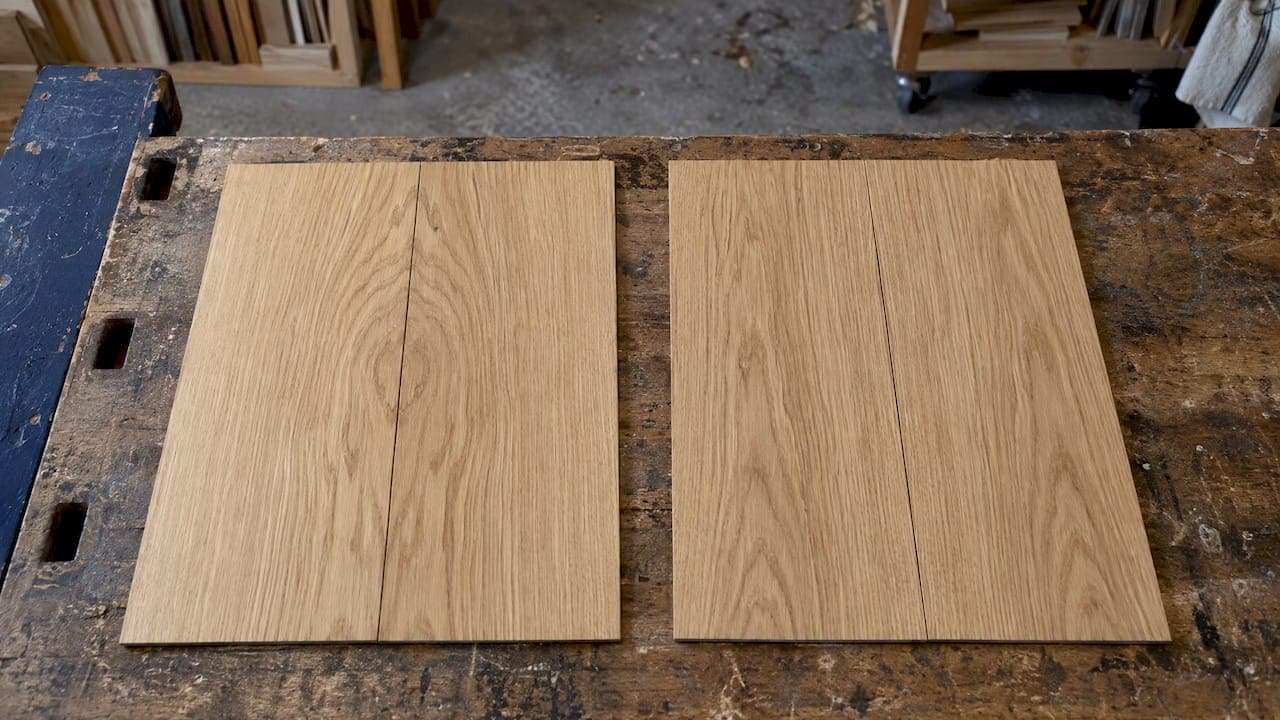
Bookmatched veneer flips every second leaf, so neighbouring leaves mirror one another across the joint. Slip matched veneer lays the leaves side by side in the order they were sliced, all facing the same way, so the grain repeats rather than reflects. Book matching gives symmetry and drama. Slip matching gives calm, uniform colour and a more architectural rhythm. Which is right depends on the species, the cut, the finish and the mood you want the piece to carry.
TL;DR
- Book match mirrors the grain at each joint: expressive, symmetrical, the most common decorative match.
- Slip match repeats the same face of each leaf: quieter, more even in tone, and well suited to straight-grained, rift or quarter-cut timber.
- The "barber pole" striping that can appear on book matched panels is a trick of light and stain absorption, not a fault, and slip matching is the usual way to avoid it.
- Matching the leaves is a separate decision from how leaves are arranged on the panel (running, balance, centre) and from sequence matching across a room. Specify all three.
- Put the choice in writing, with drawings, before anything is cut.
Table of Contents
- What each match actually does
- The barber pole effect, explained
- Choosing by species and cut
- Matching within the panel: running, balance and centre
- Sequence matching: the room-scale decision
- What it does to cost and lead time
- Why specifying it in writing matters
- Our perspective
- Start a bespoke commission
- FAQ
- Sources
What each match actually does
A veneer log, or flitch, is sliced into thin leaves that are numbered and bundled in the order they came off the knife, rather like the pages of a book. How those consecutive leaves are laid next to one another is the "match".
In a book match, consecutive leaves are laid side by side and every other leaf is turned over before joining. The result is a mirrored pattern, like an open book. Because the two faces are cut from almost the same plane of the log, the figure at the joint lines up beautifully and the grain appears to travel outwards from the centre line.
In a slip match, consecutive leaves are placed side by side in the order they were sliced, without turning them. The same face of every leaf is visible, so the grain repeats across the panel instead of reflecting. You lose the mirror, and you gain consistency.
| Book match | Slip match | |
|---|---|---|
| Leaf handling | Every second leaf turned over | All leaves face the same way |
| Visual effect | Mirror image at each joint | Repeating grain, no reflection |
| Character | Symmetrical, decorative, dramatic | Linear, even, contemporary |
| Colour behaviour | Can read as striped under light or stain | Most uniform across the panel |
| Best with | Crown cut figure, burrs, walnut, feature panels | Rift, quarter cut and straight-grained species |
| Joints | Often least visible on figured wood | Joints can show where grain does not repeat cleanly |
The last row is worth dwelling on. On a strongly figured leaf, a slip match can leave a visible step at the joint, because the figure at the right edge of one leaf does not meet the same figure at the left edge of the next. Straight grain forgives this. Heavy cathedral figure does not always.
The barber pole effect, explained
The most common reason designers move from book to slip is the barber pole effect: a striped look where alternate leaves appear lighter and darker. It is most evident when leaves are book matched, particularly in rift and quarter sawn oak.
The cause is wood anatomy rather than poor workmanship. When alternate leaves are flipped, you expose the tight side of one leaf and the loose side of the next. They reflect light and take up finish at different rates, so the panel reads as stripes, and the effect is more pronounced with darker, more penetrative stains. Viewed from one side of a room a leaf looks pale, from the other it looks dark, and the pattern shifts as you walk past.
Some people love this. It is a natural property of the material and gives a panel a living, shimmering quality. But if you need absolute colour uniformity, slip matching keeps every face oriented the same way, so light reflection and stain absorption stay consistent.

A practical consequence: the finish you want and the match you choose are linked. If you are planning a deep, dark stain on oak, ask for a sample of the exact match, cut and stain together. Our guide to reproducing stain matches covers the testing workflow, and mixing wood tones with bespoke finishes helps when a veneered piece must sit beside other timbers.
Choosing by species and cut
The cut of the log changes the answer more than most people expect.
Crown cut (flat cut) veneer shows the cathedral arches we associate with oak, ash and walnut. Book matching is the favoured choice for burrs and decorative figure, where the mirrored pairs make a feature of the pattern. On a dining table top or a cabinet door pair, a book match frames the figure like a piece of art.
Quarter cut and rift veneer have straight, linear grain. Here a slip match produces long, even stripes of grain with a measured, architectural feel, and sidesteps the barber pole risk. For a run of wall panelling in a hotel corridor, that steadiness is usually what the designer is after. If you are weighing how the cut affects stability as well as looks, our note on quarter sawn versus plain sawn timber is a useful companion.
Burr and highly figured species usually take a book match, because the mirrored symmetry turns irregular figure into a deliberate motif.
Walnut and oak deserve a mention, as they are the two timbers clients ask about most. Walnut is rich and variable and rewards a book match on a focal surface. Oak is the species where barber pole most often becomes an issue, so test before you commit. Our comparison of oak and walnut furniture and our overview of wood veneer types set out how each behaves, and the wood species selection guide goes into more depth.
Matching within the panel: running, balance and centre
Here is a point that catches many specifiers. Book and slip describe how neighbouring leaves relate. They do not describe how the leaves are arranged across the finished face. That is a separate choice: running, balance or centre match.
- Running match: leaves are used as they come, with the last leaf trimmed to fit. Economical, but the panel can look uneven, and panels cut from the same run may differ.
- Balance match: leaves are trimmed to equal widths, so the panel looks orderly and balanced. For bespoke furniture and luxury interiors, it is considered among the most pleasing and formal approaches.
- Centre match: the panel is symmetrical about a joint down the middle. It needs an even number of leaves, and it uses the most veneer of the three, so it costs more.
So a precise specification might read: book matched, balance matched, on a crown cut walnut. Or: slip matched, centre matched, on rift oak. Each phrase answers a different question, and leaving one out means someone else will fill the gap for you.
Sequence matching: the room-scale decision
You will also see "sequence matched", and it is easily confused with the above. Sequence matching is about continuity from panel to panel, not leaf to leaf. Practitioners distinguish veneer matching, the leaf-to-leaf arrangement, from sequence matching, the log-to-panel continuity. In a sequence matched set, panels, doors and joinery components come from the same flitch in order, so the grain progresses logically across a whole wall or room.
This is the territory of hotel lobbies, boardrooms and fitted joinery runs. Because the grain must continue, standard stock sheets will not do: the manufacturer has to reserve a specific flitch, and panels are numbered so they are installed in the right order. You can combine sequence matching with either book or slip matching within each panel.

There is a cost implication that surprises people. If the grain has to match perfectly from panel to panel, an off-cut from one sheet cannot simply be spliced into the middle of the sequence. It becomes unusable sequence waste. Good makers plan panel layouts against sheet dimensions to keep that to a minimum.
What it does to cost and lead time
Neither match is inherently the premium option, but the choices around them move the price.
- Waste. The same estimating source cautions against a flat allowance: 15 to 20 per cent is typical for common domestic species in a running match, while irregular species or high-figure burrs can need 40 to 50 per cent to clip out natural voids and defects. Treat these as industry estimating figures, not a quote.
- Panel layout. Centre matching uses the most material, and balance matching more than running.
- Reserved flitch. Sequence matching means setting aside a log's worth of leaves for your project.
- Pricing the whole panel. Veneer is a log-derived material, not a commodity, so the sensible approach is to price the entire specified panel, including species, cut, match and grade, rather than relying on a per-square-foot figure.
For a made-to-order piece, that means the honest answer to "how much does book matching add?" is: it depends on the timber and the layout, and we would rather show you than guess.
Why specifying it in writing matters
The Architectural Woodwork Institute's guidance treats veneer matching as a richly complex area where loose specifications lead to expensive problems on site. Clear shop drawings that define the matching sequence and face layup before production are the remedy. Assuming a default is how mismatched panels end up being replaced.
Before a commission goes into production, we would settle these points:
- Species and cut.
- Leaf match: book or slip.
- Panel layout: running, balance or centre.
- Whether panels must be sequence matched across the room or set.
- Finish and stain, approved on a sample of the same match.
- Panel dimensions, so leaf widths and joints fall where you want them.
UK specifiers working to the Architectural Woodwork Standards, or to a project's own joinery specification, will recognise this list. Whatever framework applies, the principle is the same: write down what you can see in your head.
Our perspective
We make bespoke furniture to order, with artisans, in sizes and finishes chosen for the space. In that work, veneer matching is one more place where the brief decides everything. A walnut tabletop that is meant to be the sculptural heart of a room asks for the mirrored grace of a book match. A run of rift oak doors that should disappear into the architecture asks for the discipline of a slip match.
The mistake we see is treating the match as a detail to settle late. It shapes how a piece catches the light, how it takes a stain and how it sits beside its neighbours, so we prefer to talk it through at the start, with samples where the finish is deep or the timber is oak. If you are an interior designer, architect or hospitality buyer working to a drawn specification, send it over and we will tell you plainly where the match, the layout and the finish may pull against one another. We are always happy to work with you on getting it right.
— Luke
Start a bespoke commission
If you are planning a table, console, cabinet or panelled feature that depends on a particular grain effect, we would be glad to help you specify it. See what we have made in our gallery, or begin with the Simmons Interior Supply collection, where bespoke furniture is made to order in your chosen size and finish. For a sense of how a piece is shaped around a client, the bespoke nest of coffee tables is a good place to look.
FAQ
Is book matching better than slip matching?
Neither is better in every case. Book matching is the more common decorative choice and suits figured timber and feature surfaces. Slip matching is the second most popular and is recommended where you want to minimise tonal variation, particularly with straight-grained cuts.
Why does my book matched panel look striped?
That is the barber pole effect. Flipping alternate leaves exposes different sides of the grain, which reflect light and absorb stain at different rates. It is most noticeable on rift and quarter sawn oak and with darker stains, and slip matching is the usual way to avoid it.
What is the difference between sequence matched and book matched?
Book matching describes how neighbouring leaves are joined within a panel. Sequence matching describes how multiple panels are cut from the same flitch in order, so the grain runs continuously across a room. You can have a sequence matched set where each panel is book or slip matched.
Does book matching cost more than slip matching?
Not automatically. Cost is driven more by species, panel layout and waste: centre matching uses the most veneer, and sequence matching requires a reserved flitch. Price the whole specified panel rather than the match alone.
Which match should I choose for a dark stain?
If you want even colour on oak or another species prone to striping, choose slip matching and test a sample with the exact stain. If you are happy for the panel to shimmer, a book match can be striking.
Sources
- A designer's guide to timber veneer cuts and matching techniques, Elton Group
- Book match or slip match veneer application, The Wood Veneering Company
- Architectural woodworking standards, finishing section, AWI QCP
- A practical guide to the architectural woodwork standards, AWI QCP
- Veneer matching, Dooge Veneers
- Methods of sequence matching, Timber Veneer Association of Australia
- How to estimate wood veneer square footage and waste, Oakwood Veneer
- Wood veneer: cuts, matching, species and grades, ForestSource