
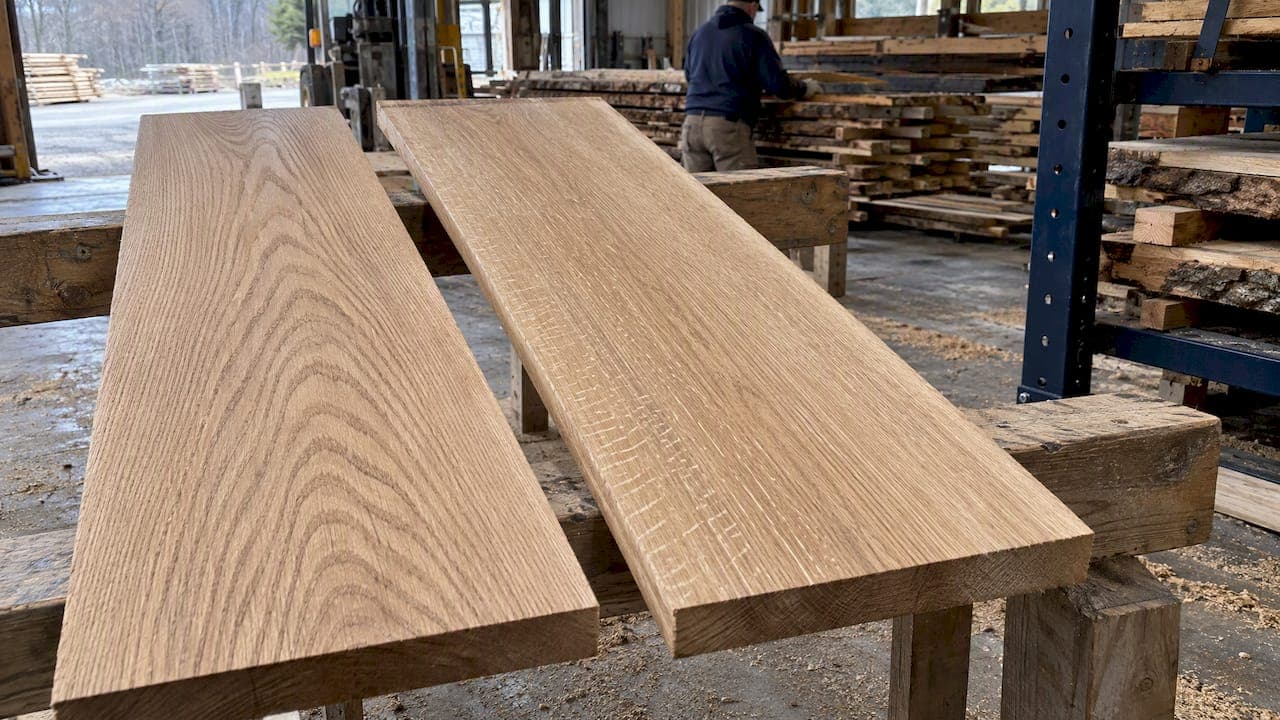
For wide, stable panels, quarter sawn timber is the better choice. For lower cost and wider individual boards, plain sawn (also called flat sawn) wins out. The difference comes down to three things: appearance, with quarter sawn giving a straight grain and ray fleck against plain sawn's cathedral arches, movement, and ultimately cost. The sections below explain how to spot each cut and choose with confidence.
TL;DR:
- Quarter sawn boards move roughly half as much across their width, resist cupping, and suit wide tabletops, flooring, cabinet panels, and humid rooms.
- Plain sawn boards usually cost less and come in wider sizes, while their cathedral grain suits decorative surfaces and narrow trim.
- Check end grain first: quarter sawn growth rings run nearly perpendicular to the face, while plain sawn rings run parallel or at a shallow angle.
- For wide solid panels, allow for seasonal movement with floating panels or breadboard ends rather than rigid joinery.
Table of Contents
- Plain sawn: cutting method, appearance and movement
- Quarter sawn: cutting method, appearance and stability
- Side by side: appearance, movement, uses and cost
- How to tell if a board is quarter sawn or plain sawn
- Choosing between quarter sawn and plain sawn for your project
- Craft perspective: how we select and work sawn timber
- Trade craftsmanship or careful DIY: a quick take
- Commissioning bespoke furniture instead of sourcing and joining timber yourself
- FAQ
- Sources
Plain sawn: cutting method, appearance and movement
Plain sawn boards, often called flat sawn, come from parallel rip cuts made straight through a squared log, slicing from one side to the other. This is the most efficient way to mill a tree, which is why plain sawn boards dominate timber yards and tend to run wider than their quarter sawn counterparts.
The face grain reveals the method: those sweeping, arched "cathedral" patterns come from the growth rings running roughly tangential to the board's face. It is a lively, decorative look that suits furniture where bold figure is the point rather than the exception.
That same tangential orientation is the reason plain sawn stock moves more across its width as humidity shifts, and why wider boards are more prone to cupping. The movement is manageable with sound joinery, but it needs respecting.
Where plain sawn earns its keep:
- Furniture carcasses and panels where cost per board foot matters more than figure control.
- Decorative tabletops and cabinet doors where cathedral grain is the desired look.
- Mouldings and trim, where boards are narrow enough that movement rarely causes problems.
Quarter sawn: cutting method, appearance and stability
Quarter sawing starts by splitting the log into quarters, then sawing each quarter so the boards come off with their faces running close to perpendicular to the growth rings. That radial orientation is what gives the cut its name and its character.
The grain reads straighter and more uniform than plain sawn, and in species like oak it reveals prominent medullary ray fleck: those silvery, flecked streaks running across the grain that give quarter sawn oak its signature look. Other species show less pronounced rays, so the visual drama varies by timber.

The practical payoff is movement. Because the rings run more radially through the board, quarter sawn stock typically moves significantly less across its width than plain sawn stock of the same species for an equivalent moisture content swing, and it resists cupping far better.
Where quarter sawn earns the premium it commands:
- Wide tabletops and bookmatched panels, where movement across a joined width would otherwise show as gaps or ridges.
- Flooring, where straight grain wears more evenly and resists cupping over time.
- Fine cabinetry and joinery, where dimensional predictability matters more than raw material cost.
Side by side: appearance, movement, uses and cost
| Dimension | Plain sawn | Quarter sawn |
|---|---|---|
| Appearance | Cathedral, arched grain figure | Straight grain, ray fleck in oak |
| Stability/movement | Greater across-width movement, prone to cupping | Roughly half the across-width movement, resists cupping |
| Typical uses | Panels, carcasses, mouldings, decorative tops | Flooring, wide tabletops, fine cabinetry |
| Cost | Lower, higher yield per log | Higher, lower yield per log |
The movement gap matters most where several boards are joined edge to edge across a wide surface, such as a dining table or a cabinet side panel. A narrow shelf in plain sawn stock will rarely cause trouble, but a 900 millimetre tabletop glued up from flatsawn boards gives seasonal movement far more room to show as cracked finish or proud joints.
Pro Tip: Choose quarter sawn for wide tabletops and cabinet panels where the joinery cannot comfortably accommodate seasonal movement.
How to tell if a board is quarter sawn or plain sawn
- Check the end grain first: quarter sawn boards show growth rings running close to perpendicular to the face, while plain sawn shows rings running roughly parallel or at a shallow angle.
- Look for medullary rays on the end grain, visible as fine lines radiating from the centre, more obvious once you know to look for them.
- Read the face grain: straight, consistent lines point to quarter sawn, while sweeping arches point to plain sawn.
- In oak, look for ray fleck on the face, the flecked pattern that only appears when the cut is close to quarter sawn.
- Ask your supplier directly how the log was milled, particularly with species where figure is subtle and visual clues alone are not conclusive.
Choosing between quarter sawn and plain sawn for your project
The right cut depends on four practical questions: how wide is the piece, how much humidity swing will it face, how much does visible grain matter to you, and what is the budget. A piece destined for a kitchen or bathroom, where humidity swings are frequent, benefits from the added stability of quarter sawn stock. A piece in a stable, climate-controlled room has more room to work with plain sawn.
Whichever cut you choose, design for movement rather than fighting it:
- Leave allowance for expansion and contraction across the width of any solid panel.
- Use floating panel construction or breadboard ends on wide tabletops rather than rigid frames.
- Choose joinery methods that permit movement without opening visible gaps.
Pro Tip: For flooring and wide tabletops, quarter sawn stock paired with movement-conscious joinery gives the most forgiving long-term result.
Craft perspective: how we select and work sawn timber
In our workshop, the choice of cut is rarely about appearance alone. When we commission a wide panel or a bookmatched tabletop, we favour quarter sawn stock precisely because it gives joinery less to fight against over the seasons.
Quarter sawn timber moves less across its width than plain sawn timber of the same species, which is why it holds its shape better in wide panels and flooring.
We acclimatise timber before cutting and choose finishes that slow moisture exchange rather than stop it outright, which keeps movement predictable long after a piece leaves the workshop. Species selection plays its part too, and our guide to choosing wood species covers how figure and stability vary across common choices like oak and walnut.
Trade craftsmanship or careful DIY: a quick take
Spending more for quarter sawn stock earns its keep on anything wide, visible and long-lived: a dining table, a floor, a statement cabinet front. For narrower, less exposed pieces, well-designed plain sawn work holds up perfectly well. The real risk is not the cut you choose but joinery that ignores movement altogether, whichever timber sits on the bench.
— Luke
Commissioning bespoke furniture instead of sourcing and joining timber yourself
Choosing between quarter sawn and plain sawn is only the first decision. Sourcing the right boards, acclimatising them, and designing joinery that survives seasonal movement is a project in itself, which is exactly the work we take off your hands with our bespoke furniture collection.

Bespoke furniture pieces are often handcrafted to order, with sizes and finishes set to fit your space rather than the other way round, so stability questions can be addressed before the piece ever reaches you. Working closely with skilled artisans allows the matching of the right cut and species to each commission rather than relying on whatever a yard happens to stock.
If you would rather see finished results than specify timber yourself:
- Browse our gallery to see completed commissions in a range of finishes.
- Visit our bespoke nest of coffee tables for an example of customisable sizing and finish.
- Get in touch through our trade and consultation page to discuss a commission.
FAQ
Is quarter sawn better than plain sawn?
Neither cut is universally better: quarter sawn gives greater dimensional stability and a straighter, more uniform grain, which suits wide panels, flooring and fine cabinetry. Plain sawn gives wider boards at lower cost and a bolder cathedral grain, which suits budget-conscious or decorative work where movement is less of a concern.
What are the disadvantages of quarter sawing?
Quarter sawing yields narrower boards from the same log and produces more waste, which pushes up the cost per board foot. It also limits the width available in a single board, so wide panels often need several boards joined together.
Is quarter sawn wood more expensive?
Yes, quarter sawn wood typically costs more than plain sawn wood of the same species, because quartering the log and cutting radially yields less usable timber per log. The extra cost reflects both lower yield and the added stability the cut provides.
How can I tell if wood is quarter sawn?
Check the end grain: quarter sawn boards show growth rings running close to perpendicular to the face, and the face grain reads as straight lines rather than arched cathedral patterns. In oak, look for medullary ray fleck on the face, a flecked pattern unique to boards cut close to the radial plane.
Sources
- Understanding wood movement: moisture, shrinkage, and acclimation | The Carpenter's Guide
- Quarter sawing — Wikipedia