
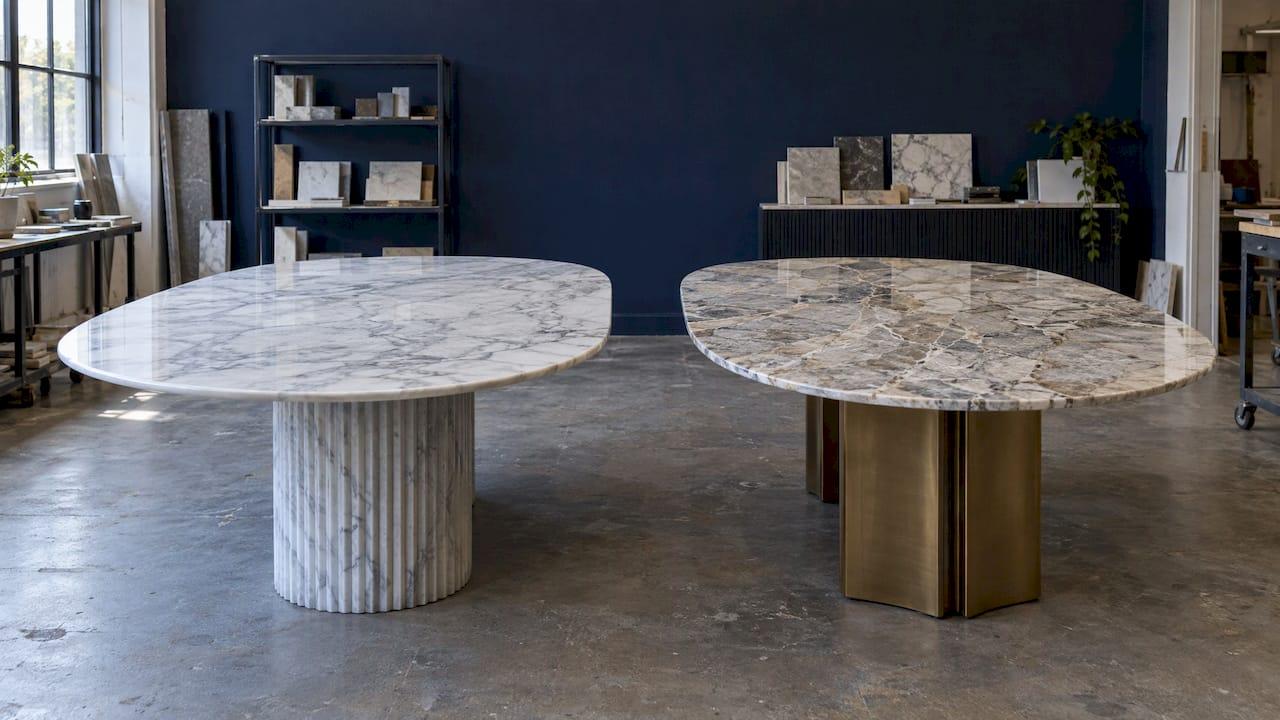
Quartzite is the harder, more forgiving stone: it resists scratches and everyday kitchen acids. Marble is the more fluid, more atmospheric stone: it softly records the life of a room. Neither is the better table in the abstract. The right choice depends on how the table will be used, how the finish should age, and whether the slab is chosen with the piece in mind. For a bespoke commission, that last point matters most. A table made to your size and finish begins with the slab, the edge and the base, not with a catalogue photograph.
This guide is written for designers, architects, hospitality teams and homeowners specifying a stone-topped table. It explains what separates the two stones, how each behaves at a dining table, and what to settle before a commission begins.
TL;DR
- Quartzite is a metamorphic rock made almost entirely of quartz, and it is far harder than marble. Marble is calcite-based, so acids leave dull marks called etching.
- Choose quartzite for a hard-working dining or hospitality table. Choose marble where a softly evolving, patinated surface is part of the appeal.
- Sealing slows liquid absorption on both stones but does not prevent marble etching. A honed finish makes etching far less conspicuous than a high polish.
- Stone tables are heavy and slab-specific: plan the base, the edge profile and a lead time of six to twelve weeks from the outset.
- Always confirm the stone's identity before you specify. "Soft quartzite" is a red flag, because it is usually marble.
Table of Contents
- What actually separates quartzite from marble
- Durability on a table: scratches, etching, heat and stains
- Which stone suits which table
- Designing the table around the stone
- What shapes the cost
- Caring for each stone
- Our perspective
- Commissioning your table with us
- FAQ
- Sources
What actually separates quartzite from marble
Both are natural metamorphic stones, formed under heat and pressure, but they begin as different rocks. Marble recrystallises from limestone or other carbonate rock, so it is built from calcite. Quartzite forms from sandstone and is made almost entirely of quartz. That single difference explains almost everything about how the two behave on a table.
On the Mohs scale, which ranks minerals by scratch resistance, quartz sits at 7. A technical bulletin from the stone trade describes quartzite as nearly twice as hard as glass and harder than a knife blade, and notes it does not etch from normal kitchen acids. Marble, by contrast, generally falls somewhere between 3 and 5 on the same scale, and its calcite reacts with acids.

How they look
The difference is visible as well as chemical. Marble's calcite lets light travel a little way into the surface, which gives that cloudy, three-dimensional depth and the veining that seems to drift beneath the polish. Quartzite's quartz tends to throw light back from the surface, producing a sharper, more glassy shine, and its veining is often straighter, more fractured or more crystalline in character, echoing the layers of the original sandstone.
That said, quartzite can be remarkably marble-like. Some quartzites are pale, softly veined and deeply luminous, which is exactly why they are so popular as a more resilient alternative to white marble. Others are dramatically coloured, in browns, greens, blues and pinks, with a character marble rarely offers.
Telling them apart before you commit
Because trade names are inconsistent, the label on a slab is not always reliable. A Building Stone Magazine article on the subject states plainly that "soft quartzite" is not a real category: a stone sold under that name is in fact marble, and the term suggests the seller does not understand quartzite.
The same article and the VMC bulletin describe simple diagnostic tests a fabricator can run on an offcut:
- Scratch test. Quartzite will scratch glass and cannot be scratched by a knife blade. Marble can be scratched with a blade.
- Acid test. A drop of dilute (around 5 to 10 per cent) hydrochloric acid fizzes on marble, because calcite reacts. It does not fizz on quartzite.
For a designer specifying a table, the practical step is to ask the maker to confirm the stone's identity in writing and to see the actual slab, not a sample of the same name.
Durability on a table: scratches, etching, heat and stains
A table top is not a worktop. Nobody chops on it, but it meets wine glasses, citrus, oils, candles, hot dishes, cutlery, laptops and children. The Worktop Fabricators Federation's UK surface guide is a useful reference for how each stone responds.
| Behaviour | Quartzite | Marble |
|---|---|---|
| Hardness (Mohs) | Around 7 | Around 3 to 5 |
| Scratching | Highly resistant | Scratches more readily, especially when polished |
| Acids (lemon, vinegar, wine, tomato) | Resists etching | Etches, leaving dull matte marks |
| Staining | Varies by slab; sealing slows absorption | Varies by slab; sealing slows absorption |
| Heat | Handles heat, but use trivets | Handles heat, but use trivets |
| Character over time | Stays largely as it was made | Develops a lived-in patina |
Etching is not staining
The two are often confused. A stain is a substance that has soaked into the stone. Etching is a different, microscopic reaction: acid dissolves a little of the calcium carbonate at the surface, leaving a dull spot. The WFF guide explains that etching is more visible in direct sunlight and less visible on honed or textured surfaces than on a high polish.
That is why finish matters as much as stone on a marble table. A honed, matt surface lets the stone age gracefully, while a mirror polish shows every mark. Sealing, meanwhile, does not stop etching. It slows liquids from soaking in, which helps against staining, but the acid reaction still happens at the surface.
Heat and impact
Both stones cope with warm plates far better than most surfaces, yet the WFF advises trivets for both, since sudden thermal shock can crack or discolour stone. A hard knock can also chip either material. Joins, cut-outs, corners and thin edges are the vulnerable points, which is a design matter as much as a material one.
Which stone suits which table
Quartzite: the dependable choice for heavy use
If the table will be used daily by a busy household, or sits in a restaurant, hotel suite or private dining room, quartzite's resistance to scratching and food acids gives you the most margin. It suits the kind of table that will hold up through long lunches without anyone hovering with a cloth. Its crisp, reflective surface also sits comfortably in contemporary and architectural schemes.
Marble: the choice for a table that grows with the room
Marble rewards clients who see a surface as something that gathers history. Its softness is part of its beauty: the way it takes light, the depth of the veining, the gentle softening of an edge over the years. A guide to stone from a UK specialist puts it well, suggesting marble be chosen with its future in mind, as a lovely surface where an evolving finish is welcome. If every ring from a glass would feel like damage, quartzite is the more restful choice. If those marks read as character, marble is hard to beat.
If you are leaning towards marble, our own marble table care routine sets out four simple habits and finish choices that keep a marble top looking its best.
A note for hospitality and commercial schemes
In hotels, restaurants and shared spaces, the question is less about preference than about how the surface will be maintained by many hands. Quartzite generally asks less of staff. Marble can still be the right answer for a statement piece in a low-traffic lounge or a private suite, where the finish and the care plan can be agreed from the start.
Designing the table around the stone
The stone is only half of the decision. A tabletop of this material is an engineering and design problem, and these are the points to resolve early.
Slab selection is part of the design
No two slabs are the same. Veining, tone and movement vary from piece to piece, and the WFF guide stresses that choosing a slab is a design decision to be discussed with the fabricator before cutting begins, with quartzite cut to make the most of the pattern's flow. Trade press makes the same point for commercial schemes: slab-to-slab variation belongs to the commission rather than being a defect to apologise for.

For a large table, ask whether the top will be one slab or joined, and how the veining will run across the length. If you are weighing grain, pattern and the way natural materials warm a room, these wood grain decor ideas show how texture can balance a polished stone surface. Our guide to bookmatched and slip matched veneer is also worth a read when you are thinking about how a pattern should travel across a surface.
Edge profile
Edges affect durability, comfort and the visual weight of the top. Bullnose, ogee, mitred and eased profiles each change how substantial the table looks and how it feels under the forearm, and a delicate corner is more exposed to chipping. It is also worth asking whether a thick-looking edge is solid stone or a built-up detail, as the two read very differently. Our guide to table edge profiles walks through how to choose.
Weight, base and support
Stone is heavy. A base and fixing method must be designed for the weight and shape of the top, and a long overhang, narrow legs or a slender pedestal change the structural brief entirely. Bring the access route into the plan too: stairs, lifts and doorways decide how a top can reach the room.
Lead time
Trade press reports that bespoke stone furniture can take six to twelve weeks, depending on material availability, complexity, slab selection and finishing. For a fitted-out hotel or a large project, that period needs to sit in the programme from the start rather than appear late as a decorative extra. Our note on custom furniture lead times for UK trade explains how to plan the schedule.
What shapes the cost
We do not quote one price for a stone table, because the figure depends on the commission. The main drivers are:
- The stone itself. Rarity, colour and the number of slabs needed all weigh on price. A top that must be a single, perfectly matched slab asks more than one with a joined top.
- Size and thickness. Larger and thicker tops use more material and need more careful handling.
- Edge and finish. A complex profile or a hand-honed finish adds fabrication time.
- The base. The structure that carries the stone has to be designed and made to take the load.
- Delivery and installation. Weight and access shape the logistics.
For trade clients managing budgets, our value engineering guide for bespoke FF&E shows where a scheme can be refined without losing its character.
Caring for each stone
The routine is simple for both, and it differs mainly in how fast you need to act.
- Use a pH-neutral stone cleaner and a soft cloth.
- Blot spills of wine, citrus, vinegar, oil and cosmetics promptly rather than wiping them across the surface.
- Avoid vinegar, lemon-based cleaners, abrasive scourers and acidic limescale removers on marble.
- Use coasters and trivets on either stone.
- Treat sealing as a decision for each slab, made with your maker, not an automatic annual chore.
Our perspective
We make tables from scratch with skilled artisans, in sizes and finishes chosen for the room they will live in. That gives us a particular view of this question: the best table is the one where the stone, the finish and the way you live have been considered together.
When a client asks us to choose between quartzite and marble, we begin with the table's daily life. Who sits at it, how often, with what on it? A family kitchen table and a private dining room in a hotel suite need different answers, and a good bespoke commission respects that.
We also believe the finish is where the real conversation happens. A honed surface, a softened edge, a carefully chosen slab: these decisions let a stone feel at ease in a space rather than precious. Whatever material you favour, we are always happy to work with you on the size, the edge and the finish until the piece fits your space exactly.
Luke
Commissioning your table with us
Our bespoke furniture collection is handcrafted to order, with size and finish tailored to your interior, for designers, architects, homeowners and hospitality clients. If you are developing a stone-topped table, you can share your dimensions, your preferred finish and the use you have in mind, and we will take it from there in close collaboration with our artisans.

Explore the bespoke furniture collection to begin a conversation about your next piece.
FAQ
Is quartzite better than marble for a dining table?
For resistance to scratches and food acids, quartzite has the advantage, which is why it suits heavily used tables. Marble remains a beautiful choice where a softly ageing surface is welcome, especially with a honed finish. The better stone is the one that matches how the table will be used.
How can I tell whether a slab is quartzite or marble?
A fabricator can scratch the stone with a knife blade and apply a drop of dilute hydrochloric acid to an offcut. Quartzite resists both, while marble scratches and fizzes. Be cautious of any stone sold as "soft quartzite", since that is a label for marble.
Does sealing stop marble from etching?
No. Sealing slows liquids from soaking in, but etching is a surface reaction between acid and calcite, so a mark can still appear. A honed finish makes any etching much less noticeable than a polished one.
How long does a bespoke stone table take?
Trade press reports six to twelve weeks for bespoke stone furniture, depending on slab availability, complexity and finishing. Allow for it early in a project programme.
Sources
- Technical bulletin on quartzite identification (VMC Stone)
- A consistent stone that's inconsistently labeled (Building Stone Magazine, Fall 2018)
- Man-made and natural stone surface guide (Worktop Fabricators Federation, March 2025)
- Why natural stone is back on the retail design brief (Retail Focus, June 2026)
- Wood grain decor ideas for warm, textured UK homes