
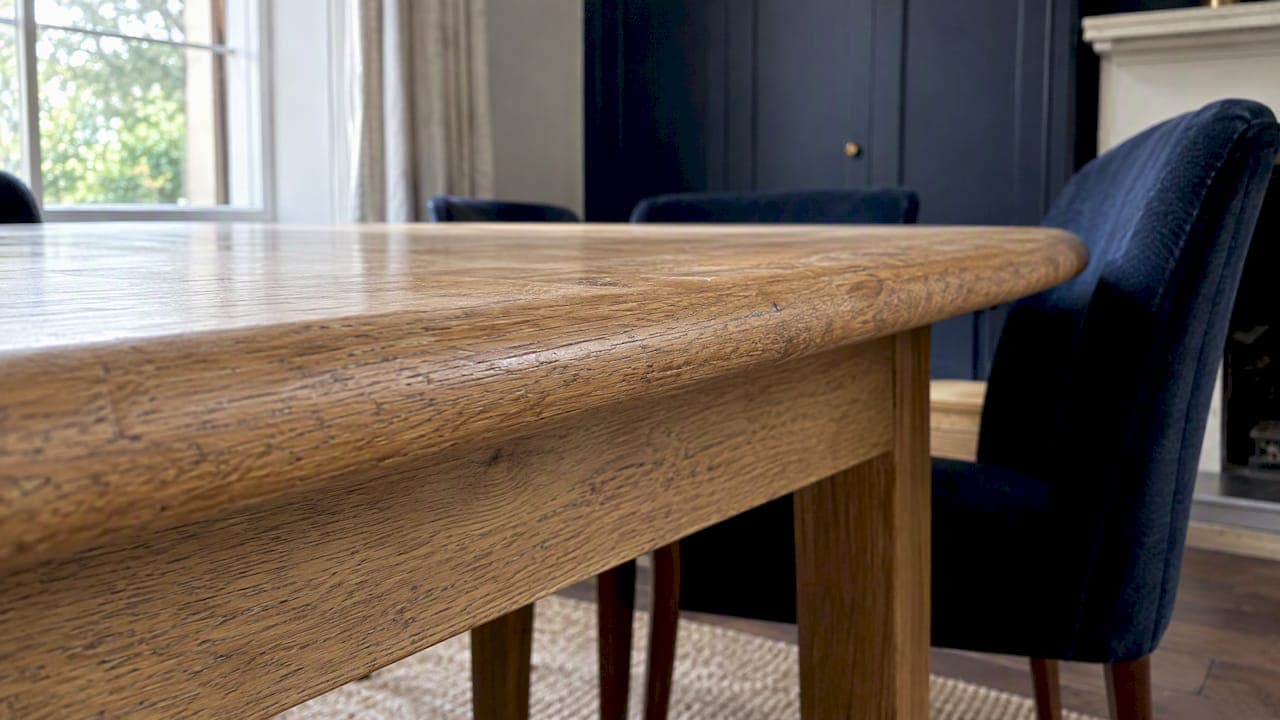
A table edge profile is the shape cut along the perimeter of the top, and it decides more than most people expect: how thick the table looks, how it feels under a forearm, how well it survives years of chairs and glassware, and whether it reads as quiet or decorative. For most contemporary dining tables, a softly eased square edge is the dependable choice. Chamfers and underbevels slim a heavy top, bullnoses soften it, and ogees and mouldings belong to more traditional pieces. Below we explain each profile, how wood and stone differ, and how to specify the right one for a bespoke commission.
TL;DR
- The edge changes how thick a top looks: an underbevel can make a heavy slab appear thinner, while a bullnose accentuates its thickness.
- Simple furniture generally calls for simple edges. Eased and square-with-an-arris profiles suit minimalist tables; ogees suit traditional ones.
- Where bodies meet the table, round or chamfer the edge. The British and European furniture standard for tables asks for exactly that.
- Wood and stone both take most profiles, but they chip and wear differently, so the right profile can differ by material.
- On a bespoke piece you can specify the profile, the radius and the finish together. Tell us early, because it affects thickness and price.
Table of Contents
- What an edge profile actually is
- The main table edge profiles, compared
- Profile comparison at a glance
- Wood and stone: same profile, different behaviour
- Choosing a profile: five questions
- What UK homeowners actually choose
- Comfort and safety
- Our perspective
- Specifying an edge on a bespoke table
- FAQ
- Sources
What an edge profile actually is
Think of the top as a flat plane and the profile as the cross-section of its outer lip. Cut it straight down and you have a square edge. Round it, angle it, step it or carve it and you have a profile. The choice sounds cosmetic, yet it governs three practical things at once: visual weight, tactile comfort and resilience.
Visual weight is the most underrated. A 50 mm oak top with a crisp square edge looks monumental. Put an underbevel on the same top and the face seems to float, because the shadow line beneath tricks the eye into reading a slimmer slab. FineWoodworking's guide to tabletop edges makes the same observation: an underbevel can make a thick top look thinner, whereas a bullnose accentuates the thickness.
Tactile comfort matters because the edge is the part of the table people actually touch. Diners rest wrists on it, children bump into it, and hotel guests lean on it during long dinners. Resilience matters because the edge takes the knocks: chair backs, trolleys, dropped cutlery.
The main table edge profiles, compared
There is no single official list, but the profiles below cover what we are asked for on bespoke tables, and they match the range that surface manufacturers and woodworking guides describe.
Square with an eased arris
The quietest option. The top and side meet at a right angle, but the sharp corner (the arris) is softened with a very small radius, often just a couple of millimetres. It looks crisp from a distance and feels friendly in the hand. For clean-lined contemporary dining tables, boardroom tables and consoles, it is our most frequent recommendation.
Chamfer and bevel
A chamfer is a flat cut at an angle across the corner. A bevel is essentially a wide chamfer, according to FineWoodworking. A small chamfer gives a precise, architectural line that catches light beautifully. A wide bevel changes the whole character of the top, creating a raised plateau effect that suits stone, glass and lacquered surfaces.
In everyday speech, "bevelled" and "chamfered" are used interchangeably, so when you brief a maker, give the angle and the width of the cut in millimetres rather than relying on the word.
Underbevel
Here the cut is made on the underside, leaving a full-thickness square edge on the top face and a slope beneath. The table looks lean from the usual viewing angle, yet the edge on top stays robust. It is a favourite on chunky slabs that would otherwise feel heavy in a modest room. If you are working out proportions, our dining table size guide shows how top thickness, overhang and room scale work together.
Bullnose and demi-bullnose
A full bullnose rounds the entire edge into a half-circle, so it is soft to touch and rather generous in appearance. A demi-bullnose rounds only the upper corner and keeps a flat face below. Both suit family tables and hospitality settings where the edge sees a lot of contact. Because they emphasise thickness, they work best on tops that are meant to look substantial.
Pencil round
A small, consistent radius, smaller than a bullnose and larger than an eased arris. It is a neat compromise: visibly softened, but still slender. Stone fabricators list it alongside bevel, bullnose, ogee, mitre and eased profiles; the Caesarstone UK catalogue shows that range for its surfaces, and notes that availability varies by location.
Ogee and moulded edges
The ogee is an S-shaped curve, concave then convex, and it is the signature of classical furniture. Add a cove, a bead or a double step and you reach the fully moulded edges of traditional refectory and library tables. They carry a great deal of character, but they demand a design that can support them. Experts quoted by FineWoodworking advise that simple, minimalist designs benefit from square or eased edges, while ornate, traditional pieces may call for complex mouldings like the ogee.
Mitred edge
A mitred edge joins two pieces at 45 degrees to form a deeper-looking edge from a thinner material. In stone it lets a 20 mm slab read as a 40 mm or 60 mm top. In veneered or laminated furniture, it gives a seamless corner with no visible end grain. It is a precise fabrication detail, so the quality of the maker shows immediately.
Waney or live edge
Not a cut at all, but the natural outer edge of the log, left as the tree grew. Each slab is unrepeatable, which is the appeal. It also brings practical consequences: width varies along the length, bark may need to be removed and the edge needs sealing. We cover those trade-offs in detail in live edge vs straight edge, including why you should allow for a width swing in slab dimensions.
Profile comparison at a glance
| Profile | Look | Feel | Best suited to |
|---|---|---|---|
| Square, eased arris | Crisp, minimal | Slightly softened | Contemporary dining, boardroom, consoles |
| Chamfer | Architectural line | Defined but not sharp | Modern wood and stone tops |
| Wide bevel | Raised plateau | Flat cut, clear angle | Stone, glass, lacquer |
| Underbevel | Slimmer, floating | Square on top | Thick slabs in smaller rooms |
| Demi-bullnose | Soft, substantial | Rounded top corner | Family and hospitality tables |
| Full bullnose | Generous, rounded | Very soft | Heavy tops, rounded forms |
| Pencil round | Subtle softening | Gentle | Everyday tables in any style |
| Ogee or moulded | Classical, decorative | Varied | Traditional and period pieces |
| Mitred | Deep, seamless | Depends on finish | Stone, veneer, laminated tops |
| Live edge | Organic, irregular | Natural, sealed | Statement tables, rustic or organic schemes |
Wood and stone: same profile, different behaviour
Most solid wood and stone tops accept most profiles, but the material changes how they age.
Wood is forgiving. A dent in oak or walnut compresses the fibres rather than breaking them, and a refinish can renew an edge. Close-grained hardwoods hold a fine, crisp arris well, while open-grained or softer species reward a slightly larger radius. Our wood species guide and the comparison of oak vs walnut will help you pair species with profile. The finish matters too: a hard-wearing oil or lacquer on a sharp edge wears through first at the corner, which is another reason to ease it. See furniture finish types for how finishes behave in use.

Stone is less forgiving. A sharp corner on marble, quartz or porcelain is the most likely place for a chip, and a chip cannot be sanded away. That is why fabricators lean towards eased, pencil or bullnose profiles on high-traffic stone, and why mitred edges need careful handling. If the top will be near a doorway or a service route, ask for a more generous radius.
Choosing a profile: five questions
- What is the style of the table? Match the profile to the piece. Simple furniture generally calls for simple edges, and heavy ornament on a minimalist frame looks confused.
- How thick is the top? Slim tops can take almost any profile. Thick slabs often look best with an underbevel or a generous eased edge, because a bullnose will exaggerate the mass.
- Who will use it? Children, older relatives, restaurant guests and hotel staff all lean, brush and bump. A rounded edge is safer and kinder.
- What is the overhang? A deep overhang puts the edge right at the diner's forearm or thigh, so comfort matters more.
- What will the room and lighting do? Chamfers and bevels create highlight lines. Under strong directional light they become a feature; under flat light they nearly vanish.
Similar logic applies to the rest of the room. A plain, sculptural table is well paired with a considered fitting, such as a sculptural metal wall light, where the object does the talking and the surrounding details stay restrained.
Keep it simple on large tables
Woodworking writer Carol Beronich of Woodsmith argues that simpler, smaller profiles tend to work better on prominent projects such as tables, because they blend with the design instead of pulling attention from the wood itself. It is a view we share. A long table is already a major gesture; the edge should support it.
What UK homeowners actually choose
The 2025 Houzz UK Kitchen Trends Report offers a useful snapshot, though it concerns kitchen worktops rather than dining tables. Square edges were the most popular choice at 47%, followed by bevelled at 26%, eased at 8% and bullnose at 6%. The pattern points to a clear preference for clean, restrained lines. For dining tables we see the same instinct: most clients start with square or lightly eased, and move to a chamfer or underbevel when they want something with a little more refinement.
Comfort and safety
Edges are not purely aesthetic. The standard for domestic and non-domestic tables, BS EN 15372:2016, says that tables should minimise the risk of injury, that tabletop edges in direct contact with users should be rounded or chamfered, and that other accessible edges should be free of burrs or sharp edges. In practice, that means a razor-square 90-degree corner is not what you want on a table people sit against.
For homes with young children or elderly residents, go a step further than the minimum: choose a demi-bullnose, a full bullnose or a generous eased radius. For hospitality, where tables are crowded and staff are carrying trays, the same logic holds. If a project is subject to a specific client or insurer specification, check it with your project lead before sign-off.

Our perspective
We make tables to order, so the edge is one of the first conversations we have, and one of the most useful. Our view is that the profile should be the last thing anyone notices and the first thing they feel. A guest should not be able to point at the edge and say what it is; they should simply find the table comfortable and well made.
For that reason we rarely push clients towards elaborate profiles. A softly eased square edge on a beautifully chosen slab, a clean underbevel on a heavy oak top, a restrained pencil round on a walnut dining table: these are the details that age well. Where a scheme genuinely calls for an ogee or a mitred stone edge, we are glad to draw it up and make it with our artisans, but we ask what the room and the people in it need before we ask what looks impressive in a drawing.
We would also encourage designers to specify profiles in millimetres, not adjectives. "3 mm eased arris" and "10 mm chamfer at 45 degrees" leave no room for interpretation, and they save a round of revisions. Our furniture design brief guide shows how to write a supplier-ready brief with tolerances.
— Luke
Specifying an edge on a bespoke table
Every piece we make is handcrafted to order, with size and finish tailored to the space, so the edge can be tailored too. Our bespoke furniture collection is available to interior designers, architects, hospitality teams and homeowners. Browse the gallery to see edges in finished pieces, then start a bespoke commission and tell us the thickness, profile and finish you have in mind. If you are still deciding, give us the room, the number of diners and the style of the table, and we will propose a profile with the reasoning behind it.
A practical brief for a bespoke top should include:
- Overall dimensions and top thickness
- Profile name, radius or chamfer size in millimetres
- Species or stone, and finish
- Whether the underside is to be bevelled
- Intended users and setting (domestic, hotel, restaurant)
FAQ
What is a bevelled edge table?
A bevelled edge table has an angled cut along the top perimeter instead of a right-angled corner. A bevel is essentially a wide chamfer, so it creates a visible sloping band that catches the light. It suits stone, glass and lacquered tops especially well.
What is the most timeless table edge?
A square edge with a lightly eased arris is the safest long-term choice. It looks clean in any era, wears gracefully and does not date. If you want a touch more refinement, a small chamfer or an underbevel keeps the same quiet character.
How do I deal with sharp table edges?
If the table is already made, a maker can ease or round the corners and refinish the edge. For a new table, ask for a rounded or chamfered edge wherever people sit or pass. The furniture standard BS EN 15372 asks for edges in contact with users to be rounded or chamfered.
Which edge makes a thick tabletop look thinner?
An underbevel. The slope beneath the top creates a shadow line and reduces the visible face, so the slab appears lighter. A bullnose has the opposite effect and accentuates thickness.
Can I have a live edge on a dining table?
Yes, though each slab varies in width and natural shape, so dimensions need some flexibility. We explain how to plan for that in our guide to live edge versus straight edge.
Sources
- The Right Edge for Your Tabletop, FineWoodworking
- Selecting Table Edge Profiles, Woodsmith
- 2025 Houzz UK Kitchen Trends Report
- BS EN 15372:2016
- Ocean Sage Fusion Worktop, Caesarstone UK