
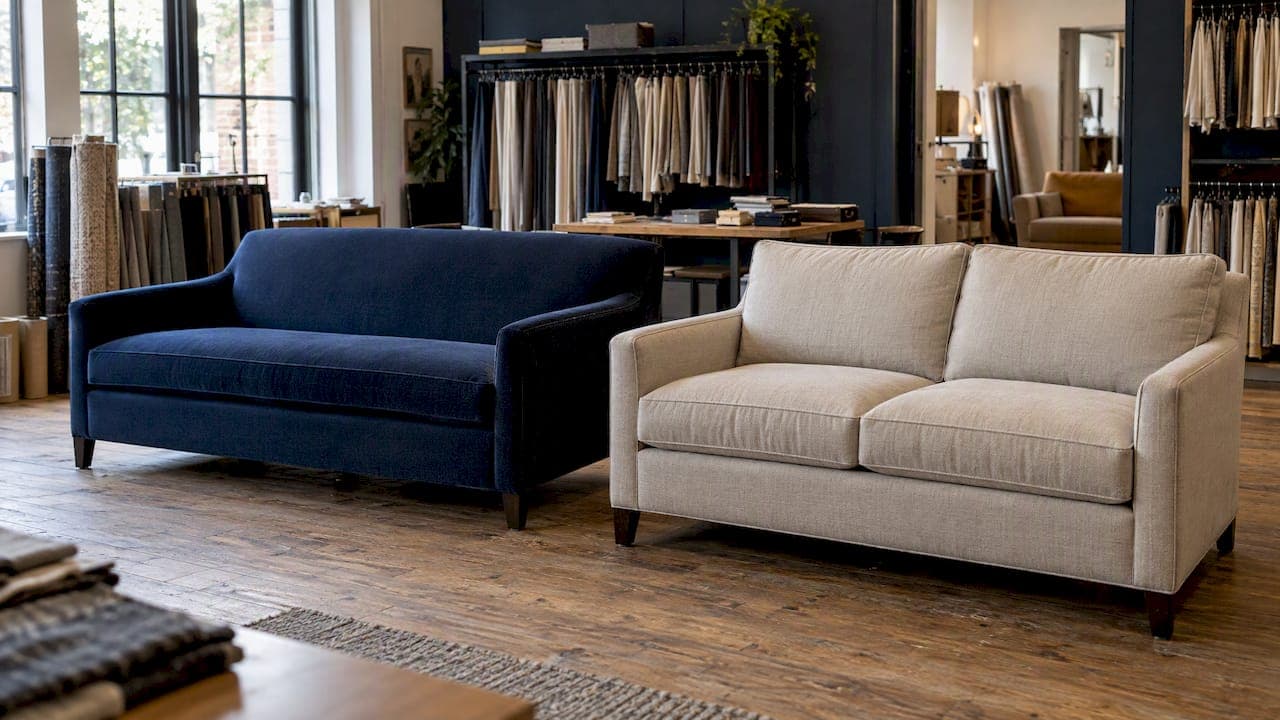
A tight back sofa has an upholstered back fixed to the frame, so the surface is smooth, firm and tailored. A loose back sofa has separate cushions along the back that you can lift, turn and rearrange, so it feels softer, deeper and more relaxed. Neither is better in the abstract. The right choice depends on how you sit, how much plumping you will tolerate and the character of the room. This guide sets out how each is made, how they compare, and how to decide, with a note on commissioning a bespoke piece where the back style can be tailored to you.
TL;DR
- Tight back: the back is built into the frame. Expect a firmer, upright feel, crisp lines and almost no daily plumping.
- Loose back: separate back cushions give a softer, more casual, nest-like feel, but they need regular fluffing and are generally the least supportive option.
- Cushion back sits between the two: cushions cut to fit the sofa, a balanced look and a softer place to lean.
- Fillings and frame quality shape comfort and longevity as much as the back style does, so judge the whole construction.
- Commissioning bespoke lets you choose the back style, depth and finish for your room and your sitting habits.
Table of Contents
- What a tight back sofa actually is
- What a loose back sofa is
- The middle path: cushion back
- Tight back vs loose back at a glance
- Comfort and support: what really differs
- Maintenance and how each style wears
- Which look suits which room
- A simple way to decide
- Common mistakes when choosing a back style
- Our perspective
- Commissioning a piece made to your measure
- FAQ
- Sources
What a tight back sofa actually is
A tight back sofa has a padded, upholstered back that is fixed to its frame, rather than separate, removable back cushions (Room AI). The fabric or leather is secured over padding and the back structure, which produces one continuous surface. The word "tight" describes this upholstery construction, not necessarily how hard the sofa feels.
The Houzz sofa-back guide, republished by New Hampshire Home Magazine, describes a tight back as a back cushion completely integrated into the sofa back. It generally feels firmer, needs no plumping or fluffing, and keeps a neat appearance. Livingetc's sofa glossary, quoting Raft's Mick Quinn, makes the same point: built-in back cushions give a firm, tailored look, and you may want extra pillows for maximum comfort.
In practice that means a tight back sofa looks the same at nine in the morning and at midnight. There is nothing to slump, nothing to rearrange, and the lines of the frame stay visible. It is the quintessential choice for a sculptural silhouette, where the shape of the piece is the point.
What a loose back sofa is
A loose back sofa, sometimes called a scatter back, has separate cushions resting against the back. The same Houzz guide, in its New Hampshire Home Magazine version, defines it as multiple large throw pillows covering the sofa back without being cut to fit precisely. It gives a casual look and a comfortable, nesting feel, but it is also the least supportive of the back styles.
That honesty matters. A loose back is wonderful for curling up, sprawling, and reading with your feet tucked beneath you. It is less forgiving if you sit upright for long periods, or if you want a sofa that supports your back without any adjustment from you.
The middle path: cushion back
Search results often split the topic into three, and it is worth doing the same. A cushion back sofa has cushions cut to fit the sofa perfectly, which creates a softer spot to lean against (Houzz). Houzz also notes that cushion backs are probably the most common type, and can look casual or formal depending on the design and the room.
If you like the idea of a loose back but find a scatter of pillows untidy, a cushion back is the natural compromise. The cushions follow the line of the frame, so the sofa reads as composed rather than casual, yet you still have something soft to sink into.
Tight back vs loose back at a glance
| Tight back | Cushion back | Loose (scatter) back | |
|---|---|---|---|
| Back construction | Upholstered and fixed to the frame | Cushions cut to fit the sofa | Large pillows, not cut to fit |
| Feel | Firmer, more upright | Softer place to lean | Softest, nest-like |
| Support | Most supportive | Balanced | Least supportive |
| Daily upkeep | Little or no plumping | Some plumping | Regular fluffing and rearranging |
| Look | Clean, tailored, more formal | Casual or formal, depending on design | Distinctly casual |
The support and look rows draw on the Houzz guide as republished by New Hampshire Home Magazine and Houzz's own cushion-back description. The upkeep row follows from the construction: anything removable is also something that shifts and flattens.
Comfort and support: what really differs
A tight back holds you in one position. Your spine meets a consistent surface, and the firmness is set by the maker, not by how recently someone plumped the cushions. If you tend to sit upright, work from the sofa with a laptop, or simply dislike sinking, this is a real advantage.
A loose back lets you shape the seat around yourself. You can pull a cushion forward for lumbar support, push it aside to stretch out, or stack two for a higher lean. The price of that flexibility is that support is only as good as the last time you arranged things.
Two cautions keep this honest.
First, the back style is only part of comfort. The English Home's guide to sofa construction points out that comfort is also heavily influenced by internal fillings. High-density foam gives structure, while feather and down offer luxurious softness but need more frequent care. A tight back with generous down wrapping can feel plush, and a loose back with dense foam can feel quite firm. If foam is your concern, our trade checklist on sofa foam density explains what to ask for.
Second, "firm" is not the same as "uncomfortable". Quinn's advice, quoted by Livingetc, is simply that you can add pillows to a tight back sofa when you want more comfort. That is a sensible answer for most households: begin with a structured sofa and soften it with one or two well-chosen cushions.
Maintenance and how each style wears
This is where the two constructions part ways most clearly in daily life.
Tight back: with no removable back cushions, there is nothing to plump and nothing to turn. The surface wears evenly because it is one continuous panel. The trade-off is that you cannot rotate or flip a back cushion to even out wear, and a stain or a worn patch sits on the sofa itself rather than on a part you can remove.
Loose back: cushions can be turned, swapped and rearranged, which spreads wear and refreshes the look. They also flatten and shift with use, so they ask for a little attention most days. If the filling is feather and down, that attention is more frequent, as The English Home notes.

The frame matters more than either. The same guide warns that softwood, particle board or plywood frames are more prone to warping or breaking than hardwood. Whichever back you choose, ask what is underneath it. Our notes on wood species selection and on MDF versus plywood explain which boards belong where. If the materials in your furniture are a worry for your home's air, there are practical steps for cutting formaldehyde in furniture worth reading before you buy.
Fabric choice interacts with the back style too. A tight back shows every pull and rub across one expanse of cloth, so a textured or tightly woven fabric is forgiving. Our guides to mohair versus velvet and bouclé durability cover the questions to ask before you commit.
Which look suits which room
The design logic is simple. Tight backs lend themselves to clean, tailored and more formal lines, while loose or scatter backs create a distinctly casual atmosphere, according to the Houzz guide. Here is how that translates into rooms.
A formal drawing room or a hotel lobby
A tight back keeps its composure under constant use and reads as deliberate. For hospitality, where a sofa is seen and sat on all day and nobody has time to plump cushions between guests, the fixed back is the practical option as well as the elegant one. Our guide to making hotel furniture last ten years goes deeper on specification for commercial use.
A family living room
Here a cushion back or a loose back usually earns its place. Children, pets and films on a Sunday afternoon call for a sofa that invites slouching. If you choose loose, accept the daily rearranging as part of the pleasure, or pick a cushion back to keep things tidier.
A modern or sculptural interior
When the sofa is a statement, such as a curved form or a low, architectural line, a tight back keeps the silhouette uninterrupted. Cushions would break the line you paid for. Our guide to curved sofa design shows how form and construction work together.
A relaxed country or cottage room
A loose back, with its generous, slightly rumpled softness, suits a room where nothing is meant to look too precise. Mix cushion sizes and fabrics and let the sofa look lived in.
Fixed seating and banquettes
For built-in or fixed seating, the back is usually part of the joinery, which is closer to a tight back by nature. If you are planning that kind of seating, our banquette seating dimensions guide is the place to start.
A simple way to decide
Answer these five questions honestly, and the choice usually makes itself.
- How do you sit? Upright and alert points to a tight back. Curled up and sprawled points to loose.
- How much upkeep will you accept? If the answer is none, choose tight. If a minute of plumping is no hardship, loose is fine.
- What is the room's character? Formal and architectural suits tight. Easy and layered suits loose. Either can suit a cushion back.
- Who uses it? A guest-heavy or commercial space benefits from a back that never looks slumped.
- What is inside it? Ask about the filling and the frame before you fall for the shape. A good construction in either style will outlast a poor one in the other.
If two answers pull in opposite directions, the cushion back is the sensible meeting point, or choose a tight back and add a pair of loose scatter cushions for softness.
Common mistakes when choosing a back style
Choosing on a showroom visit alone. A sofa that has been freshly plumped always looks wonderful. Ask how it will look after a month of use, and sit on it for longer than a minute.
Assuming tight means hard. The word describes how the upholstery is applied, as Room AI explains, not how firm the padding must be. The same back style can feel quite different depending on what is under the cover.
Assuming loose means more comfortable. Loose is softer to the eye and often to the touch, but it is the least supportive option, so it can be the wrong sofa for a long working evening.
Ignoring depth. A deep seat with a tight back can leave you perched forward unless you add cushions. A shallower seat with a loose back can feel cramped. Think of seat depth and back style as a pair.
Ignoring the frame. A beautiful back on a weak frame is a poor investment. Hardwood is the safer bet, as the frame guidance above makes clear.
Our perspective
We work with skilled artisans to make every piece from scratch, in sizes and finishes tailored to the room it is going into. From that vantage point, the tight versus loose question is rarely about which is correct. It is about what the person or the project needs the piece to do.
For trade clients, we find the back style is best settled early, alongside depth and height, because it changes how the whole piece is proportioned. A tight back asks for a considered frame and a confident silhouette. A loose back asks for generous cushions and a seat that can carry them. Treating them as an afterthought is how a sofa ends up handsome but wrong.

For homeowners, our advice is to be honest about habits. If you know you will never plump a cushion, do not buy a sofa that needs it. If you love to sink in and settle, do not be talked into a rigid back because it photographs well.
And wherever possible, specify the construction as carefully as the cover. Fabric is what people see, but the frame and filling are what they live with for years. That is the thinking behind our bespoke sofa commissioning guide for the trade.
— Luke
Commissioning a piece made to your measure
Off-the-shelf sofas make you accept a back style, a depth and a finish chosen for the average buyer. A bespoke commission reverses that. At Simmons Interior Supply, our bespoke furniture collection is handcrafted to order, with size and finish customised to suit your space, whether you are an interior designer, an architect, a hotel procurement team or a homeowner. Alongside it we offer trade-only made-to-order rugs and mirrors, so a scheme can come together from one source. You can browse our gallery for a sense of the craftsmanship, and we are always happy to talk through your project.
FAQ
What does a tight back sofa mean?
It means the back is a padded, upholstered part of the frame, with no separate, removable back cushions. The cover is secured over the padding to make one continuous surface. The result is generally firmer, with a neat, tailored appearance.
What are the pros and cons of a tight back sofa?
The advantages are a crisp, formal look, a firmer and more supportive feel, and no plumping or fluffing. The drawbacks are that you cannot turn or swap back cushions, and the firmness may feel less cosy. You can add pillows if you want more comfort, as Livingetc suggests.
Is a loose back sofa more comfortable?
It is softer and more casual, and many people find it ideal for lounging. It is also the least supportive of the back styles, so it may not suit you if you sit upright for long periods. Fillings play a large part too, so check what is inside.
What is a cushion back sofa?
It has cushions cut to fit the sofa, so they sit neatly against the frame and give a softer spot to lean. It is probably the most common type, and it can look casual or formal depending on the design and the room.
Which sofa back style lasts longest?
No back style guarantees longevity. The frame and filling matter more: hardwood frames resist warping and breaking better than softwood, particle board or plywood, according to The English Home. Choose the construction first and the back style second.
Sources
- Sofa Secrets: How to Choose the Right Sofa Back, New Hampshire Home Magazine
- Sofa Secrets: How to Choose the Right Sofa Back, Houzz
- Parts of a Couch: A Glossary to Understand Your Sofa, Livingetc
- A Complete Guide to Sofa Design and Construction, The English Home
- What is a Tight-Back Sofa?, Room AI
- 5 Steps Homeowners Can Take to Cut Formaldehyde in Furniture