
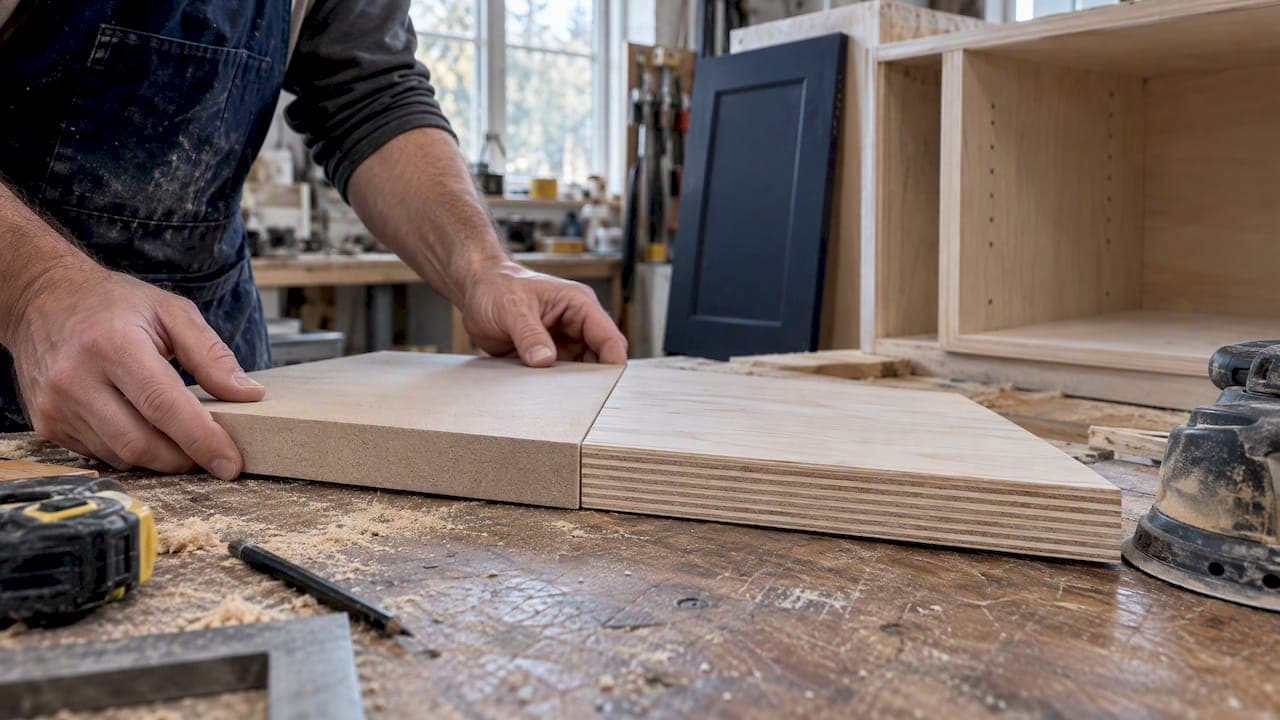
Neither board is simply better. MDF gives the smoothest surface for paint, routed profiles and veneer, while plywood gives the stiffer, more reliable structure for carcasses, shelves and anything that is fixed, loaded or handled daily. The finest bespoke furniture usually uses each where it is strongest, and the real skill lies in specifying the right grade, thickness and edge treatment for the room it will live in.
TL;DR
- MDF suits painted doors, decorative fronts, plinths and sculptural profiles, where a flawless, grain-free surface is the feature.
- Plywood suits cabinet boxes, shelves, drawer boxes and seating frames, where stiffness, screw-holding and moisture tolerance matter most.
- Standard MDF is sensitive to moisture and weaker at its edges. Moisture-resistant grades reduce swelling but are not waterproof.
- For premium work, a hybrid of plywood structure and MDF fronts is often the more intelligent specification.
- Specify the grade, thickness, service environment, edge sealing and fixing method, never just "MDF" or "plywood".
Table of Contents
- What each board actually is
- MDF and plywood compared
- Where MDF earns its place
- Where plywood earns its premium
- Moisture: the real downside of MDF
- Strength, screws and joints
- So which lasts longer?
- Dust, emissions and what to ask for
- The hybrid approach
- Our perspective
- How to specify a bespoke piece properly
- Commission something made for your space
- FAQ
- Sources
What each board actually is
MDF, medium density fibreboard, is made by reducing wood to fibres, drying them, adding a synthetic resin adhesive and pressing the mat into a board. The WPIF's PanelGuide describes dry process fibreboards in just these terms. Because there is no grain, the board is uniform from face to core, and the WPIF's own MDF publication notes that it can be cut smoothly without breakout or splintering and profiled on edges and surfaces in deeply etched shapes.
Plywood is a different animal altogether. Thin veneers are bonded with the grain of each layer at right angles to its neighbours, which is what gives the sheet its strength-to-weight ratio. A WJEC design and technology resource describes this cross-layering as the reason plywood can carry body weight in a lounge chair without warping or cracking.

One board is engineered for uniformity, the other for structure. Most of the decisions below follow from that single difference.
MDF and plywood compared
| Consideration | MDF | Plywood |
|---|---|---|
| Surface | Smooth, grain-free, ideal for paint and veneer | Visible grain, face quality varies by grade |
| Machining | Cuts cleanly, takes deep routed profiles | Good, but edges show the layers |
| Stiffness over a span | Lower, can sag under load | Higher, thanks to cross-laminated veneers |
| Screw-holding | Weaker, especially in the edge | Generally more reliable |
| Moisture | Swells if unsealed, grades vary | More tolerant, though not immune |
| Weight | Dense and heavy | Lighter for the same stiffness |
| Cost | Generally lower | Generally higher |
| Best for | Painted doors, fronts, plinths, mouldings | Carcasses, shelves, drawer boxes, seat frames |
The cost line is the one most guides lead with. Several of the pages Google ranks for this search, such as this comparison from Bob Vila, place MDF as the more economical board, with plywood costing more. Price, though, is rarely the right way to choose for a piece intended to last decades.
Where MDF earns its place
If the surface is the feature, MDF is hard to beat. Fine Woodworking points out that, because it is engineered, MDF has no grain pattern, which gives it a smooth finish ideal for paint or veneer and a consistent thickness. That is why it dominates in:
- Painted doors and drawer fronts. No grain means no telegraphing through a lacquered or hand-sprayed finish.
- Routed and sculptural profiles. Fluted, scalloped or deeply moulded fronts can be cut from solid board without chasing the grain.
- Plinths, panelling and mouldings. Long, straight, stable runs where appearance, not load, governs.
- Veneered panels. An MDF core with a pre-applied veneer gives a flat, stable panel for cabinet doors, as Fine Woodworking describes.
The UK panel industry's own view is that MDF is a practical, versatile material rather than a poor substitute, provided its limits are respected. That means extraction during machining, sealed edges and a grade chosen for the expected moisture exposure.
Where plywood earns its premium
Plywood justifies its higher price where the hidden structure does the work. In a cabinet that means the box, the shelves, the drawer boxes and any rail that takes hinges, runners or wall fixings. In seating it means the frame. Unlike MDF, plywood can also show its edge or face as a deliberate design feature, which is why birch plywood is so often left visible in drawer sides and contemporary joinery.
When readers ask about birch plywood against MDF, the answer is the same as for plywood in general: birch ply is the better choice where you want strength, a visible natural face or a crisp laminated edge, and MDF is the better choice where you want a painted, seamless one. Neither is a like-for-like substitute.
Moisture: the real downside of MDF
The most common complaint about MDF furniture is water. The EN 622-5 standard sets a 24-hour thickness swelling limit of 12% for general-purpose dry MDF in the over 12 to 19 mm range, and 8% for humid-condition MDF.H in the same range. Swiss Krono's technical data gives the same kind of figures by thickness. Treat these as test requirements, not a promise about any particular piece, since the result varies with thickness and grade.
Two practical points follow:
- A moisture-resistant grade reduces swelling; it does not eliminate it. Edges, cut-outs and screw holes remain the weak points and need careful sealing.
- Environment decides the grade. The PanelGuide is built around matching panels to dry, humid or higher-risk service conditions. A bedroom wardrobe and a hotel bathroom vanity are different briefs, and should not share a board by default.
Plywood tolerates moisture better, but it is not a licence to ignore it. Delamination, edge swelling and finish failure still occur where water sits, so detailing, such as raised feet, sealed undersides and drip-aware design, matters for both boards.
Strength, screws and joints
Plywood's cross-laminated construction gives better stiffness over a span and generally better screw retention. MDF is dense and heavy yet comparatively weak at its edges, and it will sag if a long shelf is left unsupported.
Screw placement matters more than most buyers realise. A USDA Forest Products Laboratory literature survey covers screw-holding in composite boards for furniture and cabinets, and the PanelGuide's MDF annex, cited above, recommends parallel-core screws for MDF because they hold better than conventional wood screws. In practice, a well-engineered MDF piece uses cams, dowels, bonded joints and fixing rails in plywood or solid timber at points of stress. For a refresher on the joints themselves, see our guide to furniture joinery types.
So which lasts longer?
In demanding applications, plywood generally lasts longer, because its structure resists flexing, holds fixings and tolerates humidity. But MDF can serve for many years in a dry, well-sealed interior when spans are controlled and the joints are designed properly. Longevity depends on grade, detailing, environment and workmanship far more than on the name on the board. The WPIF guidance reflects this by moving the question from "which board is better?" to "which grade suits this application and environment?" Hotels, kitchens, bathrooms and busy commercial interiors, where moisture and repeated loading dominate, are where that shift matters most.
Dust, emissions and what to ask for
MDF produces a very fine dust when cut, so workshops need effective extraction. The WPIF's MDF publication gives a UK occupational exposure limit of 5 mg/m³ for respirable wood dust and recommends suitable respiratory protection where extraction is inadequate. That is a workshop and COSHH matter, so if you cut MDF yourself, extraction and a proper mask are not optional.
On the product side, wood-based panels use resin binders, so ask your supplier for the panel's emissions documentation rather than assuming every board is equivalent. The WPIF publication refers to E1-class European MDF, but requirements can differ between Great Britain and Northern Ireland or the EU, so check the current position for your jurisdiction, particularly if a project involves cross-border supply. Finishes also play their part in indoor air quality; we cover that in our piece on low VOC furniture finishes for UK specifiers.
The hybrid approach
For premium cabinetry and bespoke casegoods, the strongest answer is frequently a combination: plywood for the skeleton, shelves, drawer boxes and fixing rails, and MDF for painted doors, sculptural profiles, plinths and decorative fronts. It echoes common cabinet guidance, in which plywood is chosen for boxes and MDF for painted fronts and routed detail. The logic is simple. You avoid paying for plywood where MDF gives the superior finish, and you avoid MDF where repeated loading or fixings govern performance.

Our perspective
We make furniture to order with skilled artisans, so we rarely start from a board and more often start from the room. How will the piece be used, how often, by whom, and in what air? A refectory-style sideboard in a quiet dining room, a bar front in a hotel lounge and a bathroom vanity are three entirely different briefs, even if the drawings look alike.
Our honest view is that the single-material argument is a false contest. Where a customer wants a lacquered, flawlessly continuous surface, MDF is the right and elegant answer, and nothing else will take that finish quite as well. Where a drawer will be opened ten thousand times, or a shelf will carry a library, we want the structure behind it to be as stiff and as forgiving as possible. A piece should look as though it was made by someone who understood both.
We also believe a specification should be more precise than a material name. When you brief us, tell us the environment, the load and the finish you have in mind, and we will talk through what goes where. Solid timber and veneer have their own roles too, and we explore them in our veneer versus solid wood comparison and our wood species selection guide.
— Luke
How to specify a bespoke piece properly
Whether you are a designer, an architect or a homeowner, a clear brief saves time and prevents disappointment. Include:
- Panel grade. Dry, humid or higher-risk, matched to the room.
- Thickness. Heavier shelves and long spans need thicker or supported boards.
- Service environment. Kitchen, bathroom, hotel corridor or dry living space.
- Edge treatment. Sealed, lipped, veneered or exposed by design.
- Fixing method. Parallel-core screws, cams, dowels, or timber and ply fixing rails.
- Finish. Paint, lacquer, veneer or oil, and its expected durability. Our guides to furniture finish types and custom finish options help here.
- Documentation. Emissions and performance declarations for the panels, and, where relevant, FSC certification.
The WPIF's PanelGuide also notes that many fibreboards are not intended for structural applications, which is another reason to let the structure sit in a board designed for it.
Commission something made for your space
Every piece in our bespoke furniture collection is handcrafted to order, with size and finish tailored to the room, for interior designers, architects, homeowners and hospitality projects. Our trade collections also include made-to-order rugs and mirrors. You can see the standard of our work in the gallery, or read more about how we work. If you have a drawing, a mood board or just a problem wall, we are always happy to talk it through.
FAQ
Is MDF better than plywood for furniture?
Not across the board. MDF is better for smooth painted finishes, routed profiles and decorative fronts, while plywood is better for load-bearing structure, fixings and moisture tolerance. Many well-made pieces use both.
What are the downsides of MDF furniture?
The main one is moisture: unsealed or poorly sealed MDF can swell, and moisture-resistant grades reduce this without removing it. MDF is also heavy, weaker at edge fixings than plywood and produces fine dust when cut. In a dry interior with sound joinery, these are manageable.
Is 12mm ply stronger than MDF?
Generally, yes, over a span, because the cross-laminated veneers add stiffness and screw-holding. Exact performance depends on the plywood grade and the MDF type, so check the manufacturer's declared properties for the specific boards.
What lasts longer, MDF or plywood?
Plywood usually lasts longer in demanding use, such as drawers, shelving and humid rooms. MDF can last many years in a dry, sealed interior if spans are controlled and joints are engineered correctly.
Sources
- WPIF PanelGuide
- PanelGuide Annex 2E: Dry process fibreboards (MDF)
- MDF: Versatile and Safe, WPIF
- BS EN 622-5 specification for dry process boards (MDF)
- Swiss Krono MDF technical data
- Fine Woodworking: plywood and sheet goods
- Bob Vila: MDF vs plywood
- WJEC: natural and manufactured timbers
- USDA Forest Products Laboratory: screw-holding in composite boards